Archive for ‘Dissident’

26/06/2013

Violence in China’s Xinjiang ‘kills 27’

BBC: “Riots have killed 27 people in China’s restive far western region of Xinjiang, Chinese state media report.
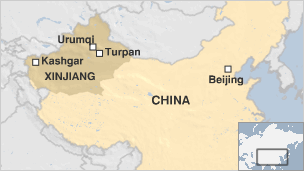
Map

The violence broke out in Turpan prefecture early on Wednesday.

Police opened fire after a mob armed with knives attacked police stations and a local government building, Xinhua news agency quoted officials as saying.

There are sporadic outbreaks of violence in Xinjiang, where there are ethnic tensions between Muslim Uighur and Han Chinese communities.

Confirming reports from the region is difficult because information is tightly controlled.

China’s state media have been quick to issue an official version of events regarding the latest round of violence in Xinjiang, but it will be tough to verify those reports.

Xinjiang lies on China’s remote north-west border and it is difficult for foreign media to travel there. Many people on both sides of the conflict are reluctant to speak to visiting journalists for fear of reprisals if they dispute the government’s stance.

Unfortunately Xinjiang usually hits international headlines when violence flares between the region’s minority ethnic Uighur Muslims and the majority Han Chinese. Many Uighurs contend that their language and religion are being smothered by an influx of Han Chinese migrants.

Xinjiang is a large geographic area rich in oil and gas deposits. Soon it will also become a major supplier of coal to China’s energy-hungry cities. The region’s fertile land also grows produce that is shipped to the rest of the country. The Han Chinese who move to Xinjiang hope to benefit from the region’s untapped resources.

The violence occurred in Turpan‘s remote township of Lukqun, about 200km (120 miles) south-east of the region’s capital, Urumqi.

The Xinhua news agency report, citing local officials, said rioters stabbed people and set police cars alight.

Seventeen people, including nine security personnel and eight civilians, were killed before police shot dead 10 of the rioters, it said.

At least three others were injured and were being treated in hospital, it added.

The Xinhua report did not provide any information on the ethnicity of those involved in the riot or on what sparked it.

But Dilxat Raxit, a spokesperson for the World Uighur Congress, an umbrella organisation of Uighur groups, told the Associated Press news agency the violence had been caused by the Chinese government’s “sustained repression and provocation” of the Uighur community.

In 2009 almost 200 people – mostly Han Chinese – were killed after deadly rioting erupted in Urumqi between the Han Chinese and Uighur communities.

In April an incident in the city of Kashgar left 21 people dead.

Uighurs and Xinjiang

Uighurs are ethnically Turkic Muslims. They make up about 45% of the region’s population; 40% are Han Chinese

China re-established control in 1949 after crushing short-lived state of East Turkestan. Since then, large-scale immigration of Han Chinese. Uighurs fear erosion of traditional culture.

The government said the violence began when “terrorists” were discovered in a building by officials searching for weapons.

But local people told the BBC that the violence involved a local family who had a longstanding dispute with officials who had been pressurising the men to shave off their beards and the women to take off their veils.

Uighurs make up about 45% of Xinjiang’s population, but say an influx of Han Chinese residents has marginalised their traditional culture.”

via BBC News – Violence in China’s Xinjiang ‘kills 27’.

See also: https://chindia-alert.org/political-factors/chinese-tensions/

21/06/2013

Tibet policy: Bold new proposals

Finally some one with a new idea for Tibet. Hopefully some progress will be made.

The Economist: “FEW outside China think the Communist Party’s strategy for Tibet is working. A combination of economic development and political repression was meant to reconcile Tibetans to Chinese rule and wean them off their loyalty to the Dalai Lama, the exiled spiritual leader. Instead disaffection is still rife, especially among the young. And all across Tibetan areas of China, Tibetans still display the Dalai Lama’s portrait, sometimes openly. Since March 2011 more than 100 Tibetans—especially in Tibetan areas of provinces bordering what China calls the Tibet Autonomous Region (TAR)—have set themselves on fire. Most have done so in part to call for the Dalai Lama’s homecoming. An overwhelming security presence and the Dalai Lama’s commitment to non-violence mean that the unrest is easily contained. Hence little has suggested that China’s leaders are concerned about the bleak implications for the future: that their rule in Tibet can be maintained only by the indefinite deployment of massive coercive force.

So for a Chinese scholar, Jin Wei, who is director of ethnic and religious studies at the Central Party School in Beijing, to call for a “creative” new approach is startling. For her to do so publicly, in an interview this month with a Hong Kong magazine, Asia Weekly, suggests that she has high-level backing. A report from a Beijing think-tank in 2009 challenged the official line that rioting in Tibet the year before was instigated from abroad. But Robert Barnett, a professor of Tibetan studies at Columbia University in New York, describes Ms Jin’s intervention as a sign that, after two decades, “debate has re-emerged within China about the government’s hard-line policies in Tibet”. Ms Jin even accused former party chiefs in Tibet of being “biased against the practice of religious affairs”. This, she said, “foreshadowed the accumulation of grievances today.”

Bold new proposals

One former party secretary in Tibet (from 1988-92) was Hu Jintao, who went on to head the party nationally for ten years until last November, when he gave way to Xi Jinping. Those who have forecast that Mr Xi might prove a bolder reformer than the cautious Mr Hu have so far seen little to back them up. Here, on Tibet, is at least a hint of a crack in the hardline consensus. Some have detected another in the appointment of Yu Zhengsheng to head the party’s main policy group on Tibet and Xinjiang, a Muslim-majority region in the north-west. Mr Yu is the head of an advisory body designed to promote national unity. Previous heads of the group have been security specialists.

This is new

Ms Jin’s analysis, though couched in the terminology of party orthodoxy, is similar to that of many foreign observers. She argues that, by demonising the Dalai Lama, and viewing any expression of Tibetan culture as potentially subversive, the party has turned even those Tibetans sympathetic to its aims against it. The struggle has evolved from “a contradiction between the central government and the Dalai Lama separatist clique into an ethnic conflict between Han Chinese and Tibetans”.

She is not advocating a new soft approach to “political” issues, such as the Dalai Lama’s call for greater autonomy for Tibet and Tibetans’ hankering after a “greater Tibet”—ie, within its historic borders, beyond the TAR. But in fact, most protests in Tibet are not about “politics”, defined like this. Many have been sparked by anger at Chinese repression—of Tibetan culture, language and tradition, or of individual protesters. It is a vicious circle, made worse by anger at the large-scale immigration into Tibet of Han Chinese.

Ms Jin has ideas on how to break the impasse. Talks with the Dalai Lama’s representatives, stalled since the most recent of nine fruitless rounds in 2010, should resume, she says. They should concentrate on “easy” issues first, setting contentious debate about Tibet’s status to one side for now. China should consider inviting the Dalai Lama to visit one of its semi-autonomous cities, Hong Kong or Macau, and eventually allowing him back to Tibet. It should also try to defuse the crisis his death will bring by agreeing with him on a chosen reincarnation from inside China’s borders. Otherwise, China risks having to deal with two incarnations: one it endorses and one in exile who is more likely to be revered by most Tibetans.”

via Tibet policy: Bold new proposals | The Economist.

29/05/2013

Settlers in Xinjiang: Circling the wagons

The Economist: “In a region plagued by ethnic strife, the growth of immigrant-dominated settlements is adding to the tension

MANY hours’ drive along what was once the southern Silk Road, through a featureless desert landscape punctuated by swirling dust-devils and occasional gnarled trees, a curious sight eventually confronts the traveller: row upon row of apartment blocks with vivid red roofs, as if a piece of Shanghai suburbia has been planted in the wilderness (see picture). Following the military-style nomenclature of immigrant settlements in China’s far west, it calls itself 38th Regiment. It is home to thousands of people, in a spot where just a few years ago there was nothing but sand.

The town is the latest addition to a vast network of such communities in the Xinjiang Uighur Autonomous Region, China’s biggest province by land area and also its most ethnically troubled. Neighbouring Tibet has long been roiled by ethnic tension, too, but rarely has it witnessed the kind of violence that has troubled Xinjiang: a low-level insurgency involving ethnic Uighurs whose Muslim faith and Central Asian culture and language set them apart from the Han Chinese who dominate places like 38th Regiment. On April 23rd, 21 people were killed near Kashgar during an encounter between police and alleged separatists. An explosion of inter-ethnic violence in 2009 in the regional capital, Urumqi, that left nearly 200 dead, by official reckoning, exacerbated the divide. The expansion of the settlement network is deepening it further.

To use its full name, the 38th Regiment of the 2nd Agricultural Division is part of the Xinjiang Production and Construction Corps. This state-run organisation, usually referred to as the bingtuan (Chinese for a military corps) controls an area twice the size of Taiwan, broken into numerous parts scattered around the province (see map). A few bits are city-sized. Most are more like towns or villages. Of their total population of more than 2.6m people, 86% are ethnically Han Chinese. In Xinjiang as a whole, in contrast, Han officially make up just over 40% of the 22m inhabitants. The rest are Uighurs and a few other ethnic groups.”

via Settlers in Xinjiang: Circling the wagons | The Economist.

26/05/2013

* Sonia Gandhi ‘devastated’ by India Chhattisgarh ambush

BBC: “The president of India’s Congress Party, Sonia Gandhi, has said she is “devastated” by Saturday’s attack on party officials in Chhattisgarh state.

Sonia Gandhi (R) and PM Manmohan Singh in a hospital in Raipur (May 26 2013)

At least 24 people were killed, including Chhattisgarh Congress chief Nandkumar Patel, his son, and local leader Mahendra Karma, when suspected Maoist rebels ambushed their convoy.

Mrs Gandhi visited some of the wounded with PM Manmohan Singh on Sunday.

The prime minister said India would “never bow down” before the rebels.

He denounced the “barbaric attack” which he said should be an inspiration in the fight against extremism and violence.

Unconfirmed reports said they were unable to visit the scene of the attack because of security concerns.”

via BBC News – Sonia Gandhi ‘devastated’ by India Chhattisgarh ambush.

See also: https://chindia-alert.org/political-factors/indian-tensions/

14/05/2013

* China launches new crackdown on internet celebrities

My personal view is that “the genie is out of the bottle” or that you cannot shut “Pandora’s box” with the Internet and social media.

Telegraph: In its latest bid to contain the often riotous jumble of news and rumour on the Chinese internet, the Communist party has decided to bring the most high-profile and influential voices to heel.

China launches new crackdown on internet celebrities

Before his account was removed, Mr Hao had 1.85 million followers

On Saturday, Hao Qun, a famous 39-year-old novelist and frequent government critic who goes by the pen name Murong Xuecun, found his account on Sina Weibo, China’s version of Twitter, deleted. He tried to open another account but failed.

Before his account was removed, Mr Hao had 1.85 million followers and his postings on the site often went viral.

The world of Weibo, which had 368 million registered users last year, operates much like Speaker’s Corner. Its most famous inhabitants command huge followings and have the power to steer debate in a way that is often uncomfortable for the Communist party.

The deletion of Mr Hao’s account follows a series of actions against other high-profile users.

He Bing, the vice president of the law school at China’s Political Science and Law university was suspended last week “for deliberately spreading rumours”. Prof He, who had close to 500,000 followers, had posted a snippet of news, which later turned out to be false, claiming that there had been a mass stabbing in a hospital in Hefei.

Since the Chinese media is carefully controlled, Weibo has developed into the country’s most important source of news.

And since newspapers and television stations are not allowed to report on many of the topics that are voiced on the internet, rumours often go unchecked and develop their own momentum.

“Some of the [high profile users] have become rumour relay stations,” noted the Global Times in an editorial last week. “Any frequent Weibo user knows that rumours cannot be widely spread unless there is a [high-profile user] helping to spread it,” it added.

“Theoretically they have the right of speech on the internet, but they should also have an equal responsibility. Currently they have no moral responsibility or legal liability for what they post.”

Kaifu Lee, the former head of Google in China, who has more followers (40 million) than Barack Obama does on Twitter (33 million), said he was careful to verify information before posting it on Weibo.

“I realise with the number of followers I have that I need to make sure the messages I forward are legitimate,” he said. “With great power comes great responsibility,” he added.

However, he noted that Weibo already has inbuilt checks that should prevent false news from gaining traction.

“If you suggest something that is clearly false and do not retract it, your reputation (online) will suffer. I think the social ecosystem should largely be self-reinforcing,” he said, adding that Sina already has a type of tribunal system that can rule over the veracity of certain posts.

Mr Lee said he did not know what the purpose of the new government “internet management” campaign was. There already exists a sophisticated censorship system that filters posts and deletes sensitive topics. “I am not in the government, so I cannot say why the government is doing this,” he said.

Zhang Lifan, a historian with almost 270,000 followers said the attempt to control high-profile users would be fruitless. “Shutting them down will not make much difference. For each account they silence, other people will speak up,” he said.

“Of course people should not spread rumours, but the government is using a double standard,” he said. “CCTV (China’s state television station) also sometimes reports the wrong news.”

The campaign appears to have sent a firm message however. Yao Bo, a commentator and restaurateur with close to 900,000 followers said a number of his friends had seen their accounts shut down. “Some of the accounts are shut down for criticising government policy, others for reporting bits of information. I now feel I need to watch what I say before I post something,” he said.”

via China launches new crackdown on internet celebrities – Telegraph.

08/05/2013

* Indian government to deploy 10,000 more personnel in four states to fight Maoists

Times of India: “With the government moving towards a fight to finish war against Maoists in Red Zone, the Union home ministry has decided to deploy additional 10 bBattalions (10,000 personnel) of paramilitary forces in four highly naxal-affected states — Jharkhand, Chhattisgarh, Odisha and Bihar.

CRPF, Central Reserve Police Force (www.crpf.n...

CRPF, Central Reserve Police Force (www.crpf.nic.in), Group Centre Pune, at Talegaon, on Old Mumbai Pune Highway (NH4) (Photo credit: Ravi Karandeekar)

Five (5,000 personnel) out of the 10 battalions will be drawn from the Central Reserve Police Force (CRPF) while the remaining five will be spared by SSB, BSF and ITBP for anti-naxal operations.

Disclosing the decision in response to a Parliament question, the ministry said that the additional 10 battalions had been sanctioned on the basis of requests made by the respective state for stepping up operations against the Red Ultras.

At present, a total number of 532 companies (53,200 personnel) of paramilitary forces have been deployed in the seven Maoist-affected states — Chhattisgarh, Jharkhand, Bihar, West Bengal, Andhra Pradesh, Maharashtra and Odisha.

Officials in the ministry said that Jharkhand — which is currently under the President’s rule — would see the maximum deployment where the security forces had already been engaged in intensive operations against the Red Ultras under the leadership of ex-CRPF chief K Vijay Kumar who is posted there as one of the advisors of the state governor.

“Idea is to continue the intensive operations against Maoists before the onset of Monsoon in these states”, said an official.”

via Government to deploy 10,000 more personnel in four states to fight Maoists – The Times of India.

01/05/2013

* China’s new mental health law to make it harder for authorities to silence petitioners

SCMP: “The director of Xinjiang‘s largest mental health institution has welcomed a new law, which went into effect on Wednesday, banning involuntary inpatient treatment for many people deemed mentally ill.

scmp-1.jpg

“Seventy to 80 per cent of the patients have been forcibly admitted to the hospital,” said Xu Xiangdong, director of the Fourth People’s Hospital in the regional capital Urumqi, the Yaxin online news portal reported on Monday.

“Because of this increased consideration for patients’ rights, [the figures] will change fundamentally,” he said, adding that it would put an end to frequent episodes of people being wrongfully declared mentally ill.

The new law, which has been debated for a quarter of a century, is meant to crack down on local authorities aiming to silence petitioners and troublemakers by arbitrarily declaring them mentally ill and locking them up in mental health wards.

Under the law, patients must first give their consent to being hospitalised, except in cases in which they could harm themselves or others.

If patients are still forcibly confined, they or their guardians have the right to seek a second opinion. Forced hospitalisations for reasons other than severe mental illness are banned.

Last week about 200 health practitioners from the region were sent to Xu’s hospital to be trained in the new provisions on patients’ rights stipulated by the new law, the Xinjiang Daily reported.

Two million people in Xinjiang live with mental disabilities, Xu estimated, amounting to more than 9 per cent of the population in the economic backwater of China’s remote northwest.

That compares with almost 8 per cent of China’s population diagnosed with some form of mental illness, according to the Ministry of Health in 2011. A largescale 2009 study estimated a much higher national average at 17.5 per cent.

In Xinjiang, authorities have not been able to provide adquate resources to deal with the increasing number of people living with mental disorders. Xu told the Yaxin portal in 2011 that the number of mentally ill patients had increased by 20 to 30 per cent annually over the last years.

In Monday’s report, he said less than 5 per cent of the two million mentally ill could receive treatment because of a lack of resources and trained staff.

Two years earlier, the regional government had reported plans to build 15 new mental hospitals and to expand current ones. Until now, only one additional hospital in Kashgar has been completed, the Yaxin report said.

In March, a gruesome murder of a seven-year-old Uygur boy by a Chinese man has caused tensions among ethnic communities in the Turpan prefecture east of Urumqi. The man had been declared mentally ill to prevent ethnic revenge attacks, locals told Radio Free Asia.”

via China’s new mental health law to make it harder for authorities to silence petitioners | South China Morning Post.

24/04/2013

* China’s Xinjiang hit by deadly clashes

BBC: “Clashes in China’s restive Xinjiang region have left 21 people dead, including 15 police officers and officials, authorities say.

Map

The violence occurred on Tuesday afternoon in Bachu county, Kashgar prefecture.

The foreign ministry said it had been a planned attack by a “violent terrorist group”, but ethnic groups questioned this.

There have been sporadic clashes in Xinjiang in recent years.

The incidents come amid rumbling ethnic tensions between the Muslim Uighur and Han Chinese communities. In 2009 almost 200 people – mostly Han Chinese – were killed after deadly rioting erupted.

Nothing is stopping foreign journalists from booking flights to Xinjiang after hearing reports of violence there. However, simply travelling to the region doesn’t guarantee the ability to dig out the truth behind this story.

In 2009, dozens of foreign reporters were permitted to join an official tour of Urumqi, the capital of Xinjiang, after clashes between minority ethnic Uighur residents and majority Chinese Hans killed 197 people.

Their experiences were mixed. Some reporters were able to speak to a variety of people on the ground, while others faced harassment and intimidation.

The situation remains the same today. Reporters who travel to the area are closely followed by government minders. Locals often hesitate to answer questions, fearing reprisals from government authorities.

Uighur exile groups often provide accounts that differ from the official Chinese government reports. Reconciling the two can be tricky.

The situation isn’t any easier for Chinese journalists. China’s propaganda departments have warned domestic news outlets against conducting their own independent reporting on sensitive Xinjiang stories, ordering them to reprint official stories from China’s major state news agencies.

It is very difficult to verify reports from Xinjiang, reports the BBC’s Celia Hatton.

Foreign journalists are allowed to travel to the region but frequently face intimidation and harassment when attempting to verify news of ethnic rioting or organised violence against government authorities.”

via BBC News – China’s Xinjiang hit by deadly clashes.

See also: https://chindia-alert.org/prognosis/chinese-challenges/

16/04/2013

* 10 Maoists killed in encounter on Andhra, Chhattigarh border: Police

Times of India: “At least 10 Maoists were killed in a gun battle between security forces and the rebels in Kanchal forests close to the inter-state border of Andhra Pradesh and Chhattisgarh in tribal Bastar region on Tuesday morning, police said.

Maoist rebels train with guns in Chhattisgarh

Preliminary reports said a joint team of Greyhounds-the elite commando force of Andhra Pradesh-and Chhattisgarh police had a fierce encounter for three hours between 0400 and 0700 hours under Pamed police station area in Bijapur district. Security forces claimed that they have gunned down 10 rebels during the encounter in which a large number of rebels were injured.

It’s not immediately known whether the bodies of slain rebels were recovered by the forces as the Maoists usually take away the bodies of their demand comrades. However, police said they have recovered arms and ammunitions, including INSAS and .303 rifles, from the encounter spot.”

via 10 Maoists killed in encounter on Andhra, Chhattigarh border: Police – The Times of India.

02/04/2013

* Uyghur Jailings Highlight Chinese Media Controls

Eurasia review: “China’s jailing of 20 ethnic Uyghurs this week on terrorism and separatism charges using online activism as a basis for their conviction reflects government moves to increase media controls and use weak laws to suppress voices in the troubled Xinjiang region, Uyghur rights groups say.

Xinjiang Uyghur Autonomous Region in China

The courts said the 20 Uyghur Muslims had had their “thoughts poisoned by religious extremism” and used cell phones and DVDs “to spread Muslim religious propaganda,” the government of the Xinjiang Uyghur Autonomous Region said on its official news website.

Nineteen of them were given prison sentences ranging from 5 years to life in prison in Xinjiang’s Kashagar prefecture while the 20th suspect was sentenced to 10 years in jail on the same day in the Bayingolin Mongolian Autonomous Prefecture.

They were accused of using the Internet, mobile phones and digital storage devices to organize, lead and participate in an alleged terrorist organization with the intent to “incite splittism,” reports have said.

Leading Uyghur activist Rebiya Kadeer of the Munich-based World Uyghur Congress (WUC) said that the sentences showed the new Chinese leadership’s “indifference for human rights and democracy” and that it will “continue with the ‘strike hard’ practices of the previous regimes.”

“It further indicates that the Chinese government will not contribute to the peaceful resolution of the conflict in the region in the near future, preferring instead to continue its counterproductive and destructive practices,” the WUC president said in a statement Thursday.”

via Uyghur Jailings Highlight Chinese Media Controls Eurasia Review | Eurasia Review.

Law of Unintended Consequences

continuously updated blog about China & India

ChiaHou's Book Reviews

continuously updated blog about China & India

What's wrong with the world; and its economy

continuously updated blog about China & India