Archive for ‘Ethnic clash’

28/11/2012

* Tibetan students protest, as four more self-immolations reported

China needs to rethink its policy on Tibet. The issue of autonomy is not going to go away. Unlike the Muslim Uighurs, who are mainly domiciled in Xinjiang, Tibetans reside in large numbers in at least four provinces of which Tibet is only the main one.

BBC: “A crowd of Tibetan students has protested in Qinghai province, activists say, as four more self-immolations were reported.

A man taking a photograph in front of a screen displaying propaganda about China's Tibet Autonomous Region in Beijing, 12 November 2012

Reports said more than 1,000 students took part in the protest, which was reportedly provoked by the contents of a book.

Twenty students were in hospital, media reports and activist groups said.

The four self-immolations, meanwhile, occurred in Gansu, Sichuan and Qinghai provinces on Sunday and Monday.

Foreign media are banned from Tibetan regions, making reports of protests and self-immolations hard to verify independently. Chinese state media reports some of the protests and burnings but not all.

The student protest took place on Monday in Gonghe county in Qinghai province, London-based Free Tibet said.”

via BBC News – Tibetan students protest, as four more self-immolations reported.

17/11/2012

* Four killed in fresh Assam violence; curfew continues in Kokrajhar

Despite the appearance of ‘unity in diversity’, India seems to be continually beset with violent tensions; by Maoists/Naxalites, by ethnic groups and borderland disaffection.

Times of India: “Bodoland area in lower Assam witnessed fresh trouble with the killing of four persons by armed assailants in Jiaguri even as police arrested a member of Bodoland Territorial Autonomous District in connection with the killing.

The assailants fired randomly on a group of persons at Jiaguri in Kokrajhar police station in which four persons were killed late on Friday night, inspector general of police (BTAD) S N Singh said.

“Monokumar Brahma alias Jalja, a member of BTAD, was arrested early today in connection with the killing,” he said.

“Two AK-47 rifles, magazines of AK-47 rifles and 60 rounds of assorted ammunition were seized from his bedroom. He is currently being interrogated,” he said.

Indefinite curfew has been continuing in Kokrajhar district as violence flared up in the area again, the police said.”

via Four killed in fresh Assam violence; curfew continues in Kokrajhar – The Times of India.

See also:

02/10/2012

* ‘Murder attempt’ on Golden Temple raid General Brar

It would seem that 28 years is not long enough for those directly affected by Operation Bluestar to forgive and forget.  That’s assuming the four suspects were indeed separatist-Sikhs bent on revenge.

BBC: “Police in London say the stabbing of the Indian general who led the 1984 raid on Sikhism’s holiest shrine was attempted murder.

File photo Lt-Gen Kuldeep Singh Brar  (left)  and  senior army officers at the site of the  Operation Blue Star in 1984

Lt-Gen Kuldeep Singh Brar was stabbed in the neck by four men with beards on Sunday night. He is out of hospital.

Hundreds died when troops flushed Sikh separatist militants out of the Golden Temple in Amritsar in Punjab state.

The 78-year-old is thought still to be a target for extremist Sikhs, but the identity of his attackers is unclear.

Lt-Gen Brar, himself a Sikh, was one of the architects of Operation Bluestar, which removed armed Sikh militants fighting for an independent homeland of Khalistan from the temple.

According to the Indian government, the operation left about 400 people, including 87 soldiers, dead.

Sikhs groups contest this figure, saying the number of casualties was several times higher.

via BBC News – ‘Murder attempt’ on Golden Temple raid General Brar.

31/08/2012

* Does China’s next leader have a soft spot for Tibet?

Reuters: “For decades, Beijing has maintained that the Dalai Lama is a separatist, but Tibet‘s exiled spiritual leader once had a special relationship with the father of Xi Jinping, the man in line to become China’s next president.

China's Vice President Xi Jinping speaks with Egypt's President Mohamed Mursi (not pictured) during a meeting at the Great Hall of the People, in Beijing August 29, 2012. REUTERS/How Hwee Young/Pool

Few people know what Xi, whose ascent to the leadership is likely to be approved at a Communist Party congress later this year, thinks of Tibet or the Dalai Lama.

But his late father, Xi Zhongxun, a liberal-minded former vice premier, had a close bond with the Tibetan leader who once gave the elder Xi an expensive watch in the 1950s, a gift that the senior party official was still wearing decades later.

The Dalai Lama, 77, recalls the elder Xi as “very friendly, comparatively more open-minded, very nice” and says he only gave watches back then to those Chinese officials he felt close to.

“We Tibetans, we get these different varieties of watch easily from India. So we take advantage of that, and brought some watches to some people when we feel some sort of close feeling, as a gift like that,” the Dalai Lama said in an interview in the Indian town of Dharamsala, a capital for Tibetan exiles in the foothills of the Himalayas.

The Dalai Lama gave the watch to the elder Xi in 1954 during an extended visit to Beijing. Xi was one of the officials who spent time with the young Dalai Lama in the capital where he spent five to six months studying Chinese and Marxism.

The Dalai Lama fled to India five years later, after a failed uprising against Communist rule, but as late as 1979, Xi senior was still wearing the watch, the make and style of which the Dalai Lama can no longer remember.

Xi senior was a dove in the party, championing the rights of Tibetans, Uighurs and other ethnic minorities. He also opposed the army crackdown on the 1989 Tiananmen student protests and was alone in criticizing the sacking of liberal party chief Hu Yaobang by the Old Guard in 1987. Xi senior died in 2002.

The Dalai Lama has never met Xi junior but his fondness for the father is, for some, a sign that China’s next leader may adopt a more reformist approach to Tibet once he formally succeeds President Hu Jintao next March. Some expect him to be more tolerant of Muslim Uighurs in the western region of Xinjiang, and also of Taiwan, the independently ruled island that China has vowed to take back, by force if necessary.

“To understand what kind of leader Xi Jinping will be, one must study his father’s (policies),” said Bao Tong, one-time top aide to purged party chief Zhao Ziyang. Bao was jailed for seven years for sympathizing with student-led demonstrations for democracy centered on Beijing’s Tiananmen Square in 1989.

“No (Chinese) Communist will betray his father,” he added.”

via Insight: Does China’s next leader have a soft spot for Tibet? | Reuters.

28/08/2012

* One killed in fresh Assam violence

BBC News: “One man has been killed and five others have been injured in fresh violence in India’s Assam state, police said.

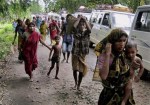
An Indian riot refugee woman sleeps as her child reads a book at a relief camp during India’s ruling Congress party President Sonia Gandhi visit in Deborgaon in Kokrajhar, India, Monday, Aug. 13, 2012

In the first incident, a man was killed and four others were wounded, while the second incident left one man injured. Both clashes occurred in Kokrajhar.

At least 87 people have died in fighting between indigenous Bodo tribes and Muslim settlers in Assam since last month.

More than 300,000 people fled their homes after the fighting.

Most of them are still living in relief camps.

There has been tension between indigenous groups and Muslim Bengali migrants in Assam for many years.

Last week, police arrested a local politician, Pradeep Brahma, for his alleged involvement in the recent ethnic violence.

Kokrajhar, Dhubri and Chirang were some of the districts worst affected by the clashes.

An indefinite curfew has been enforced in Kokrajhar and the army has marched through the streets of some of the troubled neighbourhoods.”

via BBC News – India: One killed in fresh Assam violence.

14/08/2012

* Surge in Tibetan self-immolations challenges Chinese rule-rights group

Reuters: “As many as five Tibetans set themselves ablaze in China in the past week to protest Chinese rule over Tibet, a U.S. broadcaster said, a surge highlighted by a rights group as a sustained campaign against Beijing’s grip on religious freedom.

Two self-immolations on Monday in the Aba prefecture, a mountainous and mainly ethnic Tibetan part of Sichuan province, were followed by at least one clash between police and ethnic Tibetans that left one protester dead, Radio Free Asia said.

Lungtok, a monk from the restive Kirti monastery in Aba, and Tashi, believed to be a layman, set themselves ablaze on Monday “to highlight their opposition to Chinese rule in Tibetan-populated areas”, Radio Free Asia reported, saying three other Tibetans have died in self-immolations in the past week in China.

Many Tibetans have called for Beijing to allow the return of the Dalai Lama, their self-exiled Buddhist leader. China has branded the self-immolators “terrorists” and criminals and has blamed the Dalai Lama, for inciting them.

Calls to the Aba prefecture office were not answered.

Phelim Kine, senior Asia researcher for New York-based Human Rights Watch, said the frequency of the Tibetan self-immolations is “a reflection of the ever-deepening frustration and despair” that many Tibetans feel about hopes for reform and protection for their culture, religion and language.

“We don’t see any inkling of such changes in the short to medium term, instead we see a hardening of position by the Chinese government,” he said. “This is an unfortunate trend that will continue till we head into the leadership transition.”

Chinese leaders typically clamp down on possible sources of unrest before a once in a decade congress, likely in October, to announce a new leadership team.”

via Surge in Tibetan self-immolations challenges Chinese rule-rights group | Reuters.

Tibet (and Xinjiang) continue to be sore point with China. Religious and ethnic self-determination doesn’t want to go away, despite the efforts by China to improve the social and economic conditions.

See also:

05/08/2012

* Gorkhaland demand still alive

The Hindu: “Even as West Bengal Chief Minister Mamata Banerjee assured the people of the Darjeeling hills that their demands would be met and urged them to refrain from getting into a conflict with the government, the spectre of a separate Gorkhaland loomed over the swearing-in of the elected and nominated representatives of the Gorkhaland Territorial Administration (GTA) Sabha here on Saturday.

Gorkha Janmukti Morcha (GJM) president Bimal Gurung addressed the gathering as the people of “Gorkhaland,” and said the newly-elected representatives would work to usher in development and peace for those who live in the “Gorkhaland region.” After they were sworn in, most of the members of GTA Sabha hailed “Jai Gorkhaland” from the podium. The GJM leadership used the word “Gorkhaland” repeatedly, but avoided mentioning the party’s earlier demand for a separate State. The GJM leadership has already stated that it isn’t giving up on its demand for a separate State.

The Darjeeling hills have been on the boil in recent years, with a series of agitations and bandhs called by the GJM. On July 18 last year, a tripartite treaty was signed among the Centre, the State government, and the GJM and it paved the way for the setting up of the GTA — a development for which Ms. Banerjee takes the credit, for “having restored peace to Darjeeling in three months” (since her government came to power). “The process that began on July 18 has reached its final conclusion with the swearing-in of all members of the GTA Sabha,” said Chief Secretary Samar Ghosh.”

via The Hindu : States / Other States : Gorkhaland demand still alive.

Indian ethnic minorities continue to demand separate states.

See also: ability of the Indian central government to continue to hold the country together

04/08/2012

* China – Muslim Fasting Discouraged

NY Times: “Several local governments in the western region of Xinjiang have ordered Muslim restaurants to stay open during the holy month of Ramadan and are telling civil servants and students to continue to eat and drink during daylight hours, when Muslims generally fast. Ramadan began on July 20.

A notice on the Web site of the health bureau of Urumqi, the regional capital, said local officials had discussed “increasing eating and drinking during Ramadan” and were urged “to increase the monitoring of collective eating with supplied food at work units.” The goal was to “guarantee the health of the masses,” the posting said. Local governments have been putting in place such policies for several years.

Southern Xinjiang and Urumqi have a large number of Uighurs, Muslims who often express discontent with ethnic Han, who dominate China.”

via China – Muslim Fasting Discouraged – NYTimes.com.

So while national government tries to be sympathetic with Muslims, local officials do the opposite.

See also:

03/08/2012

* 20 Sentenced in Terrorism Case

NY Times: “China has sentenced 20 people to up to 15 years in prison for advocating violence and separatism in the western region of Xinjiang, where the central government has clamped down on dissent and restricted religious practices. The state-run newspaper Xinjiang Daily said Thursday that courts in the region had found that the 20 had organized and participated in terrorist groups. The courts said four of them made illegal explosives, the newspaper reported.

The report did not cite any violence linked to the defendants. It named only five people, all with Uighur names. Xinjiang is home to a large population of minority Uighurs but is ruled by members of China’s Han ethnic majority. Violence between the groups in recent years has left nearly 200 people dead. Dilxat Raxit, a spokesman for the exiled World Uyghur Congress, said that the accused used the Internet to obtain government-controlled information and to express political views. He said the terrorist charges and verdicts were politically motivated.”

via China – 20 Sentenced in Terrorism Case – NYTimes.com.

See also: 

24/07/2012

* 4 killed in police firing as Assam violence continues

The Hindu: “The toll in continuing violence in western Assam reached 25 on Tuesday with four persons killed in police firing in Kokrajhar district, where shoot-at-sight orders and indefinite curfew were in force.

“Four persons were killed in police firing this morning when they were indulging in violence in the Rampur and Chaparkata areas of Kokrajhar,” IGP, Bodoland Territorial Areas District (BTAD), S N Singh said.

Sporadic incidents of violence and arson were reported from Kokrajhar, Chirang and Dhubri districts, while the situation was tense in neighbouring Bongaigaon and Udalguri districts. Bongaigaon and Udalguri districts fall under the BTAD.

Around 70 houses in four villages at Bijni in Chirang district were torched. Over 50,000 people are housed in relief camps.

There were reports of violence spreading to Sonitpur district in north central Assam also.

Shoot-at-sight orders and indefinite curfew continued in Kokrajhar, where the army was deployed, while night curfew was in force in Dhubri and Chirang districts, official sources said.”

via The Hindu : States / Other States : 4 killed in police firing as Assam violence continues.

See also: India suffers from serious ethnic clashes

Tags: ,
Law of Unintended Consequences

continuously updated blog about China & India

ChiaHou's Book Reviews

continuously updated blog about China & India

What's wrong with the world; and its economy

continuously updated blog about China & India