Archive for ‘GeoPolitics’

22/05/2020

China has new US$1.4 trillion plan to seize the world’s tech crown from the US

  • The tech investment push is part of a fiscal package waiting to be signed off by the National People’s Congress, which convenes this week
  • This initiative will reduce China’s dependence on foreign technology, echoing objectives set forth previously in the ‘Made in China 2025’ programme

A conductor rehearses the military band on the sidelines of the National People's Congress in Beijing's Great Hall of the People in March of last year. China’s legislature is expected to sign off on a massive tech-led stimulus plan. Photo: AP
A conductor rehearses the military band on the sidelines of the National People’s Congress in Beijing’s Great Hall of the People in March of last year. China’s legislature is expected to sign off on a massive tech-led stimulus plan. Photo: AP

Beijing is accelerating its bid for global leadership in key technologies, planning to pump more than a trillion dollars into the economy through the roll-out of everything from next-generation wireless networks to artificial intelligence (AI).

In the master plan backed by President Xi Jinping himself, China will invest an estimated 10 trillion yuan (US$1.4 trillion) over six years to 2025, calling on urban governments and private hi-tech giants like Huawei Technologies to help lay 5G wireless networks, install cameras and sensors, and develop AI software that will underpin 

autonomous driving

to automated factories and mass surveillance.

The new infrastructure initiative is expected to drive mainly local giants, from 
Alibaba Group Holding

and Huawei to SenseTime Group at the expense of US companies.

As tech nationalism mounts, the investment drive will reduce China’s dependence on foreign technology, echoing objectives set forth previously in the “Made in China 2025”
 programme. Such initiatives have already drawn fierce criticism from the Trump administration, resulting in moves to block the rise of Chinese tech companies such as Huawei.
How will China’s annual legislative meetings affect the stock investor? Five key industries to watch
18 May 2020

“Nothing like this has happened before, this is China’s gambit to win the global tech race,” said Digital China Holdings chief operating officer Maria Kwok, as she sat in a Hong Kong office surrounded by facial recognition cameras and sensors. “Starting this year, we are really beginning to see the money flow through.”

The tech investment push is part of a fiscal package waiting to be signed off by China’s legislature, the National People’s Congress, which convenes this week. The government is expected to announce infrastructure funding of as much as US$563 billion this year, against the backdrop of the country’s worst economic performance since the Mao era.
The nation’s biggest purveyors of cloud computing and data analysis Alibaba, the parent company of the South China Morning Post, and Tencent Holding  will be linchpins of the upcoming endeavour. China has already entrusted Huawei, the world’s largest telecommunications equipment supplier, to help galvanise 5G. Tech leaders including Pony Ma Huateng and Jack Ma are espousing the programme.

Maria Kwok’s company is a government-backed information technology systems integration provider, among many that are jumping at the chance. In the southern city of Guangzhou, Digital China is bringing half a million units of project housing online, including a complex three quarters the size of Central Park in New York City. To find a home, a user just has to log on to an app, scan their face and verify their identity. Leases can be signed digitally via smartphone and the renting authority is automatically flagged if a tenant’s payment is late.

China is no stranger to far-reaching plans with massive price tags that appear to achieve little. There is no guarantee this programme will deliver the economic rejuvenation its proponents promise. Unlike previous efforts to resuscitate the economy with “dumb” bridges and highways, this newly laid digital infrastructure will help national champions develop cutting-edge technologies.

“China’s new stimulus plan will likely lead to a consolidation of industrial internet
providers, and could lead to the emergence of some larger companies able to compete with global leaders, such as GE and Siemens,” said Nannan Kou, head of research at BloombergNEF, in a report. “One bet is on industrial internet-of-things (IoT) platforms, as China aims to cultivate three world leading companies in this area by 2025.”

China is not alone in pumping money into the technology sector as a way to get out of the post-coronavirus economic slump. Earlier this month, South Korea said AI and wireless communications would be at the core of it its “New Deal” to create jobs and boost growth.

Nothing like this has happened before, this is China’s gambit to win the global tech raceMaria Kwok, COO at Digital China Holdings

The 10 trillion yuan that China is estimated to spend from now until 2025 encompasses areas typically considered leading edge, such as AI and IoT, as well as items such as ultra-high voltage lines and high-speed rail, according to the government-backed China Centre for Information Industry Development. More than 20 of mainland China’s 31 provinces and regions have announced projects totaling over 1 trillion yuan with active participation from private capital, a state-backed newspaper reported on Wednesday.

Separate estimates by Morgan Stanley put new infrastructure at around US$180 billion each year for the next 11 years – or US$1.98 trillion in total. Those calculations also include power and rail lines. That annual figure would be almost double the past three-year average, the investment bank said in a March report that listed key stock beneficiaries including companies such as China Tower Corp, Alibaba, GDS Holdings, Quanta Computer and Advantech Co.

Beijing’s half-formed vision is already stirring a plethora of stocks, a big reason why five of China’s 10 best-performing stocks this year are tech plays like networking gear maker Dawning Information Industry and Apple supplier GoerTek. The bare outlines of the master plan were enough to drive pundits toward everything from satellite operators to broadband providers.

China’s telecoms carriers push to complete ‘political task’ of 5G network roll-out amid coronavirus crisis

6 Mar 2020

It is unlikely that US companies will benefit much from the tech-led stimulus and in some cases they stand to lose existing business. Earlier this year, when the country’s largest telecoms carrier China Mobile awarded contracts worth 37 billion yuan for 5G base stations, the lion’s share went to Huawei and other Chinese companies. Sweden’s Ericsson got only a little over 10 per cent of the business in the first four months. In one of its projects, Digital China will help the northeastern city of Changchun swap out American cloud computing staples IBM, Oracle and EMC with home-grown technology.

It is in data centres that a considerable chunk of the new infrastructure development will take place. Over 20 provinces have launched policies to support enterprises using cloud computing services, according to a March research note from UBS Group.

Tony Yu, chief executive of Chinese server maker H3C, said that his company was seeing a significant increase in demand for data centre services from some of the country’s top internet companies. “Rapid growth in up-and-coming sectors will bring a new force to China’s economy after the pandemic passes,” he told Bloomberg News.

From there, more investment should flow. Bain Capital-backed data centre operator ChinData Group estimated that for every one dollar spent on data centres another US$5 to US$10 in investment in related sectors would take place, including in networking, power grid and advanced equipment manufacturing. “A whole host of supply chain companies will benefit,” the company said in a statement.
There is concern about whether this long-term strategy provides much in the way of stimulus now, and where the money will come from. “It’s impossible to prop up China’s economy with new infrastructure alone,” said Zhu Tian, professor of economics at China Europe International Business School in Shanghai. “If you are worried about the government’s added debt levels and their debt servicing abilities right now, of course you wouldn’t do it. But it’s a necessary thing to do at a time of crisis.”
Digital China is confident that follow-up projects from its housing initiative in Guangzhou could generate 30 million yuan in revenue for the company. It is also hoping to replicate those efforts with local governments in the northeastern province of Jilin, where it has 3.3 billion yuan worth of projects approved. These include building a so-called city brain that will for the first time connect databases including traffic, schools and civil matters such as marriage registry. “The concept of smart cities has been touted for years but now we are finally seeing the investment,” said Kwok.
Source: SCMP
17/04/2020

Coronavirus: China oil titan warns of gathering ‘black swan’ risks for Beijing after pandemic

  • Fu Chengyu, the former chairman of China National Offshore Oil Corporation (CNOOC), says hostility towards Beijing will increase after the coronavirus
  • US will try to ‘thwart China’s rise’ and economic fallout from Covid-19 will be worse than the global financial crisis, says Fu
Former Sinopec chairman Fu Chengyu says China will face a more hostile world post coronavirus. Photo: EPA

The world is set to become more hostile for China after the coronavirus as the risk of “black swan” events gathers for Beijing, a heavyweight in China’s state oil industry has warned, reflecting growing wariness about the geopolitical environment among political and business elites.

Fu Chengyu, the former chairman of both China National Offshore Oil Corporation (CNOOC) and Sinopec Group, painted an ominous picture of increasing antagonism from the United States and damaging unforeseen events, known as black swans, like Covid-19

 at an online symposium organised by business magazine Caijing.
The US would “mercilessly” suppress China in the fields of economics, trade, finance and technology, and Washington was set on taking advantage of the coronavirus pandemic to “forge a less favourable international environment for” the nation, Fu said this week.

“We’ve smelled the odours and new plots against China are in formation,” he said.

After the epidemic, the external environment for our survival will be more severe – Fu Chengyu
“After the epidemic, the external environment for our survival will be more severe … we must prepare for the worst and do our best to achieve the best possible results.”
While Fu has retired from his posts at state companies, he is an influential voice in

China’s oil industry

with decades of experience and contacts in the US petroleum sector.

Fu was a counterpart of Rex Tillerson, who was chairman of ExxonMobil from 2006 to 2017, and served as US State Secretary under President Donald Trump until March 2018.

While at the helm of CNOOC in the early 2000s, he felt political heat from Washington over a US$18.5 billion takeover bid for the American oil company Unocal in 2005, which the company was subsequently forced to withdraw.

China says no evidence to suggest coronavirus virus came from Wuhan’s lab
Speaking at the event in Beijing, Fu said that the coronavirus, which has heightened tensions between Beijing and Washington, will have impacts on global value chains and the world trade landscape for years to come.

“The crisis stemming from the coronavirus pandemic won’t be over in just one or two years … the impact will last longer than the 2008 global financial crisis,” he said.

He added that China would face numerous “black swan” risks in the future.

President Xi Jinping warned in 2019 that China must be on guard for black swan risks as well as “grey rhino” events, referring to an obvious threat that is often neglected.

Geopolitics is getting worse and worse, and we need to be very careful. The US will try various ways to thwart China’s rise, and energy is an important area

To respond to the economic fallout from the coronavirus, China must do more to create a self-sustaining domestic economy, Fu said, and in particular reduce input prices for gas and electricity and boost public services such as health care and education.

“Geopolitics is getting worse and worse, and we need to be very careful,” Fu said. “The US will try various ways to thwart China’s rise, and energy is an important area.”

The US could potentially form a new oil export alliance with Saudi Arabia and Russia to make it possible to cut oil supplies to China, he said.

“China must be prepared for such a scenario, and even when supplies are cut off, we can have some basic self-protection.”

Source: SCMP

28/10/2019

Putin accepts Duterte invite, just before Manila-Beijing South China Sea oil talks. Coincidence?

  • The president is set to become the first Russian leader to make a state visit to the Philippines for more than 40 years, according to a former envoy
  • Moscow is aware of China’s entry into the Philippines, and could have its eye on some projects there, while the US is also watching developments
Russian President Vladimir Putin and Philippine President Rodrigo Duterte shake hands during a 2016 meeting in Peru. Photo: EPA
The timing of Moscow’s announcement over the weekend that President Vladimir Putin
has accepted an invitation to visit Manila has raised eyebrows, as it comes on the eve of crucial bilateral talks between the Philippines and China on joint oil exploration in the

South China Sea

.

In a statement immediately welcomed by the Philippine presidential palace, Igor Khovaev, Russia’s ambassador to the Philippines, on Saturday told reporters Putin had accepted Duterte’s invitation “with gratitude”.

No date has been set for the visit, with Khovaev only saying Moscow would “do our best to arrange this meeting as soon as possible”.

A steering committee with representatives from both Manila and Beijing is set to meet this week to discuss the joint oil exploration deal. China has proposed a 60 per cent-40 per cent split in favour of the Philippines, according to Hermogenes Esperon, 

Courting Russia with South China Sea oil is a ‘dangerous gamble’ for Duterte

Neither side has clarified if the split refers to ownership or revenue, and no other details were disclosed.

After an August meeting with Duterte, Chinese President Xi Jinping said the countries could take a “bigger step” in jointly developing oil and gas resources if they could properly handle their sovereignty dispute in the South China Sea.

But defence and security analysts say the Philippine president took a “dangerous gamble” on a visit to Russia last month, when he invited the Russian state oil company Rosneft to explore for oil in Philippine waters – which include parts of the South China Sea claimed by China.

The timing of Moscow’s announcement has not gone unnoticed.

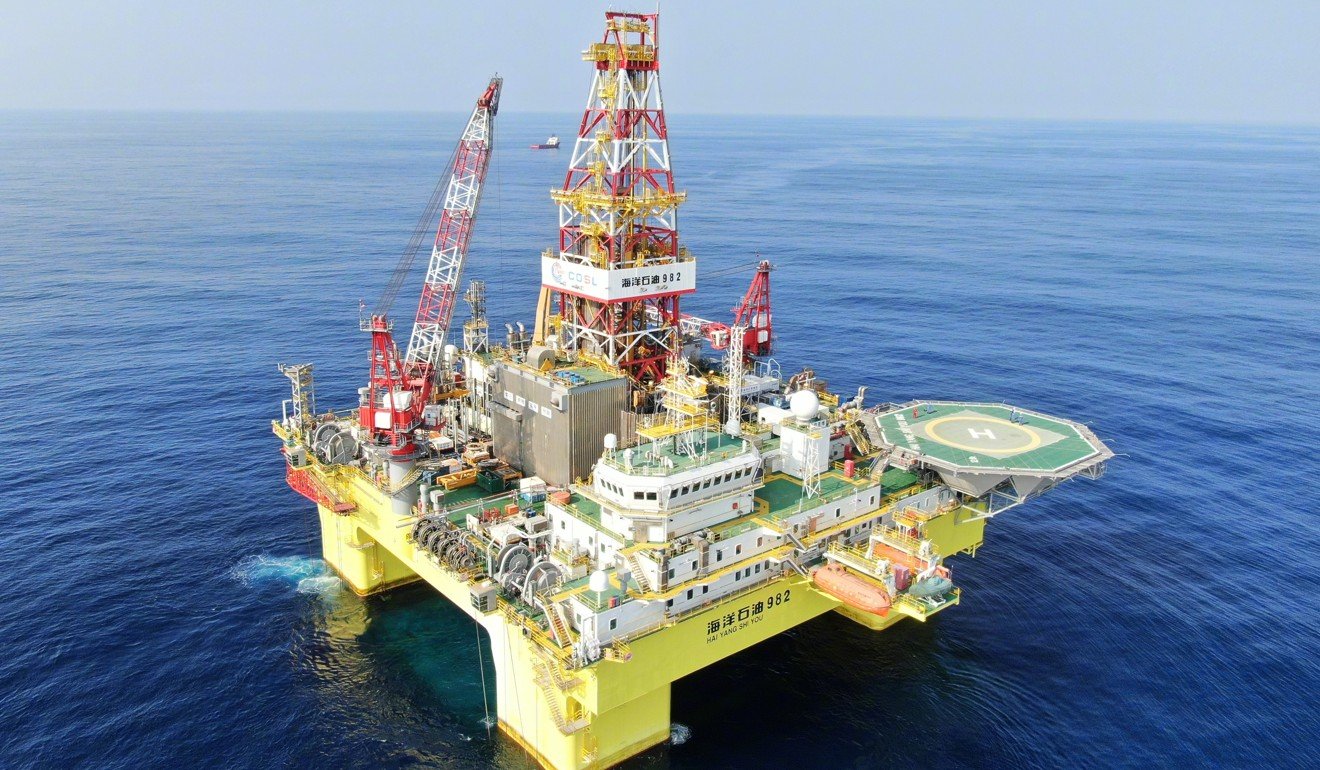
A Chinese deepwater oil rig in the South China Sea. Photo: Weibo

“It’s a welcome and historic development. Some wise guy in the Duterte government thought about timing [the invitation to Putin around the oil talks with Beijing],” said retired Philippine ambassador Lauro Baja, who once served as president of the United Nations Security Council.

Baja told the Post that no Russian president had visited the Philippines during his more than 40 years with the Department of Foreign Affairs.

“The Philippines then was almost a nonentity as far as Russia was concerned, [but] maybe now Russia recognises the strategic importance of the Philippines [in terms of] regional politics,” he said.

Baja said Moscow was aware of China’s entry into the Philippines, and could have its eye on some projects there.

“For all their so-called alliance, China and Russia are fierce competitors for influence and other benefits. And I think Russia has some objectives in mind like selling armaments and [forging] technological agreements,” he said, while cautioning that the situation remained “nebulous”.

New Philippines military chief sees no ‘shooting war’ in South China Sea despite disputes

“It’s a fascinating development but things are still early … For now, this is [just] an invitation extended by Duterte and accepted in principle by Putin.”

The United States will also be monitoring developments in the Philippines, according to Greg Poling, director of the Washington-based Centre for Strategic and International Studies’ Asia Maritime Transparency Initiative.

“Russia is eager to boost its influence in the region, and doubtless doing so with a long-standing US ally is seen as a bonus by Moscow,” he said. “There is nothing that prevents the Philippines from engaging in security cooperation with Russia, but the devil will be in the details.”

Poling added that the US would be concerned if Russia-Philippine cooperation involved acquiring military platforms that were incompatible with the shared platforms and doctrines used by Washington and Manila, as well as the latter’s other major security partners, namely Australia, Japan and South Korea.

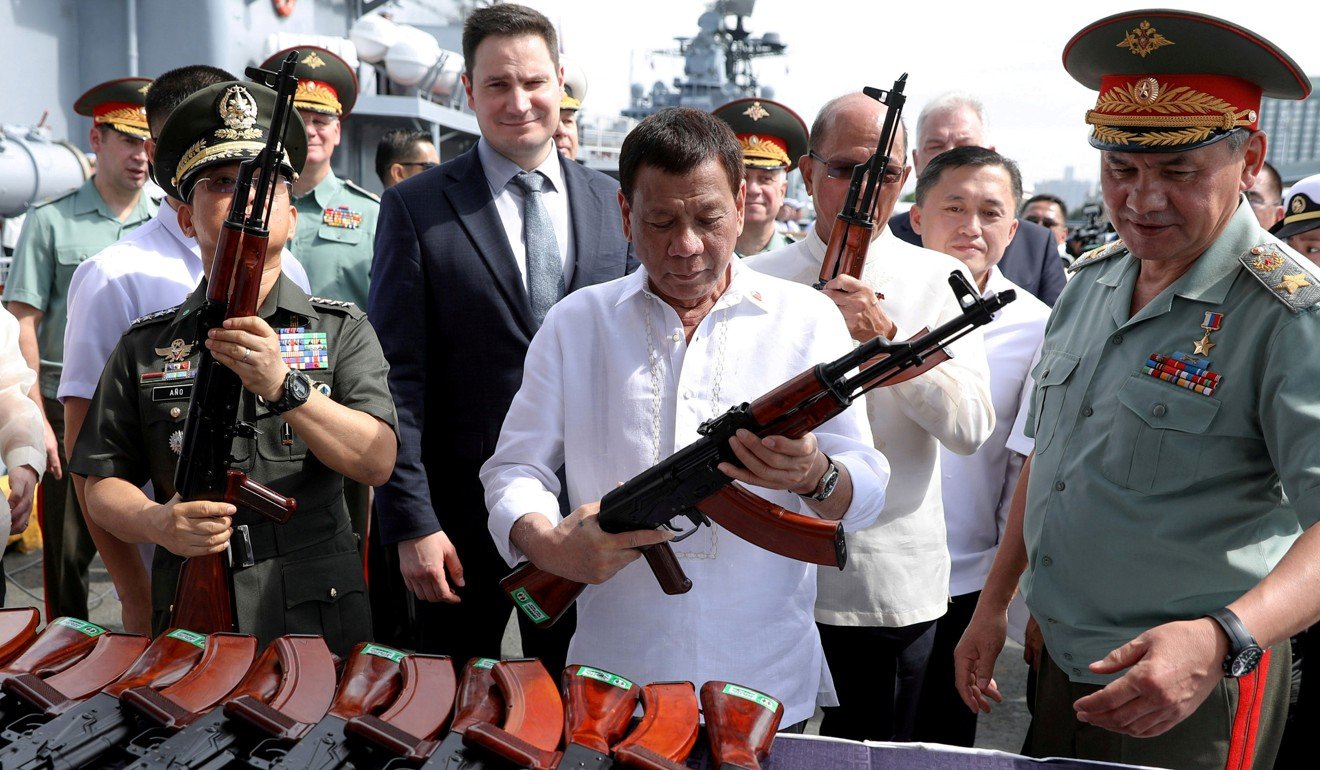
Philippine President Rodrigo Duterte inspects firearms donated by Russia in 2017. Photo: Reuters

“The US will also be concerned if any acquisitions or cooperation with Russia might threaten information security or intelligence cooperation between the US and the Philippines,” he said.

“And finally, any major platforms acquired from Russia would likely require the US to impose sanctions on the Philippines unless a waiver is granted, and the US government has been very stingy about awarding those waivers because they undermine the effectiveness of the sanctions regime.”

Moscow last week offered to help the Philippines produce its own arms for both domestic use and export with the help of Russian technology. Max Montero, an Australia-based Filipino security consultant, viewed that offer as “a swipe at the US”.

“Imagine a US stronghold and long-time ally and former colony becoming a manufacturing hub for Russian arms. And it makes it worse if [the Philippine armed forces] buys them too,” he said.

“Weakening the US alliances in Asia will benefit Russia [as it is] one of the US’ competitors in arms sales and geopolitics.”

Russia offers arms technology to the Philippines with ‘no conditions’ as US ties falter

The Philippines, Montero said, would benefit from such an arrangement since it is “a laggard in defence technology”. However, he pointed out that the country’s armed forces continue to buy weapons from the US and receive American arms as grants, potentially limiting the domestic market for Russian arms.

Navy cooperation has also been on the agenda, as Moscow and Manila discussed signing a new naval pact in March, while warships from each country have visited the other this year. Philippine naval vessels made their first-ever visit to Russia in October, while three Russian ships docked in the Philippines for a goodwill visit in January.

Russia is the top supplier of arms to Southeast Asia, and the No 2 global arms supplier, behind the US. Southeast Asia bought US$6.6 billion of Russian arms between 2010 and 2017, or more than 12 per cent of Russia’s sales, according to the Stockholm International Peace Research Institute, a Swedish think tank that publishes global arms tracking data.

Source: SCMP

03/11/2017

Five things to watch for on Donald Trump’s first Asia trip | South China Morning Post

The world will be watching as America’s leader makes his first official visit to Asia, where trade deficits and military ties are likely to be among the hot topics

US President Donald Trump’s first official visit to Asia gets under way on Friday, with a meeting with Chinese President Xi Jinping scheduled for next week likely to one of the highlights.

After a quick stop-off in Hawaii, Trump will travel to Japan, South Korea, China, Vietnam and the Philippines over the course of 12 days, taking him as close as he is ever likely to get to his greatest adversary – North Korean leader Kim Jong-un.As well as holding talks with state leaders, Trump will attend the Asia-Pacific Economic Cooperation forum in Vietnam and the US-Asean Summit in the Philippines.

Although he pledged during his presidential campaign last year to be “unpredictable” in diplomacy, here are the five issues that we think are likely to dominate his visit:

How will Donald Trump’s Beijing visit shape US strategy on China?

1) US Asia policy

Trump’s attitude towards the United States’ long-term allies, as well as partner-cum-rival China during his trip could set the foundations for US foreign relations for the rest of his presidential term.

In contrast to the “Pivot to Asia” approach adopted by his predecessor Barack Obama, Trump has made no bones about putting “America First”. It will be interesting to see how rigidly he adheres to that policy in talks with his Asian counterparts.

2) North Korea

US Secretary of State Rex Tillerson and China’s ambassador in Washington Cui Tiankai have both confirmed that the North Korea issue will top the agenda of the Sino-US meeting.

The restive state has conducted 15 missile tests since February and claims to have developed the technology to land a warhead on US soil.In response, Trump has repeatedly pressed China to do more to contain its long term ally’s weapons development programme and he is expected to further push Beijing to implement sanctions against Pyongyang and take additional steps to rein in its restive neighbour.

Trump to hop a flight home from the Philippines instead of attending East Asia SummitAlthough China has cooperated with UN Security Council resolutions on Pyongyang, North Korea’s official state media reported that Xi on Thursday expressed his hopes to promote ties between the two countries.

Before meeting Xi, Trump will visit Japan and South Korea – the United States’ closest Asian allies on the North Korea issue – and his talks there could well shed some light on how things might go in Beijing.

3) US military alliances

During his presidential campaign Trump made repeated claims that the US was bankrolling the defence of its Asian allies Japan and South Korea. Though he has yet to make any defence budget cuts, it will be of great interest not only to the United States’ allies but also other nations in the region how much he commits to America’s military development in Asia.

Will US President Donald Trump’s Asia trip result in deals to rein in North Korea?

With their shared and deepening concerns over North Korea’s nuclear weapons capabilities, Trump’s talks in Seoul may touch on the deployment of the US Terminal High Altitude Area Defence anti-missile system, an issue that has caused a year-long conflict between China and South Korea.

In Japan, whose defence ties to the US date back to the signing of the Treaty of Mutual Cooperation and Security in 1960, Prime Minister Shinzo Abe is likely hoping Trump will continue to honour the deal.In September, Trump said he would allow both Japan and South Korea to buy a “substantially increased amount” of sophisticated military equipment from the US.

4) Trade

Trump on Wednesday referred to the United States’ US$347 billion trade deficit with China as “embarrassing” and “horrible”. It should be expected, therefore, that while in Beijing he will be keen to rebalance that relationship by proposing new trade terms.

The ongoing US investigations into China’s alleged dumping of stainless steel flanges and Beijing’s intellectual property practices could also be on the agenda.

Donald Trump visit sees China’s US ambassador delay retirement

The United States’ second-largest trade deficit – US$69 billion – is with Japan, so Trump may look to continue the talks he began with Tokyo earlier in the year covering tariffs on US agricultural products and American car sales in the Asian country.

Trump has also called for a renegotiation of the 2012 US-S

Source: Five things to watch for on Donald Trump’s first Asia trip | South China Morning Post

22/09/2017

China ahead of schedule on construction of hydropower plant in Pakistan | South China Morning Post

Facility in disputed Kashmir could be completed nine months before its December 2021 deadline

China is racing to finish one of the biggest hydropower projects in Pakistan ahead of schedule, yet its location in the long-contested region of Kashmir will draw ire from India.

Construction of the 720MW Karot power station on the Jhelum river began in December and looked set to finish nine months ahead of its December 2021 completion date, a first for a Pakistan hydro-project, said Qin Guobin, chief executive officer of the state-owned China Three Gorges South Asia Investment Ltd.

The company has put in place an aggressive strategy to cut the project’s financing costs.“For us, Pakistan is a strategic market,” Qin said at the site. “If we managed to complete it earlier we can save financing costs and make it more competitive.”

China pips US in race to start the world’s first meltdown-proof nuclear power plant

Pakistan’s energy demand is expected to grow by 6 per cent to 35,000MW by 2024 as its population of more than 200 million people grows along with the economy. For more than a decade, it has been struggling to overcome daily power shortages that have left industry and residents in the dark.

China has stepped in to meet some of those shortages, financing projects worth more than US$50 billion in an economic corridor that runs through Pakistan. The route is part of Chinese President Xi Jinping’s “Belt and Road Initiative” to connect Asia with Europe and Africa with a web of ports, railways and motorways links for trade.

Three Gorges’ focus in Pakistan is clean energy and it has a US$6 billion portfolio in three hydro and three solar power plants. The Karot project is in the Pakistan-administrated part of Kashmir, which India and Pakistan both claim and have fought two wars over since independence in 1947.

The ‘Belt and Road’ projects China doesn’t want anyone talking about

India’s foreign ministry said its views on “Pakistan’s illegal occupation” of Kashmir was “a matter of record”.

“We have objected, they have proceeded nevertheless,” said G. Parthasarathy, a former Indian high commissioner to Pakistan. “This has been going on since the 1960s and 1970s, when they built the Karakoram highway” that links Pakistan with China through the disputed territory, he said.

China has a neutral stance on the Kashmir dispute, said Zhao Gancheng, director of the Centre for South Asia Studies at the Shanghai Institute for International Studies.

“The ‘Belt and Road Initiative’ cannot be delayed or sidetracked by the territorial disputes,” he said.

Relations between China and India hit a recent low during a dispute between a three-way junction between Bhutan, China’s Tibet and India’s Sikkim, which was resolved with both sides standing down in August.

China, Pakistan and the challenges of Silk Road connectivity

More broadly, New Delhi is wary of Chinese investments in neighbouring countries such as Pakistan and Sri Lanka, while Beijing is irked by India’s lack of support for its infrastructure and trade initiative.

India’s concern did not bother Qin. “It’s a political issue and not the concern of a private investor,” he said.

Pakistan considers the hydropower site a national security priority. It is dotted with army pickets and plain clothes security officials. None of the Chinese staff can leave the camp office without registering his or her name at the main gate. Of the 2,070 workers at the site, 750 are Chinese.

The concern is being taken seriously by both sides. Pakistan had created a special force of 15,000 troops to defend the Chinese projects and that number might be doubled, according to people with direct knowledge of the plans, who asked not to be identified as they were not authorised to speak to the media.

Chinese social media users fume over Indian magazine’s omission of Tibet and Taiwan from ‘map’

Yet risks remain after two Chinese nationals were killed in southwestern Balochistan in June. Islamic State claimed their murders.

The stakes are high for Pakistan, with the planned power generation projects potentially adding US$13 billion to its economy in the next seven years, according to an International Monetary Fund report published in July.

Pakistan’s hydropower generation potential is an estimated 40,000MW, although the existing installed capacity was only 7,116MW in the 2015-16 financial year, according to the National Electric Power Regulatory Authority’s latest report.

Three Gorges is now eyeing the contract for the construction of a 4,500MW Diamir-Bhasha power project in northern Gilgit-Baltistan and northwestern Chillas district.

“Pakistan’s total installed capacity is equal to one big Chinese city, like Shanghai,” Qin said. “That’s not enough.”

We recommend for you

Source: China ahead of schedule on construction of hydropower plant in Pakistan | South China Morning Post

15/09/2017

China declares itself a global power

N RECENT days government employees across China, from postal officials in the north-east to tax auditors in the south-west, have been corralled into watching state television.

The Communist Party often orders bureaucrats to study propaganda. This time, however, the mandatory viewing has deviated from the usual themes of domestic politics and economic development. Instead, it has focused on China’s emergence as a global power, and the role of the president, Xi Jinping, in bringing this about.In late August and early September the state broadcaster aired six 45-minute programmes on this topic at peak viewing hours. The Chinese title could be rendered as “Great-Power Diplomacy”, but some state media prefer to call it “Major-Country Diplomacy”. That sounds a little more modest. Describing China’s growing global clout has long been a problem for propagandists. In 2003 they seemed to have settled on the term “peaceful rise”, only to abandon it a few months later in favour of “peaceful development”—the word “rise”, they thought, risked causing alarm abroad.

There is not a hint of reticence, however, in the series’ portrayal of China’s purported foreign-policy successes under Mr Xi, and his personal involvement in them. The programmes, made with the help of the party’s own Publicity Department, are peppered with fawning remarks by Chinese and foreigners alike. In a clip from a speech given in 2015, Zimbabwe’s leader, Robert Mugabe, says of the smiling Mr Xi: “We will say he is a God-sent person.” (China has long admired Mr Mugabe’s contempt for the West.) “I really liked him, we had a great chemistry, I think,” America’s president, Donald Trump, is shown telling an American television interviewer after meeting Mr Xi in Florida in April.

Must-Xi TV

The main message is that Mr Xi is responsible for crafting a new approach to foreign policy that has won China global admiration: “great-power diplomacy with Chinese characteristics”. Mr Xi emphasised the need for this in November 2014 in a speech on foreign affairs (official translations of which often used the words “major country” instead). Last year the term appeared for the first time in the government’s annual work report. Like Deng Xiaoping’s “socialism with Chinese characteristics”, the phrase serves more to obfuscate than enlighten.

The nub of it is said to be “win-win co-operation”. But its introduction marked a clear departure from Deng’s more reticent approach to foreign policy, which was often described in China as taoguang yanghui, or “hiding brightness, nourishing obscurity”. By contrast, in the television series, the narrator says: “Maintaining world peace and stability is the unshirkable responsibility and burden of a great power.” It shows Chinese troops evacuating Chinese (and others) from strife-torn Yemen in 2015, the Chinese navy on anti-piracy missions off the Horn of Africa and Chinese marines setting off in July to establish the country’s first overseas military base in Djibouti.

While the series was being aired, a party newspaper published an article by the foreign minister, Wang Yi, on Mr Xi’s “diplomatic thought”. It said the president’s approach to foreign affairs had “blazed new trails and gone beyond traditional Western international-relations theory of the past 300 years”. The programmes aim to show that, unlike other rising powers in history, China (thanks to Mr Xi) has managed to maintain stable relations with established powers. They gloss over huge underlying tensions with Japan and America. Time and again Mr Xi is shown standing still while foreign leaders walk towards him to shake his hand. “It’s the ancient Chinese tributary system re-enacted,” says a Chinese academic, referring to emissaries from neighbouring states who brought gifts to the Chinese emperor as a means of securing peace.

But for all the talk of Mr Xi’s skills as a global leader, he still shares Deng’s aversion to risk-taking abroad. The series skates over the crisis on the Korean peninsula (a day after the final episode was shown, North Korea tested what appeared to be a hydrogen bomb.) Mr Xi’s great-power diplomacy had clearly failed to avert a grave international crisis—one that has developed not least as a result of China sitting on its hands.

Source: China declares itself a global power

27/07/2017

Britain plans to send warship to South China Sea in move likely to irk Beijing

Britain plans to send a warship to the disputed South China Sea next year to conduct freedom of navigation exercises, Defence Minister Michael Fallon said on Thursday, a move likely to anger Beijing.

Britain would increase in presence in the waters after it sent four British fighter planes for joint exercises with Japan in the region last year, he said.

China claims most of the energy-rich sea where neighbors Brunei, Malaysia, the Philippines, Taiwan and Vietnam also have claims.

“We hope to send a warship to region next year. We have not finalised exactly where that deployment will take place but we won’t be constrained by China from sailing through the South China Sea,” Fallon told Reuters.

“We have the right of freedom of navigation and we will exercise it.”

The presence of a British vessel threatens to stoke tensions, escalated by China’s naval build-up and its increasingly assertive stance.

China’s construction of islands and military facilities in the South China Sea has stoked international condemnation, amid concern Beijing is seeking to restrict free movement and extend its strategic reach.

Britain’s Secretary of State for Defence, Michael Fallon, arrives in Downing Street for a cabinet meeting, in central London, Britain July 18, 2017

Toby Melville

Britain’s move could also upset ties between London and Beijing, undermining efforts to shore up what the two governments have called a “golden era” in their relationship as Britain heads towards a divorce with the European Union.

“We flew RAF Typhoons through the South China Sea last October and we will exercise that right whenever we next have the opportunity to do so, whenever we have ships or planes in the region,” Fallon said.

The United States estimates Beijing has added more than 3,200 acres (1,300 hectares) on seven features in the South China Sea over the past three years, building runways, ports, aircraft hangars and communications equipment.

To counter the perceived Chinese aggression, the United States has conducted regular freedom of navigation exercises that have angered Beijing.

Earlier this month, the United States sent two bombers over the region, coming just a few months after it sent a warship to carry out a maneuvering drill within 12 nautical miles of one of China’s artificial islands.

China has repeatedly denounced efforts by countries from outside the region to get involved in the South China Sea dispute.

The South China Sea is expected to dominate a regional security meeting in Manila next week, where Chinese Foreign Minister Wang Yi will meet counterparts from the Association of Southeast Asian Nations (ASEAN) countries.

Meeting ASEAN diplomats in Beijing on Wednesday, Wang told them both sides must “exclude disturbances on the South China Sea issue, and maintain positive momentum”, China’s Foreign Ministry said.

Source: http://www.reuters.com/article/us-southchinasea-britain-idUSKBN1AC1CB

24/07/2017

China warns India not to harbor illusions in border stand-off

China’s defense ministry on Monday warned India not to harbor any illusions about the Chinese military’s ability to defend its territory, amid a festering border dispute.

The stand-off on a plateau next to the mountainous Indian state of Sikkim, which borders China, has ratcheted up tension between the neighbors, who share a 3,500-km (2,175-mile) frontier, large parts of which are disputed.

“Shaking a mountain is easy but shaking the People’s Liberation Army is hard,” ministry spokesman Wu Qian told a briefing, adding that its ability to defend China’s territory and sovereignty had “constantly strengthened”.

Early in June, according to the Chinese interpretation of events, Indian guards crossed into China’s Donglang region and obstructed work on a road on the plateau.

The two sides’ troops then confronted each other close to a valley controlled by China that separates India from its close ally, Bhutan, and gives China access to the so-called Chicken’s Neck, a thin strip of land connecting India and its remote northeastern regions.India has said it warned China that construction of the road near their common border would have serious security implications.

The withdrawal of Indian border guards was a precondition for resolving the situation, Wu reiterated.

“India should not leave things to luck and not harbor any unrealistic illusions,” Wu said, adding that the military had taken emergency measures in the region and would continue to increase focused deployments and drills.

“We strongly urge India to take practical steps to correct its mistake, cease provocations, and meet China halfway in jointly safeguarding the border region’s peace and tranquillity,” he said.

Speaking later, Chinese Foreign Ministry spokesman Lu Kang said Ajit Doval, India’s national security adviser, would attend a meeting in Beijing this week of security officials from the BRICS grouping that includes Brazil, Russia, India, China and South Africa.

Lu would not be drawn on whether the border issue would be discussed at the meeting, hosted by China’s top diplomat, State Councillor Yang Jiechi, meant to discuss multilateral issues.

“China hopes to maintain the peace and stability of the China-India border area, but certainly will not make any compromise on issues of territorial sovereignty,” Lu said.

Indian Prime Minister Narendra Modi is to visit China early in September for a summit of BRICS leaders.Indian officials say about 300 soldiers from either side are facing each other about 150 meters (yards) apart on the plateau.

They have told Reuters that both sides’ diplomats have quietly engaged to try to keep the stand-off from escalating, and that India’s ambassador to Beijing is leading the effort to find a way for both sides to back down without loss of face.

Chinese state media have warned India of a fate worse than its defeat suffered in a brief border war in 1962. China’s military has held live fire drills close to the disputed area, they said this month.

Source: China warns India not to harbor illusions in border stand-off

21/07/2017

Why India and Pakistan hate each other

EVERY AFTERNOON AT sunset, at a point midway along the arrow-straight road between Amritsar and Lahore, rival squads of splendidly uniformed soldiers strut and stomp a 17th-century British military drill known as Beating Retreat (pictured).

Barked commands, fierce glares and preposterously high kicks all signal violent intent. But then, lovingly and in unison, the enemies lower their national flags. Opposing guardsmen curtly shake hands, and the border gates roll shut for the night.

As India and Pakistan celebrate their twin 70th birthday this August, the frontier post of Wagah reflects the profound dysfunction in their relations. On its side Pakistan has built a multi-tiered amphitheatre for the boisterous crowds that come to watch the show. The Indians, no less rowdy, have gone one better with a half-stadium for 15,000. But the number of travellers who actually cross the border here rarely exceeds a few hundred a week.

Wagah’s silly hats and walks serve a serious function. The cuckoo-clock regularity of the show; the choreographed complicity between the two sides; and the fact that the soldiers and crowds look, act and talk very much the same—all this has the reassuring feel of a sporting rivalry between teams. No matter how bad things get between us, the ritual seems to say, we know it is just a game. Alas, the game between India and Pakistan has often turned serious.

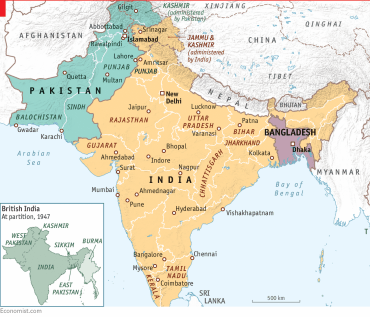
After the exhaustion of the second world war Britain was faced with two claimants to its restless Indian empire, a huge masala of ethnic, linguistic and religious groups (half of which was administered directly and half as “princely states” under 565 hereditary rulers subject to the British crown). Just about everyone wanted independence. But whereas the Congress Party of Mahatma Gandhi envisioned a unified federal state, the Muslim League of Muhammad Ali Jinnah argued that the subcontinent’s 30% Muslim minority constituted a separate nation that risked oppression under a Hindu majority. Communal riots prompted Britain’s last viceroy, Lord Mountbatten, to make a hasty decision. He split the country in two—or rather three, since the new state of Pakistan came in two parts, divided by the 2,000km (1,240-mile) expanse of the new state of India.

When the two new states were proclaimed in mid-August 1947, it was hoped the partition would be orderly. Lines had been drawn on maps, and detailed lists of personnel and assets, down to the instruments in army bands, had been assigned to each side. But the plans immediately went awry in a vast, messy and violent exchange of populations that left at least 1m dead and 15m uprooted from their homes.

Within months a more formal war had erupted. It ended by tearing the former princely state of Kashmir in two, making its 750km-long portion of the border a perpetual subject of dispute. Twice more, in 1965 and 1971, India and Pakistan fought full-blown if mercifully brief wars. The second of those, with India supporting a guerrilla insurgency in the Bengali-speaking extremity of East Pakistan, gave rise to yet another proud new country, Bangladesh; but not before at least half a million civilians had died as West Pakistan brutally tried to put down the revolt.

Even periods of relative peace have not been especially peaceful. In the 1990s Pakistan backed a guerrilla insurgency in Indian Kashmir in which at least 40,000 people lost their lives. In 1999 Pakistani troops captured some mountain peaks in the Kargil region, which India clawed back in high-altitude battles. A ceasefire in Kashmir that has held since 2003 has not stopped Pakistan-sponsored groups from striking repeatedly inside India. Pakistan claims that India, too, has covertly sponsored subversive groups.

Analysts discern a pattern in this mutual harassment: whenever politicians on both sides inch towards peace, something nasty seems to happen. Typically, these cycles start with an attack on Indian soldiers in Kashmir by infiltrators from Pakistan, triggering Indian artillery strikes, which prod the Pakistanis to respond in kind. After a few weeks things will calm down.

Just such a cycle started in late 2015, prompted, perhaps, by a surprise visit to the home of the Pakistani prime minister, Nawaz Sharif, by his Indian counterpart, Narendra Modi. Hopes raised by this overture dimmed within days when jihadist infiltrators attacked an Indian airbase. Another suicide squad struck an Indian army camp near the border, killing 19 soldiers. Faced with public outrage, Mr Modi ordered a far harder response than usual, sending commando teams into Pakistan. In the past, India had kept quiet even when it hit back, leaving room for Pakistan to climb down. This time Mr Modi’s government moved to isolate Pakistan diplomatically, rebuffed behind-the-scenes efforts to calm tensions and sent unprovoked blasts of fire across the Kashmir border.

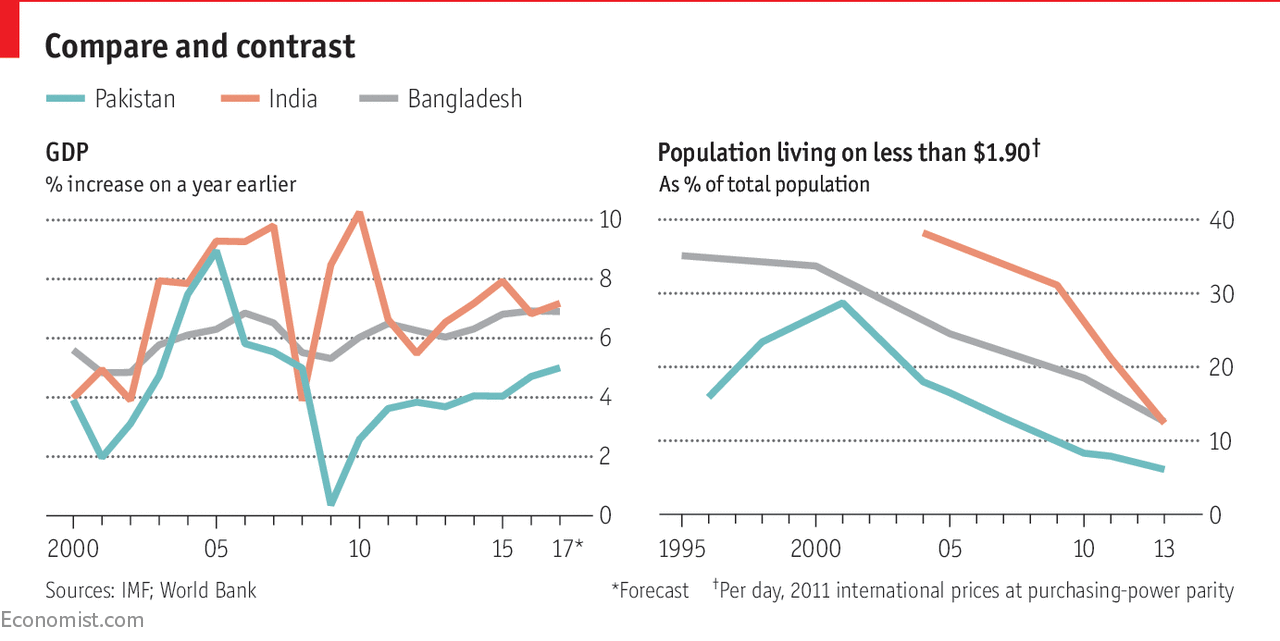
 India’s loss of patience is understandable. It has a population six times Pakistan’s and an economy eight times as big, yet it finds itself being provoked far more often than it does the provoking. When Mr Modi’s Hindu-nationalist Bharatiya Janata Party (BJP) came to power in 2014, it promised to put muscle into India’s traditionally limp foreign policy. “India for the first time is being proactive, not just responding,” says Sushant Singh, a military historian and journalist. “This is a huge shift.”

Yet Mr Modi’s pugnacity raises the risk of a dangerous escalation. “After a routine operation, the adversary may or may not escalate; after a publicised operation he will have only one option: to escalate,” writes Pratap Bhanu Mehta, one of India’s more thoughtful intellectuals.

Whether India and Pakistan are reckless enough to come to serious blows would not matter so much if they simply fielded conventional armies. But they are equipped with more than 100 nuclear warheads apiece, along with the missiles to deliver them. Since both countries revealed their nuclear hands in the 1990s, optimists who thought that a “balance of terror” would encourage them to be more moderate have been proved only partially right. Indians complain of being blackmailed: Pakistan knows that the risk of nuclear escalation stops its neighbours from responding more robustly to its provocations. Worryingly, Pakistan also rejects the nuclear doctrine of no first use. Instead, it has moved to deploy less powerful nuclear warheads as battlefield weapons, despite the risk that fallout from their use might harm its own civilians.

India does espouse a no-first-use nuclear doctrine, but its military planning is said to include a scenario of a massive conventional blitzkrieg aimed at seizing chunks of enemy territory and crushing Pakistan’s offensive capacity before it can respond. India’s arsenal includes the hypersonic Brahmos III, the world’s fastest cruise missile, which can precisely deliver a 300kg payload to any target in Pakistan. An air-launched version could reach Islamabad in two minutes, and Lahore in less than one. And in a grim calculation, India, with four times Pakistan’s territory, sees itself as better able to absorb a nuclear strike.

Alarmists will probably be proved wrong. Both countries are prone to sabre-rattling theatrics, but they are well aware that the price of full-blown war would be appalling. And despite the uncertainties generated by the rise of China, the continuing troubles in Afghanistan and the incalculability of Donald Trump’s America, the international community still seems likely to be able to pull Pakistan and India apart if need be.

As this special report will argue, though, both Pakistan and India should more openly acknowledge the costs, to themselves and to the wider region, of their seven decades of bitter separation. These include not only what they have had to spend, in lives and treasure, on waging war and maintaining military readiness over generations, but the immense opportunity cost of forgoing fruitful exchanges between parts of the same subcontinental space that in the past have always been open to each other. Trade between the two rivals adds up to barely $2.5bn a year.

Perpetual enmity has also distorted internal politics, especially in Pakistan, where overweening generals have repeatedly sabotaged democracy in the name of national security. Pakistan has suffered culturally, too; barred from its natural subcontinental hinterland, it has opened instead to the Arab world, and to the influence of less syncretic and tolerant forms of Islam. For India, enmity with Pakistan has fostered a tilt away from secular values towards a more strident identity politics.

Reflexive fear of India prompts Pakistan’s generals to meddle in Afghanistan, which they see as a strategic backyard where no foreign power can be allowed to linger. In turn, India, because of the constant aggravation from Pakistan, has become bad-tempered with its smaller neighbours. Small wonder that intra-regional trade makes up barely 5% of the subcontinent’s overall trade, compared with more than a quarter in South-East Asia. And it is no surprise that Pakistan has opened its arms to China, which is offering finance, trade and superpower patronage.

This special report will seek to unravel the causes of this irrational enmity, and to explore the contrasting internal dynamics in both countries that sustain it. It will examine new factors in this complex geopolitical board game, such as the rise of China. And it will consider what might be done to nudge the two rivals away from the vicious circle that binds them.

Source: Why India and Pakistan hate each other

21/07/2017

India says in quiet diplomacy with China to tackle border stand-off

When Chinese President Xi Jinping and Indian Prime Minister Narendra Modi met on the sidelines of a regional conference last month, officials said they reached an understanding not to let the two countries’ long-standing “differences become disputes”.

Yet within days, Chinese and Indian soldiers were jostling in a desolate but disputed border region in the Himalayas that has since grown into an eyeball-to-eyeball confrontation from which neither army is ready to back off.

The flare-up is the latest incident in a steadily deteriorating relationship between the Asian giants who are unable to agree on their 3,500 km (2,175 miles) border, over which they went to war in 1962.

Indian officials said diplomats from the two sides were now quietly trying to ensure the stand-off near the three-way border between India, its ally Bhutan, and China does not escalate into a conflict, invoking the agreement reached by their leaders at the Shanghai Cooperation Organisation summit in Astana.

Behind the scenes, India’s ambassador to Beijing is leading the effort to find a way for both sides to back down from confrontation on the Doklam plateau – which China calls Donglang – without losing face, an Indian government source aware of the sensitive negotiations told Reuters.

In public, the two sides are saying little about the delicate diplomatic engagement.

“We want both sides to call back troops and work things out with talks,” Indian Foreign Minister Sushma Swaraj told parliament on Thursday.

China says India must first pull back its troops from the area before meaningful discussions can take place.

“Of course, we have said before, China-India bilateral diplomatic channels are always open,” said Foreign Ministry spokesman Lu Kang, when asked whether talks with India were being held to defuse the situation.

“But with regard to this incident, we have emphasised many times that the Indian border defence personnel who illegally crossed the boundary withdrawing to the Indian side of the line is the basis and precondition for China and India conducting any kind of meaningful dialogue.

“Chinese state media have warned India of a fate worse than then the defeat it suffered in their border war in 1962.

Strategic Rivals

In recent years, the two have clashed over China’s strategic ties with India’s arch rival Pakistan, including a massive trade corridor that China is building through the disputed territory of Kashmir.

New Delhi has also been stung by China’s veto of United Nations sanctions against the leader of a Pakistan-based militant group and Beijing’s refusal to let it become a member of the Nuclear Suppliers Group, a global cartel.Beijing has bristled at the Modi government’s public embrace of the Dalai Lama, the Tibetan spiritual leader whom it regards as a dangerous splittist. It has also grown concerned at India’s military ties with both the United States and Japan.Indian Foreign Ministry spokesman Gopal Baglay said diplomatic channels between Delhi and Beijing were open and being used to tackle the border crisis.

“Diplomatic communications to the best of my understanding have never stopped,” he said. “There are diplomatic communications taking place.”

He would not go into further details.

Flashpoint

The latest trouble began when Chinese forces were spotted constructing a road with bulldozers and other heavy equipment in an area claimed by the tiny kingdom of Bhutan, prompting an intervention by Indian troops stationed nearby.

Groups of soldiers pushed and shoved each other, military officials said, but no weapons were used.

India said its action was guided by its special relationship with Bhutan as part of a 2007 treaty to cooperate on security issues, but also by the threat posed by the alleged Chinese incursion in Doklam to its own security.

The plateau lies close to the “Chicken’s Neck”, a 20-km wide corridor that links India to its northeastern states. The biggest fear among India’s military planners is that a Chinese offensive there could cut off the link.

China, which is engaged in a massive regional infrastructure drive to boost trade, says the area where the road was being constructed is part of its territory, and that in any case India does not have a role in what it sees as a bilateral matter with Bhutan.

About 300 soldiers from either side are facing each other about 150 metres (yards) apart on the Doklam/Donglang plateau, 10,000 feet (3,050 metres) above sea level, Indian officials say.

Behind them in the barracks below are thousands of troops ready to be deployed on either side. So far there has been no sign of either side trying to mobilise more troops, military officials in New Delhi said.

One possibility is that the weather may force the two sides to quietly disengage, the Indian government source said. Construction activity in the area can only take place between June and September before it becomes snowbound.

Source: http://uk.reuters.com/article/uk-india-china-idUKKBN1A51S9

Law of Unintended Consequences

continuously updated blog about China & India

ChiaHou's Book Reviews

continuously updated blog about China & India

What's wrong with the world; and its economy

continuously updated blog about China & India