Archive for ‘GeoPolitics’

16/09/2014

Xi’s India visit highlights changing power dynamic – Businessweek

Chinese President Xi Jinping’s trip to India this week highlights subtle shifts in the regional power dynamic that are bringing warmer ties between the two Asian giants, challenging China’s traditional relationship with Pakistan, and opening a new chapter in Beijing’s ongoing competition for influence with arch-rival Japan.

Xi is due in New Delhi on Wednesday for a three-day visit focused on trade, investment and the resolution of decades-old border disputes. With the world’s second-largest economy and a proven track record at building highways, railways, and industrial zones, China has much to offer India as it seeks to upgrade its creaky infrastructure.

The visit is the latest sign of easing suspicions between the two huge countries — which between them have 2.6 billion people — dating from a month-long border war in 1962 that left around 2,000 soldiers dead. That conflict ended in a standoff with both sides accusing the other of occupying its territory.

Xi’s visit “will definitely enhance the bilateral political mutual trust,” Chinese Assistant Foreign Minister Liu Jianchao told reporters in Beijing last week.

While ties have been steadily growing for years, they’ve been given a major boost under new Indian Prime Minister Narendra Modi, who’s signaled he wishes to pursue a more vigorous foreign policy. Xi is the first Chinese head of state to visit in eight years, while the country’s prime minister, Li Keqiang, made India his first overseas visit shortly after taking office last year.

“Good relations with India are a key part of China’s regional strategy and Xi’s visit creates the opportunity for direct face-to-face communication on the problems that still exist, such as the border issue,” said Zhao Gancheng, Director of the Asia-Pacific Center of the Shanghai Institute for International Studies.

via Xi’s India visit highlights changing power dynamic – Businessweek.

16/09/2014

India says to defend China border after standoff ahead of Xi visit | Reuters

More than 200 soldiers of the People’s Liberation Army crossed into what India considers its territory in Ladakh in the western Himalayas last week, and used cranes, bulldozers and a Hummer vehicle to build a 2-km (1.2-mile) road within it, the Hindustan Times said.

A dog rests on the Indian side of the Indo-China border at Bumla, in the northeastern Indian state of Arunachal Pradesh, November 11, 2009. REUTERS/Adnan Abidi

Indian soldiers challenged the Chinese troops and asked them to withdraw, the newspaper said. Then, on the night of September 10, soldiers demolished a temporary track built by Chinese forces.

There was no immediate comment by India’s defense ministry.

Both China and India are trying to put a positive spin on Xi’s first summit meeting with Indian Prime Minister Narendra Modi since the Indian leader took office in May. He arrives on Wednesday after touring the Maldives and Sri Lanka.

The two countries are expected to ramp up commercial ties and open the way for Chinese investment in Indian infrastructure, including railways, but the contested border remains a stumbling block to better political ties.

via India says to defend China border after standoff ahead of Xi visit | Reuters.

15/09/2014

China on track to develop Indian railways as Xi heads to South Asia | Reuters

China will pledge to invest billions of dollars in India’s rail network during a visit by President Xi Jinping this week, bringing more than diplomatic nicety to the neighbors’ first summit since Narendra Modi became prime minister in May.

China's President Xi Jinping attends a meeting with Venezuela's President Nicolas Maduro at Miraflores Palace in Caracas in this July 20, 2014 file photo. REUTERS/Jorge Silva/Files

The leaders of Asia’s three biggest economies – China, India and Japan – have crisscrossed the region this month, lobbying for strategic influence, building defense ties, and seeking new business opportunities.

Beijing’s bid to ramp up commercial ties in India comes despite a territorial dispute that has flared anew in recent years, raising concerns in New Delhi, where memories of a humiliating border war defeat in 1962 run deep.

It follows a pledge by Japan to invest $35 billion in India over the next five years – including the introduction of bullet trains – and a drive to deepen security ties during talks earlier this month between Modi and Prime Minister Shinzo Abe in Tokyo.

India and China are expected to sign a pact that will open the way for Chinese participation in new rail tracks, automated signaling for faster trains and modern stations that India’s British-built rail system desperately needs, having barely added 11,000 km of track in the 67 years since independence.

China, which added 14,000 km of track in the five years to 2011, is also pushing for a share of the lucrative high-speed train market in India, which it says would be cheaper than Japanese proposals.

“India has a strong, real desire to increase its cooperation with China and other countries to perfect and develop its rail system, and has concrete cooperation ideas,” Assistant Chinese Foreign Minister Liu Jianchao told reporters ahead of Xi’s trip.

“India is considering building high-speed railways, and China has a positive attitude towards this.”

China’s consul general in Mumbai, Liu Youfa, told the Times of India last week that Chinese investment in the modernization of India’s railways could eventually touch $50 billion.

Beijing is looking to invest another $50 billion in building India’s ports, roads and a project to link rivers, part of an infrastructure push that Modi has said is his top priority to crank up economic growth.

Chinese investment will also help narrow a trade deficit with India that hit $31 billion in 2013.

via China on track to develop Indian railways as Xi heads to South Asia | Reuters.

12/09/2014

Soft power: Confucius says | The Economist

“HARMONY is the most valuable of all things,” said the Chinese philosopher Confucius two and a half millennia ago. There is little of it in evidence in the frosty relationship between the woman who was the founding director of the Confucius Institute at the University of Oregon, Bryna Goodman, and her fellow historian, Glenn May. Their offices are separated by a ten-second walk, but the scholars do not exchange visits. Their palpable ill feeling reflects growing discord among Western scholars about a decade-old push by China to open government-funded cultural centres in schools and universities abroad. Intended to boost China’s “soft power”, the centres take the name of the peace-espousing sage. They tap into growing global demand for Chinese-language teaching. But they are also fuelling anxiety about academic freedom.

In America the Confucius programme has been widely welcomed by universities and school districts, which often do not have enough money to provide Chinese-language teachers for all who need them. But critics like Mr May believe China’s funding comes at a price: that Confucius Institutes (as those established on university campuses are known) and school-based Confucius Classrooms restrain freedom of speech by steering discussion of China away from sensitive subjects.

In June the American Association of University Professors called for universities to end or revise their contracts with Confucius Institutes (America has 100 of them) because they “function as an arm of the Chinese state and are allowed to ignore academic freedom”. Mr May has been asking the University of Oregon to close its institute, to no avail. Ms Goodman (who is no longer the institute’s director) says that in funding its interests China is like any other donor to American universities. She says that the institutes have become lodestones of what she calls a “China fear”.

When China opened its first Confucius Institute in 2004 in Seoul, it hoped the new effort would prove as uncontroversial as cultural-outreach programmes sponsored by Western governments, such as the British Council, the Alliance Française and Germany’s Goethe-Institut. The idea was to counter fears of China’s rise by raising awareness of a culture that is often described by Chinese as steeped in traditions of peace.

Through the Hanban, a government entity, China provides the centres with paid-for instructors and sponsors cultural events at them. Its spending is considerable, and growing rapidly. In 2013 it was $278m, more than six times as much as in 2006. China’s funding for Confucius Institutes amounts to about $100,000-200,000 a year on many campuses, and sometimes more (Oregon received nearly $188,000 in the last academic year). By the end of 2013 China had established 440 institutes and 646 classrooms serving 850,000 registered students. They are scattered across more than 100 countries, with America hosting more than 40% of the combined total. There are plans for another 60 institutes and 350 classrooms to be opened worldwide by the end of 2015.

Chinese officials express satisfaction. In June Liu Yunshan, who is in charge of the Communist Party’s vast propaganda apparatus, said Confucius Institutes had “emerged at the right moment”. He described them as a “spiritual high-speed rail”, promoting friendship by connecting Chinese dreams with those of the rest of the world.

Others are less sanguine, however. In America criticism has recently grown stronger. Earlier this year more than 100 members of the faculty at the University of Chicago complained that Confucius Institutes were compromising academic integrity. In an article published in 2013 by Nation magazine, one of the university’s academics, Marshall Sahlins, listed cases in several countries involving what appeared to be deference to the political sensitivities of Confucius Institutes. These included a couple of occasions when universities had invited the Dalai Lama to speak and then either cancelled the invitation or received him off-campus.

In one case, at North Carolina State University in 2009, the provost said after the cancellation of a Dalai Lama visit that the Confucius Institute had indicated the exiled Tibetan’s presence could cause problems with China. This year Steven Levine, an honorary professor at the University of Montana, wrote to hundreds of Confucius Institutes around the world asking them to mark the 25th anniversary in June of the violent suppression of the Tiananmen Square protests. None of them agreed. Global Times, a Beijing newspaper, recently called the protests of foreign academics “a continuation of McCarthyism”.

Ms Goodman argues that the study of China needs all the funding it can get, even if that means taking money from countries with vital interests at stake—whether China, Taiwan, or the United States. She says that if China were ever to meddle politically in Oregon’s institute, the Confucius programme would be quickly shut down.

Such assurances do not address a big concern of critics—that the political influence of Confucius programmes is often subtle and slow-acting. If the critics are right, it is very subtle indeed. Surveys suggest that in many countries China’s image has not markedly improved over the past decade. The Pew Research Centre, an American polling organisation, says 42% of Americans viewed China favourably in 2007. Last year only 37% did. The political dividends of China’s soft-power spending are far from obvious.

via Soft power: Confucius says | The Economist.

11/09/2014

India and China in wary dance as Xi Jinping prepares for South Asia trip | South China Morning Post

Xi Jinping will start his first South Asia tour with a visit to Beijing’s latest investment in Sri Lanka, a US$1.4-billion port city development to include a marina and a Formula One track – all just 250km from India’s coast.

japan_denmark_tok332_45418663.jpg

The president’s trip to the site, next to a major Chinese-funded commercial port, will provide a vivid reminder of Beijing’s growing economic clout in India’s backyard ahead of his maiden visit to New Delhi next week.

Despite his hardline nationalist reputation, India’s Prime Minister Narendra Modi moved quickly to engage with traditional rival China after taking office in May, inviting Xi to India.

But he has also sought to stop India’s neighbours falling further into China’s embrace, choosing Bhutan and Nepal for his first foreign trips as prime minister and extending an olive branch of peace to arch-rival Pakistan.

That may not worry China too much. Modi’s close relationship with Tokyo, on the other hand, is likely to raise alarm bells in Beijing that analysts say he may be able to use to his advantage.

Indian Prime Minister Narendra Modi pictured in New Delhi earlier this month. Photo: EPA

Modi enjoys a particularly warm friendship with his Japanese counterpart Shinzo Abe, who welcomed him even as he was shunned by Western powers over claims he failed to stop deadly religious riots in Gujarat, the state he used to run.

Both India and Japan are wary of what many see as Beijing’s growing territorial assertiveness, and Washington is eager for them to step up their cooperation by way of counterweight to China.

“China is looking at India under Modi as a serious and credible partner as well as potential adversary.” POLITICAL ANALYST SHYAM SARAN

“China is concerned that we would get closer to Japan and to the US under Modi. They don’t want that to happen,” said Jayadeva Ranade, president of the Centre for China Analysis and Strategy in New Delhi.

via India and China in wary dance as Xi Jinping prepares for South Asia trip | South China Morning Post.

04/09/2014

India and Japan Are a Perfect Fit – India Real Time – WSJ

Indian Prime Minister Narendra Modi’s visit to Japan will generate headlines for the big deals that he does (or doesn’t) conclude with his Japanese counterpart Shinzo Abe. These include civil nuclear cooperation, high-speed rail construction and defense ties.

However, the bilateral relationship ultimately depends on thousands of smaller commercial deals. If the two leaders set the tone and clear away obstacles, the India-Japan partnership can become the driver of Asia’s growth. Mr Modi said on this visit that Japan and India bear a ‘huge responsibility’ to define the path of Asian growth in the 21st century.

The two powers are complementary on several levels, but primarily in the economic realm. Japan has the largest growth problem in the world while India has the largest development problem.

There is no clearer example of this than India’s need for new roads, railways and ports. The Reserve Bank of India has defined India’s key economic problem as a supply-side deficit; demand is abundant, at times rampant, but supply responses are reduced by the unavailability and cost of capital, alongside logistics bottlenecks. The result is higher inflation and lower growth.

Japan can provide the solution in the form of capital and technology. Tokyo is a partner in the $90 billion Delhi-Mumbai Industrial Corridor which will create new “smart cities,” seven of which have started construction. Some 100 more are planned nationwide. This initiative has already yielded the Delhi Metro, built under budget and within schedule with Japanese loans and rolling stock.

via India and Japan Are a Perfect Fit – India Real Time – WSJ.

04/09/2014

Japan PM Abe appoints China-friendly lawmakers to key posts | Reuters

Japanese Prime Minister Shinzo Abe picked two veteran lawmakers with friendly ties to China for top party posts on Wednesday in an apparent signal of hope for a thaw in chilly ties with Beijing and a summit with Chinese leader Xi Jinping.

Japan's Prime Minister Shinzo Abe walks into the Prime Minister's official residence in Tokyo September 3, 2014.  REUTERS/Yuya Shino

The change in executives in Abe’s Liberal Democratic Party (LDP) is part of a broad leadership rejig, including a cabinet reshuffle, aimed at strengthening party unity and polishing Abe’s image 20 months after he surged back to office.

In a move welcomed by Tokyo stock market players, Abe drafted Yasuhisa Shiozaki, 63, a proponent of an overhaul of Japan’s Government Pension Investment Fund (GPIF), to head the ministry of labor, health and welfare, which oversees GPIF.

The fund is finalizing plans to boost the weighting of domestic stocks in its portfolio.

Abe also gave women almost a third of the posts in his 18-minister cabinet to show his commitment to promoting women as part of his “Abenomics” growth strategy.

But he retained core cabinet members such as Chief Cabinet Secretary Yoshihide Suga, Finance Minister Taro Aso, 73, Economics Minister Akira Amari, 65, and Foreign Minister Fumio Kishida, 57, signaling policy continuity.

Abe’s new line-up faces a number of challenges, including how to repair ties with China that have been frayed by rows over disputed territory and Japan’s wartime history, and whether to go ahead with a planned sales tax rise next year despite signs the economy is faltering.

via Japan PM Abe appoints China-friendly lawmakers to key posts | Reuters.

03/09/2014

In Modi’s first 100 days, foreign ministry moves fastest on Raisina Hill

With her many visits abroad, External Affairs Minister Sushma Swaraj has been running the busiest ministry in the new government.

India’s new foreign minister, Sushma Swaraj, seems to be running the busiest ministry on Raisina Hill ─ the area of Lutyen’s Delhi that houses key government buildings ─ for the regime led by Prime Minister Narendra Modi.

Modi’s decision to invite all the heads of state in the South Asian Association for Regional Cooperation group to his swearing-in ceremony, widely hailed as a good and forward-thinking move, meant that Swaraj had to be on her toes from the get-go. In no time at all, Swaraj and Modi embarked on trips to neighbouring countries such as Bangladesh and Nepal, which an Indian head of state had not officially visited since 1997.

Swaraj has had her hands full, visiting neighbours such as Bangladesh and Myanmar in quick succession while overseeing the successful evacuation of hundreds of stranded Indian citizens from hotspots such as Iraq and Libya and formulating India’s position on the conflict between Israel and the Palestinian territory of Gaza. She has just returned from Vietnam and was set to go to Beijing for a trilateral meeting with the Chinese and Russian foreign ministers but the government called off her trip, perhaps in deference to the sensitivities of Japan, where Prime Minister Modi arrived on Sunday for a summit.

On Israel, despite the BJP’s highly favourable stance towards the country, India eventually stuck to its historical position by voting in favour of Palestine at the United Nations Human Rights Commission. Many BJP supporters questioned the government’s move, with some saying it was unable to break out of a Congress-era mindset.

The new order at the Ministry of External Affairs has a spring in its heels. From looking to invite all heads of state in the African Union to New Delhi to attracting mixed responses for allowing Modi to cancel talks with Pakistan after its high commissioner met Kashmiri separatist leaders from the Hurriyat Conference, the ministry has been hogging the limelight on Raisina Hill.

via Scroll.in – News. Politics. Culture..

03/09/2014

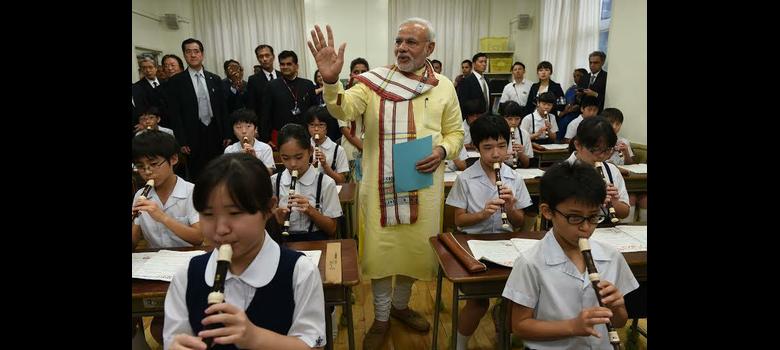
These photos show what Modi did in Japan when he wasn’t attending to business

All prime ministers enjoy spending time abroad, especially if it is while visiting a particularly friendly ally.

Prime Minister Narendra Modi isn’t exactly the jovial type. Sure, he peppers his speeches with a bit of light humour occasionally, but he doesn’t seem like the kind of person who would enjoy a comedy night on television. So what could possibly make him really happy? The same thing that makes heads of states happy all over the world: leaving their own countries to visit friendly allies.

And by any measure, it seems like Modi managed to have a blast in Japan (even if no nuclear deal was signed). Since he also happens to be the Selfie Era Prime Minister, every moment of this fun journey was documented and promptly tweeted by the prime minister’s official twitter account.

more photos from:  http://scroll.in/article/677092/These-photos-show-what-Modi-did-in-Japan-when-he-wasn’t-attending-to-business

01/09/2014

Japan and India vow to boost strategic ties during summit | Reuters

Japan and India agreed on Monday to strengthen strategic ties as Asia’s second and third biggest economies keep a wary eye on a rising China, and said they would accelerate talks on the possible sale of an amphibious aircraft to India’s navy.

India's Prime Minister Narendra Modi (R) and Japan's Prime Minister Shinzo Abe shake hands before their talks at the state guest house in Tokyo September 1, 2014. REUTERS/Toru Hanai/Files

Japanese Prime Minister Shinzo Abe and his Indian counterpart Narendra Modi also agreed to speed up talks on a so-far elusive deal on nuclear energy cooperation, welcoming what they called “significant progress” in the negotiations.

“The two prime ministers reaffirmed the importance of defense relations between Japan and India in their strategic partnership and decided to upgrade and strengthen them,” Abe and Modi said in a statement after a summit in Tokyo.

Modi, on his first major foreign visit since a landslide election win in May, arrived on Saturday for a five-day trip aimed at capitalizing on a personal affinity with Abe to bolster security and business ties in the face of an assertive China.

In a sign of their warm ties, the two leaders greeted each other with a bear hug when they met on Saturday in Japan’s ancient capital of Kyoto for an informal dinner. Modi is one of three people that Abe follows on Twitter, while the Indian leader admires Abe’s brand of nationalist politics.

“The 21st century belongs to Asia … but how the 21st century will be depends on how strong and progressive India-Japan ties are,” Modi told Japanese and Indian business executives earlier in the day.

“The 18th century situation of expansionism is now visible,” Modi said, referring to incidents such as encroachment of others countries’ territories and intruding in other countries’ seas, in a veiled reference to China, with which India shares a long disputed border.

“Such expansionism would never benefit humanity in the 21st century,” he said.

Sino-Japanese ties have also been chilled by a row over disputed isles, feuds over the wartime past, and mutual mistrust over defense policies as China seeks a bigger regional role and Abe loosens the constraints of Japan’s post-war pacificism.

Abe is keen to expand Japan’s network of security partnerships with countries such as India and Australia to cope with the challenge presented by China.

via Japan and India vow to boost strategic ties during summit | Reuters.

Law of Unintended Consequences

continuously updated blog about China & India

ChiaHou's Book Reviews

continuously updated blog about China & India

What's wrong with the world; and its economy

continuously updated blog about China & India