

China continues advance into South China Sea; military base to be built on artificial island
‘Four Dishes, One Soup’ Not Enough For Sino-Russian Gas Deal Celebration – China Real Time Report – WSJ
Say you’re the leader of the world’s No. 2 economy. You just signed a massive energy deal with your Russian counterpart that has major political and economic implications – and that, under international protocol, calls for a big-time state wingding. At the same time, you’re pushing a government austerity platform to convince your people that their leaders aren’t corrupt fat cats living large off the people.

What to do?
That’s the dilemma Chinese President Xi Jinping faced this week after he reached a 30-year, potentially $400 billion gas supply deal with Vladimir Putin. His answer, it seems, was to split the difference. The state dinner that followed the high-profile deal-signing had enough fancy dishes, tipple and desserts to fail the sort of austerity test Mr. Xi might apply to, say, a banquet thrown by county-level officials in a tier-three burg.
Still, experts said, the wines steered more to the local than to the Bordeaux, and the whole affair fell short of what you might get at a fancy wedding.
After 10 years of difficult negotiation, China and Russia signed a landmark natural-gas contract on Wednesday. The night before, Chinese President Xi Jinping and his wife Peng Liyuan hosted a dinner in Shanghai welcoming more than 300 guests from 46 countries, including Russian President Vladimir Putin.
What dishes were served during the 90-minute dinner?
The dinner was definitely more elaborate than the “four dishes and one soup” set promoted by Xi Jinping as a form of domestic cost-cutting. There were four plates of desserts alone—implying that the anti-corruption rules don’t always apply when it comes to state events, as China doesn’t want to lose face on diplomatic occasions. The six appetizers included mashed green beans, spicy cabbage, sliced whitebait, a pea dish and bamboo shoots with green onions. The five dishes and one soup served included shrimp balls, fried and braised beef, macadamia nuts with greens, flatfish with bean curd sauce, luffa with green beans and mushroom with fish maw. Other dishes included moulded pudding, vegetable dumplings and plates of fruit.
This dinner was intended to be a creative combination of Chinese and western-style cooking, one that highlighted fresh ingredients from southern regions of the Yangtze River. The executive chef behind it, Su Dexing, was also the chief cook for the state banquet during the APEC meeting in 2001, according to Shanghai International Convention Center staff.
As at many state events, China’s ubiquitous luxury liquor Maotai was also served, along with a dry red and dry white wine produced by Cofco Wines & Spirits. According to prices advertised on e-commerce websites, such red and white wine would likely cost between 400-600 yuan ($64-96) per bottle and 300 yuan per bottle, respectively.
Although abundant, the dinner was still simple compared to other options available in Shanghai, where wedding banquets can easily cost a minimum of 500 yuan per person, excluding liquor. In 5-star hotels, such meals might cost more than double that amount.
Related articles


Indonesia Beefs Up Air Force in South China Sea | The Diplomat
Indonesia is beefing up its air presence along the South China Sea, a military officer announced late last month.

According to IHS Jane’s, Lieutenant Colonel Andri Gandy, the commander of Ranai airbase on the Riau Islands, which borders the South China Sea, said Indonesia was upgrading the airbase so that it could accommodate Sukhoi Su-27 and Su-30 fighter aircraft. Separately, Indonesian Army (TNI-AD) Chief of Staff General Budiman said that four Boeing AH-64E Apache attack helicopters would be deployed to Ranai airbase.
Lt. Col Gandy said that the TNI had already installed runway lights, taxiway lights and integrated radar at the airbase. He added that there were plans to extend the length of the runway in order to accommodate the Su-27 and Su-30s.
The announcement comes at a time when Indonesia has been raising concerns about China’s territorial designs on the Natuna Sea off the coast of the Riau Islands. As The Diplomat previously reported, last month Commodore Fahru Zaini, a senior Indonesian defense official, told reporters: “China has claimed Natuna waters as their territorial waters. This arbitrary claim is related to the dispute over Spratly and Paracel Islands between China and the Philippines. This dispute will have a large impact on the security of Natuna waters.”
Although there have long been suspicions that China’s nine-dashed line overlapped with Indonesia’s exclusive economic zone (EEZ) off the Riau Islands, Indonesia has refused to officially acknowledge the dispute exists. Zaini’s comments seemed to depart from this position.
However, as Evan A. Laksmana has pointed out, the Indonesian government quickly disavowed Zaini’s statement. For example, just days after Zaini spoke, Foreign Minister Marty Natalegawa stated: “Firstly, there is no territorial dispute between Indonesia and China, especially about the Natunas. In fact, we are cooperating with China in possibly bringing about foreign direct investment plans in the Natunas. Second, we are not a claimant state in the South China Sea.”
Laksmana also points out that Indonesia has long planned to beef up its military forces in the Natuna region as one of its “flashpoint defense” areas. The Jane’s report said that Zaini described the Su-27 and Su-30s deployment as part of Indonesia’s Minimum Essential Force (MEF) concept, which Jane’s explained: “aims to establish the nature and minimum scale of military capabilities that Indonesia should seek to deploy in response to a strategic threat.”
via Indonesia Beefs Up Air Force in South China Sea | The Diplomat.
Related articles


India scales up military forces on disputed China border – CSMonitor.com
Very interesting: Pakistan is invited to Modi’s inauguration, but China is not; and more troops along Chinese border but not along border with Pakistan!
“India is raising a new mountain strike corps of nearly 90,000 soldiers to strengthen its defense along its disputed border with China in the high reaches of the Himalayas.

China will be a top foreign policy challenge for Narendra Modi, the incoming prime minister who won a landslide victory last week. Business ties between India and China are booming. But despite rounds of talks, the two countries have yet to resolve their decades-old dispute over the 2,000-mile border between the two countries. It remains one of the most militarized borders in the world.
The strike corps will have its own mountain artillery, combat engineers, anti-aircraft guns, and radio equipment. Over 35,000 soldiers have already been raised in new infantry units in India’s northeastern state of Assam. The entire corps will be fully raised over the next five years with 90,274 troops at a cost of $10.6 billion. The proposal to raise a new strike corps was recommended last year by India’s China Study Group, a government body that considers all strategic issues related to China.
The strike corps signals a new assertiveness in New Delhi and will provide an additional defense capability to India, which for a long time focused on the land borders with Pakistan. While the decision predated Mr. Modi, he is likely to further strengthen India’s military modernization which is one of his party’s top agenda items.
“China has made frequent border transgressions into Indian border,” says retired Lieutenant General Prakash Katoch, who formerly commanded the Indian Army‘s Special Forces wing. “The new prime minister has to ensure that our borders are well protected. It cannot be business as usual.”
He predicts that as both countries are growing and keen to increase their influence, China and India will increasingly step on each other’s areas of interest and importance.”
via India scales up military forces on disputed China border – CSMonitor.com.
Related articles


Tibet on track to become global tourist attraction[1]- Chinadaily.com.cn
Tourism increased in the Tibet autonomous region in the first four months of the year, as the region aspires to become a world-class travel destination.
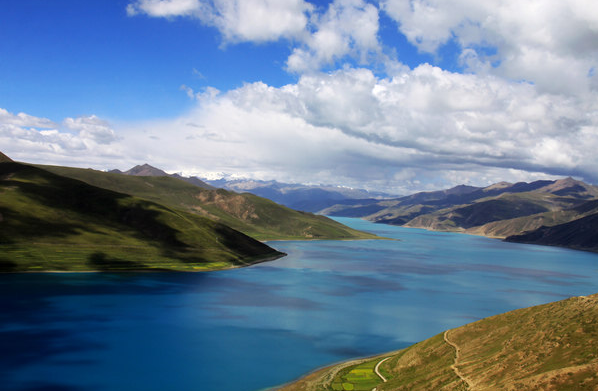
The region had more than 830,000 tourists from January through April, a year-on-year increase of 23.4 percent, the regional tourism bureau said on Tuesday.
Foreign tourists numbered 20,000, an increase of 10.3 percent, and the number of domestic tourists was 810,000, an increase of 23.8 percent.
Meanwhile, the revenue generated by the tourism industry was 926 million yuan ($148.4 million), an increase of 26.2 percent, it said.
Karral Millar, 62, an Australian tourist, said she had a good time in Tibet.
“It’s wonderful. It’s been three days now. We have visited the Potala Palace and many temples, and we are learning new things about Tibetan Buddhism and history,” Millar said on Tuesday.
Cycling has become a popular way to tour the region in recent years, as many tourists want to have close contact with the natural scenery and culture of Tibet.
“It’s my second time in Tibet. I am absolutely impressed with the natural scenery and unique culture. I feel as if I am at home here,” said Liu Xiaojun, from Hebei province.
“I am also overwhelmed with the hospitality and politeness of the local people,” said Liu, adding that he plans to make a bicycle tour to Zhangmu Port in Tibet’s Xigaze prefecture.
Many businesses near the scenic spots in Lhasa see the coming of summer peak season as a harvest.
“Compared with the same period last year, we had more guests this year. We have 62 rooms, and more than half are booked every day,” said India, 41, a receptionist at the Kyichu Hotel, a Nepalese hotel in Lhasa.
Tibet received more than 12 million tourists from home and abroad lastar.
The region hopes to have 15 million tourists this year.
via Tibet on track to become global tourist attraction[1]- Chinadaily.com.cn.
Related articles


India Invites Pakistan to Narendra Modi’s Swearing-In – India Real Time – WSJ
Interestingly, China, another close neighbour has NOT been invited!
“In a surprise gesture, India has invited the leader of Pakistan—its neighbor and arch-enemy—to attend the swearing-in ceremony of a new prime minister.

The leaders of other South Asian nations are being invited, too, including Afghanistan, Sri Lanka, Nepal, Bhutan, Maldives and Bangladesh, according to a spokeswoman for the Bharatiya Janata Party, which dominated India’s recent parliamentary election. But all eyes will be on Pakistan, which has fought three wars with India since the two nations gained independence from the colonial British in 1947.
As of Tuesday afternoon, Pakistan hadn’t yet received its invitation, according to Pakistan’s foreign ministry.
Traditionally, swearings-in have been attended mainly by family members and Indian government figures. India’s next prime minister, Narendra Modi of the BJP, is scheduled to be sworn in at a ceremony on May 26. The invitations have been sent by India’s Ministry of External Affairs.
According to the BJP spokeswoman, Nirmala Sitharaman, invitations have been sent to all members of the South Asian Association for Regional Cooperation, or SAARC. The organization’s purpose is to work toward peace and strengthened economic ties in the region.
“We are looking forward to having a good relationship in our neighborhood and we want to build goodwill,” Ms. Sitharaman told The Wall Street Journal.
Mr. Modi, a Hindu nationalist leader, is expected to pursue a muscular foreign policy. In the past, he has criticized the rival Congress party’s stance on territorial disputes with China and on border skirmishes with Pakistan. His party, the BJP, won 282 of the 543 elected seats in Parliament this month. The Congress party, which previously led the national government, won only 44 seats—its worst tally in party history.
After winning the elections, Mr. Modi, who has served as the chief minister of Gujarat for more than a decade, was congratulated by Pakistan Prime Minister Nawaz Sharif. Mr. Sharif came to power in Pakistan in the elections held last year.
India and Pakistan have a tense and fragile relationship. The invitation to attend the swearing-in comes only two days after Indian security forces said they were in pursuit of alleged militants in the state of Jammu and Kashmir, where India and Pakistan regularly skirmish.”
via India Invites Pakistan to Narendra Modi’s Swearing-In – India Real Time – WSJ.
Related articles


Does China Pose a Threat to Global Food Security? It Says No – China Real Time Report – WSJ
Twenty years ago, environmental advocate Lester Brown got in hot water with Beijing for writing a book called “Who Will Feed China?”

China was displeased with the suggestion in his book that the country’s growing population and water scarcity could drastically burden the world’s food resources. Beijing publicly criticized the author – then began a series of reforms including improving farming techniques and adopting a national policy of self-sufficiency in grain consumption that vindicated Mr. Brown’s arguments. It paved the way for a gradual rapprochement with the American, now 80.
Détente is over.
On Wednesday, China’s agriculture ministry issued a statement again criticizing Mr. Brown. It took umbrage with an essay he wrote titled “Can the World Feed China?” a riff on his earlier book. The essay details Mr. Brown’s concerns that rising domestic pressures on food consumption could result in spiking food prices and political unrest as China joins in a global “scramble for food.”
It isn’t clear why Mr. Brown was singled out for criticism; many analysts have in one form or other also articulated these trends, though arguably not as directly or pungently. But the move underscores how increasingly sensitive China is to the growing impression that it can’t feed itself and that its acquisitions of global food assets are posing a risk to food security for the rest of the world. China has been keen in recent years to head off any impression that it’s on a global grab for natural resources.
Mr. Brown wasn’t immediately available for comment.
The government is unhappy with the notion it’s being blamed for sharpening global competition for food. Mr. Brown’s essay said China’s rising grain imports mean “it is competing directly with scores of other grain-importing countries.” He also warned that China’s purchase last year of U.S. pork producer Smithfield Foods “was really a pork security move.” So too, he said, was China’s deal with Ukraine to provide $3 billion in loans in exchange for corn. “Such moves by China exemplify the new geopolitics of food scarcity that affects us all,” he wrote.
Not likely, ministry spokesman Bi Meijia said in the government’s statement. Mr. Bi said 97% of China’s grain consumption comes from its own output, not imports.
“On the issue of food security, China not only does not pose a threat to the world, but makes a contribution to global food security,” he said. China intends to continue its existing policies, he said.
Mr. Bi said rising grain imports aren’t due to domestic shortages, but because global prices are lower than domestic prices. The ministry also pointed out that imports accounted for just 2.6% of domestic grain production volume in 2013, and just 4% of global output.
via Does China Pose a Threat to Global Food Security? It Says No – China Real Time Report – WSJ.
‘No Gene for Invasion in Chinese People’s Blood,’ Says Xi, Amid Sino-Vietnam Tensions – Businessweek
As tensions grow between China and its neighbors, some words of reassurance are certainly welcome. Still, it’s questionable just how calming Xi Jinping’s recent ones were.

China does not accept that “might is right,” said China’s president and party secretary, speaking yesterday at a commemoration ceremony in Beijing for the 60th anniversary of the Chinese People’s Association for Friendship with Foreign Countries. “There is no gene for invasion in Chinese people’s blood,” Xi continued, the official Xinhua News Agency reported on May 16.
Speaking of invasions, that is what China did when it sent troops into northern Vietnam in 1979, a foray that sparked a short-lived but bloody war between the two countries. China and Vietnam have a history of “collaboration and cordiality, but also tumult and hostility” going back as far as the first century B.C., wrote Dennis McCornac, a professor at Loyola University Maryland, in 2011.
via ‘No Gene for Invasion in Chinese People’s Blood,’ Says Xi, Amid Sino-Vietnam Tensions – Businessweek.
Related articles


More than 1,000 Hongkongers cancel Vietnam trips in wake of rioting | South China Morning Post
More than 1,000 Hongkongers have cancelled their trips to Vietnam as the anti-Chinese riots show no sign of easing in the country.

The Hong Kong tourists had joined 45 tour groups that would have been departing between today and May 26.
Joseph Tung Yao-chung, executive director of Hong Kong’s Travel Industry Council, said today that tour operators believed risks might grow, although sightseeing spots on their itineraries were currently safe.
Chinese nationals cross from Vietnam into Cambodia at a checkpoint in Binh Duong province. Photo: Reuters
He said 14 tour groups with 350 Hongkongers are now in Vietnam and they are asked to report to the council of their situation every day. There has been no report of any trouble so far, said Tung, and the tour groups are expected to return to the city by next Tuesday.
Violence against Chinese companies in Vietnam turned deadly yesterday, with the Hong Kong government upgrading its travel alert from amber to red.
Xinhua reported that at least two Chinese had been killed in riots over the establishment of an oil rig in the disputed Paracel Islands two weeks ago.
Another 10 Chinese were said by Xinhua to be missing and more than 100 hospitalised.
via More than 1,000 Hongkongers cancel Vietnam trips in wake of rioting | South China Morning Post.
Related articles


China Says It Wants To Build Massive Railway To America
China has announced an ambitious engineering plan to build a bullet train railway to America, state media reported Thursday.

Possible route of a bridge or tunnel across the Bering Strait. (Photo credit: Wikipedia)
The massive railway network, nicknamed “China-Russia-Canada-America,” would run north from China, through Siberia and Russia, under the Pacific Ocean to Alaska, then down through Canada to the contiguous United States, The Guardian reports.
The trip from China to the contiguous U.S. would take less than two days, with trains traveling about 217 mph, according to The Beijing Times. China will reportedly fund the construction of the 8,079 miles of railway track, including a 125-mile underwater tunnel across the Bering Strait from Russia to Alaska.
But this may not be the best time for China to embark on such an epic undertaking, considering the country’s railway industry is in the red, as The Economic Times points out.
“China’s railway sector is still being haunted by deep debts. Therefore, even with the government’s support, it must persuade banks to lend a colossal amount of money,” an unnamed expert from Beijing Jiaotong University told The Economic Times.
Aside from financial challenges, many are skeptical of whether the engineering required to build such a massive network is feasible.
According to The Guardian, “The Bering Strait tunnel alone would require an unprecedented feat of engineering – it would be the world’s longest undersea tunnel – four times the length of the Channel Tunnel” connecting the United Kingdom and France.
China Daily claims that the technology needed to construct the undersea tunnel is already available. But even if it is, The Economist’s Gulliver business travel blog says the railway plan is simply not a realistic or necessary project.
“Languorous tourists might love it, just as they do the Orient Express or the Ghan train through the Australian Outback, and I suppose it might also carry some freight. But still, there is no practical case for it,” the blog post’s author writes. “Nonetheless, such ambition is to be admired in an abstract way.”
The Guardian notes that it is unclear whether China has consulted Russia, the U.S. or Canada about the project.
via China Says It Wants To Build Massive Railway To America.

 CHINDIA ALERT: You'll be living in their world, very soon