Archive for ‘GeoPolitics’

24/06/2016

China rejects bending rule for India to join nuclear club | Reuters

China maintains its opposition to India joining a group of nations seeking to prevent the proliferation of nuclear weapons by controlling access to sensitive technology, said the head of the arms control department in China’s Foreign Ministry.

The Nuclear Suppliers Group (NSG) met this week in Seoul, but China said it would not bend the rules and allow India membership as it had not signed the nuclear Non-Proliferation Treaty (NPT), the main global arms control pact.

“Applicant countries must be signatories of the Treaty on the Non-Proliferation of nuclear weapons (NPT),” Wang Qun, the head of arms control department in China’s Foreign Ministry, was quoted as saying in Seoul on Thursday night.

“This is a pillar, not something that China set. It is universally recognized by the international community,” Wang said according to a statement released by the Chinese foreign ministry on Friday.China is leading opposition to a push by the United States to bring India into the NSG which aims to prevent nuclear weapons proliferation by stopping the sale of items that can be used to make nuclear arms.

The issue of India’s membership was not formally discussed at the NSG meeting this week, Wang said on Friday.

The United States, which has a nuclear cooperation deal with India, considers it a nuclear power that plays by the rules and is not a proliferator, and wants to bring Asia’s third largest economy into the 48-member group.

India already enjoys most of the benefits of membership under a 2008 exemption to NSG rules granted to support its nuclear cooperation deal with Washington.

On Friday, on the sidelines of the plenary meeting of the NSG, Wang stressed China considered it important to handle new memberships under a consensus and that there was no move yet to allow a non-NPT state to join.

“International rules will have to be respected, big or small,” Wang told Reuters. “Big like NPT. Small like the rules and procedures of this group.”   “The important question of which we are concerned, is how to deal with the question of participation of countries within the group of non-NPT states. It’s a formidable task.”Indian Prime Minister Narendra Modi raised the issue on Thursday at a meeting with Chinese President Xi Jinping at a regional summit in Tashkent, Uzbekistan, but there was no breakthrough.

One diplomat at the NSG plenary in Seoul said the group’s outgoing chairman, Argentinian diplomat Rafael Grossi, would act as a “facilitator” to continue to search for an accession deal.

Opponents argue that granting India membership would further undermine efforts to prevent proliferation. It would also infuriate India’s rival Pakistan, an ally of China’s, which has responded to India’s membership bid with one of its own.Pakistan joining would be unacceptable to many, given its track record. The father of its nuclear weapons program ran an illicit network for years that sold nuclear secrets to countries including North Korea and Iran.

Source: China rejects bending rule for India to join nuclear club | Reuters

22/06/2016

India’s Space Agency Sends 20 Satellites Into Orbit – India Real Time – WSJ

India on Wednesday put 20 satellites into the Earth’s orbit, including 17 from foreign countries, a record number for its space agency as it seeks to become a low-cost and reliable choice for launches.

The successful mission by the Indian Space Research Organisation puts it right after Russia and the U.S. for the number of satellites launched from a single rocket so far, said an ISRO official. In 2014, a single Russian space launch vehicle deployed 33 satellites. A National Aeronautics and Space Administration rocket carried 29 satellites in 2013.

ISRO’s rocket, the Polar Satellite Launch Vehicle, carried its own Cartosat-2 series satellite for earth observation along with 13 satellites from the U.S., two from Canada, one each from Germany and Indonesia and two from Indian academic institutions.

“ISRO continues to break new barriers,” Indian Prime Minister Narendra Modi said on his Twitter account. He said the country’s space program “has time and again shown the transformative potential of science and technology in people’s lives.”

The launch comes as global space agencies face competition from private companies who are aiming to bring down the cost and time for manufacturing and launching satellites by automating their production and using unmanned reusable rockets.

U.S. businessman Greg Wyler has joined hands with Airbus Group SE to build an automated manufacturing facility in Florida that can churn out hundreds of satellites each year. Traditional satellites are built using touch labor. SpaceX, an aerospace startup founded by Elon Musk, successfully landed a rocket on an ocean platform in early May after launching a communications satellite.

India has been fast achieving recognition as a budget option for launching satellites. In 2014, ISRO put a satellite into the orbit of Mars, becoming the first Asian country to reach the red planet, and at fraction of the cost of a similar launch in U.S. and Europe.

In May ISRO launched the test model of its planned reusable space shuttle.  In April, it launched the seventh satellite needed to create its own navigation system, joining a small group of nations with their own versions of GPS.

The global space industry was estimated to be worth $330 billion in 2014, the latest year for which data are available, according to the Space Foundation, a U.S.-based research group. Commercial space activities comprised as much as 76% of the industry, it said.

There were 92 rocket launches in 2014, and Russia continues to hold its leadership in this area with 32 rocket launches, followed by U.S. with 32 and 11 by Europe, the Space Foundation said. It didn’t provide figures for India.Ajay Lele, a senior fellow at New Delhi-based Institute for Defense Studies and Analyses estimates the U.S. has about a 40% share of the global satellite-launching market, while Europe has 25% and Russia 20%. Countries such as China and India have a much smaller share of the market of about 3% percent or less, Mr. Lele said.

ISRO officials said after the launch they want to accelerate the pace of sending satellites into space by extending partnerships with private Indian companies. The space organization has launched more than 57 satellites from about 20 countries on board the PSLV over about two decades.

Source: India’s Space Agency Sends 20 Satellites Into Orbit – India Real Time – WSJ

16/06/2016

U.S., India and Japan Begin to Shape a New Order on Asia’s High Seas – India Real Time – WSJ

From the waters of the Philippine Sea this week emerged a partial outline of Washington’s vision for a new Asian maritime-security order that unites democratic powers to contend with a more-assertive and well-armed China.

A U.S. Navy aircraft-carrier strike group along with warships from India and Japan jointly practiced anti-submarine warfare and air-defense and search-and-rescue drills in one of the largest and most complex exercises held by the three countries.

The maneuvers were being tracked by a Chinese surveillance vessel, a U.S. Navy officer aboard the carrier USS John C. Stennis said on Wednesday. Last week, China’s Foreign Ministry spokesman Hong Lei said Beijing hoped the training “will be conducive to regional peace, security and stability.

”Washington and Tokyo have long cooperated closely on defense. And the U.S. has been working to deepen strategic ties with India and to encourage New Delhi to play a more active role, not just in the Indian Ocean but also in the Pacific, as China’s rise shifts the regional balance of power.

Americans are looking for those who can share the burden,” said C. Raja Mohan, director of the Carnegie Endowment for International Peace’s India center. A strengthened three-way partnership among the U.S., Japan and India is “an important strategic shift.”

Source: U.S., India and Japan Begin to Shape a New Order on Asia’s High Seas – India Real Time – WSJ

10/06/2016

Is China Rattled By the India-U.S. Love-In? – India Real Time – WSJ

Indian Prime Minister Narendra Modi has made strengthening ties with the U.S. one of his key foreign-policy objectives, as the two countries seek to counterbalance China’s growing footprint in Asia.

In a speech to a joint meeting of the U.S. Congress Wednesday, the conclusion of a three-day trip to the country, Mr. Modi didn’t directly mention China, but said: “In Asia, the absence of an agreed security architecture creates uncertainty.

”A strong India-U.S. partnership can “help ensure security of the sea lanes of commerce and freedom of navigation on seas,” he added.

So is the beefed-up alliance between the two countries making Beijing uncomfortable? The country’s press provides some clues.

Source: Is China Rattled By the India-U.S. Love-In? – India Real Time – WSJ

08/06/2016

U.S. Firm to Build Six Nuclear Reactors in India – India Real Time – WSJ

The U.S. and India agreed to move ahead with the construction of six nuclear reactors in India by an American company, the first such move since the countries signed a landmark civil nuclear deal in 2008.

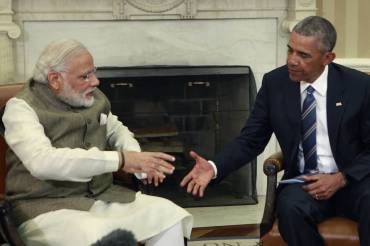
The breakthrough capped a wide-ranging White House meeting on Tuesday between President Barack Obama and Indian Prime Minister Narendra Modi, who are seeking closer cooperation as Washington wants to boost New Delhi’s role in counterbalancing China.

The meeting, which included lunch at the White House, will be followed on Wednesday by a speech by Mr. Modi to Congress, wrapping up the Indian leader’s fourth visit to the U.S. as part of an increasingly close relationship that has been sought by both governments.

The warming Indian relationship is backed by the lure of accelerating growth in that country, signs of improvement in the business climate, shared democratic values and some overlapping strategic goals.

By contrast, recent U.S. interactions with China, a far bigger Asian economy and U.S. trading partner whose growth appears to be slowing down, have been marked by strains and warnings over economic and security issues.

Source: U.S. Firm to Build Six Nuclear Reactors in India – India Real Time – WSJ

04/06/2016

Dam completion signifies growing Indian influence in Afghanistan | Reuters

Prime Minister Narendra Modi visited Afghanistan on Saturday to mark the completion of a nearly $300 million hydroelectric dam project, the latest symbol of Indian investment in its South Asian neighbour.

The dam, originally built in western Herat province in 1976 before being damaged during the civil wars of the 1990s, was rebuilt by some 1,500 Indian and Afghan engineers, according to the Indian Ministry of External Affairs.

“It is symbol of our friendship and would usher in hope, light up homes, nourish the fertile fields of Heart and bring prosperity to the people of the region,” Modi said in a social media post as he departed for Afghanistan, the first stop on a five-country trip.

Afghan President Ashraf Ghani has nurtured closer ties with India in the past year as relations with Pakistan have deteriorated in the face of continued insurgent attacks and border tensions.

Afghanistan has walked a fine line as it accepts Indian aid, with Pakistan historically wary of any Indian influence in Afghanistan.

Salma Dam is another big step in deepening and broadening the relationship between Afghanistan and India,” Ghani said in a post on Twitter.

At more than 100 metres (330 feet) high and 540 metres (1,770 feet) wide, the dam is designed to generate 42 megawatts of power and help irrigate 75,000 hectares of land, according to Modi.

India has poured more than $1 billion into Afghanistan reconstruction projects and humanitarian aid, making it one of the largest donors to the war-torn country.

A new national assembly building in Kabul and major power line and road construction have been among the main projects funded by India.

Source: Dam completion signifies growing Indian influence in Afghanistan | Reuters

05/03/2016

China lays out its vision to become a tech power | Reuters

China aims to become a world leader in advanced industries such as semiconductors and in the next generation of chip materials, robotics, aviation equipment and satellites, the government said in its blueprint for development between 2016 and 2020.

In its new draft five-year development plan unveiled on Saturday, Beijing also said it aims to use the internet to bolster a slowing economy and make the country a cyber power.

China aims to boost its R&D spending to 2.5 percent of gross domestic product for the five-year period, compared with 2.1 percent of GDP in 2011-to-2015.

Innovation is the primary driving force for the country’s development, Premier Li Keqiang said in a speech at the start of the annual full session of parliament.

China is hoping to marry its tech sector’s nimbleness and ability to gather and process mountains of data to make other, traditional areas of the economy more advanced and efficient, with an eye to shoring up its slowing economy and helping transition to a growth model that is driven more by services and consumption than by exports and investment.

This policy, known as “Internet Plus”, also applies to government, health care and education.

As technology has come to permeate every layer of Chinese business and society, controlling technology and using technology to exert control have become key priorities for the government.

China will implement its “cyber power strategy”, the five-year plan said, underscoring the weight Beijing gives to controlling the Internet, both for domestic national security and the aim of becoming a powerful voice in international governance of the web. China aims to increase Internet control capabilities, set up a network security review system, strengthen cyberspace control and promote a multilateral, democratic and transparent international Internet governance system, according to the plan.

Source: China lays out its vision to become a tech power | Reuters

20/02/2016

Leaders of Nepal and India mend fences after friction | Reuters

The leaders of Nepal and India have overcome mutual misgivings, India’s foreign secretary said on Saturday, after talks to ease tensions over Nepal’s recently-adopted constitution.

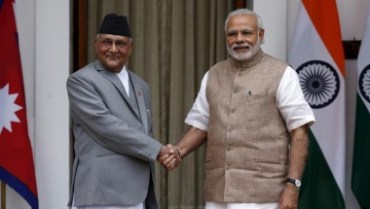
Nepal's Prime Minister Khadga Prasad Sharma Oli (L) shakes hands with his Indian counterpart Narendra Modi during a photo opportunity ahead of their meeting at Hyderabad House in New Delhi, India, February 20, 2016. REUTERS/Adnan Abidi

Prime Minister K.P. Oli visited New Delhi for talks with his Indian counterpart Narendra Modi after a months-long freeze in relations triggered by the grievances of plains dwellers in southern Nepal who have close historical ties to India.

Nepal, which moved from absolute to constitutional monarchy in 1990, made changes to its constitution to ensure greater participation of the Madhesi community in parliament.

But community leaders said the amendments failed to address their central fear that provincial borders would be redrawn in a way that would divide them.

“Our prime minister appreciated the progress made towards consolidation of constitutional democracy in Nepal,” Indian Foreign Secretary Subrahmanyan Jaishankar told a news briefing.

Source: Leaders of Nepal and India mend fences after friction | Reuters

16/02/2016

First train from China to Iran stimulates Silk Road revival – Xinhua | English.news.cn

First cargo train from China to Iran arrived in Tehran on Monday, indicating a milestone in reviving the “Silk Road,” which has opened a new chapter of win-win cooperation between China and Iran.

English: the Silk Road in Central Asia

English: the Silk Road in Central Asia (Photo credit: Wikipedia)

silk road

The train, also referred to as Silk Road train, has passed through Kazakhstan and Turkmenistan to Iran, travelling a distance of 10,399 kilometers. It had left Yiwu city in east China’s Zhejiang Province on January 28.

This train was carrying dozens of cargo containers, according to the deputy of Iran’s Road and Urbanism Minister, Mohsen Pour-Aqaei, who made a welcome speech after the arrival of the cargo train at Tehran Train Station on Monday.

As known to all, ancient Silk Road trade route had served as an important bridge for East-West trade and brought a close link between the Chinese and Persian civilizations.

The “Belt and Road” initiative was raised by Chinese President Xi Jinping in 2013, which refers to the New Silk Road Economic Belt, linking China with Europe through Central and Western Asia, and the 21st Century Maritime Silk Road, connecting China with Southeast Asian countries, Africa and Europe.

“To revive the Silk Road Economic Belt, the launch of the train is an important move, since about 700 kilometers of trip has been done per day,” said Pour-Aqaei, who was present at the welcome ceremony of the train in Tehran’s Railway Station.

“Compared to the sea voyage of the cargo ships from China’s Shanghai city to Iran’s Bandar Abbas port city, the travel time of the train was 30 days shorter,” he said.

Pour-Aqaei, also the Managing Director of Iran’s Railway Company, added that according to the plan, there would be one such a trip from China to Iran every month.

The travel of cargo train from China to Iran is part of a Chinese initiative to revive the ancient Silk Road used by the traders to commute between Europe and East Asia.

Tehran will not be the final destination of these kinds of trains from China, the Iranian deputy minister said, adding that in the future, the train will reach Europe.

This will benefit Iran as the transit course for the cargo trains from the east Asia to Europe, he said.

Chinese ambassador to Iran Pang Sen told Xinhua that as one of the cooperation projects after Chinese President Xi Jinping’s state visit to Iran, the cargo train is playing a important role to promote construction of the “Belt and Road” initiative.

Meanwhile, the railway line from Yiwu to Tehran provides the two countries an express and efficient cargo trade transportation method, Pang said, adding that the countries along the railway line will furthur upgrade rail technology with the aim to make its transportation ability faster and better.

Source: First train from China to Iran stimulates Silk Road revival – Xinhua | English.news.cn

10/02/2016

U.S. and India consider joint patrols in South China Sea – U.S. official | Reuters

The United States and India have held talks about conducting joint naval patrols that a U.S. defence official said could include the disputed South China Sea, a move that would likely anger Beijing, which claims most of the waterway.

An Indian Navy personnel gestures on the deck of the newly built INS Kochi, a guided missile destroyer, during a media tour at the naval dockyard in Mumbai, India September 28, 2015. REUTERS/Shailesh Andrade/Files

Washington wants its regional allies and other Asian nations to take a more united stance against China over the South China Sea, where tensions have spiked in the wake of Beijing’s construction of seven man-made islands in the Spratly archipelago.

India and the United States have ramped up military ties in recent years, holding naval exercises in the Indian Ocean that last year involved the Japanese navy.

But the Indian navy has never carried out joint patrols with another country and a naval spokesman told Reuters there was no change in the government’s policy of only joining an international military effort under the United Nations flag.

He pointed to India’s refusal to be part of anti-piracy missions involving dozens of countries in the Gulf of Aden and instead carrying out its own operations there since 2008.

The U.S. defence official said the two sides had discussed joint patrols, adding that both were hopeful of launching them within the year. The patrols would likely be in the Indian Ocean where the Indian navy is a major player as well as the South China Sea, the official told Reuters in New Delhi on condition of anonymity.

The official gave no details on the scale of the proposed patrols.

There was no immediate comment from China, which is on a week-long holiday for Chinese New Year.

China accused Washington this month of seeking maritime hegemony in the name of freedom of navigation after a U.S. Navy destroyer sailed within 12 nautical miles of a disputed island in the Paracel chain of the South China Sea in late January.

The U.S. Navy conducted a similar exercise in October near one of China’s artificial islands in the Spratlys.

Source: Exclusive: U.S. and India consider joint patrols in South China Sea – U.S. official | Reuters

Law of Unintended Consequences

continuously updated blog about China & India

ChiaHou's Book Reviews

continuously updated blog about China & India

What's wrong with the world; and its economy

continuously updated blog about China & India