Archive for ‘Governance’

28/05/2020

China’s Civil Code adopted at national legislature

BEIJING, May 28 (Xinhua) — Chinese lawmakers Thursday voted to adopt the country’s long-expected Civil Code at the third session of the 13th National People’s Congress, the top legislature.

The Civil Code will take effect on Jan. 1, 2021.

In addition to general provisions and supplementary provisions, the Civil Code, the world’s latest modern-day civil law, has six parts on real rights, contracts, personality rights, marriage and family, succession, and tort liabilities.

The personal rights, property rights and other lawful rights and interests of the parties to civil legal relations shall be protected by law and shall not be infringed upon by any organization or individual, reads the Civil Code in its opening chapter.

Lawmakers say the codification is not about formulating a new civil law but rather systematically incorporating existing civil laws and regulations, modifying and improving them to adapt to new situations while maintaining their consistency.

A major innovation of China’s Civil Code, jurists say, is embodied in the personality rights part. While some countries have related law provisions, few have a specific law book in civil code dedicated to protecting personality rights.

The personality rights part covers stipulations on a civil subject’s rights to his or her life, body, health, name, portrait, reputation and privacy, among others.

The personality rights part shows that China has reached a new height in protecting the dignity of people, said Chen Jingying, a national lawmaker and vice president of East China University of Political Science and Law.

The Civil Code is a milestone in developing the socialist legal system with Chinese characteristics, and will greatly boost the modernization of China’s system and capacity for governance, said Wang Yi, dean of the law school at Renmin University of China.

Source: Xinhua

12/02/2020

Coronavirus cases fall, experts disagree whether peak is near

BEIJING/SINGAPORE (Reuters) – China reported on Wednesday its smallest number of coronavirus cases since January, lending weight to a prediction by its top medical adviser for the outbreak to end by April, but a global infectious diseases expert warned of the spread elsewhere.

Financial markets took heart from the outlook of the Chinese official, epidemiologist Zhong Nanshan, who said on Tuesday the number of new cases was falling in some provinces, and forecast the epidemic would peak this month, even as the death toll in China rose to more than 1,100 people.

World stocks, which had seen rounds of sell-offs over the virus, surged to record highs on hopes of a peak in cases. The Dow industrials, S&P 500 and Nasdaq all hit new highs, and Asian shares nudged higher on Wednesday.

But the World Health Organization (WHO) has warned that the epidemic poses a global threat akin to terrorism and one expert coordinating its response said while the outbreak may be peaking at its epicentre in China, it was likely to spread elsewhere in the world, where it had just begun.

“It has spread to other places where it’s the beginning of the outbreak,” the official, Dale Fisher, head of the Global Outbreak Alert and Response Network coordinated by the WHO, said in an interview in Singapore.

“In Singapore, we are at the beginning of the outbreak.”

Singapore has reported 47 cases and worry about the spread is growing. Its biggest bank, DBS (DBSM.SI), evacuated 300 staff from its head office on Wednesday after a confirmed coronavirus case in the building.

Hundreds of cases have been reported in dozens of other countries and territories around the world, but only two people have died outside mainland China – one in Hong Kong and another in the Philippines.

WHO chief Tedros Adhanom Ghebreyesus said on Tuesday the world had to “wake up and consider this enemy virus as public enemy number one” and the first vaccine was 18 months away.

In China, total infections have hit 44,653, health officials said, including 2,015 new confirmed cases on Tuesday. That was the lowest daily rise in new cases since Jan. 30.

The number of deaths on the mainland rose by 97 to 1,113 by the end of Tuesday.

But doubts have been aired on social media about how reliable the figures are, after the government last week amended guidelines on the classification of cases.

‘STAY HOPEFUL’

The biggest cluster of cases outside China is aboard the Diamond Princess cruise ship quarantined off Japan’s port of Yokohama, with about 3,700 people on board. Japanese officials on Wednesday said 39 more people had tested positive for the virus, taking the total to 175.

One of the new cases was a quarantine officer.

Thailand said it was barring passengers from another cruise ship, MS Westerdam, from disembarking, the latest country to turn it away amid fears of the coronavirus, despite no confirmed infections on board.

“We try to stay hopeful,” American passenger Angela Jones told Reuters in a video recording. “But each day, that becomes a little bit more difficult, when country after country rejects us.”

Echoing the comparison with the fight against terrorism, China’s state news agency Xinhua said late on Tuesday the epidemic was a “battle that has no gunpowder smoke but must be won”.

The epidemic was a big test of China’s governance and capabilities and some officials were still “dropping the ball” in places where it was most severe, it said, adding: “This is a wake-up call.”

The government of Hubei, the central province at the outbreak’s epicentre, dismissed the provincial health commission’s Communist Party boss, state media said on Tuesday, amid mounting public anger over the crisis.

China’s censors had allowed criticism of local officials but have begun cracking down on reporting of the outbreak, issuing reprimands to tech firms that gave free rein to online speech, Chinese journalists said.

The pathogen has been named COVID-19 – CO for corona, VI for virus, D for disease and 19 for the year it emerged. It is suspected to have come from a market that illegally traded wildlife in Hubei’s capital of Wuhan in December.

The city of 11 million people remains under virtual lockdown as part of China’s unprecedented measures to seal infected regions and limit transmission routes.

Travel restrictions that have paralysed the world’s second-biggest economy have left Wuhan and other Chinese cities resembling ghost towns.

Even if the epidemic ends soon, it has taken a toll of China’s economy, with companies laying off workers and needing loans running into billions of dollars to stay afloat. Supply chains for makers of items from cars to smartphones have broken down.

ANZ Bank said China’s first-quarter growth would probably slow to 3.2% to 4.0%, down from a projection of 5.0%.

The likely slowdown in China could shave 0.1 to 0.2 percentage points off both euro zone and British growth this year, credit rating agency S&P Global estimated.

Source: Reuters

12/03/2019

Congress working committee meeting LIVE| ‘Unemployment highest in 45 years’: Rahul Gandhi at Gujarat rally

CWC meeting LIVE: Congress is launching its Lok Sabha election campaign from Ahmedabad in Gujarat, the home state of PM Narendra Modi and BJP president Amit Shah with a meeting of its top leaders, including Rahul Gandhi, Sonia Gandhi, Manmohan Singh.

The Congress is launching its Lok Sabha election campaign from Ahmedabad in Gujarat, the home state of Prime Minister Narendra Modi and BJP president Amit Shah with a meeting of its Congress Working Committee (CWC) and a public rally by its top leaders.

Congress president Rahul Gandhi, UPA chairperson Sonia Gandhi, former Prime Minister Manmohan Singh and party general secretaries, including Priyanka Gandhi, will be among the senior leaders of the party attending the meeting.

The Congress Working Committee, the highest decision-making arm of the party, would seek answers to failures and unfulfilled promises of the Modi government on governance, agrarian distress, economic issues, unemployment, national security and women’s safety, according to party leaders.

Hardik Patel, a prominent young leader of Patidars, who is leading a movement for reservation in jobs and education for their community, is likely to join Congress and contest the Lok Sabha elections on a party ticket, according to sources.

Source: Hindustan Times

12/12/2018

China establishes governance principle of respecting, protecting human rights: white paper

BEIJING, Dec. 12 (Xinhua) — A white paper released Wednesday by the State Council Information Office said China has firmly established a governance principle of respecting and protecting human rights.

“It is the determination and ultimate goal of the Communist Party of China (CPC) and the Chinese government to respect and protect human rights,” said the document, titled “Progress in Human Rights over the 40 Years of Reform and Opening Up in China.”

Since the launch of reform and opening up in 1978, “respecting and protecting human rights” has been written into the reports to CPC National Congresses, the Constitution of the People’s Republic of China, the Constitution of the CPC, and strategies and plans for national development, becoming an important principle of governance for the CPC and the Chinese government, it said.

According to the white paper, that the state respects and protects human rights has been established as an important principle of the Constitution of China.

Also, the CPC pursues human rights protection in its governance, the document said.

The white paper noted that it has become a core goal of national development to respect and protect human rights.

07/03/2014

China’s restless West: The burden of empire | The Economist

After a brutal attack in China, the Communist Party needs to change its policies towards minorities

A GROUP of knife-wielding assailants, apparently Muslims from western China, caused mayhem and murder on March 1st in the south-western Chinese city of Kunming, stabbing 29 people to death at the railway station and injuring 140 others. The attack has shocked China. The crime against innocents is monstrous and unjustifiable, and has been rightly condemned by the Chinese government and by America. But as well as rounding up the culprits, the Communist Party must face up to an uncomfortable truth. Its policy for integrating the country’s restless western regions—a policy that mixes repression, development and Han-Chinese migration—is failing to persuade non-Han groups of the merits of Chinese rule.

The party says the attackers were “Xinjiang extremists”, by implication ethnic Uighurs, a Turkic people with ties to Central Asia who once formed the majority in the region of Xinjiang. The killers may have been radicalised abroad with notions of global jihad. Whatever the truth, there is no doubt that Uighurs are committing ever more desperate acts. Scarcely a week passes in Xinjiang without anti-government violence.

The party claims that Xinjiang has been part of China for 2,000 years. Yet for most of that time, the region has been on the fringe of China’s empire, or outside it altogether. An attempt to incorporate these lands began only with the Qing dynasty’s conquests in the mid-18th century. (The name Xinjiang, “new frontier”, was bestowed only in the 1880s.) During the chaos of the 1940s, Uighurs declared a short-lived independent state of East Turkestan. But from 1949 the Communists began integrating Xinjiang into China by force. Demobbed Chinese soldiers were sent to colonise arid lands, the state repression of Uighurs drawing heavily on the Soviet tactics for handling “nationalities”. Uighur resentment of the Han runs deep. The feeling is mutual. Many Chinese are openly racist towards Uighurs, and the government thinks them ungrateful. In 2009 hundreds of people were killed during street fighting between Uighurs and Han, who now make up two-fifths of Xinjiang’s population and control a disproportionate share of its wealth.

Identity crisis

The Kunming killers’ motives may never be known. But fears of militant Islamism arriving at the heart of China must not obscure the broader problem of Chinese oppression in Xinjiang. Recent crackdowns hit at the heart of Uighur identity: students are banned from fasting during Ramadan, religious teaching for children is restricted, and Uighur-language education is limited. Many Uighurs, like their neighbours in Tibet, fear that their culture will be extinguished. Xinjiang and Tibet (and Inner Mongolia) are still China’s colonies, their pacification under the Communist Party a continued imperial project. Were it not for the Dalai Lama’s restraining influence, violence in Tibet might be as bad as it is in Xinjiang. As it is, over 100 Tibetans have burned themselves to death in protest at Chinese rule.

There is a large military presence in China’s west. The government seems to believe that unless Uighurs and Tibetans are held in check by force, the western regions could break away. That is always a danger. But suppression, which leads to explosions of anger, may increase the risk, not mitigate it.

The only way forward is to show Uighurs (and Tibetans) how they can live peacefully and prosperously together within China. The first step is for the party to lift the bans on religious and cultural practices, give Uighurs and Tibetans more space to be themselves, and strive against prejudice in Chinese society. Economic development needs to be aimed at Uighur and Tibetan communities. Otherwise, there will be more violence and instability.

via China’s restless West: The burden of empire | The Economist.

Enhanced by Zemanta
24/07/2013

Sri Lanka teams up with Chinese firm for $1.4 billion port city

Reuters: “Sri Lanka has finalized a $1.43 billion deal with China Communications Construction Co Ltd (601800.SS) to build a city on a 230 hectare site that will be reclaimed from the sea, the head of the state-run Ports Authority said on Wednesday.

A general view of the Colombo South Harbor at Colombo Port July 24, 2013. REUTERS-Dinuka Liyanawatte

The site is next to the island nation’s main Colombo port and Colombo‘s historic Galle Face Green seafront. It is also close to where Shangri-La Hotels Lanka Ltd, a subsidiary of Hong Kong-listed Shangri-La Asia Ltd (0069.HK), is building a 500-room hotel.

“The Chinese firm will invest in reclaiming the land and infrastructure of the port city,” Priyath Wickrama, chairman of Sri Lanka Ports Authority, told reporters. “It will be given around 50 hectare of reclaimed land on a 99-year lease for its investment.”

The 39-month long construction project will start in September, Wickrama said, adding the city would include eco-parks, residential areas, offices and shopping malls.

Since the end of a nearly three-decade war in May 2009, the Indian Ocean island nation has been spending heavily on infrastructure, including ports to attract foreign investments to its $59 billion economy.

It has already created new land near the proposed port city as part of its expansion of the Colombo port to double its capacity by 2015.”

via Sri Lanka teams up with Chinese firm for $1.4 billion port city | Reuters.

26/06/2013

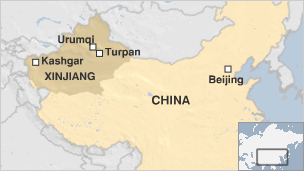
Violence in China’s Xinjiang ‘kills 27’

BBC: “Riots have killed 27 people in China’s restive far western region of Xinjiang, Chinese state media report.

Map

The violence broke out in Turpan prefecture early on Wednesday.

Police opened fire after a mob armed with knives attacked police stations and a local government building, Xinhua news agency quoted officials as saying.

There are sporadic outbreaks of violence in Xinjiang, where there are ethnic tensions between Muslim Uighur and Han Chinese communities.

Confirming reports from the region is difficult because information is tightly controlled.

China’s state media have been quick to issue an official version of events regarding the latest round of violence in Xinjiang, but it will be tough to verify those reports.

Xinjiang lies on China’s remote north-west border and it is difficult for foreign media to travel there. Many people on both sides of the conflict are reluctant to speak to visiting journalists for fear of reprisals if they dispute the government’s stance.

Unfortunately Xinjiang usually hits international headlines when violence flares between the region’s minority ethnic Uighur Muslims and the majority Han Chinese. Many Uighurs contend that their language and religion are being smothered by an influx of Han Chinese migrants.

Xinjiang is a large geographic area rich in oil and gas deposits. Soon it will also become a major supplier of coal to China’s energy-hungry cities. The region’s fertile land also grows produce that is shipped to the rest of the country. The Han Chinese who move to Xinjiang hope to benefit from the region’s untapped resources.

The violence occurred in Turpan‘s remote township of Lukqun, about 200km (120 miles) south-east of the region’s capital, Urumqi.

The Xinhua news agency report, citing local officials, said rioters stabbed people and set police cars alight.

Seventeen people, including nine security personnel and eight civilians, were killed before police shot dead 10 of the rioters, it said.

At least three others were injured and were being treated in hospital, it added.

The Xinhua report did not provide any information on the ethnicity of those involved in the riot or on what sparked it.

But Dilxat Raxit, a spokesperson for the World Uighur Congress, an umbrella organisation of Uighur groups, told the Associated Press news agency the violence had been caused by the Chinese government’s “sustained repression and provocation” of the Uighur community.

In 2009 almost 200 people – mostly Han Chinese – were killed after deadly rioting erupted in Urumqi between the Han Chinese and Uighur communities.

In April an incident in the city of Kashgar left 21 people dead.

Uighurs and Xinjiang

Uighurs are ethnically Turkic Muslims. They make up about 45% of the region’s population; 40% are Han Chinese

China re-established control in 1949 after crushing short-lived state of East Turkestan. Since then, large-scale immigration of Han Chinese. Uighurs fear erosion of traditional culture.

The government said the violence began when “terrorists” were discovered in a building by officials searching for weapons.

But local people told the BBC that the violence involved a local family who had a longstanding dispute with officials who had been pressurising the men to shave off their beards and the women to take off their veils.

Uighurs make up about 45% of Xinjiang’s population, but say an influx of Han Chinese residents has marginalised their traditional culture.”

via BBC News – Violence in China’s Xinjiang ‘kills 27’.

See also: https://chindia-alert.org/political-factors/chinese-tensions/

01/05/2013

* China’s new mental health law to make it harder for authorities to silence petitioners

SCMP: “The director of Xinjiang‘s largest mental health institution has welcomed a new law, which went into effect on Wednesday, banning involuntary inpatient treatment for many people deemed mentally ill.

scmp-1.jpg

“Seventy to 80 per cent of the patients have been forcibly admitted to the hospital,” said Xu Xiangdong, director of the Fourth People’s Hospital in the regional capital Urumqi, the Yaxin online news portal reported on Monday.

“Because of this increased consideration for patients’ rights, [the figures] will change fundamentally,” he said, adding that it would put an end to frequent episodes of people being wrongfully declared mentally ill.

The new law, which has been debated for a quarter of a century, is meant to crack down on local authorities aiming to silence petitioners and troublemakers by arbitrarily declaring them mentally ill and locking them up in mental health wards.

Under the law, patients must first give their consent to being hospitalised, except in cases in which they could harm themselves or others.

If patients are still forcibly confined, they or their guardians have the right to seek a second opinion. Forced hospitalisations for reasons other than severe mental illness are banned.

Last week about 200 health practitioners from the region were sent to Xu’s hospital to be trained in the new provisions on patients’ rights stipulated by the new law, the Xinjiang Daily reported.

Two million people in Xinjiang live with mental disabilities, Xu estimated, amounting to more than 9 per cent of the population in the economic backwater of China’s remote northwest.

That compares with almost 8 per cent of China’s population diagnosed with some form of mental illness, according to the Ministry of Health in 2011. A largescale 2009 study estimated a much higher national average at 17.5 per cent.

In Xinjiang, authorities have not been able to provide adquate resources to deal with the increasing number of people living with mental disorders. Xu told the Yaxin portal in 2011 that the number of mentally ill patients had increased by 20 to 30 per cent annually over the last years.

In Monday’s report, he said less than 5 per cent of the two million mentally ill could receive treatment because of a lack of resources and trained staff.

Two years earlier, the regional government had reported plans to build 15 new mental hospitals and to expand current ones. Until now, only one additional hospital in Kashgar has been completed, the Yaxin report said.

In March, a gruesome murder of a seven-year-old Uygur boy by a Chinese man has caused tensions among ethnic communities in the Turpan prefecture east of Urumqi. The man had been declared mentally ill to prevent ethnic revenge attacks, locals told Radio Free Asia.”

via China’s new mental health law to make it harder for authorities to silence petitioners | South China Morning Post.

20/01/2013

* In China, Discontent Among the Normally Faithful

NYT: “Barely two months into their jobs, the Communist Party’s new leaders are being confronted by the challenges posed by a constituency that has generally been one of the party’s most ardent supporters: the middle-class and well-off Chinese who have benefited from a three-decade economic boom.

A Jan. 9 demonstration in Guangzhou, where people protested the censorship of a paper known for investigative reporting.

A widening discontent was evident this month in the anticensorship street protests in the southern city of Guangzhou and in the online outrage that exploded over an extraordinary surge in air pollution in the north. Anger has also reached a boil over fears concerning hazardous tap water and over a factory spill of 39 tons of a toxic chemical in Shanxi Province that has led to panic in nearby cities.

For years, many China observers have asserted that the party’s authoritarian system endures because ordinary Chinese buy into a grand bargain: the party guarantees economic growth, and in exchange the people do not question the way the party rules. Now, many whose lives improved under the boom are reneging on their end of the deal, and in ways more vocal than ever before. Their ranks include billionaires and students, movie stars and homemakers.

Few are advocating an overthrow of the party. Many just want the system to provide a more secure life. But in doing so, they are demanding something that challenges the very nature of the party-controlled state: transparency.

More and more Chinese say they distrust the Wizard-of-Oz-style of control the Communist Party has exercised since it seized power in 1949, and they are asking their leaders to disseminate enough information so they can judge whether officials, who are widely believed to be corrupt, are doing their jobs properly. Without open information and discussion, they say, citizens cannot tell whether officials are delivering on basic needs.

“Chinese people want freedom of speech,” said Xiao Qinshan, 46, a man in a wheelchair at the Guangzhou protests.”

via In China, Discontent Among the Normally Faithful – NYTimes.com.

13/01/2013

Prof Chovanec is based in China and has great insights about all matters relating to China. This time about the likelihood of revolution in China.

prchovanec's avatarPatrick Chovanec

A surprising number of people in China have been writing and talking about “revolution”.  First came word, in November, that China’s new leaders have been advising their colleagues to read Alexis de Tocqueville’s classic book on the French Revolution, L’Ancien Régime et la Révolution (The Old Regime and the Revolution), which subsequently has shot to the top of China’s best seller lists.  Just this past week, Chinese scholar Zhao Dinxing, a sociology professor at the University of Chicago, felt the need to publish an article (in Chinese) laying out the reasons China won’t have a revolution (you can read an English summary here).  Minxin Pei, on the other hand, thinks it will.

In the midst of this debate, I happened across an interesting set of passages in retired Harvard professor Richard Pipes’ slender volume Three “Whys” of the Russian Revolution.  The first “why” he…

View original post 541 more words

Tags: ,
Law of Unintended Consequences

continuously updated blog about China & India

ChiaHou's Book Reviews

continuously updated blog about China & India

What's wrong with the world; and its economy

continuously updated blog about China & India