Archive for ‘Insurgency’

01/11/2013

Tiananmen crash ‘incited by Islamists’ – BBC News

China\’s top security official says a deadly crash in Beijing\’s Tiananmen Square was incited by the East Turkestan Islamic Movement.

The crash occurred on Monday when a car ploughed into a crowd then burst into flames, killing three people inside the vehicle and two tourists.

Police have arrested five suspects, all from the western region of Xinjiang, home to minority Uighur Muslims.

Security has also been tightened in Xinjiang, which borders Central Asia.

China often blames the ETIM group for incidents in Xinjiang. But the BBC correspondent in Beijing says few believe that the group has any capacity to carry out any serious acts of terror in China.

Uighur groups claim China uses ETIM as an excuse to justify repressive security in Xinjiang.

via BBC News – Tiananmen crash ‘incited by Islamists’.

21/10/2013

Movie Review: Shahid | India Insight

(Any opinions expressed here are those of the author and not of Thomson Reuters)

The best thing about Hansal Mehta’s “Shahid” is that the filmmaker tries to tell a fascinating story. In a way, it is the story of the city of Mumbai — beginning with the riots that followed the 1992 demolition of the Babri Masjid in Ayodhya, and leading up to the attack on Mumbai that killed 166 people in 2008.

These events are depicted through the real-life story of Shahid Azmi, a teenager who gets caught up in the Mumbai riots, and a few months later, finds himself in Pakistan at a training camp for militants. A disillusioned Azmi returns to India but is tortured and imprisoned under the country’s anti-terror laws.

Azmi completes his schooling in jail, and after his release, studies law to help defend those he believes were wrongly accused and jailed on charges of terrorism.

Azmi, who was from a poor family that lived in a slum for a while, got as many as 17 people acquitted before he was shot dead in his office in the suburbs in 2010, while he was handling the case of a defendant in the Mumbai attacks.

Given the source material Mehta has, this is a film that promises to be gripping, and thankfully, the director doesn’t over-dramatize events. He uses a restrained, subtle narrative to tell the audiences Shahid’s story, rarely judging his motives or intentions. Mehta touches all aspects of Shahid’s life — his strained marriage, his relationship with his mother and brothers — never lingering for longer than necessary, and giving us a glimpse into a world not many of us are exposed to.

Even the drudgery of daily court proceedings is made fascinating, thanks to its lead actor. As Shahid, Raj Kumar injects the right amount of earnestness, anger and vulnerability into his role, to make this one of the best performances we have seen this year. The other actors, including Baljinder Kaur as Shahid’s mother, and Mohammed Zeeshan Ayyub as his elder brother are excellent. None of the performances feel like acting — right from the locations to the people who live there, they all seem completely real, and this is a huge strength of the film.

The one grouse with “Shahid” is perhaps it doesn’t tell the whole story, especially at the beginning. I wish Mehta had answered questions of how and why Shahid went to Pakistan, what caused his disillusionment, and made him return. Nevertheless, this is a small grouse with a film that is otherwise uplifting.

via Movie Review: Shahid | India Insight.

08/09/2013

Jairam blames ‘forcible acquisition’ for Naxal problem

The Hindu: “Coming down heavily on PSUs for displacing tribals, Union Minister Jairam Ramesh on Sunday blamed their actions for growth of Naxalism in many areas and cautioned that the era of “forcible acquisition” was now over.

The Union Rural Development Minister said if the new Land Acquisition Act is implemented properly, it will put an end to “inhumane” displacement of tribals from forests and check Maoist menace. File photo

The Union Rural Development Minister said if the new Land Acquisition Act is implemented properly, it will put an end to “inhumane” displacement of tribals from forests and check Maoist menace.

“The record of public sector (PSUs) in displacements is worse than the record of the private sector. This is a sad truth… that more displacement has been caused by government and public sector projects than private sector projects…particularly in Naxal areas. And this is why Naxalism has grown in these areas,” the Minister said.

Mr. Ramesh slammed National Thermal Power Corporation for allegedly seeking police help for forcibly acquiring land in Keredari block of Jharkhand’s Hazaribagh district, where a villager agitating against land acquisition was shot dead two months ago.

He was addressing Hindi and regional media two days after Parliament passed the path-breaking ‘Right to Fair Compensation and Transparency in Land Acquisition, Rehabilitation and Resettlement Act, 2013’.

Criticising NTPC for the alleged forced acquisition, Ramesh said, “Companies must also learn to be sensitive, changing aspirations.”

“NTPC will face a challenge. If there is firing in an NTPC project and people get killed in that firing, they cannot acquire the land…Indian companies still believe that they can use government to forcibly acquire land. That era is gone. You cannot do forcible acquisition,” the Minister said when asked about the reported criticism by a top NTPC official of the new Land Acquisition legislation.

“If this (new) land acquisition law is properly implemented, it will defeat Naxalism,” he said, referring to incidents of “inhumane” displacement of tribals from forests for various public and private sector projects in mineral-rich states like Jharkhand, Odisha and Chhattisgarh.

The new law will be notified in three months.

Mr. Ramesh said, “Land Acquisition is the root of the Maoist issue. If you have a humane, sensitive and responsible land acquisition policy, lot of your problems relating to Naxalism would go. Tribals will be with you.

“It is a fact that many of the tribals have been displaced and they have not got proper compensation, they have not got rehabilitation and resettlement…particularly in mining of coal and irrigation projects,” he added.

Mr. Ramesh, the architect of the new Land Acquisition Bill, said the 119-year-old Land Acquisition Act, 1894, had a “very important role” in encouraging Maoist activities in Odisha, Chhattisgarh, Jharkhand, parts of tribal Maharashtra and tribal Andhra Pradesh.

When asked that 13 laws, including the Indian Railways Act, National Highways Act, Land Acquisition Mines Act and Coal Bearing Areas Acquisition and Development Act, under which bulk of the land acquisition takes place, are exempted from the purview of the Bill, the Minister said, “Within one year, all compensation, all rehabilitation and resettlement…all these Acts will come under the newly enacted legislation.””

via Jairam blames ‘forcible acquisition’ for Naxal problem – The Hindu.

See also:

21/07/2013

Kashmir militants rebuild their lives as hopes of a lasting peace grow

The Observer: “Shabir Ahmed Dar has come home. His children play under the walnut trees where he once played. His father, white-bearded and thin now, watches them. The village of Degoom, the cluster of traditional brick-and-wood houses in Kashmir where Dar grew up, is still reached by a dirt road and hay is still hung from the branches of the soaring chinar trees to dry.

Shabir Ahmed Dar with one of his children

But Dar has changed, even if Degoom has not. It is 22 years since he left the village to steal over the “line of control” (LoC), the de facto border separating the Indian and Pakistani parts of this long-disputed former princely state high in the Himalayan foothills. Along with a dozen or so other teenagers, he hoped to take part in the insurgency which pitted groups of young Muslim Kashmiris enrolled in Islamist militant groups, and later extremists from Pakistan too, against Indian security forces.

“I went because everyone else was going. The situation was bad here. I had my beliefs, my dream for my homeland. I was very young,” he said, sitting in the room where he had slept as a child.

The conflict had only just begun when he left. Over the next two decades, an estimated 50,000 soldiers, policemen, militants and, above all, ordinary people were to die. Dar’s aim had been to “create a true Islamic society” in Kashmir. This could only be achieved by accession to Pakistan or independence, he believed.

But once across the LoC, even though he spent only a few months with the militant group he had set out to join and never took part in any fighting, he was unable to return. “I was stuck there. I made a new life. I married and found work. I didn’t think I would ever come back here,” Dar said.

But now the 36-year-old has finally come home, with his Pakistani-born wife and three children. He is one of 400 former militants who have taken advantage of a new “rehabilitation” policy launched by the youthful chief minister of the state, Omar Abdullah.

Dar’s father heard of the scheme and convinced his son to return last year. “I am an old man. I wanted to see my son and grandchildren before I die. I wanted him to have his share of our land,” said Dar senior, who is 70.

The scheme is an indication of the changes in this beautiful, battered land. In recent years, economic growth in India has begun to benefit Kashmir, the country’s only Muslim-majority state. At the same time, despite a series of spectacular attacks on security forces by militants in recent months, violence has fallen to its lowest levels since the insurgency broke out in the late 1980s. The two phenomena are connected, many observers say.

It is this relative calm that has allowed Dar and the others to return – and allows even some hardened veterans who have renounced violence to live unmolested. “A few years ago the [Indian intelligence] agencies would have shot this down because they would have seen it as another move to infiltrate [militants from Pakistan],” Abdullah, the chief minister, said.

The scheme is not, however, an amnesty. “If there are cases against them they will still be arrested [and] prosecuted … Largely this scheme has been taken up by those who have not carried out any acts of terrorism. Either they never came [across the LoC], or if they came we never knew about it,” Abdullah said.”

via Kashmir militants rebuild their lives as hopes of a lasting peace grow | World news | The Observer.

28/06/2013

Death toll from Xinjiang attacks rises to 35

SCMP: “Beijing yesterday raised the death toll from a series of attacks in Turpan , Xinjiang , on Wednesday from 27 to 35.

e22b4f2d9201a0f19cff5f0782b8ea82.jpg

Twenty-four were killed by rioters, including two policemen, Xinhua said, adding that 16 of them were Uygurs. Police killed 11 rioters, while 21 police officers and civilians were injured.

Xinhua said an unspecified number of “mobsters” stormed the government office, the police station, the People’s Armed Police base and a construction site in Lukqun township, Shanshan county, at around 5.50am on Wednesday. The authorities did not mention that a PAP base was also among the targets of attacks until yesterday.

It said four suspected rioters who were injured had been detained.

It was the first Chinese-language report on the incident released by Xinhua, which carried an English report roughly seven hours after the attacks.

Neither report mentioned the number of attackers, their ethnicity or what caused the attacks. But yesterday’s report branded the incident a “violent terrorist attack”.

A visitor to Turpan yesterday said he saw a roadblock with armed police officers and about 20 police vehicles.

A resident said a helicopter arrived on the scene along with many police and soldiers.

The Global Times, a tabloid affiliated with the People’s Daily, yesterday quoted an unnamed regional official as saying that “earlier this year local police handled a case in which a store was attacked, which might have triggered that violence”.

The attack came less than two weeks ahead of the fourth anniversary of ethnic clashes between Han Chinese and Uygurs in Urumqi , the regional capital, which left nearly 200 dead. Two months ago, 15 policemen or officials and six assailants were killed in another conflict in Bachu county, Kashgar , which involved attackers armed with knives and axes and the burning of a house.

A Lukqun resident told the South China Morning Post by phone that local officials had told people to stay at home and be vigilant soon after the violence on Wednesday, adding that dozens of militia soldiers from his village were patrolling the streets.

It was the deadliest unrest in the region since the media-savvy Zhang Chunxian became regional party secretary in April 2010, less than a year after the bloody clashes in Urumqi.”

via Death toll from Xinjiang attacks rises to 35 | South China Morning Post.

See also:

26/06/2013

Violence in China’s Xinjiang ‘kills 27’

BBC: “Riots have killed 27 people in China’s restive far western region of Xinjiang, Chinese state media report.
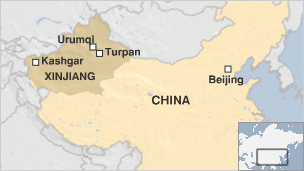
Map

The violence broke out in Turpan prefecture early on Wednesday.

Police opened fire after a mob armed with knives attacked police stations and a local government building, Xinhua news agency quoted officials as saying.

There are sporadic outbreaks of violence in Xinjiang, where there are ethnic tensions between Muslim Uighur and Han Chinese communities.

Confirming reports from the region is difficult because information is tightly controlled.

China’s state media have been quick to issue an official version of events regarding the latest round of violence in Xinjiang, but it will be tough to verify those reports.

Xinjiang lies on China’s remote north-west border and it is difficult for foreign media to travel there. Many people on both sides of the conflict are reluctant to speak to visiting journalists for fear of reprisals if they dispute the government’s stance.

Unfortunately Xinjiang usually hits international headlines when violence flares between the region’s minority ethnic Uighur Muslims and the majority Han Chinese. Many Uighurs contend that their language and religion are being smothered by an influx of Han Chinese migrants.

Xinjiang is a large geographic area rich in oil and gas deposits. Soon it will also become a major supplier of coal to China’s energy-hungry cities. The region’s fertile land also grows produce that is shipped to the rest of the country. The Han Chinese who move to Xinjiang hope to benefit from the region’s untapped resources.

The violence occurred in Turpan‘s remote township of Lukqun, about 200km (120 miles) south-east of the region’s capital, Urumqi.

The Xinhua news agency report, citing local officials, said rioters stabbed people and set police cars alight.

Seventeen people, including nine security personnel and eight civilians, were killed before police shot dead 10 of the rioters, it said.

At least three others were injured and were being treated in hospital, it added.

The Xinhua report did not provide any information on the ethnicity of those involved in the riot or on what sparked it.

But Dilxat Raxit, a spokesperson for the World Uighur Congress, an umbrella organisation of Uighur groups, told the Associated Press news agency the violence had been caused by the Chinese government’s “sustained repression and provocation” of the Uighur community.

In 2009 almost 200 people – mostly Han Chinese – were killed after deadly rioting erupted in Urumqi between the Han Chinese and Uighur communities.

In April an incident in the city of Kashgar left 21 people dead.

Uighurs and Xinjiang

Uighurs are ethnically Turkic Muslims. They make up about 45% of the region’s population; 40% are Han Chinese

China re-established control in 1949 after crushing short-lived state of East Turkestan. Since then, large-scale immigration of Han Chinese. Uighurs fear erosion of traditional culture.

The government said the violence began when “terrorists” were discovered in a building by officials searching for weapons.

But local people told the BBC that the violence involved a local family who had a longstanding dispute with officials who had been pressurising the men to shave off their beards and the women to take off their veils.

Uighurs make up about 45% of Xinjiang’s population, but say an influx of Han Chinese residents has marginalised their traditional culture.”

via BBC News – Violence in China’s Xinjiang ‘kills 27’.

See also: https://chindia-alert.org/political-factors/chinese-tensions/

29/05/2013

Settlers in Xinjiang: Circling the wagons

The Economist: “In a region plagued by ethnic strife, the growth of immigrant-dominated settlements is adding to the tension

MANY hours’ drive along what was once the southern Silk Road, through a featureless desert landscape punctuated by swirling dust-devils and occasional gnarled trees, a curious sight eventually confronts the traveller: row upon row of apartment blocks with vivid red roofs, as if a piece of Shanghai suburbia has been planted in the wilderness (see picture). Following the military-style nomenclature of immigrant settlements in China’s far west, it calls itself 38th Regiment. It is home to thousands of people, in a spot where just a few years ago there was nothing but sand.

The town is the latest addition to a vast network of such communities in the Xinjiang Uighur Autonomous Region, China’s biggest province by land area and also its most ethnically troubled. Neighbouring Tibet has long been roiled by ethnic tension, too, but rarely has it witnessed the kind of violence that has troubled Xinjiang: a low-level insurgency involving ethnic Uighurs whose Muslim faith and Central Asian culture and language set them apart from the Han Chinese who dominate places like 38th Regiment. On April 23rd, 21 people were killed near Kashgar during an encounter between police and alleged separatists. An explosion of inter-ethnic violence in 2009 in the regional capital, Urumqi, that left nearly 200 dead, by official reckoning, exacerbated the divide. The expansion of the settlement network is deepening it further.

To use its full name, the 38th Regiment of the 2nd Agricultural Division is part of the Xinjiang Production and Construction Corps. This state-run organisation, usually referred to as the bingtuan (Chinese for a military corps) controls an area twice the size of Taiwan, broken into numerous parts scattered around the province (see map). A few bits are city-sized. Most are more like towns or villages. Of their total population of more than 2.6m people, 86% are ethnically Han Chinese. In Xinjiang as a whole, in contrast, Han officially make up just over 40% of the 22m inhabitants. The rest are Uighurs and a few other ethnic groups.”

via Settlers in Xinjiang: Circling the wagons | The Economist.

26/05/2013

* Sonia Gandhi ‘devastated’ by India Chhattisgarh ambush

BBC: “The president of India’s Congress Party, Sonia Gandhi, has said she is “devastated” by Saturday’s attack on party officials in Chhattisgarh state.

Sonia Gandhi (R) and PM Manmohan Singh in a hospital in Raipur (May 26 2013)

At least 24 people were killed, including Chhattisgarh Congress chief Nandkumar Patel, his son, and local leader Mahendra Karma, when suspected Maoist rebels ambushed their convoy.

Mrs Gandhi visited some of the wounded with PM Manmohan Singh on Sunday.

The prime minister said India would “never bow down” before the rebels.

He denounced the “barbaric attack” which he said should be an inspiration in the fight against extremism and violence.

Unconfirmed reports said they were unable to visit the scene of the attack because of security concerns.”

via BBC News – Sonia Gandhi ‘devastated’ by India Chhattisgarh ambush.

See also: https://chindia-alert.org/political-factors/indian-tensions/

12/05/2013

* China’s Evolving ‘Core Interests’

NY Times: “Whenever China wants to identify the issues considered important enough to go to war over, it uses the term “core interests.” The phrase was once restricted to Taiwan, the island nation that China has threatened to forcibly unify with the mainland. About five years ago, Chinese leaders expanded the term to include Tibet and Xinjiang, two provinces with indigenous autonomy movements that Beijing has worked feverishly to control.

An image of the Chinese flag and sailors standing on Spratly Islands is displayed on a big screen in Tiananmen Square, March 2, 2013.

Since then, Chinese officials have spoken more broadly about economic growth, territorial integrity and preserving the Communist system. But recently they narrowed their sights again, extending the term explicitly to the East China Sea, where Beijing and Tokyo are dangerously squabbling over some uninhabited islands. Top Chinese military officials first delivered the message to Gen. Martin Dempsey, chairman of the Joint Chiefs of Staff, when he visited Beijing last month. The next day, the Foreign Ministry spokeswoman, Hua Chunying, told reporters that “the Diaoyu Islands are about sovereignty and territorial integrity. Of course it’s China’s core interest.”

This wording, with its threatening implications, is raising new tensions in a region already on edge over North Korea and several other maritime disputes, and it will make it harder to peacefully resolve the dispute over the islands, called Diaoyu in China, and Senkaku in Japan.

While Japan has held the islands for more than a century, China also claims title and has sent armed ships and planes from civilian maritime agencies to assert a presence around them. The waters adjacent to the islands are believed to hold oil and gas deposits.

To some extent, China is simply throwing its weight around, challenging the United States and its regional allies. On Wednesday and Thursday, Chinese state-run newspapers carried commentaries questioning Japan’s sovereignty over the island of Okinawa, where about 25,000 American troops are based. Japan, whose wartime aggression against China and other countries still engenders animosity, has not helped. Last September, the government of Prime Minister Yoshihiko Noda provocatively bought three of the islands from their private owner.”

via China’s Evolving ‘Core Interests’ – NYTimes.com.

08/05/2013

* Indian government to deploy 10,000 more personnel in four states to fight Maoists

Times of India: “With the government moving towards a fight to finish war against Maoists in Red Zone, the Union home ministry has decided to deploy additional 10 bBattalions (10,000 personnel) of paramilitary forces in four highly naxal-affected states — Jharkhand, Chhattisgarh, Odisha and Bihar.

CRPF, Central Reserve Police Force (www.crpf.n...

CRPF, Central Reserve Police Force (www.crpf.nic.in), Group Centre Pune, at Talegaon, on Old Mumbai Pune Highway (NH4) (Photo credit: Ravi Karandeekar)

Five (5,000 personnel) out of the 10 battalions will be drawn from the Central Reserve Police Force (CRPF) while the remaining five will be spared by SSB, BSF and ITBP for anti-naxal operations.

Disclosing the decision in response to a Parliament question, the ministry said that the additional 10 battalions had been sanctioned on the basis of requests made by the respective state for stepping up operations against the Red Ultras.

At present, a total number of 532 companies (53,200 personnel) of paramilitary forces have been deployed in the seven Maoist-affected states — Chhattisgarh, Jharkhand, Bihar, West Bengal, Andhra Pradesh, Maharashtra and Odisha.

Officials in the ministry said that Jharkhand — which is currently under the President’s rule — would see the maximum deployment where the security forces had already been engaged in intensive operations against the Red Ultras under the leadership of ex-CRPF chief K Vijay Kumar who is posted there as one of the advisors of the state governor.

“Idea is to continue the intensive operations against Maoists before the onset of Monsoon in these states”, said an official.”

via Government to deploy 10,000 more personnel in four states to fight Maoists – The Times of India.

Law of Unintended Consequences

continuously updated blog about China & India

ChiaHou's Book Reviews

continuously updated blog about China & India

What's wrong with the world; and its economy

continuously updated blog about China & India