Archive for ‘Internal politics’

26/06/2013

Chinese Leader Xi Jinping’s Rare Scolding of Top Communist Party Leaders

WSJ: “After telling the lower ranks of the Communist Party to shape up and make a clean break from past practice, Chinese leader Xi Jinping has taken aim at a new target:  the Party leadership itself.

And he’s done so with authority and openness from the highest pulpit of politics in China–the Politburo, the very place where the senior leaders sit and make policy.

In a speech at the conclusion of a three-day special meeting that was covered across Party media and took up nearly half of the evening newscast on Tuesday evening, Xi proclaimed that senior members of the Party needed “to play an exemplary role,” and that they had to be “broad-minded enough to reject any selfishness…to adhere to self-respect, self-examination and self-admonition” in their work (in Chinese).

It’s extremely rare for Politburo proceedings to be spoken of in such detail and openness.  And it’s unprecedented in modern times for the Party boss to start taking swings at his colleagues at the top by so directly reminding them of their responsibilities—a move that suggests he might be planning something even stronger soon.

Having just admonished lower-level cadres in a salvo last week, some observers might think that Xi is simply putting on a show here. After all, it’s difficult to demand improvement in the work-styles of the rank and file without at least paying lip-service to the idea that those at the top could stand to do a little better themselves.

But the tone of Xi’s comments and the play they’ve received in the state media suggest this is far more than just rhetorical window dressing.  It wasn’t enough for high officials to “strictly abide by party discipline and act in strict accordance with policies and procedures,” Xi said. Those at the top must also “strictly manage their relatives and their staff and refrain from abuse of power.”

“The sole pursuit” of senior members of the Party, Xi insisted, should be tied to “the Party’s cause and interests” – in other words, “to seek benefits for the Chinese people as a whole.”

Whether it’s misuse of official license plates or the high-end looting of state assets (in Chinese), Xi knows that corruption is not always confined to lower-level cadres.

Xi was careful to concede that there have been some positive developments in the ways by which the Politburo and other Party bodies operate, such as “improvements in research and reporting.”  Meetings have been shortened and presentations streamlined, “enhancing the majority of party members’ and cadres’ sense of purpose, as well as the view of the masses” towards the Party leadership, he noted.

But it’s clearly morality at the top — not the way that decisions are made — that concerns Xi and his allies the most.   As Xi’s speech noted, “as long as Politburo comrades always and everywhere set an example, they can continue to call the shots, for that will have a strong demonstration effect, and the Party will be very powerful.”
via Chinese Leader Xi Jinping’s Rare Scolding of Top Communist Party Leaders – China Real Time Report – WSJ.

26/06/2013

Violence in China’s Xinjiang ‘kills 27’

BBC: “Riots have killed 27 people in China’s restive far western region of Xinjiang, Chinese state media report.

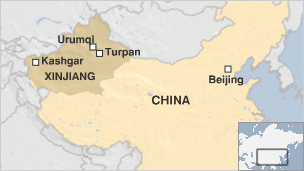
Map

The violence broke out in Turpan prefecture early on Wednesday.

Police opened fire after a mob armed with knives attacked police stations and a local government building, Xinhua news agency quoted officials as saying.

There are sporadic outbreaks of violence in Xinjiang, where there are ethnic tensions between Muslim Uighur and Han Chinese communities.

Confirming reports from the region is difficult because information is tightly controlled.

China’s state media have been quick to issue an official version of events regarding the latest round of violence in Xinjiang, but it will be tough to verify those reports.

Xinjiang lies on China’s remote north-west border and it is difficult for foreign media to travel there. Many people on both sides of the conflict are reluctant to speak to visiting journalists for fear of reprisals if they dispute the government’s stance.

Unfortunately Xinjiang usually hits international headlines when violence flares between the region’s minority ethnic Uighur Muslims and the majority Han Chinese. Many Uighurs contend that their language and religion are being smothered by an influx of Han Chinese migrants.

Xinjiang is a large geographic area rich in oil and gas deposits. Soon it will also become a major supplier of coal to China’s energy-hungry cities. The region’s fertile land also grows produce that is shipped to the rest of the country. The Han Chinese who move to Xinjiang hope to benefit from the region’s untapped resources.

The violence occurred in Turpan‘s remote township of Lukqun, about 200km (120 miles) south-east of the region’s capital, Urumqi.

The Xinhua news agency report, citing local officials, said rioters stabbed people and set police cars alight.

Seventeen people, including nine security personnel and eight civilians, were killed before police shot dead 10 of the rioters, it said.

At least three others were injured and were being treated in hospital, it added.

The Xinhua report did not provide any information on the ethnicity of those involved in the riot or on what sparked it.

But Dilxat Raxit, a spokesperson for the World Uighur Congress, an umbrella organisation of Uighur groups, told the Associated Press news agency the violence had been caused by the Chinese government’s “sustained repression and provocation” of the Uighur community.

In 2009 almost 200 people – mostly Han Chinese – were killed after deadly rioting erupted in Urumqi between the Han Chinese and Uighur communities.

In April an incident in the city of Kashgar left 21 people dead.

Uighurs and Xinjiang

Uighurs are ethnically Turkic Muslims. They make up about 45% of the region’s population; 40% are Han Chinese

China re-established control in 1949 after crushing short-lived state of East Turkestan. Since then, large-scale immigration of Han Chinese. Uighurs fear erosion of traditional culture.

The government said the violence began when “terrorists” were discovered in a building by officials searching for weapons.

But local people told the BBC that the violence involved a local family who had a longstanding dispute with officials who had been pressurising the men to shave off their beards and the women to take off their veils.

Uighurs make up about 45% of Xinjiang’s population, but say an influx of Han Chinese residents has marginalised their traditional culture.”

via BBC News – Violence in China’s Xinjiang ‘kills 27’.

See also: https://chindia-alert.org/political-factors/chinese-tensions/

29/05/2013

Settlers in Xinjiang: Circling the wagons

The Economist: “In a region plagued by ethnic strife, the growth of immigrant-dominated settlements is adding to the tension

MANY hours’ drive along what was once the southern Silk Road, through a featureless desert landscape punctuated by swirling dust-devils and occasional gnarled trees, a curious sight eventually confronts the traveller: row upon row of apartment blocks with vivid red roofs, as if a piece of Shanghai suburbia has been planted in the wilderness (see picture). Following the military-style nomenclature of immigrant settlements in China’s far west, it calls itself 38th Regiment. It is home to thousands of people, in a spot where just a few years ago there was nothing but sand.

The town is the latest addition to a vast network of such communities in the Xinjiang Uighur Autonomous Region, China’s biggest province by land area and also its most ethnically troubled. Neighbouring Tibet has long been roiled by ethnic tension, too, but rarely has it witnessed the kind of violence that has troubled Xinjiang: a low-level insurgency involving ethnic Uighurs whose Muslim faith and Central Asian culture and language set them apart from the Han Chinese who dominate places like 38th Regiment. On April 23rd, 21 people were killed near Kashgar during an encounter between police and alleged separatists. An explosion of inter-ethnic violence in 2009 in the regional capital, Urumqi, that left nearly 200 dead, by official reckoning, exacerbated the divide. The expansion of the settlement network is deepening it further.

To use its full name, the 38th Regiment of the 2nd Agricultural Division is part of the Xinjiang Production and Construction Corps. This state-run organisation, usually referred to as the bingtuan (Chinese for a military corps) controls an area twice the size of Taiwan, broken into numerous parts scattered around the province (see map). A few bits are city-sized. Most are more like towns or villages. Of their total population of more than 2.6m people, 86% are ethnically Han Chinese. In Xinjiang as a whole, in contrast, Han officially make up just over 40% of the 22m inhabitants. The rest are Uighurs and a few other ethnic groups.”

via Settlers in Xinjiang: Circling the wagons | The Economist.

26/05/2013

* Sonia Gandhi ‘devastated’ by India Chhattisgarh ambush

BBC: “The president of India’s Congress Party, Sonia Gandhi, has said she is “devastated” by Saturday’s attack on party officials in Chhattisgarh state.

Sonia Gandhi (R) and PM Manmohan Singh in a hospital in Raipur (May 26 2013)

At least 24 people were killed, including Chhattisgarh Congress chief Nandkumar Patel, his son, and local leader Mahendra Karma, when suspected Maoist rebels ambushed their convoy.

Mrs Gandhi visited some of the wounded with PM Manmohan Singh on Sunday.

The prime minister said India would “never bow down” before the rebels.

He denounced the “barbaric attack” which he said should be an inspiration in the fight against extremism and violence.

Unconfirmed reports said they were unable to visit the scene of the attack because of security concerns.”

via BBC News – Sonia Gandhi ‘devastated’ by India Chhattisgarh ambush.

See also: https://chindia-alert.org/political-factors/indian-tensions/

23/05/2013

* Conservatives counter demands for constitutional rule in China

It seems the ‘gloves are off’ – conservatives versus the President: see last para of this article.

SCMP: “Chinese conservatives have come out to argue against the adoption of “constitutional rule”, a term increasingly used by liberals to demand the realisation of basic human rights guaranteed in the Chinese constitution.

china_housing_xhg104_5351411.jpg

The nationalistic Global Times in an editorial on Wednesday called such demands “empty political slogans” made by “a group of misled intellectuals”.

These intellectuals wanted to “change China’s course of development”, the paper argued.

“If the entire Western world together can’t muster the might [to change China’s course], then a small group of domestic dissenters will be even less able to do so.”

Even though the Chinese constitution in theory guarantees freedom of speech, the press and to demonstrate, and the right to elect and be elected, human rights organisations say such rights are consistently cracked down upon.

Many lament that courts cannot invoke the constitution to protect the civil and political rights of citizens. Nobel Peace Prize laureate Liu Xiaobo has attempted to cite rights guaranteed in the constitution in his trial for “inciting subversion of state power” that led to an 11-year prison sentence in 2009.

When the liberal Guangzhou-based newspaper Southern Weekly called for a realisation of a “constitutional dream” in its traditional New Years editorial in January, censors replaced the text with a more muted version, triggering a rare public strike by journalists.

Democracy activists are often seen holding placards with the Chinese characters for “constitutional rule” in photos shared on microblogs.

The editorial in the Global Times, which ranks among the most widely read dailies in China, comes a day after a Beijing law scholar Yang Xiaoqing wrote an article with similar reasoning for the Communist Party’s bi-weekly Red Flag Magazine.

Citing Marx and Engels, the Renmin University professor repudiated what she called the “old Western” understanding of constitutional rule as an oppressive tool of the – in Marxian terms – capitalist stage of development.

Those with capital use the constitution’s allure to trick those who have nothing into believing that they lived in a fair system, she argued in ideologically orthodox terms. Citing Deng Xiaoping and Jiang Zemin, she predicted chaos for China if the country were ever to come under constituional rule.

In contrast to that chaos, Yang offers a vision of a “Chinese contribution to humanity in regards to constitutional rule” in which China’s People’s Congresses under the leadership of the Communist Party are truly representative of the nation’s people and are able to supervise the judiciary.

While a few people supported her comments, they have predominantely been mocked on microblogs, with thousands of people sharing her photo. Lei Yi, a Beijing-based historian, sarcastically wrote in a microblog post that he was reminded of Stalin and Pol Pot.

President Xi Jinping has repeatedly called for more respect of the constitution since he assumed the leadership of the Communist Party in autumn. “No organisation or individual should be put above the constitution and the law,” he reportedly said at a Politburo seminar in February.”

via Conservatives counter demands for constitutional rule in China | South China Morning Post.

14/05/2013

* China issues white paper on human rights

China Daily: “The Chinese government on Tuesday released a white paper detailing the progress made in human rights in 2012, stressing its achievements in improving living standards and increasing room for citizens to express their opinions.

Human Rights in China (organization)

Human Rights in China (organization) (Photo credit: Wikipedia)

“The cause of human rights in China has entered a stage of planned, sustainable, steady and comprehensive development,” says the white paper, published by the State Council Information Office under the title “Progress in China’s Human Rights in 2012.”

Development is the key to solving all existing problems and facilitating the progress of human rights in China, the paper says.

China has combined its human rights endeavors with economic, political, cultural, social and ecological construction, it said.

The country has prioritized people’s rights to subsistence and development and made efforts to promote the comprehensive and balanced development of their economic, social and cultural rights, as well as their civil and political rights, it notes.

“After years of unremitting efforts, China has reached a higher level in terms of people’s living standards, democracy, rule of law, cultural development, social security and environmental protection,” says the white paper.

In 2012, the annual per capita net income for both urban and rural residents increased, hefty investment was directed to poverty reduction programs, housing conditions were improved for both urban and rural residents and the state made proactive efforts to boost employment, according to the white paper.

Practical measures have been taken to ensure citizens’ right to know and right to be heard, according to the white paper.

Deepened reform and the rapid development of information technology have given the public greater power to acquire information and express their opinions, it notes.

The creation of the Regulations on Government Information Disclosure has helped establish a system for disclosing information, the white paper says.

In 2012, more than 90 central government departments made their budgets and expenses for official receptions, vehicles and overseas trips known to the public. The Communist Party of China (CPC) continued to press ahead with making Party affairs public and established a spokesperson system for Party committees, the paper says.

The Internet has become an important channel for citizens to exercise their rights to know, participate, be heard and supervise, as well as become an important means for the government to hear public opinions, according to the white paper.

Democracy building at the grassroots level further expanded citizens’ right to participate, the paper says.

By the end of 2012, direct elections had been held for over 98 percent of village committees across the country, with participation reaching 95 percent.”

via China issues white paper on human rights |Politics |chinadaily.com.cn.

14/05/2013

* China launches new crackdown on internet celebrities

My personal view is that “the genie is out of the bottle” or that you cannot shut “Pandora’s box” with the Internet and social media.

Telegraph: In its latest bid to contain the often riotous jumble of news and rumour on the Chinese internet, the Communist party has decided to bring the most high-profile and influential voices to heel.

China launches new crackdown on internet celebrities

Before his account was removed, Mr Hao had 1.85 million followers

On Saturday, Hao Qun, a famous 39-year-old novelist and frequent government critic who goes by the pen name Murong Xuecun, found his account on Sina Weibo, China’s version of Twitter, deleted. He tried to open another account but failed.

Before his account was removed, Mr Hao had 1.85 million followers and his postings on the site often went viral.

The world of Weibo, which had 368 million registered users last year, operates much like Speaker’s Corner. Its most famous inhabitants command huge followings and have the power to steer debate in a way that is often uncomfortable for the Communist party.

The deletion of Mr Hao’s account follows a series of actions against other high-profile users.

He Bing, the vice president of the law school at China’s Political Science and Law university was suspended last week “for deliberately spreading rumours”. Prof He, who had close to 500,000 followers, had posted a snippet of news, which later turned out to be false, claiming that there had been a mass stabbing in a hospital in Hefei.

Since the Chinese media is carefully controlled, Weibo has developed into the country’s most important source of news.

And since newspapers and television stations are not allowed to report on many of the topics that are voiced on the internet, rumours often go unchecked and develop their own momentum.

“Some of the [high profile users] have become rumour relay stations,” noted the Global Times in an editorial last week. “Any frequent Weibo user knows that rumours cannot be widely spread unless there is a [high-profile user] helping to spread it,” it added.

“Theoretically they have the right of speech on the internet, but they should also have an equal responsibility. Currently they have no moral responsibility or legal liability for what they post.”

Kaifu Lee, the former head of Google in China, who has more followers (40 million) than Barack Obama does on Twitter (33 million), said he was careful to verify information before posting it on Weibo.

“I realise with the number of followers I have that I need to make sure the messages I forward are legitimate,” he said. “With great power comes great responsibility,” he added.

However, he noted that Weibo already has inbuilt checks that should prevent false news from gaining traction.

“If you suggest something that is clearly false and do not retract it, your reputation (online) will suffer. I think the social ecosystem should largely be self-reinforcing,” he said, adding that Sina already has a type of tribunal system that can rule over the veracity of certain posts.

Mr Lee said he did not know what the purpose of the new government “internet management” campaign was. There already exists a sophisticated censorship system that filters posts and deletes sensitive topics. “I am not in the government, so I cannot say why the government is doing this,” he said.

Zhang Lifan, a historian with almost 270,000 followers said the attempt to control high-profile users would be fruitless. “Shutting them down will not make much difference. For each account they silence, other people will speak up,” he said.

“Of course people should not spread rumours, but the government is using a double standard,” he said. “CCTV (China’s state television station) also sometimes reports the wrong news.”

The campaign appears to have sent a firm message however. Yao Bo, a commentator and restaurateur with close to 900,000 followers said a number of his friends had seen their accounts shut down. “Some of the accounts are shut down for criticising government policy, others for reporting bits of information. I now feel I need to watch what I say before I post something,” he said.”

via China launches new crackdown on internet celebrities – Telegraph.

12/05/2013

* China’s Evolving ‘Core Interests’

NY Times: “Whenever China wants to identify the issues considered important enough to go to war over, it uses the term “core interests.” The phrase was once restricted to Taiwan, the island nation that China has threatened to forcibly unify with the mainland. About five years ago, Chinese leaders expanded the term to include Tibet and Xinjiang, two provinces with indigenous autonomy movements that Beijing has worked feverishly to control.

An image of the Chinese flag and sailors standing on Spratly Islands is displayed on a big screen in Tiananmen Square, March 2, 2013.

Since then, Chinese officials have spoken more broadly about economic growth, territorial integrity and preserving the Communist system. But recently they narrowed their sights again, extending the term explicitly to the East China Sea, where Beijing and Tokyo are dangerously squabbling over some uninhabited islands. Top Chinese military officials first delivered the message to Gen. Martin Dempsey, chairman of the Joint Chiefs of Staff, when he visited Beijing last month. The next day, the Foreign Ministry spokeswoman, Hua Chunying, told reporters that “the Diaoyu Islands are about sovereignty and territorial integrity. Of course it’s China’s core interest.”

This wording, with its threatening implications, is raising new tensions in a region already on edge over North Korea and several other maritime disputes, and it will make it harder to peacefully resolve the dispute over the islands, called Diaoyu in China, and Senkaku in Japan.

While Japan has held the islands for more than a century, China also claims title and has sent armed ships and planes from civilian maritime agencies to assert a presence around them. The waters adjacent to the islands are believed to hold oil and gas deposits.

To some extent, China is simply throwing its weight around, challenging the United States and its regional allies. On Wednesday and Thursday, Chinese state-run newspapers carried commentaries questioning Japan’s sovereignty over the island of Okinawa, where about 25,000 American troops are based. Japan, whose wartime aggression against China and other countries still engenders animosity, has not helped. Last September, the government of Prime Minister Yoshihiko Noda provocatively bought three of the islands from their private owner.”

via China’s Evolving ‘Core Interests’ – NYTimes.com.

08/05/2013

* Detention of petitioners denounced

China Daily: “Anti-graft officials vow protection of whistle-blowers from retaliation

Officials with China’s top anti-graft authority expressed firm opposition on Tuesday to the detention of petitioners.

Authorities are not allowed to detain petitioners at any level of petition offices and at public venues, said Zhang Shaolong, deputy director of the office of letters and calls of the Central Commission for Discipline Inspection of the Communist Party of China.

It is a legal channel for petitioners to submit whistle-blowing materials face to face to the anti-graft authorities, and the petitioners should receive a warm welcome from anti-corruption agencies, he said.

Zhang made the remarks on Tuesday during an online interview with two other anti-graft officials from the commission.

Under the administrative mechanism in most places, the leading officials will not get promoted if too many petitioners appeal to higher authorities.

Many corrupt officials were exposed by online posts, Zhang said, adding that some inaccurate online information has also made the investigations of corrupt officials difficult.

Among all the cases investigated by the commission last year, about 41.8 percent of the clues were collected from the public whistle-blowers through online reports, letters and calls, Zhang said.

Guo Hongliang, Zhang’s colleague who also attended the online interview, said that the commission has received 301,000 online whistle-blowing reports from 2008 to 2012.

The commission established 12388.gov.cn, its online whistle-blowing website, in October 2009, and the Internet has become one of the most important channels for the commission to collect information, he said.

Deng Jixun, another colleague of Zhang who attended the interview, said that real-name whistle-blowing activities should be encouraged to promote the efficiency of anti-corruption work.

The anti-graft authorities should protect real-name whistle-blowers from being victims of retaliation, he said.

Zhang acknowledged that some officials try to prevent people from petitioning to higher levels of government, and these officials’ behavior should be firmly opposed.

A report in People’s Daily revealed that many petitioners had been detained by the government of Hai’an county in Jiangsu province since March when they tried to visit the anti-graft officials from an inspection team sent by the provincial government.”

via Detention of petitioners denounced |Politics |chinadaily.com.cn.

08/05/2013

* Indian government to deploy 10,000 more personnel in four states to fight Maoists

Times of India: “With the government moving towards a fight to finish war against Maoists in Red Zone, the Union home ministry has decided to deploy additional 10 bBattalions (10,000 personnel) of paramilitary forces in four highly naxal-affected states — Jharkhand, Chhattisgarh, Odisha and Bihar.

CRPF, Central Reserve Police Force (www.crpf.n...

CRPF, Central Reserve Police Force (www.crpf.nic.in), Group Centre Pune, at Talegaon, on Old Mumbai Pune Highway (NH4) (Photo credit: Ravi Karandeekar)

Five (5,000 personnel) out of the 10 battalions will be drawn from the Central Reserve Police Force (CRPF) while the remaining five will be spared by SSB, BSF and ITBP for anti-naxal operations.

Disclosing the decision in response to a Parliament question, the ministry said that the additional 10 battalions had been sanctioned on the basis of requests made by the respective state for stepping up operations against the Red Ultras.

At present, a total number of 532 companies (53,200 personnel) of paramilitary forces have been deployed in the seven Maoist-affected states — Chhattisgarh, Jharkhand, Bihar, West Bengal, Andhra Pradesh, Maharashtra and Odisha.

Officials in the ministry said that Jharkhand — which is currently under the President’s rule — would see the maximum deployment where the security forces had already been engaged in intensive operations against the Red Ultras under the leadership of ex-CRPF chief K Vijay Kumar who is posted there as one of the advisors of the state governor.

“Idea is to continue the intensive operations against Maoists before the onset of Monsoon in these states”, said an official.”

via Government to deploy 10,000 more personnel in four states to fight Maoists – The Times of India.

Law of Unintended Consequences

continuously updated blog about China & India

ChiaHou's Book Reviews

continuously updated blog about China & India

What's wrong with the world; and its economy

continuously updated blog about China & India