Archive for ‘Internal politics’

10/11/2014

Who’s Who in Narendra Modi’s New Cabinet in India – India Real Time – WSJ

In his first Cabinet reshuffle late Sunday, India’s Prime Minister Narendra Modi expanded the number of ministers in his government from 44 to 65.

That takes him just six shy of his predecessor Manmohan Singh’s coterie before his Congress party was ousted in national elections earlier this year by Mr. Modi’s Bharatiya Janata Party that campaigned with a mantra for “minimum government, maximum governance.”

The enlargement nudges up the number of women ministers to eight from seven and gives key posts to members of parliament from states that are due for local elections in the coming months.

Here are the main moves, promotions, demotions and new arrivals in the modified Cabinet.

Major Cabinet Minister Moves

Suresh Prabhu becomes railway minister replacing Sadananda Gowda. Mr. Prabhu, 61, a former member of the Shiv Sena party, resigned from the regional party to join the Bharatiya Janata Party on Sunday. A chartered accountant by profession and also a law graduate, Mr. Prabhu served as a cabinet minister in the previous BJP-led National Democratic Alliance for six years, handling key portfolios such as power, heavy industries and public enterprises and environment and forests among others. Mr. Prabhu has often been described by many as that “un-common whiff of much needed fresh air on the horizon of Indian public life,” according to his official website.

Manohar G. Parrikar is the new defense minister. Mr. Parrikar quit as Goa’s Chief Minister last week and takes charge of the defense ministry from Arun Jaitley.

A technocrat-turned-politician, Mr. Parrikar joined the BJP in 1988 and went on to become the chief minister of Goa for the first time in 2000. During his time as chief minister, he was credited with improving the western state’s infrastructure  overseeing the construction of major bridges, building bus stands and improving the road network across the state. “Known to be a man of action and principles, Mr. Parrikar is known as Mr. Clean in Goa,” his website said. As the new defense minister, Mr. Parrikar faces the daunting task of closing the country’s pending defense deals.

Arun Jaitley was relieved of the defense portfolio but was given an additional charge of information and broadcasting ministry previously held by Prakash Javadekar. Mr. Jaitley also continues as the head of the finance and corporate affairs ministries. A lawyer by profession, the BJP leader is known to be media-savvy.

Dr. Harsh Vardhan was deprived of his health and family welfare ministry in the shuffle and shifted to a low-key science and technology, Earth sciences ministry. Dr. Vardhan ran for the post of Delhi chief minister in elections in December but was beaten to the position by Aam Aadmi Party leader Arvind Kejriwal who stepped down only a few weeks in to the job.

Prime Minister Modi remains in charge of Personnel, Public Grievances and Pensions, the Department of Atomic Energy Department of Space; all important policy issues and all other portfolios not allocated to any minister, according to the press information bureau.

more on Cabinet Ministers and Ministers of State …

via Who’s Who in Narendra Modi’s New Cabinet in India – India Real Time – WSJ.

05/11/2014

How Modi Has Moved Into Kejriwal’s Space – India Real Time – WSJ

The capital of the world’s largest democracy, which has been under president’s rule for the best part of a year, is set for a fresh election.

There’s no firm date yet for the high-stakes Delhi polls, but for one man the stakes are higher than for most.

Arvind Kejriwal, former chief minister and anti-corruption activist, has what some analysts describe as one last chance to unite his fractious, young party and revive his own flagging political fortunes.

Mr. Kejriwal’s Aam Admi Party, which stormed Delhi’s political scene last year with its anti-graft slogans and innovative grass-roots campaign, has struggled to remain relevant since national elections in May, in which it won just four out of 543 parliamentary seats.

In part, analysts suggest, this is because his common man calling card and campaign for a corruption-free India have been appropriated by the leader of the ruling Bharatiya Janata Party, Prime Minister Narendra Modi, leaving the AAP headman little space to distinguish himself.

Despite their wide economic and ideological differences, Mr. Modi does appear to have encroached on Mr. Kejriwal’s political ground in recent months.

Let’s look at the evidence.

First, the broom. Mr. Kejriwal’s party made the tool of India’s army of sweepers a weapon in his political arsenal.  As AAP’s symbol, the broom was a visual metaphor of the party’s aim to clean up politics in India.

Mr. Modi has taken the metaphor and made it literal. With a broom in hand last month, he promised to literally clean up India. Everyone from Bollywood stars to opposition politicians has taken up brooms to join him in the sanitation program.

via How Modi Has Moved Into Kejriwal’s Space – India Real Time – WSJ.

28/10/2014

Banyan: The enablers | The Economist

NOT since Indira Gandhi has a prime minister of India been as dominant as Narendra Modi. His clout comes from the big electoral victory in May of his Bharatiya Janata Party (BJP) after a remarkably personalised campaign; from a hyperactive prime minister’s office that makes Mr Modi look presidential; and from an opposition Congress party in tatters. But even the mightiest cannot rule alone, and Mr Modi relies on two old allies, both crucial. One, Amit Shah, engineers the electoral victories that give Mr Modi his authority. The other, Arun Jaitley, must take that authority and out of it craft policies and decisions that will launch the economic recovery which Mr Modi has promised and by which he will be judged. These two men are Mr Modi’s enablers.

Now the BJP’s president, Mr Shah is a master of the dark political arts—indeed, his hooded eyes give him the air of a pantomime villain. He has served Mr Modi for nearly three decades. The pair collaborated in the state of Gujarat, where Mr Modi won three elections and ruled for a dozen years. Mr Shah had charge of ten state ministries, including home affairs.

Long an outsider in the urbane circles of Delhi’s national-level politics, Mr Shah is uncomfortable in English and rarely gives interviews. When he makes an exception, as he did after state-assembly elections this month in which the BJP seized control of Maharashtra and Haryana, he mostly uses the time to extol his boss. Of himself, he says merely: “Sometimes you get more credit than you deserve.” Mr Shah is too modest. He ran both state campaigns, just as he crafted the BJP general-election success in India’s most populous state, Uttar Pradesh (UP). That victory was at the heart of Mr Modi’s national triumph in May.

Mr Modi stirs voters, but the alchemy of Mr Shah, who turned 50 this week, is to convert popularity into power. In UP the BJP’s share of the vote was 42%, compared with Congress’s 7.5%. That translated into 71 out of 80 of the national seats from the vast state, a golden return. Imbalances between vote share and seats are normal in first-past-the-post electoral systems, but achieving victory in India takes more skill and stamina than elsewhere. Mr Shah makes minute analyses of millions-strong constituencies, imposing candidates and recruiting volunteers early, often from the Hindu-nationalist RSS organisation, where he and Mr Modi were once leaders. He tailors messages according to the audience. He has, variously, presented Mr Modi as a bringer of good economic times, a Hindu strongman and a figure of humble caste. Mr Shah has turned Hindus against Muslims (notoriously, he told Hindu Jats in UP to take electoral “revenge” following communal riots in late 2013). But he has also taken advantage of Shia Muslim antipathy towards Sunnis (in Lucknow, UP’s capital). Mr Modi’s campaigning certainly helps. He led 38 rallies in the recent state elections. Congress’s Rahul Gandhi showed up for only ten.

via Banyan: The enablers | The Economist.

04/10/2014

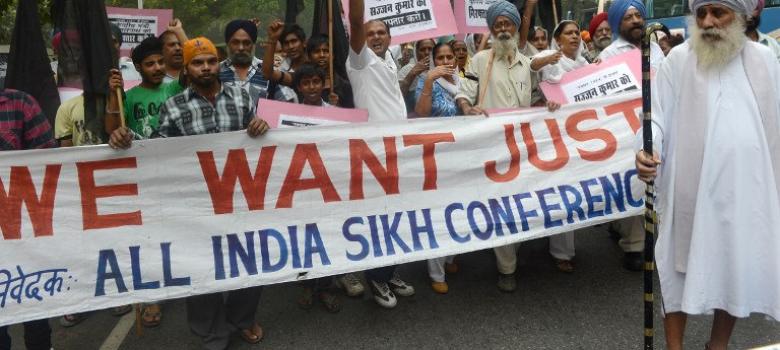
1984 anti-Sikh riots were an organised massacre, says ‘Caravan’ article

Avtar Singh Gill, the former petroleum secretary, alleged that Rajiv Gandhi aide Arun Nehru had sanctioned the violence.

Did disparate groups of rioters act spontaneously during the anti-Sikh riots of 1984, or was the violence orchestrated at the behest of the top leadership of the Congress? This question has dogged Congress governments since Delhi’s Sikh comunity was devastated by one the bloodiest bouts of communal carnage after Independence. The Congress has long maintained that the violence was an unplanned response to the assassination of Prime Minister Indira Gandhi by two Sikh bodyguards on October 31, 1984. The riots continued until November 3.

Now, a recent statement by a senior government official of the time has added credence to the allegation that the violence was indeed orchestrated, and that the clearance came from the top. Avtar Singh Gill, the former petroleum secretary, has told Caravan magazine that Arun Nehru, a cousin and confidant of Rajiv Gandhi, had given clearance for Sikhs to be attacked and killed in Delhi.

In an article by the magazine’s political editor Hartosh Singh Bal in the latest issue, Gill is quoted as saying that on November 1, 1984, “Lalit Suri of Lalit Hotels, who used to come and see me often, dropped by. He was the errand boy for Rajiv Gandhi, and since he often needed some work done, he was close to me. He came to me in the ministry and said, ‘Clearance has been given by Arun Nehru for the killings in Delhi and the killings have started.  The strategy is to catch Sikh youth, fling a tyre over their heads, douse them with kerosene and set them on fire. This will calm the anger of the Hindus.”

Gurudwara lists

Gill is also quoted as saying that Suri “told me that I should be careful even though my name is not in the voters’ list, the Delhi Gurdwara voters’ list. ‘They [the rioters] have been provided this list. This will last for three days. It has started today, it will end on the third [of November].’”

Gill’s revelations also appear to put to rest the long-term speculation about Arun Nehru’s role in the violence. “That Arun Nehru had a role in the violence has long been widely rumoured, but Gill’s statement marks the first time a senior government official has put the accusation on record,” writes Bal. “His story offers the first coherent explanation for the nature of the violence in Delhi,”

Gill and Nehru

Gill’s revelations have greater significance because he was often consulted by Arun Nehru on Punjab and Sikh issues. “As one of the few Sikhs in a senior position in the government – even though I was clean shaven, he [Nehru] wanted to know my views,” the former petroleum secretary is quoted as saying.

Gill’s also explains – again for the first time – how rioters could easily identify Sikh houses. Lawyer HS Phoolka, who is leading the legal battle to secure justice for the victims of the 1984 riots, is quoted in the article saying “the ease with which Sikh houses were identified would make sense if Gurdwara voters’ lists were available”.

Gurdwara voter lists contain the names of people eligible to vote in the elections to the Delhi Sikh Gurdwara Management Committee. That these lists were already available to “people in the higher ranks” is made clear by another contention Phoolka makes in this article.

via 1984 anti-Sikh riots were an organised massacre, says ‘Caravan’ article.

04/10/2014

Meet the Hong Kong teenager who’s standing up to the Chinese Communist Party

Joshua Wong Chi-fu is Hong Kong’s most prominent pro-democracy student leader.

Political movements often conjure images of passionate university-goers championing progressive views they learned on campus. But the long, storied history of Hong Kong’s student-led political movements is taking a different turn: The most prominent student leader of the territory’s pro-democracy protests is only 17 years old.

Sporting heavy black glasses and a bowl cut, Joshua Wong Chi-fung doesn’t exactly cut a menacing figure. But his activism against what many in Hong Kong perceive to be the Chinese Communist Party’s encroachment onto their freedoms has already attracted Beijing’s attention. Mainland authorities call him an “extremist.” A party document on national security identifies Wong by name as a threat to internal stability. Pro-Beijing newspapers in Hong Kong, meanwhile, accuse him of working for the US Central Intelligence Agency to infiltrate Hong Kong schools. (Wong denies the charges.)

Joshua Wong’s fight against ‘brainwashing’

Wong got his start in 2011, when he and fellow students founded a group called “Scholarism,” which they thought was catchier than the direct translation of the Chinese, meaning “scholarly trends.” Wong and Scholarism rose to prominence in 2012, when the Hong Kong government tried to roll out Communist Party-approved “patriotic” education in Hong Kong’s public schools, to replace civics classes. The curriculum included textbooks like one titled “The China Model,” which characterised China’s Communist Party as “progressive, selfless and united,” and criticized multi-party systems like Hong Kong’s while avoiding major (unflattering) events – notably, the Great Leap Forward, the Cultural Revolution and the Tiananmen Square massacres of 1989 – reports the New York Times (paywall).

One Hong Kong journalist likened the move to a Trojan horse that dissolved Hong Kong’s identity; Wong called it “brainwashing,” an attempt to require students to “develop an emotional attachment to China,” as he put it in this video by the South China Morning Post (paywall). In Sep. 2012, Wong and Scholarism mobilized more than 120,000 people to demonstrate (paywall) against the education programme, including a slew of students who went on hunger strike. Within days, the Hong Kong government scrapped the plan for mandatory implementation.

Wong’s next battle: ‘universal suffrage’

But Wong and Scholarism knew that as long as Hong Kong lacks representative government, both the education issue and the Chinese government’s failed 2003 attempt to impose US Patriot Act-style rules on Hong Kong would eventually resurface. So they began researching the controversy that’s now galvanising the Umbrella Revolution: universal suffrage.

This issue is really confusing – and, as even Wong admits, “really boring.” The background goes something like this: Hong Kong is governed by what’s called the Basic Law, which legal scholars from the then-British colony and the mainland wrote up prior to the 1997 handover. The law promises Hong Kong a “high degree of autonomy” until 2047 (after which, it is assumed, it will merge with the People’s Republic of China for good). It also indicates, although vaguely, that the ultimate objective is for the chief executive and the congress to be elected by universal suffrage by Hong Kong’s seven million people.

That’s not how it is at the moment. Hong Kong’s chief executive is currently chosen by an “election committee” made up of 1,193 members selected to represent “functional constituencies,” such as business and labor groups. Beijing controls who is on the committee, and, in turn, whom the committee elects; the committee also decides who runs. Ultimately, since the Chinese government still has to officially “appoint” the chosen candidate, it has veto power over the chief executive.

In 2007, the National People’s Congress, China’s legislature, promised that by 2017, Hong Kong’s chief executive “may be implemented by the method of universal suffrage.” Some in Hong Kong read that to mean by 2017, they’d have fully democratic elections. But the NPC, evidently, had something else in mind: that each and every Hong Kong citizen would be allowed to vote – but only for one of three candidates selected by the (Communist Party-picked) “electoral committee.”

via Meet the Hong Kong teenager who’s standing up to the Chinese Communist Party.

03/10/2014

Hong Kong protests: No exit | The Economist

IT IS a challenge unlike anything Chinese leaders have seen since Tiananmen Square in 1989; a city roiled by days of unauthorised protests led by students demanding democracy. On October 1st, the 65th anniversary of Communist rule in China, anti-government demonstrations in Hong Kong, which had begun nine days earlier with class boycotts, swelled to include well over 100,000 people. Protesters, conveniently armed with the umbrellas that have become their rallying symbol, endured downpours of rain to jeer the territory’s leader, Leung Chun-ying, as he presided over the raising of the national flag. A few raised their middle fingers towards it.

The “umbrella revolution”, as the movement has been dubbed, is the nightmare Communist Party leaders in Beijing have long feared from Hong Kong and the “one country, two systems” arrangement it has enjoyed since its handover from Britain in 1997. It is the first large-scale student-led protest for democracy to erupt in any Chinese city since 1989. And it presents unusual challenges. The authorities in Hong Kong are reined in by a legal system bequeathed by the British; they cannot, as officials commonly do in mainland China, handle unrest with a combination of astute bargaining, thuggish violence, ruthless treatment of ringleaders and tight controls over media and the internet. Xi Jinping, China’s president, is constrained by a desire to keep Hong Kong stable and prosperous: a botched response could badly damage one of the world’s wealthiest economies and China’s image.

But if the protests continue far beyond the public holiday on October 1st and 2nd, leaders in Beijing will doubtless become impatient for tougher action. On October 1st the party’s newspaper, the People’s Daily, called on Hong Kong residents to support “resolute” action by the police against the demonstrators, who it said would “reap what they have sown”. The party does not want Hong Kong’s protests to fan dissent elsewhere. Chinese censors on the mainland have been working hard to make sure they do not (see article). So too have China’s police, who have rounded up dozens of activists on the mainland for expressing sympathy with the protests. Some tour groups have reportedly been denied permits to go to Hong Kong on their usual shopping extravaganzas. Despite the party’s efforts, however, news of Hong Kong’s defiance is spreading in China.

The protesters’ main demand is that the people of Hong Kong be allowed to vote for any candidate of their choosing in elections for the post of chief executive in 2017 (the first in which citizens would have such a vote). Mr Xi has made clear he does not want any Western-style democracy within China’s borders. The current election plan, which China proposed on August 31st, calls for candidates to be screened by a committee stacked with party supporters.

Several protest movements have converged to challenge this. Until recently the best-known was Occupy Central with Love and Peace, which is modelled on Occupy Wall Street and named after an important business district in the heart of Hong Kong. But even Occupy Central’s leaders, who teach at local universities, wondered whether they could muster meaningful numbers. Then came the students, both from universities and schools, thousands of whom began boycotting classes on September 22nd. On the evening of September 26th the police inflamed their passions by arresting Joshua Wong, the 17-year-old leader of a movement called Scholarism, which two years ago led successful protests against an effort to introduce party-backed “patriotic” teaching in schools. Mr Wong was released on September 28th, but in the early hours of that day Benny Tai, one of the leaders of Occupy Central, announced that its protest, which had been scheduled for October 1st, would begin immediately.

via Hong Kong protests: No exit | The Economist.

02/10/2014

Hong Kong’s protests: A tough test for China’s leaders | The Economist

IT IS a most unusual sight on Chinese soil, and most unsettling for leaders in Beijing. On September 28th and 29th tens of thousands of demonstrators surrounded government offices and filled major thoroughfares around Hong Kong, braving rounds of tear gas from riot police to call for democracy and demand the resignation of Leung Chun-ying, the territory’s Beijing-backed chief executive. One image broadcast and shared around the world, of a lone protester holding his umbrella aloft in a cloud of tear gas (pictured above), has given the non-violent protests a poetic echo of “tank man” from the crackdown at Tiananmen Square in 1989.

Umbrella man

It also captures precisely what Communist Party leaders in Beijing fear from Hong Kong and its special status under the “one country, two systems” arrangement it has enjoyed since the territory’s handover from Britain in 1997. Not only are its people willing (and allowed by law) to challenge their government openly, but they also could become an inspiration for protests elsewhere in China. The spread of news and images of the protests has been blocked or heavily censored on the mainland, but as the protests carry on, the risk of contagion rises. In that sense this marks one of the most difficult tests of Chinese rule since Tiananmen.

Compounding the difficulty is the lack of a middle ground. The protesters’ main demand is that the people of Hong Kong be allowed to vote for any candidate of their choosing in elections for the post of chief executive in 2017 (the first in which citizens would have such a vote). President Xi Jinping has made clear he will have nothing resembling full Western democracy within China’s borders. The current election plan, put forward by the central government on August 31st, gives the central government an effective veto over nominees to ensure that Hong Kong remains firmly under its control.

Several protest movements have converged to challenge that control. Until recently the best-known movement had been Occupy Central with Love and Peace, which is modelled on Occupy Wall Street and named after an important business district at the heart of Hong Kong. But even Occupy’s leaders wondered whether they could muster meaningful numbers.

The biggest drivers of these protests have been university students and secondary school students, thousands of whom boycotted classes last week. On the evening of September 26th the leader of the secondary school students, 17-year-old Joshua Wong of Scholarism, was arrested—a move that, along with the use of pepper spray by police, was credited with swelling the popularity of the protests over the weekend (Mr Wong was released on Sunday). In the early hours of September 28th Benny Tai, one of the leaders of Occupy Central, announced that its protest, which had been scheduled for October 1st, China’s national day holiday, would begin immediately.

Mr Leung has shown no sign of bending. On the afternoon of September 28th, at a press conference held inside the government headquarters while thousands of protesters surrounded the building, Mr Leung repeated his endorsement of the election plan. It calls for chief executive candidates to be screened by a committee stacked with Communist Party supporters (he was elected by a similar committee in 2012, collecting 689 votes along with the derisive nickname “689”). Mr Leung acknowledged that the plan may not have been the “ideal” that some wanted, but he called it progress nonetheless. He said it had given Hong Kong citizens the “universal suffrage” they had been promised. Mr Leung said he welcomed “rational” dialogue but that the government would be “resolute” in dealing with the “unlawful” demonstrations. Asked whether the Chinese army would ever be used, Mr Leung expressed his confidence in the police. The tear gas canisters began flying shortly afterward, surprising protesters who exclaimed variations of “are you kidding?” and “shame on you”. Many donned goggles and unfurled umbrellas to protect themselves against the gas, while some raised their hands and yelled, “don’t shoot”. The protests did not become violent, but they grew and spread to other areas. The calls for Mr Leung’s resignation became louder.

via Hong Kong’s protests: A tough test for China’s leaders | The Economist.

16/09/2014

BJP Fares Poorly in By-Elections in India’s Most-Populous State – India Real Time – WSJ

The Bharatiya Janata Party’s landslide victory in national elections a few months ago spawned predictions of an unstoppable political juggernaut. But results of by-elections show cracks in the BJP’s dominance.

India’s governing party held onto only three of 11 seats that went to the polls for the legislative assembly of Uttar Pradesh, the country’s most-populous state. The BJP had won all these seats in the last state elections in 2012.

The regional Samajwadi Party, which governs the state but suffered a big blow in national elections, won the remaining eight seats, according to India’s Election Commission.

Just four months ago, the BJP won a historic 72 of 80 seats for the national Parliament from Uttar Pradesh on the back of a wave of support for Prime Minister Narendra Modi. This result helped propel the party to a majority in the lower house of Parliament, with 282 of 543 seats.

The magnitude of the win raised expectations that the BJP would come out on top in the by-polls, which are mid-term elections held for those seats that have fallen vacant since the previous election.

The results showed that while Mr. Modi had swung the national election by making it a presidential-style vote for or against his leadership, his charisma might not be enough to carry his party to power in state elections, where local issues and caste equations dominate the vote. It also raised questions about the BJP’s prospects in crucial upcoming state elections in Maharashtra and Haryana.

Some also saw the outcome as fallout from a polarizing BJP campaign that critics say sought to consolidate Hindu votes in Uttar Pradesh by spreading animosity against Muslims – and marked a return by the party, which has roots in India’s Hindu nationalist movement, to the religious agenda that defined its strategy a decade ago.

via BJP Fares Poorly in By-Elections in India’s Most-Populous State – India Real Time – WSJ.

04/09/2014

Democracy for Hong Kong: Unyielding | The Economist

PRO-DEMOCRACY activists announced the start of a “new era of civil disobedience” on the night of August 31st, after China’s top legislature laid down restrictive guidelines on the kind of elections that are allowed in Hong Kong, a semi-autonomous territory. Officials in Beijing had promised to allow the election of Hong Kong’s next leader, in 2017, through universal suffrage. With the announcement China has clarified that there is a catch, a big one: the government sees itself as being under no obligation to allow open nominations for the election’s candidates. Before the announcement, Chen Zuoer, one of the officials who helped negotiate Hong Kong’s handover to mainland China back in 1997, had warned that “blood will be shed” if their opponents refuse to back down.

In a show of defiance, an alliance of activists who support fully open elections held a rally on Sunday night to declare that it would launch waves of protests, culminating in the occupation of the city’s main financial district. Their movement has been many months in the making; they call it “Occupy Central with Love and Peace”. It was first proposed nearly two years ago by Benny Tai, an associate law professor at the University of Hong Kong, in anticipation of a disappointing official interpretation of “universal suffrage”—just like the one that the central government has now given them.

Police arrested at least 22 people during protests that began on Sunday night and carried through Monday morning. The student-union president at the Chinese University of Hong Kong has announced a strike; students there will have a rally of their own on September 4th around a replica of the “Goddess of Democracy” statue that became famous for its appearance in Tiananmen Square in 1989. Other universities are expected to see strikes of their own announced in the next few days.

Many of the participants at Sunday’s rally despair at convincing the bureaucrats in Beijing to change their position—but they feel they need to put up a fight anyway. “Normal protests are no longer useful,” in the words of Agnes Chow Ting, a student protester. She led a failed attempt after the rally to “ambush” a delegation of officials from the central government.

Such actions may attract international attention but indeed, they are less than likely to sway decision-makers in Beijing. Li Fei, a deputy secretary-general of the National People’s Congress Standing Committee, told local politicians on September 1st that the committee believes Hong Kong’s police will be capable of handling any disturbance that might be caused by “a small group of people seeking to undermine Hong Kong”, as he characterises the Occupy movement.

Hong Kong’s current chief executive, Leung Chun-ying, was picked for the role in 2012 by a 1,200-member “election committee”. A reliable majority of that committee were Hong Kongers who will ever be glad to demonstrate loyalty to their counterparts in Beijing.

via Democracy for Hong Kong: Unyielding | The Economist.

20/08/2014

Wounded Congress desperately seeking alliances for upcoming assembly elections

The Congress party is losing legislators but is keen to show it remains a political force as polls approach in Maharashtra, Jharkhand, Haryana and Kashmir.

Still reeling from its decimation in the Lok Sabha elections, the Congress now has to contend with legislators in several states quitting the party to join the Bharatiya Janata Party. There are rumours that even veteran Delhi Congress leader Dr AK Walia is in talks to join the BJP.

What makes the situation worse is that members of legislative assemblies from regional parties are also joining the BJP, making it hard for the Congress to compete.

The party is now desperately looking to form alliances with regional parties and even independent MLAs to save face in the upcoming state elections in Maharashtra, Haryana, Jharkhand and Jammu and Kashmir.

Jharkhand

With the Jharkhand Vikas Morcha deciding to merge with the BJP, it is becoming increasingly difficult for the Congress to establish any sort of stronghold in the state. The party’s general secretary in the state, BK Hariprasad, says it is looking to put together an alliance with the Rashtriya Janata Dal, with which it has already reached an agreement in Bihar. The party is also working on a tie-up with Janata Dal (United), which split with the BJP before the general elections.

The party already has an alliance with the Jharkhand Mukti Morcha. However, the district presidents in the region are not keen to continue with it, following the JMM’s demand that it be allocated 25-30 of the 81 seats in state polls due at the end of the year.

“The party has a stronghold in the state and it will perform much better if we contest on our own instead of seat sharing,” a district president of the Congress said. “The leadership should not concede to the demands of the regional alliances and deprive our own people of a chance to contest the polls.”

via Scroll.in – News. Politics. Culture..

Law of Unintended Consequences

continuously updated blog about China & India

ChiaHou's Book Reviews

continuously updated blog about China & India

What's wrong with the world; and its economy

continuously updated blog about China & India