Archive for ‘Internal politics’

07/08/2014

Rahul Gandhi Wakes Up to New Role as Rebel Leader – India Real Time – WSJ

There’s nothing particularly newsworthy about boisterous Indian lawmakers blocking debate on the floor of Parliament when they don’t get their way, unless one of the lawmakers is the usually-reticent Rahul Gandhi.

The typically uninvolved Parliamentary back-bencher and Congress party vice president made the front pages of Indian newspapers Thursday after he and others mobbed the desk of the lower house of Parliament’s speaker, demanding to be heard.

“Rip Van Winkle Rahul Finally Rises Out of Slumber,” read an Economic Times headline paired with a recent photograph of Mr. Gandhi nodding off during a parliamentary session.

Mr. Gandhi, who is part of a diminished Congress camp of 44 representatives in the 545-member Lok Sabha, also made a rare statement to reporters outside Parliament complaining that opposition parties were not being allowed to speak. He accused speaker Sumitra Mahajan of bias after she shot down a proposal to discuss recent communal violence.

“There is a mood in Parliament that only one man’s voice counts,” Mr. Gandhi said in an apparent reference to Prime Minister Narendra Modi.

On the campaign trail a few months ago, Mr. Gandhi had said a Modi-led government would polarize Indians and trigger religious unrest.

Mr. Gandhi’s outburst was described as “surprisingly belligerent” in the Times of India that also carried a front-page story about what they called his “new-found combativeness.”

The fourth-generation scion’s occasional public outbursts are closely covered by the national media. In October when he called an executive order by his own party’s government “complete nonsense,” his tantrum was reported, discussed and debated for days.

On Wednesday, television news channels questioned what may have prompted a reaction from a leader who in his decade-long career in Parliament has rarely engaged in debate or taken the lead on policy issues.

The governing Bharatiya Janata Party offered one theory.

Finance Minister Arun Jaitley said Mr. Gandhi’s show of aggression was a result of internal rumblings – a “palace coup” – in the beleaguered Congress that is struggling to bounce back after its worst ever electoral defeat in national elections.

The party’s dynastic leadership by president Sonia Gandhi and her son, Rahul, must be struggling and Mr. Gandhi’s actions Wednesday were an attempt “to show they are also capable of aggression,” Mr. Jaitley said.

Congress spokesman Randeep Singh Surjewala said there “wasn’t an iota of doubt or question” within his party on the Gandhis’ leadership. Some “disgruntled elements hankering for immediate power” had abandoned the Congress after the electoral defeat, Mr. Surjewala said, but added that his party had weathered numerous challenges in the past and, like before, would emerge stronger.

He said the Modi-led government couldn’t run away from a discussion on religious violence by making personal attacks against Congress or its leaders.

via Rahul Gandhi Wakes Up to New Role as Rebel Leader – India Real Time – WSJ.
07/08/2014

The BJP’s real opposition turns out to be a far-Left-far-Right combination

When the final results of the general election were tallied up, it was hard not to marvel at the sheer size of the Bharatiya Janata Party’s victory and the unprecedented defeated delivered to the Indian National Congress. With the BJP emerging not just as the single largest party but also the first since 1984 to cross the halfway mark by itself and the Congress not even having enough seats to automatically be given the Leader of the Opposition post, there were genuine concerns about unbridled majoritarianism. Where would the opposition to the BJP come from?

Since the Congress continues to occupy the muddled middle and has pinned all its hopes on  Rajya Sabha numbers, where it has more seats than the BJP, the answer actually turns out to be an unusual combination of players both to the right and the left of the BJP. From labour law reform to the introduction of further foreign direct investment in insurance, it is BJP-affiliated organisations making common cause with pro-labour and Leftist outfits that have caused the most headaches for the new government.

With the Left and Right managing to converge on swadeshi issues, those who fall more in the pro-market camp within the BJP — many of whom were seen as the intellectual leaders of the campaign that brought Prime Minister Narendra Modi to power — are starting to get disconcerted with  government’s actions.

FDI in insurance

This appears to be the new government’s first big legislative battle, as the opposition parties have attempted to use their superior numbers in the Rajya Sabha to stand in the way of an attempt to increase the foreign direct investment cap in insurance from 26% to 49%. The government can resort to a joint sitting of the houses to bulldoze its legislation through the Parliament, but it is the reaction from trade unions and state insurance companies that has got the BJP concerned.

Crucially, the Bharatiya Mazdoor Sangh, the BJP-affiliated organisation that counts itself as the largest centrally organised trade union in the country, has joined forces with an array of other labour organisations as well as employees of state insurance corporations in threatening to strike if the cap is raised. The communist parties have always been staunch opponents of additional foreign investment. They have now come together with outfits like the BMS to prevent a move that finance minister Arun Jaitley has said is crucial to help reinvigorate economic activity.

Genetically modified crops

Shortly after representatives of the Swadeshi Jagran Manch and the Bharatiya Kisan Sangh met with environment minister Prakash Javadekar, he announced that the government was putting field trials of the genetically modified crops on hold. The news prompted loud howls from many who believe GM crops are important for Indian agriculture to take its next step forward. But it was welcomed by both the Sangh Parivar organisations that had met Javadekar as well as by many on the Left who have sought to halt GM crops for years now.

Swadeshi education

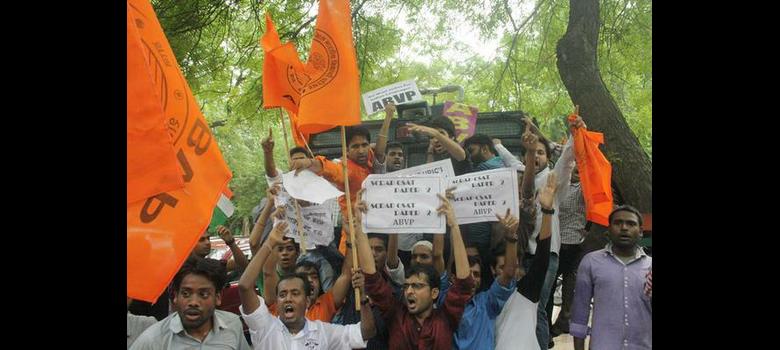
The Akhil Bharatiya Vidya Parishad, the BJP’s Youth Wing, sensed during last year’s Delhi University Student Union elections that opposition to the new Four Year Undergraduate Programme could be a key plank in remaining popular on campus. Incidentally, the FYUP had been opposed by the more left-wing organisations on campus from the very get-go, so the ABVP joined up with them to call for a roll-back of the four-year programme. The agitation quickly became a national issue, and eventually the FYUP was rolled back.

This ABVP-Left combine has now re-emerged in the agitation against the Union Public Service Commission’s Common Scholastic Aptitude Test, which is being fought on grounds that it is biased towards urban students. Yet again, the combined forces have managed to extract a concession from the government — despite opposition from the more reformist sections of the BJP.

Labour law reforms

Trade unions from across the country are meeting this week to try and decide how to approach the issue of labour law reforms, after the Rajasthan government last month passed legislation that made it easier for companies to retrench employees. These unions include both those on the Left, including the Communist Party of India (Marxist)-backed Centre of Indian Trade Unions  as well as the BJP-affiliated Bharatiya Mazdoor Sangh. Any decision to strike or launch a nationwide campaign by these groups could have a significant impact on a government that has insisted it is working primarily for the poor.

Foreign relations

The Modi government’s decision to vote against Israel at a United Nations forum shocked many supporters, who believe that India must be stand with Tel Aviv and remain steadfast against Islamic terrorism. It came as a pleasant surprise to those on the Left, however, who have always pushed India to speak up for those who live under Israeli occupation in Gaza and the West Bank.

The foreign relations convergence of the Left and Right was given a bigger boost after the Modi government decided to stand in the way of the World Trade Organisation’s Bali Package. Although the two factions here are unlikely to work together in pressuring the government to make decisions, particularly in the neighbourhood, the pressure to keep India relatively insulated from the West is likely to gain purchase from both sides.

via Scroll.in – News. Politics. Culture..

06/08/2014

Scramble for Dalit votes is sparking increased communal violence in UP

The key force driving the increasing communal polarisation in Uttar Pradesh is the scramble for Dalit votes in an attempt to weaken the Bahujan Samaj Party and deter Muslims from rallying behind it.

This strategy was evolved, and implemented, during the last Lok Sabha elections. But the competition to woo Dalits has gathered momentum ahead of bypolls to 12 assembly seats, five of which are in the western section of the state, which is often billed as the “wild west” of the Hindi heartland.

As the Indian Express reported, more than 600 incidents of communal violence have taken place in the state since May.

The Bharatiya Janata Party’s stake in the bypolls, which have yet to be scheduled, is enormous. Eleven of the 12 constituencies here had BJP MLAs, all of whom were elected to the Lok Sabha, as was the party’s ally, Apna Dal leader Anupriya Patel. The results will help measure the durability of the Modi wave, and its possible impact on the UP assembly elections in early 2017.  The verdict from UP could well determine the chances of Prime Minister Narendra Modi winning a second successive term in the 2019 polls.

The need to cobble together an electoral majority is driving political parties to resort to communal mobilisation. Local disputes over land, civic amenities, and exploitative gender relations have been given a communal hue and magnified to portray a monolith Hindu community arrayed against the Muslims.

via Scroll.in – News. Politics. Culture..

15/07/2014

One injured as explosion hits Xining airport car park in Qinghai | South China Morning Post

An explosion rocked the car park of Xining’s main airport today, state media reported. One person was injured by shrapnel, according to the authorities.

xining_blast-net.jpg

Police and bomb experts rushed to the scene within minutes of the blast and cordoned off the area around the busy Caojiapu (variably spelled as Caojiabao) airport.

One cleaner was hit when the object detonated in the lot just outside the terminal, the China West Airport Group said in a press statement at 4pm.

According to Chinanews.com, the staff was hit by a piece of glass and was sent to hospital.

Airport operations were not affected, the airport authority said. Cars in the parking lot were moved to other areas to clear the scene.

The Qinghai public security bureau and armed police are now conducting further investigation.

The explosives were concealed in a rubbish bin at the corner of the car park, according to the China Youth Daily.

A person surnamed Bao working for the public security bureau of Haidong prefecture near Xining told the South China Morning Post that the bureau’s command centre were not informed of the blast as yet, but that they would be sending staff to the scene.

“Airport police, anti-terror police, SWAT and paramilitary [officers] have cordoned off the site and are doing further investigation,” Bao said.

The Caojiapu airport is the busiest airport in the Tibet Plateau region. According to the airport’s figures, it handles four million trips a day.

Earlier in June, the airport held an emergency rescue drill – the largest held in the past 10 years – involving firefighters, medical emergency response teams as well as runway and airport maintenance teams.

Clearing explosives was part of the drill.

via One injured as explosion hits Xining airport car park in Qinghai | South China Morning Post.

08/07/2014

Congress to Parliament: Please Don’t Oppose Our Opposition – India Real Time – WSJ

India’s new session of Parliament has begun, and the Congress Party has a request: Make us the official “leader of the opposition.”

It turns out, that may be asking too much.

The Congress Party — which has governed India for most of the country’s modern history — lost so badly this time, it might not qualify for the right to name the official opposition leader, according to the parliamentary rulebook.

This isn’t a surprise: It’s well known that Congress’s drubbing in the election this year left it with less than 10% of the seats in the lower house of Parliament, the Lok Sabha. So, even though it’s the second-largest party in Parliament, behind the triumphant Bharatiya Janata Party, its share of seats is too small to qualify as official opposition leader.

Nevertheless, Congress has started pressing the issue. “We are the single largest party and we have a pre-poll alliance,” Congress party president Sonia Gandhi said during a televised press conference Monday, as Parliament’s budget session commenced. “We are entitled to get the post.”

Congress spokesman Randeep Surjewala said the post of the leader of opposition is a “constitutional right” of the Congress party. “The Lok Sabha cannot function without the opposition leader.”

Under Indian parliamentary procedural rules, the post of the leader of opposition has the rank of a cabinet minister. It goes to the second-largest party in the Lok Sabha, unless that party fails to win 10% of the seats, or 55, in the 545-member Lok Sabha. Congress has 44 members.

The job comes with some significant responsibilities. The leader of the opposition is part of a panel that selects members of the Central Vigilance Commission; members of the anti-graft national ombudsman, known as the Lokpal; and head of the Central Bureau of Investigation, the country’s federal investigative agency.

Subhash C. Kashyap, historian and former secretary-general of the Lok Sabha, said the Congress party should “stop hankering” for the post. “All its claims are unnecessary, unfounded and without any legal basis.”

via Congress to Parliament: Please Don’t Oppose Our Opposition – India Real Time – WSJ.

06/06/2014

China frees three activists after Tiananmen anniversary | Reuters

China released on Thursday three activists who had been detained for a month for attending a meeting to commemorate the military suppression of pro-democracy protests in Tiananmen Square in 1989, their lawyers said.

A police car guards in front of a giant portrait of China's late Chairman Mao Zedong at Tiananmen Square in Beijing June 4, 2014. REUTERS/Petar Kujundzic

The activists were freed a day after the 25th anniversary of the bloody crackdown, marked by tens of thousands of people in Hong Kong, even as Chinese authorities sought to whitewash the event in the mainland.

Two of their peers remained in custody.

via China frees three activists after Tiananmen anniversary | Reuters.

Enhanced by Zemanta
23/05/2014

Businessman linked to China’s ex-security tsar sentenced to death | Reuters

A former mining magnate with suspected ties to the family of China’s retired security tsar Zhou Yongkang was sentenced to death on Friday on charges of leading a gang on a crime spree spanning two decades.

Liu Han, former chairman of Hanlong Mining, smokes a cigarette during a conference in Mianyang, Sichuan province, in this file photo taken March 21, 2008.REUTERS/Stringer/Files

The sentencing of Liu Han, handed down by a court in the central province of Hubei, was the culmination of one of the highest-profile cases against a private businessman since President Xi Jinping took office last year and began a campaign against pervasive graft.

Liu’s younger brother Liu Yong, also known as Liu Wei, was also sentenced to death. Microblog statements from state media outlets China Central Television and the Xinhua news agency said the brothers, along with their 36-member “mafia-style” gang, committed intentional homicide.

Xi’s crackdown has zeroed in on Sichuan province, where Liu’s company – privately held Hanlong Mining – is based. Sichuan was a power base for Zhou, the retired chief of China’s vast domestic security apparatus, who stands at the centre of the biggest corruption scandal in more than six decades, sources have told Reuters.

Sources have told Reuters that Liu was once a business associate of Zhou Bin, Zhou Yongkang’s eldest son.

State media have not explicitly linked Liu’s case to Zhou Yongkang, but have said Liu’s rise coincided with Zhou’s time as Sichuan’s Communist Party boss.

Liu’s lawyer could not be immediately reached for comment.

Willy Lam, a scholar of Chinese history and politics at the Chinese University of Hong Kong, said there would be extra attention paid to the case because of Liu’s links to the Zhou family.

“I think what’s happening is that Xi Jinping and (Party anti-corruption tsar) Wang Qishan want to establish a harsh precedent because this is one of the biggest corruption cases since Xi took over,” Lam said. “They want to set a precedent to make people afraid, in a sense, to have a deterrence impact on corrupt officials.”

via Businessman linked to China’s ex-security tsar sentenced to death | Reuters.

Enhanced by Zemanta
21/05/2014

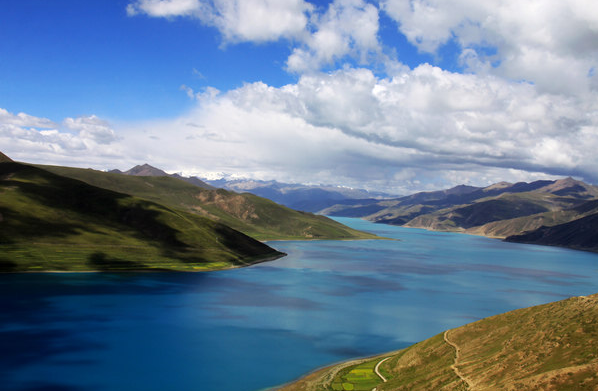
Tibet on track to become global tourist attraction[1]- Chinadaily.com.cn

Tourism increased in the Tibet autonomous region in the first four months of the year, as the region aspires to become a world-class travel destination.

Tibet on track to become global tourist attraction

The region had more than 830,000 tourists from January through April, a year-on-year increase of 23.4 percent, the regional tourism bureau said on Tuesday.

Foreign tourists numbered 20,000, an increase of 10.3 percent, and the number of domestic tourists was 810,000, an increase of 23.8 percent.

Meanwhile, the revenue generated by the tourism industry was 926 million yuan ($148.4 million), an increase of 26.2 percent, it said.

Karral Millar, 62, an Australian tourist, said she had a good time in Tibet.

“It’s wonderful. It’s been three days now. We have visited the Potala Palace and many temples, and we are learning new things about Tibetan Buddhism and history,” Millar said on Tuesday.

Cycling has become a popular way to tour the region in recent years, as many tourists want to have close contact with the natural scenery and culture of Tibet.

“It’s my second time in Tibet. I am absolutely impressed with the natural scenery and unique culture. I feel as if I am at home here,” said Liu Xiaojun, from Hebei province.

“I am also overwhelmed with the hospitality and politeness of the local people,” said Liu, adding that he plans to make a bicycle tour to Zhangmu Port in Tibet’s Xigaze prefecture.

Many businesses near the scenic spots in Lhasa see the coming of summer peak season as a harvest.

“Compared with the same period last year, we had more guests this year. We have 62 rooms, and more than half are booked every day,” said India, 41, a receptionist at the Kyichu Hotel, a Nepalese hotel in Lhasa.

Tibet received more than 12 million tourists from home and abroad lastar.

The region hopes to have 15 million tourists this year.

via Tibet on track to become global tourist attraction[1]- Chinadaily.com.cn.

Enhanced by Zemanta
17/05/2014

India’s Modi gets hero’s welcome as he brings new era to New Delhi | Reuters

Hundreds of Indians thronged the leafy streets of New Delhi on Saturday to greet Narendra Modi‘s triumphant march into the capital after he decimated the Nehru-Gandhi dynasty and the ruling Congress party in the biggest election victory the country has seen in 30 years.

Hindu nationalist Narendra Modi, the prime ministerial candidate for India's Bharatiya Janata Party (BJP), gestures towards his supporters from his car during a road show upon his arrival at the airport in New Delhi May 17, 2014. REUTERS/Adnan Abidi

Modi leaned far out of his car, waving a victory sign to jubilant supporters, in a drive from the airport to the headquarters of his Bharatiya Janata Party (BJP) in the center of town.

A Hindu nationalist who critics fear will be divisive and autocratic, Modi toned down religious issues in his pitch to India’s 815 million voters and won the world’s biggest ever election with promises of economic development for all.

The three-times chief minister of the western state of Gujarat is an outsider to Delhi’s power circle. The low-caste son of a tea stall-owner, his rise to power signals the end of an era dominated by the descendants of India’s first prime minister, independence hero Jawaharlal Nehru.

“Four to five generations have been wasted since 1952, this victory has been achieved after that,” Modi said, in a jibe at the Nehru-Gandhi family and the Congress it dominates.

Describing himself as a “worker”, he hailed grass-roots campaigners who showered him with pink rose petals as he arrived at party headquarters. There he met other party leaders and was expected to start discussions about forming a cabinet. Modi will not formally take office until after Tuesday, the party said.

Modi has given India its first parliamentary majority after 25 years of coalition governments, with his party winning more than six times the seats garnered by Congress.

With almost all 543 seats declared by Saturday morning, Modi’s BJP looked set to win 282 seats, 10 more than the majority required to rule. With its allied parties, it was heading for a comfortable tally of around 337 – the clearest result since the 1984 assassination of prime minister Indira Gandhi propelled her son Rajiv to office.

During the campaign Modi was explicit about wanting to end the dominance of the Nehru-Gandhi family on Indian politics. He may have achieved the goal, with Congress reduced to just 44 seats, less than half of its previous worst showing.

Modi’s landslide win gives him ample room to advance reforms started 23 years ago by current Prime Minister Manmohan Singh but which have stalled in recent years.

Despite his party’s pasting, 81-year-old Singh was magnanimous in his final address to the nation on Saturday, wishing the incoming government success. Later, he tendered his resignation.

“I am confident about the future of India,” he said in his televised message. “I firmly believe that the emergence of India as a major powerhouse of the evolving global economy is an idea whose time has come.”

Unlike Singh and his predecessors, Modi will not have to deal with unruly partners to implement reform. That could usher in profound economic changes, with some supporters imagining him as India’s answer to former British leader Margaret Thatcher.

via India’s Modi gets hero’s welcome as he brings new era to New Delhi | Reuters.

Enhanced by Zemanta
16/05/2014

Islamic leaders join efforts against extremism – China – Chinadaily.com.cn

China’s top Islamic leaders urged the nation’s Muslims to resist religious extremism and oppose to terrorism after a number of violent attacks in the Xinjiang Uygur autonomous region in March and April.

An SVG map of China with the Xinjiang autonomo...

An SVG map of China with the Xinjiang autonomous region highlighted Legend: Image:China map legend.png The orange area is Aksai Chin, a part of Xinjiang which is claimed by India. (Photo credit: Wikipedia)

Around 80 religious leaders and scholars discussed Islamic doctrine by quoting the Quran and the teachings of the Prophet Muhammad on Wednesday and Thursday in Urumqi, the region’s capital. On Thursday, Islamic leaders in China passed a proposal calling on all Muslims in the country to regulate their behavior, resist religious extremism and improve their moral outlook.

Abulitif Abdureyim, director of the Xinjiang Islamic Association, said governments at all levels in the region are resisiting religious extremism.

“The attackers who carried out the terrorist activities cannot go to heaven because they have violated the sayings in the Quran,” he said.

Wang Yujie, a professor of religious studies at Renmin University of China, said separatist forces are the main source of terrorism in Xinjiang.

In recent years, China has seen a number of violent attacks on police, government organs and civilians. Most of the attacks have taken place in Xinjiang.

A national security blue paper said on May 6 that religious extremism was the major reason for 10 violent terrorist attacks last year.

via Islamic leaders join efforts against extremism – China – Chinadaily.com.cn.

Enhanced by Zemanta
Law of Unintended Consequences

continuously updated blog about China & India

ChiaHou's Book Reviews

continuously updated blog about China & India

What's wrong with the world; and its economy

continuously updated blog about China & India