Archive for ‘non-military intervention’

25/08/2016

China’s logistic hub in Djibouti to stabilize region, protect interests – Global Times

About 7,700 kilometers away from Beijing, in Djibouti in the Horn of Africa, China’s first overseas installation for naval vessels is under construction.
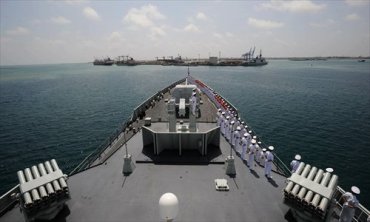
Scheduled to be completed in 2017, the base is set to resupply Chinese warships, according to government statements.

But despite Beijing’s insistence that the facility will simply help with escort missions, peacekeeping and humanitarian rescues in the Gulf of Aden and the waters off Somalia, many have argued this move represents Chinese “military expansion” beyond the Asia-Pacific region.

“Through exaggerating or distorting, they attempt to hype the ‘threat of China’ and tarnish China’s image, so as to suppress China’s efforts to build maritime power,” Li Jie, a Beijing-based maritime expert, told the Global Times.

“The base is far less than a military base in its scale and function,” said Zhang Junshe, a researcher from PLA Naval Military Studies Research Institute. “The base will be a logistic hub for Chinese vessels to get replenishment and temporary rest. It differs from US-style military bases, which have become bridgeheads for the country to easily and quickly wield military deterrence or intervention to other territories,” Li noted. The Republic of Djibouti, located in a strategically important position between the Indian Ocean and the Red Sea, hosts the military facilities of several countries, including the US, Japan and France, the country’s former colonial ruler. Italy and Spain also have permanent military installations in the country, according to a recent report by Hong Kong-based Phoenix TV.

These countries have stationed a variety of assets in these bases, including personnel, ships, UAVs and surveillance aircraft which are used for anti-terror and anti-piracy operations in Africa and the Middle East.
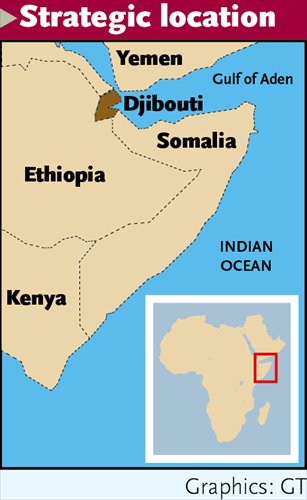
International obligations

The news that China will build a “military base” in Djibouti was first revealed in May last year, when Djiboutian President Ismail Omar Guelleh told AFP that “discussions are ongoing,” and China’s presence would be “welcome.

“Since then, it has aroused wide attention and concern. The US even reportedly protested against it. “Washington protested against the China-Djibouti pact and expressed concern over China’s plans to build a military base in the Obock region, but to no avail,” according to an article published in April on foreignaffairs.com, a US-based international affairs news portal.

At a regular press briefing on November 26, 2015, China’s foreign ministry first confirmed that China was negotiating with Djibouti over the construction of a “logistics facility.” Spokesman Hong Lei citied the need to resolve resupply difficulties for Chinese escort vessels, adding “[The facility] will be significant for Chinese army to fulfill its international obligations and safeguard global and regional peace and stability.”

Three months later at a press briefing by Chinese defense ministry on February 25, spokesman Wu Qian told media that China had reached an agreement with Djibouti to build a facility and construction had already begun. According to official figures, China has deployed more than 30,000 personnel on peacekeeping missions, the most of any of the five permanent members of the UN Security Council.Since 2008, China has sent 22 escort fleets, a total of more than 60 vessels, to the Gulf of Aden and Somali waters, escorting more than 6,000 ships from home and abroad.

In March last year, hundreds of Chinese nationals threatened by escalating violence in Yemen were evacuated to Djibouti by their government.

But currently, these fleets need to dock in the ports of other countries to get rest and food supplies. “They need to organize people to purchase food locally. Besides, due to different types of fuels, refueling is also a problem,” Zhang said.

The new base will help China save money. Yang Huawen, a captain from China’s Northern Theater Command who joined a 10-month peacekeeping operation in Mali in 2014, is happy this facility is being built.

“In those tropical areas, the food goes bad quickly. The cost of mending equipment and maintenance is high,” Yang told the Global Times. “Building a logistic hub in the region can provide stable supplies efficiently and economically.”

Djibouti, with a landmass of 23,200 square kilometers of which 90 percent is volcanic desert, is poor in natural resources. Its ability to produce fruits, vegetables, and seafood is limited, according to a Chinese national who has spent time in the country. “Most of its vegetables are imported from its neighbor Ethiopia. Vegetables sell for there as much as five to 10 times what they do on the domestic market in China,” said the person.

Zhang also cited another advantage of the new facility – the Chinese government needn’t conduct diplomatic negotiations with the host country each time its vessels dock in their port.


Source: China’s logistic hub in Djibouti to stabilize region, protect interests – Global Times

04/01/2014

Chinese warship in Cyprus to aid Syrian chemical weapons removal | Reuters

A Chinese frigate which will help escort Syria\’s stockpile of chemical weapons out of the country docked in Cyprus on Saturday as part of a delayed international mission.

Chinese nationals living in Cyprus wave Chinese national flags as the Chinese frigate Yancheng comes in to dock at Limassol port, January 4, 2014. REUTERS-Andreas Manolis

The Yancheng, a missile frigate, will accompany a Norwegian-Danish convoy which is in international waters off Syria, waiting for the go-ahead from international watchdogs overseeing the removal of the chemical arsenal.

The mission to ship chemicals from Syria has missed its December 31 target date and Chinese and Cypriot officials said it was unclear exactly when it would begin.

via Chinese warship in Cyprus to aid Syrian chemical weapons removal | Reuters.

Enhanced by Zemanta
26/07/2013

India, China trying to develop mechanism to prevent face-off: AK Antony

Daulat Beg Oldi is in northernmost Ladakh.

Daulat Beg Oldi is in northernmost Ladakh. (Photo credit: Wikipedia)

Times of India: “NEW DELHI: India and China are trying to develop effective mechanisms to prevent the “embarrassing” face-offs between their troops along the “disputed” points of the Line of Actual Control, defence minister AK Antony said here on Friday.


Terming the 21-day stand-off between the two sides in Depsang valley in Daulat Beg Oldi area as an “unusual” incident, the defence minister said the two countries will meet soon in Beijing to discuss issues and try to find a solution for such “unpleasant incidents”.

“Till the final settlement of the border issue, we are trying to find out more effective mechanisms to prevent occasional incidents. There are many points in the LAC that are disputed and they are patrolled by both sides. So, sometimes it leads to some face-off,” he told reporters on the 14th anniversary of Kargil Vijay Diwas.”

via India, China trying to develop mechanism to prevent face-off: AK Antony – The Times of India.

10/04/2013

* Indian Prime Minister Manmohan Singh Mourns U.N. Peacekeepers Killed in South Sudan

WSJ: “Indian Prime Minister Manmohan Singh paid tribute to the five “brave soldiers” who died Tuesday morning in the deadliest attack on the United Nations in South Sudan since the country’s secession in July 2011.

The five Indian soldiers, including a lieutenant colonel, were part of a group escorting a convoy of U.N. civilian staff and contractors. They came under attack near the settlement of Gumuruk in Jonglei state, South Sudan. Around 200 armed men attacked the convoy. No group has claimed responsibility for the attack, in which two U.N. staff and five civilian contractors were also killed.

The dead Indian troops have been named as Lieutenant Colonel Mahipal Singh, Shiv Kumar Pal, Hira Lal, Bharat Singh and Nand Kishore.

Nine others, including four Indian soldiers, were injured in the attack, according to reports.

via Indian Prime Minister Manmohan Singh Mourns U.N. Peacekeepers Killed in South Sudan – India Real Time – WSJ.

14/08/2012

* Syria crisis: China hosts Assad aide Bouthaina Shaaban

BBC News: “A senior aide to Syria’s President Bashar al-Assad has flown to China for talks on the crisis, officials say.

The Chinese foreign ministry said Bouthaina Shaaban would meet Foreign Minister Yang Jiechi later.

The ministry said it was part of its effort to implement the UN’s six-point peace plan. China has twice vetoed UN resolutions against the Assad regime.

Meanwhile, UN humanitarian chief Valerie Amos has arrived in Syria to assess the flow of emergency aid.

She is expected to ask for more visas for foreign aid workers as the Syrian Arab Red Crescent struggles to distribute food.

The UN says an estimated two million Syrian civilians have now been affected by the crisis and more than one million have fled their homes.

Tens of thousands of people have fled across Syria’s borders into Turkey, Jordan, Lebanon and Iraq amid continuing violence across the country.

In another development, foreign ministers of the Islamic Co-operation Organisation (OIC) have called for Syria to be suspended from the 57-nation bloc at an emergency two-day summit in Mecca, Saudi Arabia, which starts on Tuesday.

Only ministers from Algeria and Iran, which is regarded as Syria’s closest ally, were against the recommendation, reports say.

“We certainly do not agree with the suspension of any OIC member,” Iranian Foreign Minister Ali Akbar Salehi said after a preliminary meeting in the city of Jeddah on Monday.

“We have to look for other ways, means and mechanisms for resolving conflicts and crises,” he said.”

via BBC News – Syria crisis: China hosts Assad aide Bouthaina Shaaban.

Despite the deteriorating situation in Syria, China resolutely sticks to its principle of non-military intervention and its position of not supporting any regime change.

Law of Unintended Consequences

continuously updated blog about China & India

ChiaHou's Book Reviews

continuously updated blog about China & India

What's wrong with the world; and its economy

continuously updated blog about China & India