Chindia Alert: You’ll be Living in their World Very Soon
aims to alert you to the threats and opportunities that China and India present. China and India require serious attention; case of ‘hidden dragon and crouching tiger’.
Without this attention, governments, businesses and, indeed, individuals may find themselves at a great disadvantage sooner rather than later.
The POSTs (front webpages) are mainly 'cuttings' from reliable sources, updated continuously.
The PAGEs (see Tabs, above) attempt to make the information more meaningful by putting some structure to the information we have researched and assembled since 2006.
Chinese President Xi Jinping holds a welcome ceremony for Suriname’s President Desire Bouterse before their talks at the Great Hall of the People in Beijing, capital of China, Nov. 27, 2019. (Xinhua/Yue Yuewei)
BEIJING, Nov. 27 (Xinhua) — China and Suriname on Wednesday decided to upgrade their relationship to a strategic partnership of cooperation.
The announcement came as Chinese President Xi Jinping held talks with Surinamese President Desire Bouterse at the Great Hall of the People in Beijing.
During the talks, Xi said Suriname is one of the first Caribbean countries to establish diplomatic relations with China. The relations can be considered a model of friendly relations and equal treatment between countries of different sizes.
The development of bilateral ties is in an important historical period, and China is willing to work with Suriname to take the opportunity of the Belt and Road cooperation to uplift the ties to new heights, said Xi.
Xi stressed that the two countries should maintain support on issues involving each other’s core interests and major concerns.
Xi called on the two sides to deepen cooperation in areas such as infrastructure construction, agriculture, forestry, fisheries, communications and energy, and explore cooperation in new areas such as new energy, digital economy, tourism and ocean economy.
“China encourages more capable Chinese companies to invest in Suriname,” said Xi.
Noting that Suriname is one of the countries with the largest overseas Chinese population in the Caribbean area, Xi said it is necessary to promote cultural exchanges, facilitate personnel exchanges and strengthen cooperation in areas such as education and law enforcement. China will also send a medical expert panel to Suriname.
The two sides should maintain communication and coordination on global issues, practice multilateralism, build an open world economy and safeguard the common interests of both countries and all developing countries, said Xi.
China is willing to continue to speak out from a sense of justice for Suriname on multilateral occasions and work together with the international community including Suriname to constructively participate in the multilateral process on global climate issues, he said.
Xi added that China has always respected the right of Latin American people to choose their own development path and supported the process of Latin American integration and the handling of regional issues through dialogue and consultation.
China is willing to work with Latin America to promote the construction of the Belt and Road and deepen China-Latin America cooperation by the principles of equal treatment and mutual benefit, said Xi.
Bouterse extended congratulations on the 70th founding anniversary of the People’s Republic of China, and said under Xi’s leadership, socialism with Chinese characteristics will be a success and will bring benefits to the Chinese people and people around the world.
Underscoring the historic and political significance of his visit, Bouterse said Suriname will firmly uphold the one-China principle and support China’s national reunification.
He said Suriname is grateful for China’s help in his country’s economic and social development, and ready to work with China to enhance exchanges at all levels, cement political mutual trust, expand economic and trade cooperation, deepen people-to-people exchanges and take the joint construction of the Belt and Road as an opportunity to upgrade bilateral strategic relations.
Suriname stands ready to work with China to safeguard multilateralism, international law and basic norms of international relations, Bouterse said.
After the meeting, Xi and Bouterse witnessed the signing of several cooperation documents.
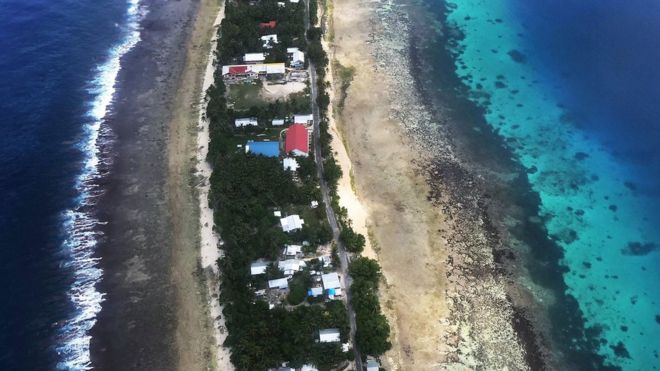
Image copyrightGETTY IMAGESImage captionTuvalu is battling rising sea levels
The tiny South Pacific nation of Tuvalu has rejected offers from Chinese firms to build artificial islands that would help it deal with rising sea levels, its foreign minister says.
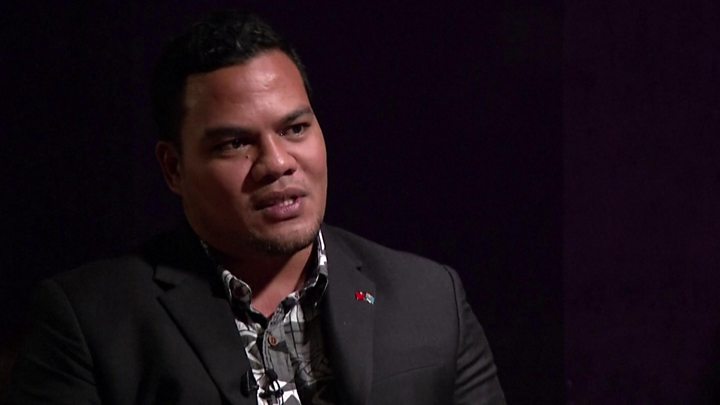
Simon Kofe told Reuters he saw the offers as an attempt to reduce Taiwan’s influence in the region.
But he instead reaffirmed his country’s support for Taiwan.
China has increased efforts to expand its influence in the Pacific, alarming the United States and its allies.
Only 15 countries recognise Taiwan as a sovereign nation and have full diplomatic relations. A number of countries have switched their allegiance from Taiwan to China in recent years.
China refuses to have diplomatic relations with any country that recognises Taiwan.
In recent months Taiwan lost two allies in the region, when Kiribati and the Solomon Islands switched diplomatic recognition to China. Beijing has been accused of luring them in with the promise of financial aid and airplanes.
Media caption Tuvalu’s foreign minister discusses increasing pressure from China
Mr Kofe expressed his backing for Taiwan and said his nation was setting up a group to unite Taiwan’s four remaining Pacific allies – the Marshall Islands, Palau, Nauru and Tuvalu.
“We believe in the power of grouping together and collaborating,” he told Reuters news agency.
“Together with our partners, we will be able to counter the influence from mainland China.”
Mr Kofe said Chinese companies had approached local communities offering to help with a $400m (£310m) government plan to build artificial islands. He believes the companies were backed by the Chinese government.
“We are hearing a lot of information about debt,” he said. “China buying our islands and looking at setting up military bases in our part of the world. Those are things that are concerning to us.”
Beijing has proposed Taiwan operate under a “one country, two systems” structure, similar to Hong Kong.
Since Taiwan President Tsai Ing-wen took office in 2016, seven countries have dropped Taiwan as a diplomatic ally. The support from Tuvalu could help her as she seeks re-election in January.
HONG KONG (Reuters) – China’s People’s Liberation Army (PLA) soldiers in shorts and t-shirts made a surprising appearance in some Hong Kong streets on Saturday, briefly helping residents clean up debris after anti-government protests blocked roads, witnesses said.
The presence of PLA troops on the streets, even to help clean up roads near their base, could stoke further controversy over the Chinese-ruled territory’s autonomous status.
Hong Kong has been rocked by more than five months of demonstrations by protesters angry at perceived Communist Party meddling in the former British colony, which was guaranteed its freedoms when it returned to Chinese rule in 1997.
Beijing denies interfering and has blamed the unrest on foreign influences.
Clashes between protesters and police have become increasingly violent. China has warned that any attempt at independence for Hong Kong will be crushed, but troops have remained inside their base.
RELATED COVERAGE
China’s PLA soldiers seen helping clean up streets after Hong Kong protests – RTHK
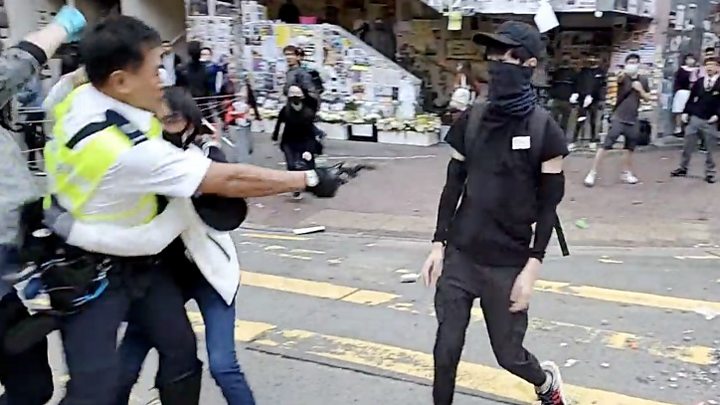
Saturday’s clean up followed some of the worst violence seen this year, after a police operation against protesters at the Chinese University of Hong Kong on Tuesday.
The authorities have since largely stayed away from at least five university campuses that had been barricaded by thousands of students and activists who stockpiled petrol bombs, catapults, bows and arrows and other weapons.
Many protesters appeared to have left the campuses by late Saturday, though some remained behind to man makeshift barricades. Hong Kong’s Cross-Harbour Tunnel was still blocked by protesters occupying Polytechnic University.
Earlier, hundreds of pro-China demonstrators gathered by the city’s legislature and police headquarters, waving Chinese and Hong Kong flags. Some held up posters reading “Police we stand with you”, while others chanted “Support the police”.
Pro-China protests have so far attracted much smaller numbers than those angry at Beijing.
RARE TROOP PRESENCE
By late afternoon, the PLA soldiers had left the streets outside Baptist University, beside their barracks in leafy Kowloon Tong.
Chinese troops have appeared on local streets only once since the 1997 handover, to help with cleanup operations after a typhoon in late 2018. It was not immediately clear how many were involved on Saturday.
Calls to the PLA Hong Kong garrison office and a media liaison officer went unanswered.
Demosistō, a pro-democracy organisation, said Saturday’s cleanup operation could set a “grave precedent” if the city’s government invites the military to deal with internal problems.
In August, Beijing moved thousands of troops across the border into Hong Kong in what state news agency Xinhua described as a routine “rotation”.
Foreign envoys and security analysts estimate up to 12,000 troops are now based across Hong Kong — more than double the usual garrison number.
Standing beside a black flag with the slogan “Liberate Hong Kong, Revolution of our Times,” James Wong, 23, was among a handful of protesters still manning a bridge at Baptist University.
“We didn’t want to confront the people and the PLA troops directly,” he told Reuters. “We are not directly against the PLA, but rather the government. But the PLA should not leave their base because this is Hong Kong territory.”
Wong said even after the campus fortifications have been dismantled “Hong Kong will keep resisting until the government responds to our demands”.
Hundreds of residents moved in to help clear barricaded roads near several universities.
Clashes on Saturday saw at least one petrol bomb thrown before anti-government protesters at the campuses retreated. No soldiers appeared to have been involved in the confrontations.
“We just want our lives to continue,” said one resident who was helping clear streets near HKU. “There are many elderly who need to go the hospital and children who need to go to school. I am very sad to see what is happening in my community.”
PRO-POLICE DEMONSTRATION
Saturday’s rally to denounce the anti-government violence drew a mix of young and elderly.
“From the bottom of our hearts, we believe it is the correct thing to support the police in fighting the rioters for Hong Kong citizens,” said a 49-year-old housewife surnamed Kong.
“A lot of people keep silent, afraid of the rioters. It’s time for all the people who are silent to step up and say that’s enough.”
A 70-year-old street cleaner died on Thursday after being hit on the head by one of several bricks police said had been thrown by “masked rioters”. On Monday, police blamed a “rioter” for dousing a man in petrol and setting him on fire. The victim is in critical condition.
On the same day, police shot a protester in the abdomen. He was in a stable condition.
Many pro-police protesters laid white flowers outside the government office to pay their respects to the cleaner. Others applauded and cheered the police, some bowing and giving thumbs up as they walked past riot police on duty.
Authorities said on Saturday that a highway blocked by anti-government protesters on Friday had reopened after being cleared of debris and petrol bombs.
Train services suspended earlier in the week were gradually resuming, metro operator MTR Corp (0066.HK) said.
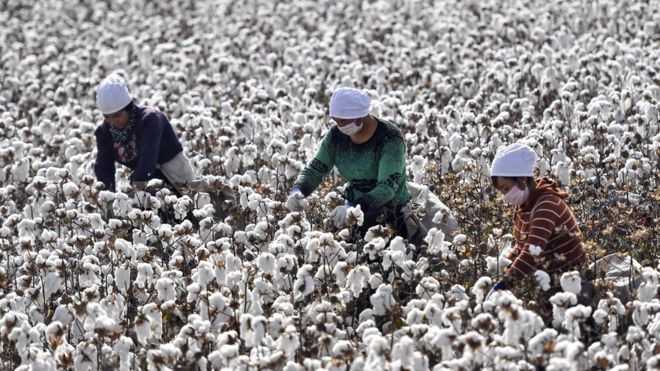
Global retailers are facing scrutiny over cotton supplies sourced from Xinjiang, a Chinese region plagued by allegations of human rights abuses.
China is one of the world’s top cotton producers and most of its crop is grown in Xinjiang.
Rights groups say Xinjiang’s Uighur minority are being persecuted and recruited for forced labour.
Many brands are thought to indirectly source cotton products from the Xinjiang region in China’s far west.
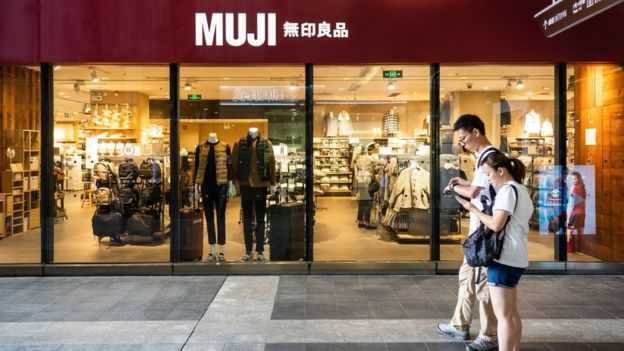
Japanese retailers Muji and Uniqlo attracted attention recently after a report highlighted the brands used the Xinjiang-origin of their cotton as a selling point in advertisements.
“You can’t be sure that you don’t have coerced labour in your supply chain if you do cotton business in China,” said Nathan Ruser, researcher at the Australian Strategic Policy Institute.
“Xinjiang labour and what is almost certainly coerced labour is very deeply entrenched into the supply chain that exists in Xinjiang.”
What is happening in Xinjiang?
UN experts and human rights groups say China is holding more than a million Uighurs and other ethnic minorities in vast detention camps.
Rights groups also say people in camps are made to learn Mandarin Chinese, swear loyalty to President Xi Jinping, and criticise or renounce their faith.
China says those people are attending “vocational training centres” which are giving them jobs and helping them integrate into Chinese society, in the name of preventing terrorism.
What is produced in Xinjiang?
The Xinjiang region is a key hub of Chinese cotton production.
Last year, 84% of Chinese cotton came from Xinjiang, the report said.
That has raised concerns over whether forced labour has been used in the production of cotton from the region.
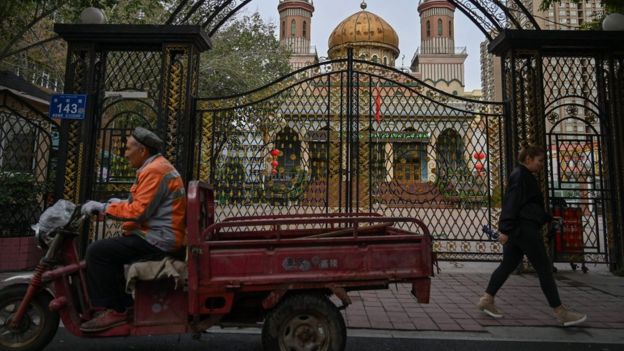
Image copyright GETTY IMAGESImage caption The Uighurs are mostly Muslims, and number about 11 million in China’s Xinjiang region
Nury Turkel, chairman of the Uighur Human Rights Project in Washington, said the Uighurs were being “detained and tormented” and “swept into a vast system of forced labor” in Xinjiang.
In testimony to US congress, he said it was becoming “increasingly hard to ignore the fact” that the goods manufactured in the region have “a high likelihood” of being produced with forced labour.
Which brands use Xinjiang cotton?
Amy Lehr, director of CSIS Human Rights Initiative, said in many cases Western companies aren’t buying directly from factories in Xinjiang.
“Rather, the products may go through several stages of transformation after leaving Xinjiang before they are sent to large Western brands,” she said.
Some, like Muji, are very open about sourcing material from Xinjiang.
“Uniqlo does not have any production partners located in the Xinjiang region. Moreover, Uniqlo production partners must commit to our strict company code of conduct.
“To the best of our knowledge, this means our cotton comes only from ethical sources,” the spokesperson told the BBC.
Many of the companies looked into the allegations, including those without clear links to the Huafu mill.
In a statement to the BBC, Adidas said: “While we do not have a contractual relationship with Huafu Fashion Co., or any direct leverage with this business entity or its subsidiary, we are currently investigating these claims.”
“We advised our material suppliers to place no orders with Huafu until we have completed those investigations,” the Adidas spokesperson said.
Esprit, which also does not source cotton directly from Xinjiang, said it had made several inquiries earlier this year.
“We concluded that a very small amount of cotton from a Huafu factory in Xinjiang was used in a limited number of Esprit garments,” the firm said in a statement.
The company has instructed all suppliers to not source Huafu yarn from Aksu, the statement said.
H&M said it does not have “a direct or indirect business relationship” with any garment manufacturer in the Xinjiang region.
“We have an indirect business relationship with Huafu’s spinning unit in Shanyu, which is not located in the Xinjiang region, and according to our data, the vast majority of the yarn used for our garment manufacturing comes from this spinning unit,” a spokesperson for H&M said.
“Since we have an indirect business relationship with the yarn supplier Huafu, we also asked for access to their spinning facilities in Aksu. Our investigations showed no evidence of forced labor.”
Hong Kong’s rule of law has been pushed to the “brink of total collapse” after more than five months of protests, police have warned.
The warning came as protesters clashed with police across the city on Tuesday.
At the Chinese University of Hong Kong, police fired tear gas and rubber bullets at protesters who built barricades on the campus.
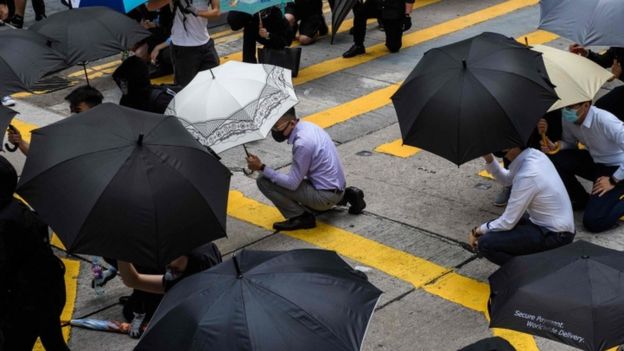
Earlier in the day, around 1,000 protesters rallied in central Hong Kong during the lunch hour blocking roads
Protesters, wearing office clothes, were seen chanting: “Fight for freedom, stand with Hong Kong!”
The demonstrations come just a day after the territory saw a marked escalation in violence, with police shooting one activist in the torso. A pro-Beijing supporter was set on fire by anti-government protesters.
The protests started in June against a now-withdrawn plan to allow extradition to mainland China, but have since morphed into wider demonstrations, with activists demanding greater democracy and police accountability in Hong Kong.
On Tuesday afternoon, police spokesman Kong Wing-cheung hit out at the protesters, saying they had “countless examples of rioters using random and indiscriminate violence against innocent” people.
“Hong Kong’s rule of law has been pushed to the brink of total collapse as masked rioters recklessly escalate their violence under the hope that they can get away with it,” he told reporters, adding that Monday’s attack on the pro-Beijing supporter was being investigated as attempted murder.
Image copyright AFPImage caption Protesters and office workers were seen blocking roads in Hong Kong’s financial district
Speaking at the same conference, Supt Li Kwai-wah defended the officer’s decision to shoot the protester on Monday.
“We found out that our colleague did not only face threat from one person, instead it was a group of people with an organised plan attempting to steal the gun,” he said.
“In a situation like this, we believe our police are reacting according to the guideline, to protect themselves as well as the people around them.”
Both the protester and the pro-Beijing supporter remain in hospital, with the latter in a critical condition.
What happened on Tuesday?
Clashes erupted at the Chinese University of Hong Kong, with police firing tear gas to disperse students, while at City University there was a standoff between students and riot police which continued into the evening.
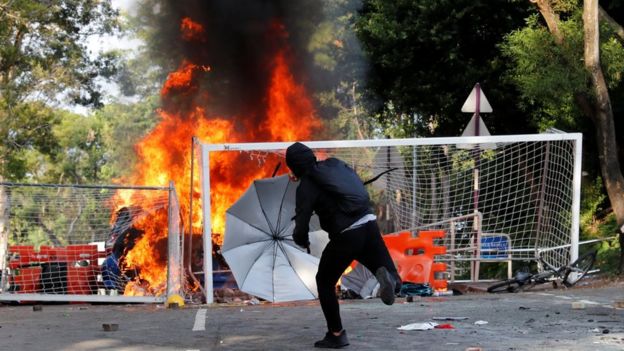
Police continued to use tear gas to try to disperse the protesters who responded with bricks and petrol bombs. Hundreds of protesters remain at the Chinese University of Hong Kong.
Image copyright REUTERSImage caption Students at Hong Kong’s Chinese University fought with police throughout the day
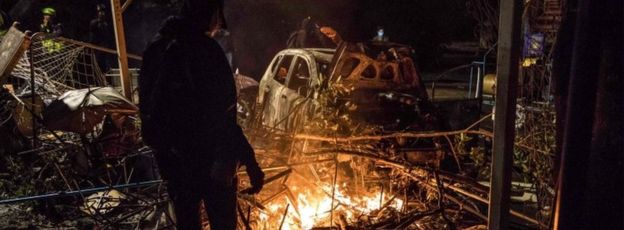
Students built roadblocks on streets in and around City University campus to stop police from entering. At one stage, a van used as part of a street barricade was set on fire.
Students at Hong Kong Polytechnic also tried to disrupt traffic near their campus.
In the morning, suspended railway services and road closures had already led to long traffic jams in the early rush hour. At noon, protesters moved into the city’s central business district for a flash mob protest.
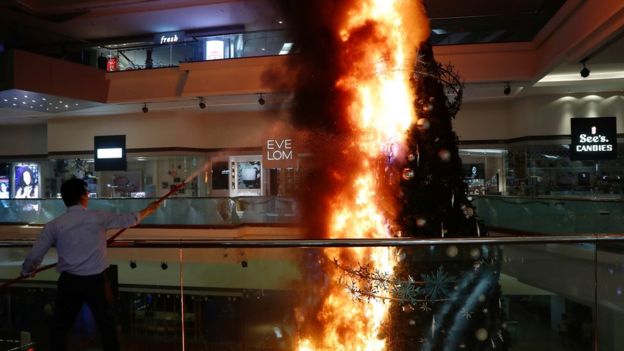
Image copyright REUTERSImage caption At Festival Walk shopping mall, a Christmas tree was set on fire
Protests continued to intensify throughout the day. A Christmas tree inside Festival Walk shopping mall was set on fire by protesters while others were seen smashing a glass railing with hammers.
Train stations were closed across the city.
Media caption This Hong Kong protester’s shooting was livestreamed on Facebook
Eight universities have announced they will suspend classes on Wednesday.
Monday’s protests saw 260 people arrested bringing the number to more than 3,000 since the protests began in June.
Students swear they will not surrender
Grace Tsoi, BBC World Service, at the Chinese University of Hong Kong
Image copyright AFPImage caption Hundreds of protesters remain at the university
The ground was strewn with bricks. The air was filled with the smell of tear gas. Fire was raging on campus. Hundreds of protesters, most of them clad in black, formed human chains to pass bricks and petrol bombs to the front line.
One of the best universities in Hong Kong has turned into a battlefield after another day of intense clashes between students, who have been at the forefront of anti-government protests, and police.
The Chinese University students have been putting up resistance since the morning. On Monday, police seemed to change strategy by deploying forces to campuses. Students told me they should not be allowed there.
The university’s management has tried to deescalate the situation. Vice-chancellor Rocky Tuan was also tear gassed as he was negotiating with police.
Dozens of students have been injured, including at least one hit in the eye by a projectile. The night is young and students swear they will not surrender.
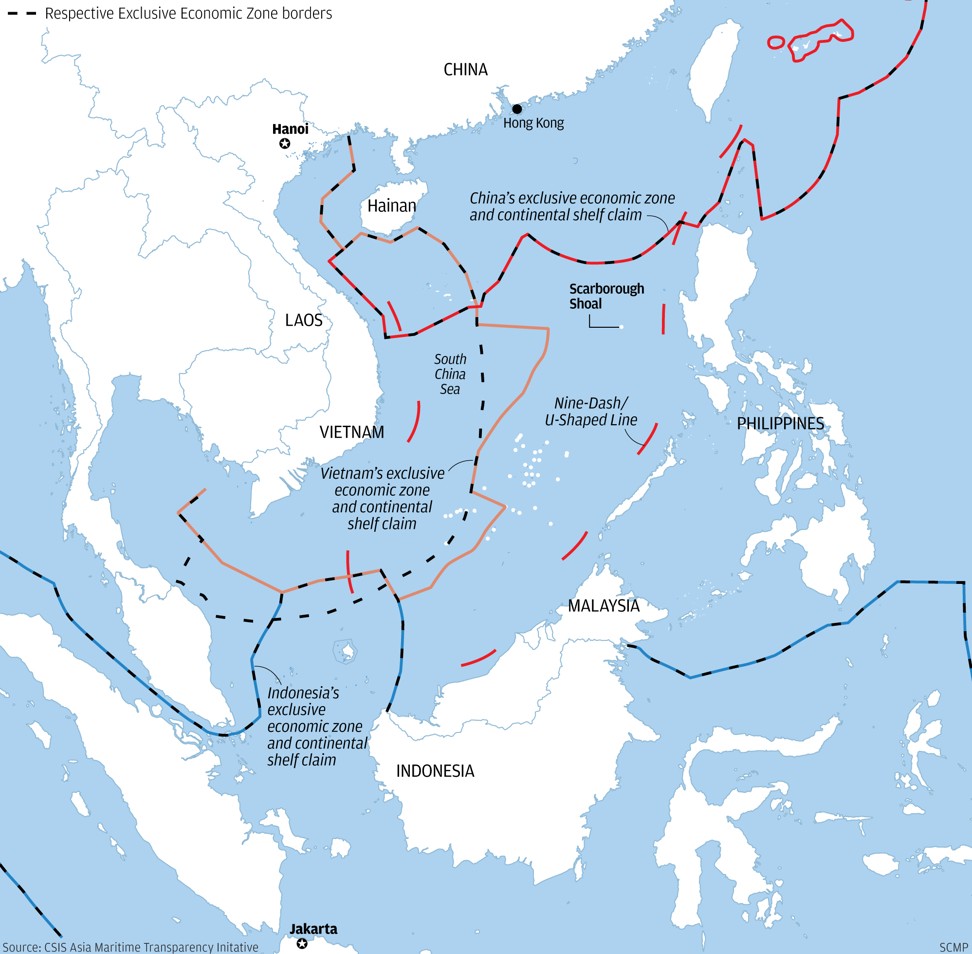
Chan is accused of supporting Beijing’s so-called nine-dash line, which is its historical justification for its territorial claims in the resource-rich sea
Vietnam, Malaysia, the Philippines, Taiwan and Brunei all have competing claims in the waterway that overlap with China’s
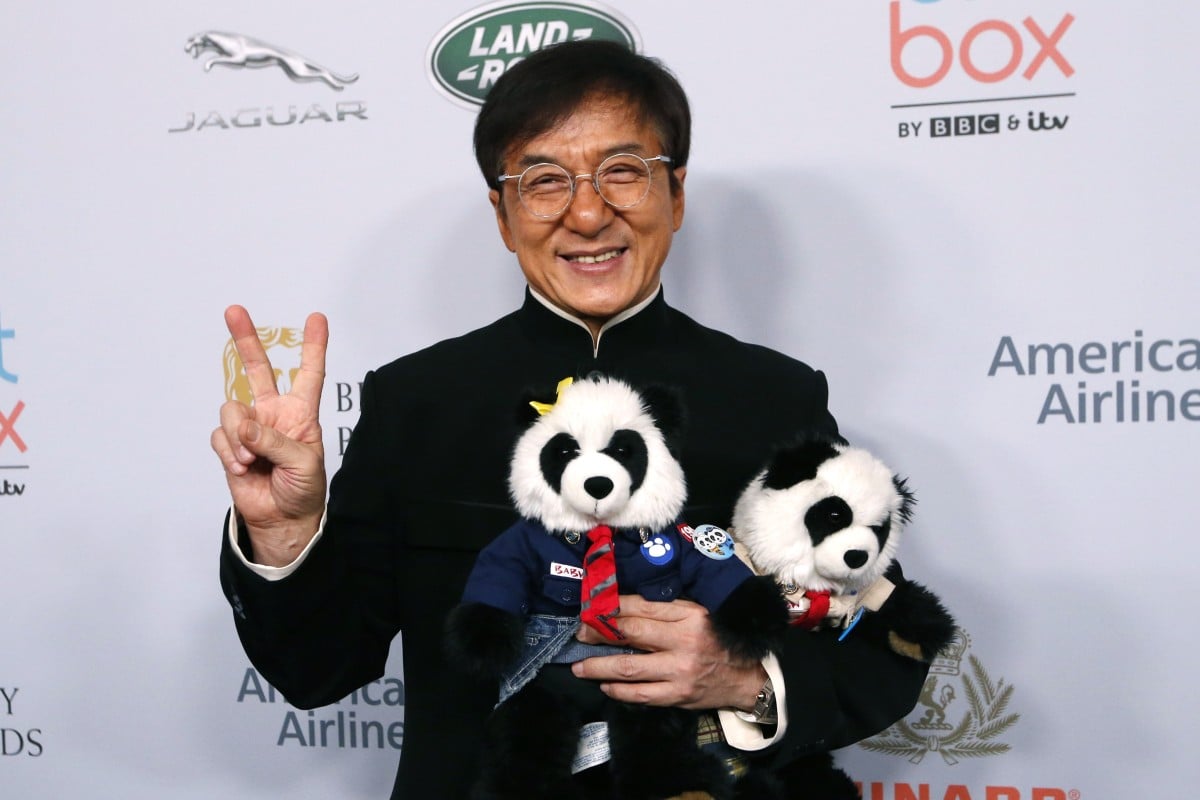
Film star Jackie Chan. Photo: Reuters
Martial arts film star Jackie Chan’s planned visit to Vietnam for a charity has been cancelled following an online backlash related to Beijing’s expansive claims in the disputed South China Sea.
The Hong Kong-born actor was set to visit Hanoi on November 10 to support Operation Smile, a charity that gives free surgery to children with facial disfigurements.
Jackie Chan says he wants to make films in Saudi Arabia
But the plans were scrapped after thousands of angry Facebook users flooded the charity’s official page when his visit was announced last week.
Some of their comments claimed Chan had spoken in support of China’s so-called nine-dash line – its historical justification for its territorial claims in the resource-rich sea.
A map showing claimant countries’ exclusive economic zones in the South China Sea.
However, Chan has not explicitly expressed public support for the controversial maritime assertion.
Vietnam, Malaysia, the Philippines, Taiwan and Brunei all have competing claims in the waterway that overlap with China’s – long a source of tension in the region.
Issuing a mea culpa on Friday for failing “to predict the reaction” of the Vietnamese public, the charity asserted that their work is “non-political”.
“We are very sorry … Operation Smile will not organise any activities with [Chan’s] involvement” in Vietnam, they said.
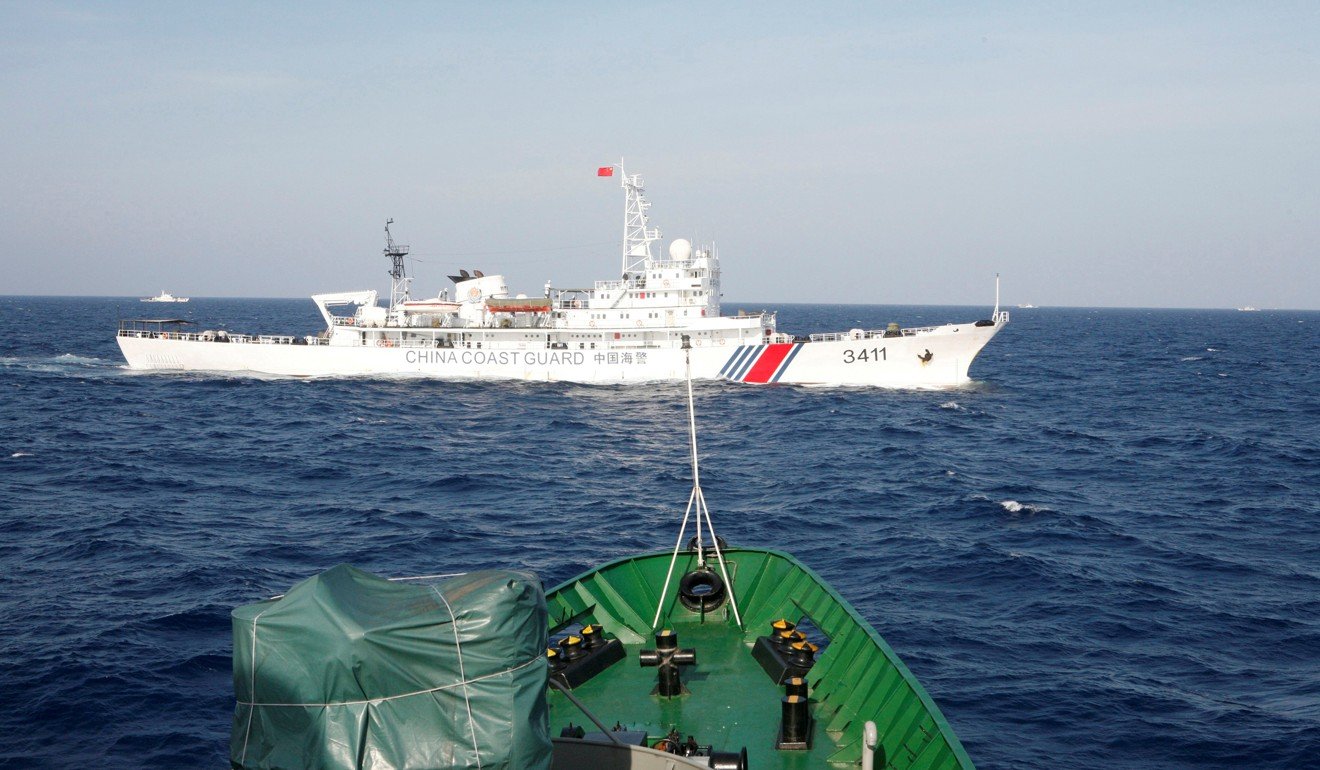
A Chinese coastguard ship sails by a Vietnamese vessel off the coast of Vietnam in 2014. Photo: Reuters
Vietnam is one of Beijing’s most vocal critics over the flashpoint South China Sea issue.
The foreign ministry on Thursday repeated its usual proclamation on the sea, citing the country’s “full legal basis and true evidence to affirm Vietnam’s sovereignty”, deputy spokesperson Ngo Toan Thang said.
Chan has in the past been accused of siding with China over Hong Kong’s democracy protests after calling the unrest in his hometown “sad and depressing”.
The comment sparked ire in Hong Kong but was warmly received by many in China where he has a massive fan base.
Abominable has been criticised for a scene showing the nine-dash line. Photo: DreamWorks
Beijing claims most the South China Sea through the vague delineation, which is based on maps from the 1940s as the then-Republic of China snapped up islands from Japanese control.
Chinese Vice Premier Han Zheng, also a member of the Standing Committee of the Political Bureau of the Communist Party of China Central Committee, meets with Kazakhstan’s First Deputy Prime Minister Alikhan Smailov, who also co-chaired the 9th meeting of the China-Kazakhstan Cooperation Committee, in Beijing, capital of China, Nov. 4, 2019. (Xinhua/Yan Yan)
BEIJING, Nov. 4 (Xinhua) — Chinese Vice Premier Han Zheng met with Kazakhstan’s First Deputy Prime Minister Alikhan Smailov Monday in Beijing, who also co-chaired the 9th meeting of the China-Kazakhstan Cooperation Committee.
Han, also a Standing Committee member of the Political Bureau of the Communist Party of China Central Committee, said the development of bilateral ties had been healthy and steady to become a model of relations between neighboring countries.
Earlier this year, China and Kazakhstan upgraded their relations to a permanent comprehensive strategic partnership, which Han said marked a new phase of bilateral relations.
The China-Kazakhstan Cooperation Committee, as an intergovernmental mechanism, makes overall planning for, coordinates and guides bilateral cooperation.
Han said since the last meeting of the committee, the two countries had deepened the synergy of their development strategies, accelerated trade, investment and industrial cooperation, strengthened financial cooperation, and continuously enhanced cooperation in security, environmental protection, energy, technology and mining.
Noting the solid foundation, huge potential and broad prospects of bilateral cooperation, Han said the two countries should promote cooperation in industrial capacity, transportation, agriculture and energy.
He called on the two sides to jointly implement the synergy between the Silk Road Economic Belt and Kazakhstan’s “Bright Road” new economic policy, strengthen innovation-driven cooperation and carry out digital industry, blockchain and biotechnology cooperation to create new growth points.
He said the two sides should carry out more facilitation measures to constantly optimize the business environment and guarantee the rights and interests of enterprises from both countries.
Smailov said Kazakhstan is ready to work with China to promote cooperation in trade, finance, energy, agriculture, transportation, logistics and infrastructure to benefit the two peoples.
Latest measures grant island’s people and enterprises more equal treatment with their mainland counterparts
Package in March last year was dismissed by Taiwan’s Mainland Affairs Council as an attempt to buy political support
Taipei’s elections in January could influence the tone of cross-strait relations. Photo: EPA-EFE
Beijing announced a series of sweeteners for Taiwanese businesses and individuals on Monday – including participation in its 5G research and allowing Taiwanese to use mainland consular services – only two months before Taiwan’s critical presidential election.
The latest 26 measures drawn up by 20 government departments, including the State Council’s Taiwan Affairs Office and the National Development and Reform Commission, are designed to attract more Taiwanese to live and work in mainland China, despite worsening cross-strait relations.
But Taiwan’s Mainland Affairs Council criticised the move as an attempt by the Chinese Communist Party to “divide Taiwan internally, and was a further reflection of attempts to try to interfere in and influence Taiwan’s election”.
It follows a similar package of 31 measures unveiled by Beijing in March last year, which included tax incentives, preferential land-use policies for Taiwanese businesses on the mainland and benefits for Taiwanese individuals in studying or living on the mainland.
Taiwan charges pro-Beijing politicians with accepting mainland cash
The latest measures to grant Taiwan-funded enterprises more equal treatment with their mainland counterparts include offering access to research and development in 5G technology, investment in passenger and cargo air services, the establishment of microlending and financing companies and the right to apply for financial guarantees from local government funds.
Taiwanese individuals will also be officially entitled to mainland Chinese consular protection abroad, will be treated the same as their mainland counterparts when buying residential property on the mainland, and will be able to train in Beijing for the 2020 Olympic Games.
Beijing claims sovereignty over self-ruled Taiwan, and has not renounced the use of force to take the democratic island into its fold. Beijing’s ruling Communist Party has stressed its intention to promote “peaceful reunification”, pledging in its communique from the fourth plenary meeting of the party’s elite last week to “deepen cross-strait integration and development” while opposing Taiwanese independence.
The latest measures from Beijing came ahead of Taiwan’s presidential and legislative elections in January. Relations across the Taiwan Strait have been frozen under the administration of independence-leaning Taiwanese President, ostensibly over her refusal to accept the “1992 consensus”, or the understanding that there is only “one China” – something that Beijing considers a prerequisite for any talks with Taipei.
Taiwan’s Mainland Affairs Council said on Monday that the roll-out of the 26 measures one year later was intended to “cover up” the fact that the 31 measures had not been executed properly, and reflected administrative problems on the mainland amid slowing economic growth.
“Even more than that, it also reflects that during this period Taiwanese people have rejected ‘one country, two systems’ and do not agree with the results of the Communist Party’s united front divisions,” the council said.
“We urge the Communist Party officials to specifically implement protections for Taiwanese businesses and Taiwanese people in their investments and lives.”
Joseph Wu, Taipei’s foreign minister, also responded with a tweet written in simplified Chinese – which is used on the mainland – rather than the traditional Chinese used in Taiwan.
“China’s Taiwan Affairs Office came out with 26 measures and last year there were 31 – it looks like there are so many measures,” he wrote. “But we in Taiwan do not need one country, two systems, so there is really no need to be so polite. Giving your people more freedom is also good!”
Ongoing anti-government protests in Hong Kong – which is semi-autonomous from Beijing under the one country, two systems model – have highlighted for many Taiwanese voters the threat from Beijing to the island’s sovereignty.
The latest polling by the MAC found that 89 per cent of respondents opposed the one country, two systems framework that Beijing proposed for Taiwan, up from 75 per cent in a similar survey in January.
Edward I-hsin Chen, a political-science professor at Chinese Culture University in Taipei, said the impact of the 26 measures on the election would depend on how they were implemented, but that one country, two systems was clearly not palatable for Taiwanese voters, whether they supported Tsai’s Democratic Progressive Party (DPP) or the mainland-friendly Kuomintang (KMT).
“Taiwan, of course, will not accept one country, two systems, so these policies will need to be more long-term. Mainland officials did not handle the Hong Kong issue very well, so it will be very hard for one country, two systems in Taiwan – blue and green will both reject it,” he said, referring to the party colours for the KMT and DPP. “But it is good for Taiwanese people and businesses to be able to take part in the 5G sector, and there will be more cooperation in the future.”
Lin Chingfa, former chairman of the Beijing-based Association of Taiwan Investment Enterprises, said he believed the new measures were intended to appeal to Taiwanese youth.
“A very important direction for cross-strait cooperation nowadays is to bridge the opportunities available in mainland China for young people who feel deprived from the slow Taiwanese economy. Some of these policies should be especially appealing to them because it shows that the country hopes to make it more convenient for young Taiwan people willing to come,” Lin said.
He said this approach was especially obvious in the measures that were introduced to provide equal treatment for Taiwan people on the mainland – for example the opportunities for Taiwan people to apply for scholarships and the expansion of places for Taiwanese students at universities.
BEIJING, Oct. 30 (Xinhua) — China on Wednesday urged countries including the United States and Britain to stop distorting facts on Xinjiang-related issues and make real and concrete efforts to support the healthy development of the international human rights cause.
Foreign Ministry spokesperson Geng Shuang made the remarks at a press briefing when he was asked to comment on what happened during the dialogue between the Third Committee of the United Nations General Assembly and the Committee on the Elimination of Racial Discrimination.
On Oct. 29, a few Western countries including the United States and Britain delivered a common speech during the dialogue, criticizing China’s Xinjiang policy, while more than 60 others countries also made common speeches supporting China’s position on Xinjiang, praising China’s great progress in human rights protection and opposing interference in China’s domestic affairs under the name of human rights.
“The anti-China show put on by a handful of Western countries was a disgraceful failure,” Geng said.
He said the vocational and educational training institutions in Xinjiang were set up as preventive measures to combat terrorism and radicalization, which have turned the security situation around.
For three years, not a single violent or terrorist incident has taken place in Xinjiang, and the region now enjoys social stability and unity among all ethnic groups, said Geng, adding that people there are now living a happy life with a stronger sense of fulfillment and security, while their rights to life, health and development are also significantly improved.
“We urge countries like the United States and Britain to stop calling white black and standing on the opposite of facts,” Geng said.
Geng noted that in March this year, the 46th session of the Council of Foreign Ministers of the Organization of Islamic Cooperation (OIC) adopted a resolution, which spoke highly of and fully recognized the efforts China has made for Chinese Muslims.
In July, ambassadors from more than 50 countries to the UN office at Geneva co-signed a letter to the president of the UN Human Rights Council and High Commissioner for Human Rights, praising China for its respect and protection of human rights in fighting terrorism and deradicalization.
“These events fully indicated to us what is the overwhelming opinion of the international society. Tarnishing China will not get support and is completely futile,” Geng said.
As countries like the United States and Britain have disgraceful human rights records, they have no right to judge other countries and should seriously reflect on themselves, said Geng, adding that China urges those countries to stop politicizing and using double standards on human rights issues, and stop interfering in other countries’ domestic affairs under the pretext of human rights.
India has formally divided the state of Jammu and Kashmir into two new federally-administered territories.
In the new arrangement, Jammu and Kashmir is one territory, and Ladakh, which borders China, is separate.
The two new union territories are now ruled directly from the capital Delhi.
It’s part of a controversial move announced in August to tighten the Indian government’s control over the part of Kashmir it administers.
R K Mathur and Girish Chandra Murmu were sworn in as lieutenant governors of Ladakh and Jammu and Kashmir respectively on Thursday.
“Now the real participation of co-operative federalism will be seen. New highways, new railway lines, new schools, new hospitals will take the development of the people of Jammu and Kashmir to new heights,” Prime Minister Narendra Modi said at a public rally in the western state of Gujarat.
Union territories have far less autonomy from the federal government than states do.
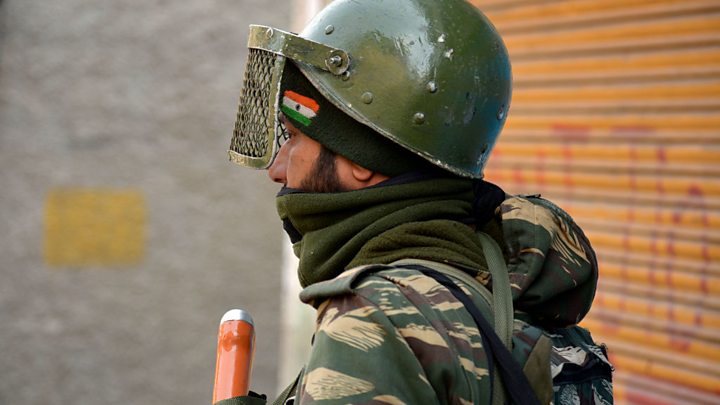
The former state has long been one of the world’s most dangerous flashpoints and is a highly militarised area.
India and Pakistan both claim Kashmir in full, but control only parts of it.
How does this affect the people there?
Almost 98% of the state’s population will be in the union territory of Jammu and Kashmir, comprising two regions – the Muslim-majority Kashmir valley, which has about eight million people, and the Hindu-majority Jammu, which has about six million.
The third region, the newly created union territory of Ladakh, is a high-altitude desert inhabited by 300,000 people, with almost equal numbers of Muslims and Buddhists.
Workers from the previous state government will continue to retain their jobs in the new territories, the government said.
What’s the background?
On 5 August, the government revoked Kashmir’s special status, sparking protests in the Muslim-majority valley.
Article 370, as the constitutional provision guaranteeing special status was known, allowed the region a certain amount of autonomy, including special privileges in property ownership, education and jobs. This provision had underpinned India’s often fraught relationship with Kashmir.
Before the Bharatiya Janata Party-led government announced its decision to scrap the special status, it put the region under lockdown – mobile phone networks, landlines and the internet were cut off; and regional political leaders were placed under house arrest.
Media caption The children being ‘tortured’ in Kashmir
The region also witnessed protests where security forces often clashed with civilians. Thousands of activists and others were believed to have been picked up from their homes in the days that followed the surprise move.
Almost three months later, the situation is still far from normal.
On Tuesday, militants killed five migrant labourers in Kulgam district. Just a day before, a truck driver from outside the region was killed in Anantnag district.
Earlier this month, the Indian government restored mobile services 72 days after they were suspended.
But internet services continue to be suspended and most businesses remain closed – some in protest against the government, and others for fear of reprisals from militants opposed to Indian rule.






 CHINDIA ALERT: You'll be living in their world, very soon