Archive for ‘Politics’

12/08/2012

* Cleaning up after Pranab Mukherjee leaves finance ministry

Reuters:”Pranab Mukherjee’s reign as Indian finance minister was stained by economic meddling and political favouritism. Now he is gone, and some of his excesses are being reversed. An enemy has been pardoned and a friend has not received a plum job. This could be the beginning of a better era.

Imagine if Tim Geithner had been accused of putting pressure on the securities regulator to protect some political friends. The U.S. Treasury Secretary would be in serious hot water. But when the former number two at the Securities and Exchange Board of India (SEBI) accused Mukherjee of something similar – putting pressure on the SEBI chairman to “manage” some high-profile corporate cases – there was little attention.

Rather, in a move that was all too typical of the Mukherjee regime, the finance ministry countered with allegations against the whistle-blower, K.M. Abraham. But the post-Mukherjee government is different. Prime Minister Manmohan Singh has cleared Abraham.

In another development, the board of UTI, Asia’s oldest asset management company, is set to appoint a new chief executive. The position has been vacant for the past year and a half as the finance minister put pressure on the company, 26 percent owned by U.S. fund manager T. Rowe Price, to appoint the brother of one of Mukherjee’s most powerful advisors. The former political favourite, Jitesh Khosla, hasn’t made the new shortlist.

India’s new finance minister, P. Chidambaram, is also shaking up his own team. On Sunday he announced that the top officials in the revenue and expenditure departments would swap jobs. That seems to be a signal of a shift in the tax department’s priorities. It might pave the way for a reversal of Mukherjee’s damaging retrospective tax grabs.”

via India Insight.

12/08/2012

* Pakistani Hindu pilgrims allowed to cross into India after detention

BBC News: “Pakistan officials have allowed a group of Hindu pilgrims who were detained at the border to cross into India.

More than 200 Pakistani Hindus were held at the Wagah crossing near Lahore after local media reported that they intended to emigrate.

Although the group had valid pilgrimage visas, it was rumoured they planned to remain in India because of growing attacks against minorities in Pakistan.

They were allowed to pass after they assured officials they would return.

A spokesperson for the pilgrims, Santosh Puri, told the BBC the group had assured the authorities that “this is a pilgrimage” and no one intends to emigrate.

Pakistani rights activists say dozens of Pakistani Hindu families have moved to India to escape killings, abductions and forced conversions in recent years.

According to Indian officials, Pakistani Hindus have often entered India on visit visas, only to settle there permanently.”

via BBC News – Pakistani Hindu pilgrims allowed to cross into India after detention.

12/08/2012

* Beijing Reasserts Its Claims in South China Sea

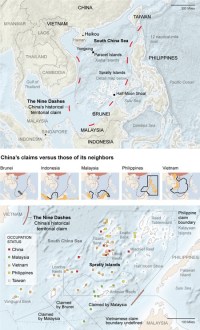
NY Times: “China does not want to control all of the South China Sea, says Wu Shicun, the president of a government-sponsored research institute here devoted to that strategic waterway, whose seabed is believed to be rich in oil and natural gas. It wants only 80 percent.

Mr. Wu is a silver-haired politician with a taste for European oil paintings and fine furniture. He is also an effective, aggressive advocate for Beijing’s longstanding claim over much of the South China Sea in an increasingly fractious dispute with several other countries in the region that is drawing the United States deeper into the conflict.

China recently established a larger army garrison and expanded the size of an ostensible legislature to govern a speck of land, known as Yongxing Island, more than 200 miles southeast of Hainan. The goal of that move, Mr. Wu said, is to allow Beijing to “exercise sovereignty over all land features inside the South China Sea,” including more than 40 islands “now occupied illegally” by Vietnam, the Philippines and Malaysia.

In the past several weeks, China has steadily increased its pressure, sending patrols with bigger ships and issuing persistent warnings in government-controlled newspapers for Washington to stop supporting its Asian friends against China.

The leadership in Beijing appears to have fastened on to the South China Sea as a way of showing its domestic audience that China is now a regional power, able to get its way in an area it has long considered rightfully its own. Some analysts view the stepped-up actions as a diversion from the coming once-a-decade leadership transition, letting the government show strength at a potentially vulnerable moment.

The Obama administration, alarmed at Beijing’s push, contends that the disputes should be settled by negotiation, and that as one of the most important trade corridors in the world, the South China Sea must enjoy freedom of navigation. The State Department, in an unusually strong statement issued this month intended to warn China that it should moderate its behavior, said that Washington believed the claims should be settled “without coercion, without intimidation, without threats and without the use of force.”

Washington was reacting to what it saw as a continuing campaign on the South China Sea after Beijing prevented the Association of Southeast Asian Nations, at its summit meeting in Cambodia in July, from releasing a communiqué outlining a common approach to the South China Sea.

The dispute keeps escalating. On July 31, the 85th anniversary of the founding of the People’s Liberation Army, the Chinese Defense Ministry heralded the occasion by announcing “a regular combat-readiness patrol system” for the waters in the sea under China’s jurisdiction.

The government then said it had launched its newest patrol vessel: a 5,400-ton ship. It was specifically designed to maintain “marine sovereignty,” said People’s Daily, the Communist Party’s leading newspaper.””

via Beijing Reasserts Its Claims in South China Sea – NYTimes.com.

10/08/2012

* India can win gold for corruption, Guru Ramdev says

Times of India: “If the Olympics gave a medal for corruption, India could have won a gold, yoga guru Baba Ramdev said on Friday as thousands poured into the Ramlila Grounds here for day two of his fast.

Calling on all of India to support his agitation against black money and graft, Ramdev said: “India could have won gold if there was a competition for corruption in the Olympics.

The crowds, which had started gathering since 8am, cheered and clapped enthusiastically, to which Ramdev said, “This is not a matter to applaud.””

via India can win gold for corruption, Ramdev says – The Times of India.

Both India and China are in the middling levels of Transparency International index of corruption, though amongst the top of the larger economies.  However, whereas China appears to be trying to tackle it at the national level, it is far from obvious that India is trying to do so.

See also:

10/08/2012

Once again, some signs that China is ‘softening’ on contovertial cases. Question is: is it a general policy or only for this year, the year of leadership change?

09/08/2012

* Agni-II successfully test-fired

the Hindu: “India successfully test-fired nuclear weapons capable strategic ballistic missile, Agni-II, for its full range of more than 2,000 km from Wheeler Island off the Odisha Coast on Thursday.

The launch was carried out by Strategic Force Command personnel from a mobile launcher. The Intermediate Range Ballistic Missile, which carried a dummy payload of 1,000 kg, was fired at 8.46 a.m. from a rail mobile launcher. Agni-II has already been inducted into the services and belongs to the group of Agni class of strategic missiles which form the bulwark of India”s nuclear deterrence policy.

Top Defence Research and Development Organisation (DRDO) officials told The Hindu from Wheeler Island that the two-stage solid-propelled missile followed a text-book trajectory and zeroed in on to a pre-determined target point in the Bay of Bengal with a single to two digit accuracy after a 700-second flight.

They said the re-entry systems worked well and all other systems functioned perfectly.The electro-optical systems and telemetry stations tracked and monitored the missile’s flight path. Two ships stationed in the vicinity of the target point witnessed the terminal event.

The SFC personnel conducted the trial as part of regular user exercise. Agni-II is 20 metres long and capable of carrying a nuclear warhead weighing one ton.

It was the third success in a row for Agni variants following the launch of Agni-V in April and Agni-1 recently.”

via The Hindu : News / National : Agni-II successfully test-fired.

09/08/2012

* Bo Xilai scandal: Gu Kailai on trial for Neil Heywood death

BBC News: “The first day of the trial of the wife of former high-flying Chinese lawmaker Bo Xilai on charges of murdering UK businessman Neil Heywood has ended.

Gu Kailai is accused of poisoning Mr Heywood in 2011 in Chongqing, where her husband was the Communist party head.

State media has called the case against her and an aide “substantial”.

The country is preparing to install a new generation of leaders, and Bo Xilai had once been seen as a strong contender for one of the top jobs.

He was sacked in March and is currently under investigation for unspecified “disciplinary violations”.

The BBC’s John Sudworth says some Chinese leaders are said to welcome the demise of such an openly ambitious colleague, but the case still needs careful handling for fear it might taint the Communist Party itself.”

via BBC News – Bo Xilai scandal: Gu Kailai on trial for Neil Heywood death.


08/08/2012

* Dollar losing its attraction

The Times: “Soft power is sometimes defined as a way of achieving the outcome you desire without using force. In Britain’s case, this has traditionally been exercised using subtle diplomacy, cultural and legal institutions.

The United States exercises soft power through its culture, films and music, too, but it also does through the ubiquity of the US dollar.

With power comes responsibility. There is a danger now that, in seeking to use the dollar’s reserve currency status to achieve US foreign policy aims, America is undermining that power. A key criticism of the US sanctions on Iran, particularly the ban on Iranian banks from using the Swift payments system, is that it has created incentives for other countries to trade with Iran without using dollars. Iran itself has exploited this by using its own currency in bilateral trade deals with India, China, Russia and Japan.

It is a small step from finding ways of trading with Iran without using dollars to trading with each other without using dollars, something that has been noted by the People’s Bank of China, whose officials are talking increasingly loudly about how and when the yuan might become a global reserve currency.

The aggression shown by the New York State Department of Financial Services towards Standard Chartered has just created another incentive to avoid doing business in dollars.”

via It may be unfair, but the damage is done | The Times.

It’s called shooting oneself in the foot. It’s also another case of the Law of Unintended Consequences.  See also:


07/08/2012

* In China’s Power Nexus, a Tale of Redemption

WSJ: “Liu Minghui’s battle to clear his name and save his business, a fight that pitted him against some of the most powerful forces in China, began the day of his company’s Christmas party in 2010.China Gas

Mr. Liu was set to leave his 18th-floor office in Shenzhen to cross the nearby border to Hong Kong for the party when plainclothes Public Security Bureau officers arrested him on suspicion of stealing money from the company he ran and co-founded, China Gas Holdings Ltd.

The former managing director spent nearly the next year in a Chinese jail, during which time he was forced to leave his executive and board roles at the company while remaining a substantial shareholder. He emerged from detention in time to see one of the country’s biggest companies launch a hostile offer for China Gas, the first by a state-owned business against a privately controlled company.

Now Mr. Liu’s comeback is nearly complete. He has been exonerated in the embezzlement case and is poised to win his fight with state-owned energy giant China Petroleum & Chemical Corp., or Sinopec, and its partner, ENN Energy Holdings Ltd. The bidding consortium on Monday extended the deadline for the US$2.15 billion offer until early September, saying the bid is still waiting regulatory approval. But with the stock trading at a 22% premium to the offer price of 3.50 Hong Kong dollars a share, the group seems unlikely to attract the shareholder support needed to take control.

The case highlights the harsh nature of business in China, where the legal system is opaque and the fate of companies can be decided in Beijing. It remains unclear why Mr. Liu was arrested and then cleared, why Sinopec bid for his company and why a surprising group of white knights came to Mr. Liu’s rescue.”

via In China’s Power Nexus, a Tale of Redemption; Sinpec, China Gas, Liu Menghui – WSJ.com.

In the same issue of WSJ.com, this article shows the positive (though still opaque) side of Chinese criminal justice and another the opposite: https://chindia-alert.org/2012/08/07/chinese-criminal-procedure-at-its-worst/

07/08/2012

* Chinese Criminal Procedure at its Worst

WSJ: “On July 23rd in Guizhou province, lawyers obtained a partial victory for some  of the defendants accused of involvement in organized crime. Not all the accused were as fortunate, and the limited results came with the support of an intense Internet campaign to publicize gross violations of China’s Criminal Procedure Law by police and judges.

This case shows Chinese criminal procedure at its worst. It exposes extensive cooperation between police and court officials in violating Chinese procedural law to obtain convictions in a case brought during a nation-wide campaign with strong political overtones.  At the same time, it also provides a glimpse of the work of dedicated lawyers defending their clients and how they have begun to use the Internet to publicize the problems they encounter. The case is reported in great detail in a blog post on Tea Leaf Nation that is well worth reading and is the source of the following account of the events in this case to date.

In March 2010, Li Qinghong, a real-estate businessman, was sentenced to 19 years in prison for alleged involvement in organized crime  The case against Li and 16 others had begun in 2008 with a charge of gambling, but escalated in 2010 when a nation-wide “crackdown” campaign against organized crime was launched.  In this case, the Guizhou Provincial Coordination Office to Fight Organized Crime organized a meeting to mobilize police, prosecutors and courts to cooperate closely.

The case was remanded by the Guizhou Provincial Court for “lack of factual clarity,” and the Guiyang City District Court reprosecuted the case this year and increased the number of defendants to 57. The defendants’ lawyers took to the Internet to appeal for additional legal assistance, and were ultimately joined by lawyers from outside Guiyang Province. According to the CCP-led Global Times, a total of 88 lawyers formed a panel for the defense.

The defense lawyers say they regarded the case as a test of the entire criminal defense system, because it involved illegally obtained evidence, false testimony and the complicity of police and the courts in these procedural violations. At the trial more than 10 defendants testified to having been tortured, the police were not allowed to testify, and the court refused to exclude evidence that allegedly had been obtained illegally, according to the Tea Leaf Nation account. In addition, during the proceedings the court expelled four lawyers for their aggressive arguments on procedural violations.

The account goes on to say that court officers promised the defendants who were represented by lawyers from outside of Guizhou that they would receive lenient sentences if they fired those lawyers, which some did — only to reveal three weeks later that they had released their lawyers solely because of great pressure on them. Some of those defendants then rehired their lawyers.  After these events, one lawyer was quoted as saying “The criminal defense system in China is near its doomsday.”

The defense lawyers took their efforts to the public via the Internet in addition to vigorous arguments in court. They say that at issue was “the last defense, a life-or-death moment for the rule of law and for criminal defense.” They obtained only a partial victory:  Although some defendants were found innocent, defendant Li Qinghong was sentenced to 15 years in prison. Li has appealed.

The defense lawyers ascribed their (partial) success to a massive use of microblogs, having posted more than 1,000 tweets, including extensive daily updates via Sina Weibo, during the 47-day trial.  They emphasized that their use of social media filled a vacuum created by traditional media’s lack of attention to the case. They are quoted in the blog post as saying that these efforts, in addition to raising netizens’ awareness of the issues at stake in their case, “balanced the voice of the official media,” and helped to protect the lawyers’ personal safety.”

via Chinese Criminal Procedure at its Worst – China Real Time Report – WSJ.

In the same issue of WSJ.com, this article shows the ‘worst of’ Chinese criminal justice and another more ‘positive’ case: https://chindia-alert.org/2012/08/07/wsj-in-chinas-power-nexus-a-tale-of-redemption/

See also: http://unintend-conseq.blogspot.co.uk/2012/08/social-media-triggers-revolutions.html

Law of Unintended Consequences

continuously updated blog about China & India

ChiaHou's Book Reviews

continuously updated blog about China & India

What's wrong with the world; and its economy

continuously updated blog about China & India