Archive for ‘Politics’

23/05/2012

* Taiwan spies increase in carrier threat

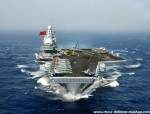
Hong Kong Standard: “Taiwan’s intelligence chief said Beijing plans to build two aircraft carriers to go with the first one in its fleet, a refitted former Soviet carrier currently undergoing sea trials.

“Indeed, the Chinese communists have decided to build two aircraft carriers on their own,” Tsai Teh-sheng, head of the National Security Bureau, told lawmakers. Construction is expected to start next year and in 2015, with the warships, which would be conventionally powered, to be delivered in 2020 and 2022. Tsai said Beijing has conducted six sea trials of its first carrier since the middle of last year, and that Taiwan expects it to go into service before the end of this year. Initially it may simply be used for training purposes but it can be sent for battles when necessary in the future,” he said. The ship’s sea trials have sparked international concern about the mainlands widening naval reach amid growing regional tensions over maritime disputes and a US campaign to assert itself as a Pacific power.”

via Taiwan spies increase in carrier threat – The Standard.

20/05/2012

* China dissident Chen Guangcheng arrives in the US

BBC News: “Chinese activist Chen Guangcheng has arrived in New York to begin a new life in the United States.

The blind human rights lawyer caused a diplomatic crisis when he escaped house arrest to arrive at the US embassy in Beijing last month. Speaking outside New York University, where he has been offered a fellowship, Mr Chen said China had dealt with the situation with “restraint and calm”. But he raised concerns about ongoing reprisals against his family. “Acts of retribution in Shandong have not been abated and my rights to practice law have been curbed – we hope to see a thorough investigation into this,” he said, referring to the province where he was kept under house arrest. The activist thanked US officials and his supporters for their help and said he had come to the United States for “recuperation in body and spirit”.

Chen Guangcheng and his family were taken from a Beijing hospital, where he was being treated for a foot injury, to the capitals airport on Saturday. A crowd of activists, supporters and curious New Yorkers greeted Chen at the university apartment block in Greenwich Village where he and his family will stay. Wearing dark glasses and hobbling on crutches, he may not have looked like a conquering hero, but that is how he was treated. There were cheers and screams of encouragement. Some had brought flowers, while one woman was led away in tears after failing to secure a hug from her idol.

Former House speaker Nancy Pelosi described his arrival in the US as “a milestone in the cause for human rights in China“.”

via BBC News – China dissident Chen Guangcheng arrives in the US.

19/05/2012

* The world turned upside down: how workers are moving from PIIGS to BRICS

The Times: “The eurozone was dreamland for the formerly impoverished fringe of southern Europe. To share the same currency as the powerful Germans and French was a sure sign that the bad times — of dusty villages emptied of menfolk — were over. They bought German cars, borrowed money to build villas and said farewell to centuries of emigration.

BRICS counties. BRICS - Brazil, Russia, India,...

BRICS counties. BRICS – Brazil, Russia, India, People’s Republic of China, South Africa. Português: As Potências regionais. (Photo credit: Wikipedia)

Now, as dreamland turns to nightmare, young Portuguese, Spaniards and Greeks are on the move again, travelling in search of work and security to countries they had previously treated with contempt or indifference. People from the PIIGS — Portugal, Ireland, Italy, Greece and Spain — are heading for the BRICs — Brazil, India and China but not Russia — as the global turmoil creates a new trend: reverse migration.

The movement of peoples began in earnest at the outset of the financial crisis three years ago, as the strong-growth cultures became a magnet not only for European adventurers but for well-educated native-born emigrants returning home. The rapid unravelling of the PIIGS has, however, made this an act of desperation for many. Across the globe millions of people are on the move as who is rich, who is poor, who is up, who is down is defined anew. Remarkably, at least 10,000 Portuguese have left for Angola. …Angola was a Portuguese colony for three hundred years, a supplier of slaves to the mercantile class in the 17th century. Today it is Africa’s second-largest oil producer and while not exactly a BRIC — two thirds of its population live on £1.30 a day — it has an energy that has drained from its former colonial master.

Brazil has become a natural destination for the Portuguese — and the Spanish. In Madrid, a website, Pepas y Pepes, has been set up to guide would-be emigrants. Even its name is a sad echo, adapted from a famous Spanish film called ¡Vente a Alemania, Pepe! — Come to Germany, Pepe! — which was inspired by the exodus after the Spanish Civil War. … A Barcelona businessman, Jordi Camps, has set up a travel company in China, China a la Carta. “Here you can smell growth,” he says. “It is sad to hear the news from Spain.”

There are two trends unfolding in the world. The first is that many hundreds of thousands who emigrated from what was once called the developing world to Europe and the United States are now being drawn back by the resurgent economies of their homelands. … Nowadays it is an eerily quiet place with giant razor-wired pens all empty of Mexican illegals. Instead, as the US economy wobbles uncertainly, Mexicans are heading home for work. For the first time since the Great Depression more Mexicans are leaving the US than entering it — and most of them are finding jobs.

There is huge reverse migration, too, by overseas Chinese and Indians. Almost 135,000 Chinese students returned home in 2009-10 after finishing their education abroad, an increase of 24.7 per cent. Zhang Peizhuo, a 45-year-old chemical researcher who stayed in Britain for 12 years after graduating there, has now gone back to China, in part because of government incentives. “Huge growth potential and increasing government subsidies have made returning home to start a business an attractive option for many overseas Chinese,” he said.

According to the recruitment company Kelly Services India, as many as 300,000 Indian professionals are expected to return to their homeland in the next four years: “Hype or reality, people do believe that the BRICs are the future and that there are a lot more job opportunities in India than elsewhere.” …

via The world turned upside down: how workers are moving from PIIGS to BRICS | The Times.

See also: https://chindia-alert.org/economic-factors/

15/05/2012

* Carr: China concerned by Australia-US military ties

BBC News: “China has raised concerns over growing military ties between Australia and the US, Australian Foreign Minister Bob Carr said as he visited Beijing.

Chinese officials had told him that “the time for Cold War alliances has long since passed”, he told reporters. The US has recently started rotating troops through bases in Australia.

On Monday Mr Carr met counterpart Yang Jiechi. He is also due to meet Vice Premier Li Keqiang to discuss a China-Australia free trade deal. China is a major trading partner for Australia and about a quarter of all Australian exports now go to China. But Australia’s key security partnership is with the US. Last month the first contingent of some US marines to be stationed in Darwin arrived; the US will eventually deploy a 2,500-strong force in northern Australia by 2017.”

via BBC News – Carr: China concerned by Australia-US military ties.

Related article: 

10/05/2012

* Marine forces of China, Thailand to hold joint training

China Daily: “Marine forces of China and Thailand will hold a joint military training in south Chinas Guangdong province from May 9 to 29, sources with Ministry of National Defense said Tuesday.

Garuda as national symbol of Thailand

Garuda as national symbol of Thailand (Photo credit: Wikipedia)

The training, codenamed Blue Commando-2012, will be conducted in Zhanjiang and Shanwei of the province in line with an agreement reached by the two countries navies, according to the ministry’s information office. The training will be the second of its kind by the two navies marine forces since 2010, and it will feature anti-terrorism and increase mutual understanding of the two forces.”

via Marine forces of China, Thailand to hold joint training|chinadaily.com.cn.

It takes two to tango. So it is with the US trying to ‘surround’ China with alliances or naval exercise with Australia, India, Philippines and (see other post) with Singapore.  In the meanwhile, China is holding exercises or reaffirming military alliances with Russia and Thailand.

Related articles and posts:

10/05/2012

* U.S. plans 10-month warship deployment to Singapore

Strait of Malacca from globe at Field Museum

Strait of Malacca from globe at Field Museum (Photo credit: Wikipedia)

Reuters: “The first of a new class of U.S. coastal warships will be sent to Singapore next spring for a roughly 10-month deployment, the Navy said on Wednesday, spotlighting a move that may stir China’s fears of U.S. involvement in South China Sea disputes.

Deployment of the shallow-draft ship “Freedom” will help refine crew rotations, logistics and maintenance processes to maximize the classs value to U.S. combat commanders, Rear Admiral Thomas Rowden, the Navys director of surface warfare, told reporters.”Well be deploying the ship for about 10 months in the spring of next year” to Singapore, he said in a teleconference. “In the meantime, were prepping her for success in the execution of that deployment.

“Singapore is strategically located along the Strait of Malacca, the chief link between the Indian and Pacific Oceans through which flows about 40 percent of world trade. The government has discussed hosting up to four such U.S. “Littoral Combat Ships,” or LCS, on a rotational basis at its naval facilities. Both countries have said the deployment stops short of a basing agreement.”

via U.S. plans 10-month warship deployment to Singapore | Reuters.

It takes two to tango. So it is with the US trying to ‘surround’ China with alliances or naval exercise with Australia, India, Philippines and with Singapore.  In the meanwhile, China is holding exercises or reaffirming military alliances with Russia and Thailand (see other post).

Related articles and posts:

09/05/2012

* China, Singapore to build 100 bln yuan high-tech zone

Xinhua: “The construction of a 100-billion yuan (16 billion U.S. dollars) high-tech zone was jointly launched Tuesday in southwest China’s Sichuan province by the provincial government and a Singapore company.

The Singapore-Sichuan High-tech Innovation Park, planned to cover 10.34 square kilometers and house 120,000 residents in Gaoxin district and Tianfu district in Chengdu, capital of Sichuan, is expected to attract an investment of 100 billion yuan from 2012 to 2020. Under the guidance of Sichuan government authorities, the project will be operated by the Singapore-Sichuan company Sino-Singapore Chengdu High-Tech Innovation Park Development Company Ltd., with a registered capital of 297 million U.S. dollars, jointly invested by Singapore state-owned company Temasek Holdings and Chengdu High-tech Investment Group, said Tang Hua, deputy director of the development administration of Gaoxin district. …

The park will mainly focus on eight industries including information technology, service outsourcing, digital media, biomedicine, environmental protection, precision machinery, finance and training, Tang said.The park is expected to have 120,000 to 150,000 employees as a new platform for China, Singapore and other countries to invest in western China, said Lim Swee Say, minister of Prime Ministers Office, advisor of Singapore-Sichuan Trade and Investment Committee, secretary-general of Singapore National Trade Union Congress.”

via China, Singapore to build 100 bln yuan high-tech zone – Xinhua | English.news.cn.

Yet another sign of China’s determination to reduce reliance on foreign hi-tech.

Related articles:

08/05/2012

* China issues policies to raise wellbeing of working women

Xinhua: “A new regulation, made public Monday, provides employed Chinese women with better welfare policies, including extended maternity leave and higher workplace protection.

A pregnant woman

A pregnant woman (Photo credit: Wikipedia)

According to the regulation adopted by the State Council in April, maternity leave has been extended from 90 days to 98 days, which is in line with the 14-week minimum standard set by the International Labour Organization. The regulation more clearly specifies leave granted to women who have miscarriages. According to it, a female employee will get 15 days of leave if their miscarriage occurs within the first four months of pregnancy and 42 days of leave if it happens later. Under the regulation, female employees should be paid either by the maternity insurance programs they have joined or by employers during their maternity leave.

The regulation also expands the categories of jobs that pregnant women and breastfeeding mothers are banned from working for, while removing restrictions on what jobs married women at the childbearing age should take.It also imposes clear penalties on the offenders, ranging from 1,000 to 300,000 yuan 159 to 47,619 U.S. dollars. And it stipulates that those employers who seriously violate the rules should be suspended from operation.

According to the government, China is estimated to currently have 102 million women in full-time employment.”

via China issues policies to raise wellbeing of working women – Xinhua | English.news.cn.

07/05/2012

* China, Central Asian countries hold cooperation forum

The proposed Central Asian Union, covering the...

Xinhua: “China and five Central Asian nations held a cooperation forum on Monday in Tongxiang of east China’s Zhejiang province. The forum, themed around mutual trust, cooperation and harmonious development, focused on pragmatic, social and cultural cooperation between China and Kyrgyzstan, Tajikistan, Kazakhstan, Turkmenistan and Uzbekistan.

It also saw the signing of a declaration on further promoting their cooperation. Bai Lichen, vice chairman of the Chinese Peoples Political Consultative Conference, Chinas top advisory body, attended the opening ceremony and met with representatives from the five Central Asian countries.”

via China, Central Asian countries hold cooperation forum – Xinhua | English.news.cn.

Related post: https://chindiapedia.wordpress.com/wp-admin/post.php?post=5753&action=edit

https://chindia-alert.org/political-factors/geopolitics-chinese/

07/05/2012

* U.S. agrees to treat West Bengal as partner for investment: Mamata

Trinamool Congress chief Mamata Banerjee atten...

Trinamool Congress chief Mamata Banerjee September 7, 2008. (Photo credit: Wikipedia)

The Hindu: “The U.S. has agreed to treat West Bengal as a partner state for investment in the changed political situation, Chief Minister Mamata Banerjee said in Kolkata on Monday.

“As per partner state, they will invest in West Bengal which was not taking place due to the political situation in the past,” Ms. Banerjee told reporters after a 52-minute meeting with U.S. Secretary of State Hillary Clinton. She also said that the issue of FDI in retail did not come up during the meeting. She said that the areas identified for U.S. investment were IT, software sector, manufacturing, deep sea port, tourism, health care and education. “They will give full support for economic and business development,” Mr. Banerjee said, adding that Chief Secretary Samar Ghosh and U.S. Ambassador Nancy Powell would coordinate and monitor the progress.”

via The Hindu : News / National : U.S. agrees to treat West Bengal as partner for investment: Mamata.

Law of Unintended Consequences

continuously updated blog about China & India

ChiaHou's Book Reviews

continuously updated blog about China & India

What's wrong with the world; and its economy

continuously updated blog about China & India