Archive for ‘Politics’

14/02/2019

Sweden replaces China envoy in furore over dissident bookseller

STOCKHOLM (Reuters) – Sweden said on Thursday it had replaced its ambassador to China after her “incorrect” handling of unauthorized meetings intended to help free dissident bookseller Gui Minhai.

The Hong Kong-based, Swedish publisher of books critical of China’s communist leaders was abducted in Thailand in 2015 and later appeared in custody in mainland China.

His daughter Angela Gui said this week she had met ambassador Anna Lindstedt and two businessmen in Stockholm in January, where she was advised to keep quiet about her father’s case while negotiations were proceeding.

Sweden’s Foreign Ministry said that was not an official meeting, and Lindstedt had now returned to Sweden with an interim envoy sent to Beijing during an inquiry.

“Neither the Foreign Ministry nor the Foreign Minister were informed until after the event,” ministry spokesman Rasmus Eljanskog said in an emailed statement.

“As a consequence of the incorrect manner in which the said meetings were handled, we are now conducting an internal investigation.”

Gui, 54, became a Swedish citizen after studying there in the 1980s. After the abduction, he was released in October 2017, but his whereabouts were unclear until January last year when his daughter said he was seized by Chinese agents on a Beijing-bound train in the presence of Swedish diplomats.

China later confirmed it had detained him again.

In her blog, Angela Gui said Lindstedt invited her to Stockholm to meet two businessmen who could help secure her father’s release.

“OUTRAGEOUS SCANDAL”

“The businessman said, ‘you care about Anna (Lindstedt), right? If you keep talking to the media it’ll damage her career. You don’t want her to come to any harm, do you?’”, she said in the post on blog portal Medium.

“In order for this to happen (negotiations), I was told I needed to be quiet. I wasn’t to tell anyone about this, or say anything publicly about the case,” she added.

“I’m not going to be quiet in exchange for … an arbitrary promise that my father ‘might’ be released. Threats, verbal abuse, bribes, or flattery won’t change that.”

China’s Foreign Ministry declined comment, with spokeswoman Hua Chunying saying she knew nothing about Gui’s latest situation. On its website, China’s embassy in Stockholm said it had not authorized anyone to “engage” with Gui’s daughter.

“The Chinese side handles the Gui Minhai case in accordance with law and legal procedure,” it said.

Gui’s original abduction – along with four others in the Hong Kong book trade – fed worries about interference from Beijing despite guarantees of wide-ranging freedoms for the former British colony which returned to Chinese rule in 1997.

The four others have since returned to Hong Kong. The United States and European Union have urged Gui’s release.

Sweden said it was continuing to seek Gui’s freedom, as Lindstedt faced scathing criticism for what the leader of Sweden’s Left Party called an “outrageous scandal”.

“A Swedish ambassador has done the bidding of a dictatorship and tried to silence the daughter of a Swedish political prisoner in China,” Jonas Sjostedt told local TV.

“I don’t think we have seen a worse scandal in Swedish foreign administration for decades.”

Lindstedt could not immediately be reached for comment.

Source: Reuters

12/02/2019

The impossible job – India’s pollsters face uphill battle to call election

NEW DELHI (Reuters) – Thousands of candidates, hundreds of parties, endless combinations of possible coalitions – spare a thought for India’s pollsters, tasked with making sense of the country’s fiendishly complicated politics ahead of a general election due by May.

The ruling Bharatiya Janata Party led by Prime Minister Narendra Modi won a surprise majority in 2014. Until last year, many predicted a similar result. But amid rising anger over unemployment and a fall in rural incomes, the BJP lost key state elections in December, making this contest more closely fought than first expected.

That means surveys conducted on behalf of newspapers and TV channels will be closely scrutinised. Some of India’s top pollsters however, told Reuters current surveys could be wide of the mark until the parties finalise alliances, which could be as late as April – and even then, there are challenges.

“In India there are certain relationships between caste, religion and allegiance,” said VK Bajaj, chief executive of Today’s Chanakya, the only polling firm to predict the BJP would win an outright majority in 2014. “We have to do checks and counter-checks when collecting our samples.”

CHEQUERED PAST

Opinion polls grew in popularity in India in the 1990s, after economic liberalisation saw a boom in privately-owned newspapers and TV channels, all demanding their own surveys.

In 1998 and 1999, the polls closely predicted the share of seats for the winning BJP-led coalition, according to data collected by Praveen Rai, an analyst who has tracked opinion polls in India for more than 15 years at the Centre for the Study of Developing Societies, which also runs its own surveys.

But in the last three elections, polls have been significantly wide of the mark. In 2004 and 2009 the victorious Congress alliance was completely underestimated, while in 2014 only Bajaj’s firm predicted the BJP would win an outright majority.
Elections in India have become “increasingly multi-varied”, Rai said, with the emergence of regional parties complicating pollsters’ efforts.

REALITY ON THE GROUND

Many polls are conducted face-to-face, and collecting representative samples can be hard in a country that still has several armed separatist movements and tribal communities unused to opinion polling.

When CNX, one of India’s largest polling companies, conducts fieldwork in rural Chhattisgarh and Jharkhand – two states with large tribal populations – it often finds many are unfamiliar with the concept of opinion polls.

“In areas where people are not so educated it is difficult for them to understand,” said Bhawesh Jha, CNX’s founder.

Elsewhere, a lack of trust in why polls are conducted and how the data is used means respondents are also less truthful than other countries, pollsters said.

“Dubious opinion polls conducted by some media houses to sway the elections for political parties … has definitely created a bad name for the polling industry in India,” Rai said.

India lacks strong data protections laws like those in North America and Europe, and many people still believe their details will be passed on to political parties, Rai and Jha said, meaning answers were often those they think the pollster wants to hear.

“We have to convince people we are not going to reveal their identity,” Jha said.

COMPLEX ARITHMETIC

Current polls are making large assumptions, no more so than in Uttar Pradesh, India’s largest state with a population of more than 200 million that accounts for nearly a fifth of the seats in India’s lower house.

Results there have been so difficult to predict that the state has earned the nickname “Ulta Pradesh” – a play on the Hindi word meaning “reverse” – for its ability to confound experts.

A recent poll there found that if two regional parties already in alliance joined forced with the main opposition Congress, the BJP would be wiped out in the state, almost certainly losing power nationally.

But like other states in India, much depends on who contests from where – and to what extent Congress stands its candidates down to allow regional parties a run.

Until the final seats sharing agreements and candidate lists are announced – which may not be until April – current polls are little more than guesswork, said Today’s Chanakya chief Bajaj.

“We have to wait until the final alliances come out,” he said. “It is not possible to do anything until that.”

Source: Reuters

09/02/2019

Relief reaches blizzard-hit Tibetan prefecture

XINING, Feb. 9 (Xinhua) — After days of snow storms, roads in many areas of Yushu Tibetan Autonomous Prefecture, northwest China’s Qinghai Province, are covered under snow as deep as 45 centimeters.

Tsertra, deputy director of the Yushu Disaster Relief Work and Emergency Headquarters, said one city and five other counties in Yushu were hit by the snow storms. Thousands of livestock were reported dead.

The local authority has sent vets, medicine and fodders to the blizzard-hit areas.

Drapa Sum, director of the health center in Gyeldo County, one of the worst-hit areas, said that he and his colleagues this week visited a number of blizzard-hit villages, some 5,000 meters above sea level on average.

“Villagers were relieved to see doctors and vets come to their rescue,” said Drapa Sum.

He said the trips were extremely dangerous, as roads were buried in snow.

By Friday, 4,653 tonnes of fodders had been transported to the blizzard-hit areas. The bureau of agriculture and rural affairs with the Qinghai Provincial Government has set aside 10 million yuan (about 1.48 million U.S. dollars) to purchase more fodders, said He Bo, deputy head of Yushu Tibetan Autonomous Prefectural Government.

He said the primary relief work now is to clear the snow-covered roads to ensure supplies reach the disaster-hit villages. Strong winds are blowing snow to block the roads despite the efforts to clear them.

The snowstorms have also led to the deaths of wild animals by the hundred in the region.

The Administration for the National Park of Sanjiangyuan (Three-River-Source) has earmarked a fund of 100,000 yuan for helping wild animals survive the harsh winter.

Source: Xinhua

09/02/2019

After China objects to PM Modi’s Arunachal visit, MEA says state integral part

Modi’s visit was part of a series of public meetings in the region aimed at garnering support for the Bharatiya Janata Party ahead of elections that are due to be held by May.

INDIA Updated: Feb 09, 2019 16:14 IST

HT Correspondent
HT Correspondent
Hindustan Times, New Delhi/Bejing
China,PM Modi,Arunachal Pradesh
Both India and China have sought to rebuild trust after an armed standoff over a stretch of the Himalayan border in 2017.(Twitter/BJP4India)

Prime Minister Narendra Modi’s visit to Arunachal Pradesh on Saturday saw jagged exchange between China and India. China’s foreign ministry Objected to PM Modi’s Arunachal visit saying “resolutely opposes” activities of Indian leaders in the region.

Responding to China’s objection to PM Modi’s visit to the northeastern state, the Ministry of External Affairs (MEA) said the state is “an integral and inalienable part of India.” Modi’s visit was part of a series of public meetings in the region aimed at garnering support for the Bharatiya Janata Party ahead of elections that are due to be held by May.

“The State of Arunachal Pradesh is an integral and inalienable part of India. Indian leaders visit Arunachal Pradesh from time to time, as they visit other parts of India… This consistent position has been conveyed to Chinese side on several occasions,” news agency ANI quoted MEA as saying.

Despite recent efforts to improve bilateral ties in both countries, disputes over the mountainous Indo-China border – which triggered a war in 1962 – and the region that China claims as southern Tibet have remained a sensitive issue.

On Saturday, India’s foreign ministry did not immediately respond to a request for comment.

Both India and China have sought to rebuild trust after an armed standoff over a stretch of the Himalayan border in 2017.

Source: Hindusatn Times

07/02/2019

As good as gold for some brides in India as election nears

NEW DELHI (Reuters) – An India state will give gold worth about $530 to every bride from a poor family, the latest budget giveaway ahead of a general election that must be held by May.

The northeastern state of Assam is run by Prime Minister Narendra Modi’s Hindu nationalist Bharatiya Janata Party (BJP), which is facing a battle for re-election because of low farm incomes and a lack of jobs that have turned off some of those who backed it in the last polls, in 2014.

The federal government announced cash handouts to farmers and tax cuts for the lower middle class last week.

On Thursday, the Reserve Bank of India (RBI) cut interest rates for the first time since 2017, in line with a government demand as it attempts to stimulate the economy.

The opposition Congress party has also been forgiving farmers’ loans and announcing it would provide the unemployed with cash handouts in some of the states it controls.

But handing out gold to brides is new.

The tea-growing state’s finance minister, Himanta Biswa Sarma, allocated 3 billion rupees ($42 million) for the next fiscal year, from April 1, for the gold programme.

That would buy 875 kg of gold, enough for about 80,000 brides.

“A customary ritual which has been part of Assamese society for centuries is to gift a set of gold ornaments to one’s daughter as a blessing as she leaves her father’s home to start a new life,” Sarma said in his budget speech on Wednesday.

He said the programme should stop families falling into debt to pay for daughters’ weddings.

“I feel that it’s my solemn responsibility to stand with those fathers who cannot afford to gift a set of gold ornaments,” he said.

The Assam government would buy the gold from the RBI and give it to the beneficiaries directly, Sarma told Reuters on Thursday.

The programme would be limited to two women from each family with an income of less than 500,000 rupees (£5,422) a year. Each bride would get a “tola”, or 11.66 grams, of gold.

Indian brides traditionally get gold, which helps make the country the world’s second-biggest buyer of the metal after China. The World Gold Council expects India to consume 750-850 tonnes of gold this year.

The Assam government hasn’t stopped at gold.

Sarma said the state would also give electric bikes to girls who score at least 60 percent in school-leaving exams, for getting to places of higher studies.

He rejected opposition accusations he was making “fake promises” to win votes.

Political parties and candidates find different ways to give presents to voters.

In the past, gifts have included electric fans, laptops, pressure cookers and televisions.

Under the election law, the gift-giving has to stop once an election date is set.

Source: Reuters

30/01/2019

China firmly supports Philippines in fighting terrorism: ambassador

MANILA, Jan. 29 (Xinhua) — Chinese Ambassador to the Philippines Zhao Jianhua said Tuesday that China will give its “firm support” to the Filipinos and the Philippine government in the fight against violent extremism after twin blasts hit a cathedral in the southern Philippines.

In a speech at the Chinese New Year reception, Zhao said the Chinese government expressed its deepest condolences and sympathies to the families of those who were killed and injured in Sunday’s blasts in Jolo city of Sulu province.

“Chinese government once again will give its firm support to the Philippine people and Philippine government for fighting against all barbaric violence including terrorism,” he said.

Bombings hit a cathedral in Sulu province of the southern Philippines last Sunday, killing 21 people and wounding more than 100 others.

Source: Xinhua

28/01/2019

Chinese envoy calls for more flexible approach in investment treaty talks with EU

BRUSSELS, Jan. 28 (Xinhua) — China and the European Union (EU) could take a more flexible approach by setting phase-based targets in Bilateral Investment Treaty (BIT) negotiations and have some early harvests which would be followed by more to come, the Chinese envoy to the EU has said.

Zhang Ming, head of the Chinese mission to the EU, made the remarks in a recent interview with the Financial Times, according to an edited transcript of the interview provided by the mission on Sunday night.

“The BIT talks is a priority in China-EU relations. Both sides have put in a great deal of effort. Both sides are pushing the talks in good faith,” Zhang said.

Last year, the two sides exchanged the market access offers, which marked big progress and brought the talks into a new phase, he said.

“This year, we hope to make further progress. To conclude the agreement requires both sides to work together in the same spirit. This is a process of making compromise. We hope that our European friends can work together with us,” Zhang said.

“Usually, the negotiating parties tend to set an ultimate goal. Reaching the goal takes quite some time,” he said, proposing that the two sides could set phase-based targets and have some early harvests.

China is now the EU’s second-biggest trading partner while the EU is China’s biggest trading partner.

The two sides launched negotiations for a BIT in 2013 with the aim of providing investors on both sides with predictable, long-term access to each other’s markets, and protecting investors and investments.

Source: Xinhua

28/01/2019

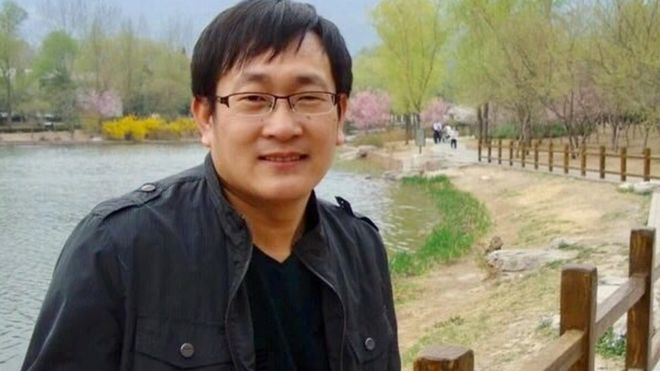
Wang Quanzhang: China jails leading human rights lawyer

Wang QuanzhangImage copyrightFAMILY
Image captionWang Quanzhang went missing in a 2015 crackdown

China has sentenced prominent human rights lawyer Wang Quanzhang to four and a half years in prison for state subversion.

Wang, 42, had defended political campaigners and victims of land seizures, as well as followers of the banned spiritual Falun Gong movement.

He was one of several lawyers and activists arrested in a 2015 crackdown, and the last to go on trial.

China has intensified its prosecution of rights lawyers in recent years.

Mr Wang was “found guilty of subverting state power, sentenced to four years and six months in prison, and deprived of political rights for five years,” the court in Tianjin said.

The trial had been conducted behind closed doors with journalists and foreign diplomats barred from entering the courthouse.

Reuters news agency reports that Wang fired his state-appointed lawyer during the proceedings.

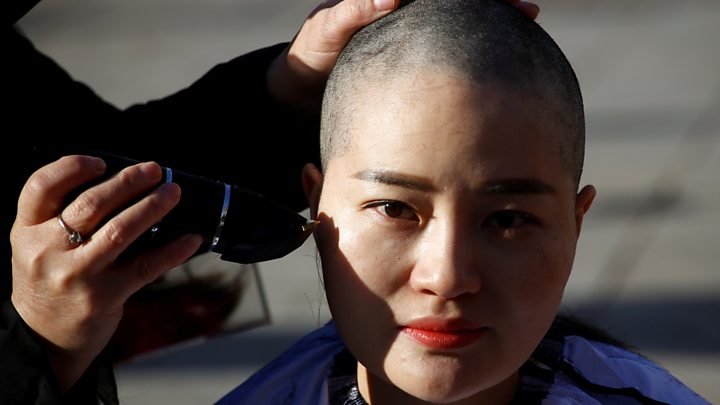
Wang’s wife, Li Wenzu, was also banned from attending and confined to her home in Beijing. A tireless champion of his case, she has shaved her head in protest against his detention and files near-weekly petitions to China’s highest court.

Media captionWang’s wife and her friends shave their heads to protest against his detention

In April, police intercepted Ms Li after she began a 100km (62 mile) march calling for her husband’s release. She was forcibly returned to Beijing and placed under temporary house arrest with her five-year-old son.

After the verdict Ms Li tweeted: “Wang Quanqi is not guilty, the public prosecution law is guilty!”

Presentational grey line

‘A chilling message’

John Sudworth, BBC News, Beijing

Wang Quanzhang had disappeared so completely into a legal black hole, that for much of the past three and half years, his family did not know if he was alive or dead.

He was denied family visits and denied the right to appoint his own lawyer.

Perhaps he’d been seriously injured, those who knew him wondered. Or perhaps, against all the odds, he was somehow managing to hold out – refusing the pressure, and perhaps the torture too, and refusing to confess.

Other lawyers caught up in the same 2015 crackdown, have since been processed, convicted and sentenced.

Whatever the reason for the delay in Mr Wang’s case – his brief one-day trial was finally held behind closed doors over Christmas – he has been found guilty for much the same reason; his attempts to use the letter of the Chinese law to hold the authorities to account in their own Communist Party-run courts.

As the Party has been making clear in recent years, it sees concepts such as constitutionalism and an independent judicial system as dangerous Western ideals.

Mr Wang’s fate is likely intended to reinforce that chilling message.

Presentational grey line

Michael Caster, researcher and author of The People’s Republic of the Disappeared, told the BBC that Wang’s case was “emblematic of Xi Jinping’s assault on the human rights and legal community”.

“The rights defence and broader civil society community in China is rightly outraged. For some time now they have rallied around Wang Quanzhang and his wife Li Wenzu as symbolic of both abuse and resistance under Xi Jinping,” he said after the sentencing.

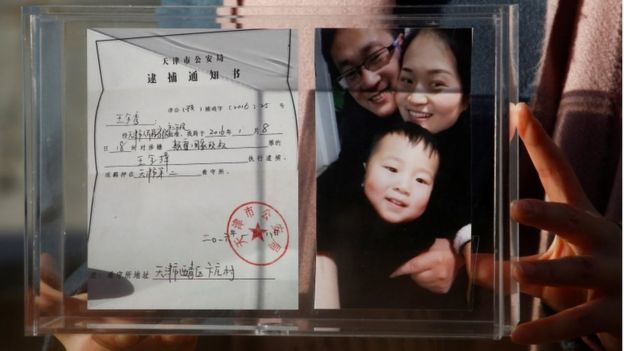
Li Wenzu, the wife of prominent Chinese rights lawyer Wang Quanzhang, holds a box with a family picture and her husband's detention notice, before shaving her head in protest in Beijing, ChinaImage copyrightREUTERS
Image captionLi Wenzu holds a family picture, and her husband’s detention notice

Mr Caster said that “the UN Working Group on Arbitrary Detention has found that Wang’s detention is arbitrary, which means that under international law he should never have faced a trial in the first place, and so obviously should never have faced any length of sentence”.

Rights groups have condemned the trial with Amnesty International calling it a “sham” and the verdict “a gross injustice”.

“It’s outrageous that Wang Quanzhang is being punished for peacefully standing up for human rights in China,” Amnesty China researcher Doriane Lau said in a statement.

China’s crackdown on lawyers, known as the “709” crackdown because it began on 9 July, has been seen by activists as a sign of a growing intolerance of dissent under President Xi Jinping.

More than 200 people were detained in that sweep, with many given jail terms, suspended sentences or house arrest.

Source: The BBC

27/01/2019

Spy novels, ‘daigou’ and democracy: the many lives of Australian writer held in China

EIJING/SYDNEY (Reuters) – A Chinese-born Australian writer detained by authorities in Beijing for suspected espionage has long been a divisive figure among overseas Chinese dissidents and activists.

To his supporters, Yang Hengjun is a dedicated democracy activist who believed that China’s autocratic system would, with time, necessarily liberalize. His detractors say he had long since abandoned criticising the ruling Chinese Communist Party in favour of protecting his personal and business interests.

Yang, 53, whose legal name is Yang Jun, was detained in southern China’s Guangzhou while waiting for a transfer to Shanghai earlier this month, after flying in from New York.

He was taken to Beijing, where China has said the city’s State Security Bureau is holding him under “coercive measures”, a euphemism for detention, as he is investigated on suspicion of “endangering state security”.

Yang’s lawyer, Mo Shaoping, told Reuters his client was suspected of “espionage”, and was being held under “residential surveillance at a designated location”, a special detention measure that allows authorities to interrogate suspects without necessarily granting access to legal representation.

Although his recent writing has mostly avoid Chinese politics, Yang first became prominent in the early 2000s when he earned the nickname of “democracy peddler”.

Before censorship of China’s microblogs intensified, Yang’s essays on topics ranging from Chinese nationalism to the fate of ethnic minorities in Tibet, made him a popular commentator. He also wrote a trilogy of spy novels set in China.

More recently, Yang had largely steered clear of issues deemed sensitive by the Communist Party, only occasionally writing about U.S. politics, and instead had thrown his energy into a “daigou” business, procuring overseas products for Chinese buyers.

His store on China’s popular mobile platform WeChat sold U.S.-made luxury bags, vitamins, baby formula and watches.

An employee of the store, who declined to be named, said that Yang started the store at the request of his readers, who wanted to buy real and fairly priced goods. Asked what would happen to the store now, he said he was waiting for instructions.

“KEEPS TO HIMSELF”

For the last two years, Yang, who friends describe as an affable, jocular but academic figure, had been living in New York as a visiting scholar at Columbia University.

“He was quite aloof from politics and tended to keep his personal news to himself,” Yang’s former landlord, New York-based businessman Yi Gai, told Reuters.

“About 75 percent of his energy and time was spent on his daigou work,” added Yi, who is also a friend of Yang’s.

Another friend, who hadn’t spoken to Yang in several months, said the Australian writer believed his views were not a challenge to China’s rulers.

“He played within the system. He had never called for the bottom to rise up. He wants reform only,” said the friend, who declined to be named for fear for his safety.

Feng Chongyi, an academic at the University of Technology in Sydney, who was himself detained during a 2017 visit to China, said he believed Yang’s detention was related to his international connections.

Tensions have risen in recent weeks between China and some Western countries after two Canadians, a diplomat on unpaid leave and a consultant, were arrested in China on suspicion of endangering state security.

Those arrests were widely seen in the West as retaliation by China for Canada’s arrest of Meng Wanzhou, a senior Huawei Technologies executive, on Dec. 1 at the request of the United States for allegedly violating U.S. sanctions on Iran.

Australian officials have called on China to handle the matter “transparently and fairly”, but have downplayed the connection between Yang’s case and those of the Canadians.

“He is well-connected in China and internationally. He knows high-profile people in the Communist Party and he believed that meant he could travel to China with relative impunity,” Feng said.

POOR BACKGROUND

Yang came from a poor background in China, but studied political economy at Shanghai’s prestigious Fudan University, according to his own accounts of his time there.

Yang had often told friends that, before his writing career, he worked for China’s Foreign Ministry. But ministry spokeswoman Hua Chunying told Reuters that Yang had never been employed there.

He would also tell friends that he knew Wang Huning, the Chinese Communist Party’s chief of ideology, while at Fudan, according to two sources.

Friends say he became an Australian citizen in the early 2000s.

Xia Yeliang, a former professor at Peking University who now lives in Virginia, said Yang was a controversial figure among China’s overseas dissident community.

Yang was believed in recent years to have married a well-known nationalist blogger, Yuan Ruijuan, souring his reputation among overseas democracy activists, Xia told Reuters by phone.

At times Yang had said his spy novels, which were serialised on his website, were based on his abundant personal experience within the Chinese system, Xia added.

The novels pit China’s spy agency against the CIA and FBI and include double-agents, clones, and a main character who, like Yang, wrote fictional spy novels and attended Fudan University.

Yi, the landlord and friend, said Yang “was not willing to keep in close contact with radical dissidents, and definitely wouldn’t cooperate with them, so it’s natural that radical dissidents would be suspicious and speculate about him”.

Before Yang left for China this month, Yi and some friends met him and the topic of his security came up, but everyone thought he would be fine.

“It looks like we misjudged,” he said.

Source: Reuters
24/01/2019

China detains Australian on suspicion of endangering security

BEIJING/SYDNEY (Reuters) – Chinese authorities are holding an Australian writer, who used to be a Chinese citizen, on suspicion of endangering state security, China said on Thursday, and his lawyer said he was suspected of espionage.

Australian officials said Yang Hengjun was detained shortly after he flew in to the southern city of Guangzhou from New York last week, but it did not believe his detention was the result of rising tension between China and the West.

Chinese foreign ministry spokeswoman Hua Chunying said that Australia was officially notified after Yang was placed under “coercive measures” – a euphemism for detention – in Beijing.

“The Australian citizen Yang Jun, due to being suspected of engaging in criminal acts that endangered China’s national security, was recently placed under coercive measures and is being investigated by the Beijing city State Security Bureau,” Hua told reporters.

Yang’s rights and interests were being protected in accordance with the law, she told a regular news briefing in Beijing, using a slightly different name for him.

Australian Defence Minister Christopher Pyne, arrived on in Beijing on Thursday on for scheduled talks, said Australia would normally expect to be told of such a case within three days under existing diplomatic conventions.

Yang went missing on Friday and Australia was not told until four days later. Pyne said the late notification was disappointing and he would be raising it in his talks with Chinese officials.

“He’s being held in residential surveillance,” Pyne told reporters.

The Australian government was first alerted that Yang had gone missing after friends said he had been out of contact for several days.

Yang’s lawyer, Mo Shaoping, told Reuters that his client was suspected of “espionage”, and was being held under “residential surveillance at a designated location”.

The special detention measure allows authorities to interrogate suspects for six months without necessarily granting access to legal representation. Rights groups say that the lack of oversight raises concern about abuse by interrogators.

Mo said he had been retained by Yang’s wife but because the case involved state security, he would need approval from the authorities before he would be able to meet Yang.

WARNING

Tensions have risen in recent weeks between China and some Western countries after two Canadians, a diplomat on unpaid leave and a consultant, were arrested in China on suspicion of endangering state security.

Those arrests were widely seen in the West as retaliation by China for Canada’s arrest of Meng Wanzhou, a senior Huawei Technologies [HWT.UL] executive, on Dec. 1 at the request of the United States for allegedly violating U.S. sanctions on Iran.

Australia joined international condemnation of the arrest of the two Canadians, but Yang has long been in the sights of Chinese authorities.

He has criticised what he described as Chinese interference in Australia.

Feng Chongyi, an academic at the University of Technology in Sydney, said he asked Yang not to go to China because of the tension.

“I didn’t think it would be safe for him because of the situation with Huawei but he believed that he would be fine as he had been there so many times,” Feng said.

Australian Foreign Minister Marise Payne said staff from Australia’s embassy met Chinese officials on Thursday and, while details were limited, she said there was no evidence Yang’s case was linked to Australia’s criticism of the detention of the Canadians.

“I’d be concerned if there was an indication of that,” Payne told reporters in Sydney.

“We are calling on the Chinese authorities to ensure this matter is dealt with transparently and fairly.”

‘CAN’T HIDE’

Yang was also reported missing for several days while in China in 2011. Two sources familiar with the details said he had been detained but agreed to say he had been unwell.

However, Yang is not seen as a radical dissident.

He became famous in the 2000s for his political essays, which earned him the nickname “democracy peddler”. In recent years, he had published little commentary, instead writing more fiction, including a trilogy of spy novels.

Deng Yuwen, a Beijing-based political analyst who knows Yang, told Reuters that he did not know the reason for Yang’s detention but that his WeChat accounts had been deleted.

“He has basically not publicly released any political essays in recent years,” Deng said.

Chinese President Xi Jinping has presided over a crackdown on dissent since coming to power in 2012, with hundreds of rights lawyers and activists detained. Dozens have been jailed.

Relations between Australia and its largest trading partner have been strained in recent years and Pyne’s trip was arranged in a bid to repair ties damaged by Australian accusations in 2017 that China was meddling in its affairs.

Analysts said Yang’s arrest would add to pressure on Australia to take a stand, and it would prolong tension.

“Australia can’t hide from this. It will need to respectfully protect its citizens,” said Rory Medcalf, head of the National Security College at the Australian National University.

“This detention marks the new normal in the bilateral tension, which will be constant low-level tension.”

Source: Reuters

Law of Unintended Consequences

continuously updated blog about China & India

ChiaHou's Book Reviews

continuously updated blog about China & India

What's wrong with the world; and its economy

continuously updated blog about China & India