Archive for ‘Politics’

23/01/2019

Priyanka Gandhi Vadra enters active politics, named Congress General Secretary for UP East

Priyanka Gandhi will take charge in the first week of February.

SNS Web | New Delhi | 

Priyanka Gandhi Vadra has officially entered active politics with Congress President Rahul Gandhi appointing his sister as Congress General Secretary for Uttar Pradesh (East) for the upcoming Lok Sabha elections.

The announcement was made by the Indian National Congress on Wednesday. Priyanka will take charge in the first week of February.

“Honourable Congress president has appointed Shrimati Priyanka Gandhi Vadra as AICC General Secretary for Uttar Pradesh East. She will be taking charge with effect on first week of February 2019,” the party said in an official release signed by General Secretary Ashok Gehlot.

Priyanka’s appointment comes as a major challenge for UP CM and BJP’s star campaigner Yogi Adityanath.

“The responsibility given to Priyanka ji is very important. This will not only have an effect on eastern Uttar Pradesh but also other regions,” Senior Congress leader Motilal Vohra said.

Priyanka has always had a say in strategising electoral campaigns and preparing the candidate list for the Congress. Except for 2017 UP elections, Priyanka in years before, had spent days on the campaign trail, meeting people and even directing election strategies. She has campaigned for Rahul Gandhi and Sonia Gandhi in the Lok Sabha constituencies of Amethi and Rae Bareli, respectively.

Businessman Robert Vadra, Priyanka Gandhi Vadra’s husband, took to Facebook to congratulate her “Congratulations P… always by your side in every phase of your life. Give it your best,” he said in the post.

Meanwhile, Member of Parliament Jyotiraditya Scindia was appointed Congress General Secretary for Uttar Pradesh (West).

KC Venugopal was named Congress General Secretary (Organisation), even as he continues in his role as AICC General Secretary in-charge for Karnataka.

Source: The Statesman

23/01/2019

Opening of China’s market could serve as future global growth driver: experts

DAVOS, Switzerland, Jan. 22 (Xinhua) — The opening of China’s market is likely to increase the competitiveness of the Chinese economy, which could serve as a future driver of global growth, experts attending the ongoing World Economic Forum (WEF) Annual Meeting said Tuesday.

Attending a penal discussion titled “Rethinking Global Financial Risk,” Fang Xinghai, vice chairman of the China Securities Regulatory Commission, said that the Chinese economy may slow down in 2019 but “it won’t be a collapse.”

“China’s vision for the economy is to make it open, large and competitive. It will be a huge opportunity for all companies,” Fang said, adding that declines in overheated sectors, such as real estate and infrastructure, could provide useful correctives for the market.

Saying that opening up is good for China, Fang emphasized that over the last 40 years China has never had a significant financial crisis.

“How has it managed that? We have a very top-down approach to financial risk management. If risks are accumulating the government will step in. There is a lesson that the rest of the world should look at,” he said.

Jin Keyu, professor of economics of the London School of Economics and Political Science, said only two years ago China was considered as a ticking financial bomb, and the slowdown is the consequence of the government’s successful efforts to deleverage.

“These efforts have made China safer, much of this is the deliberate effort of the government,” she said.

Most of the economic experts predicted economic slowdowns in major global markets, including China and the United States, for 2019, but according to Jin, though growth has become more of an issue, the Chinese government is now shifting its focus to revamping growth.

“China has a lot more scope than most countries in this regard,” she said, adding that China’s main challenge is “how to unleash the real potential of the real economy.”

Ray Dalio, founder of investment management firm Bridgewater Associates, noted that there’s a top-down way of setting a mission, and working those things in a top-down way in China that has produced a 20-fold increase in income.

Chairman of the Swiss bank UBS Axel A. Weber said at the discussion that most of the growth seen globally is “generated by China being included in the world economy.”

“The more we can connect stock markets, the more we can bring international investors into the Chinese economy,” he noted.

Though soft but stable growth characterizes the general outlook for 2019, experts attending the discussion noted that a range of serious risks still exist on the periphery, such as a hard Brexit, climate change, and cybersecurity.

Experts at the discussion also predicted that easing monetary policies and fiscal reforms could offset the slowdown, but with interest rates still at post-financial crisis low points, there are questions about how much room central banks have to manoeuvre.

The 2019 annual meeting of WEF kicked off here Tuesday, bringing together more than 3,000 global leaders from politics, government, civil society, academia, arts and culture as well as the media.

Source: Xinhua

23/01/2019

Xi extends Spring Festival greetings to military veterans

CHINA-BEIJING-XI JINPING-MILITARY VETERANS-SPRING FESTIVAL GREETINGS (CN)

Chinese President Xi Jinping, also general secretary of the Communist Party of China Central Committee and chairman of the Central Military Commission, shakes hands with the retirees during a gala for retired military officials with Beijing-based troops in Beijing, capital of China, on Jan. 22, 2019. Xi extended his Spring Festival greetings to military veterans and retired military officials. (Xinhua/Li Gang)

BEIJING, Jan. 22 (Xinhua) — President Xi Jinping on Tuesday extended his Spring Festival greetings to military veterans and retired military officials.

Xi, also general secretary of the Communist Party of China Central Committee and chairman of the Central Military Commission, watched a gala for retired military officials with Beijing-based troops.

Xi shook hands with the retirees and asked about their health and lives.

Songs and dances about building strong armed forces and the military’s loyalty to the Party were performed.

Senior military officials including Xu Qiliang, Zhang Youxia, Wei Fenghe, Li Zuocheng, Miao Hua and Zhang Shengmin were also present at the show.

Spring Festival, the Chinese Lunar New Year, falls on Feb. 5 this year.

Source: Xinhua

20/01/2019

Bullet trains maintained in China’s Guiyang to ensure safety for Spring Festival travel rush

CHINA-GUIYANG-SPRING FESTIVAL-TRAVEL (CN)

Mechanics check a bullet train at a maintenance station to ensure safety for the upcoming Spring Festival travel rush in Guiyang, capital of southwest China’s Guizhou Province, Jan. 19, 2019. (Xinhua/Ou Dongqu)

Source: Xinhua

19/01/2019

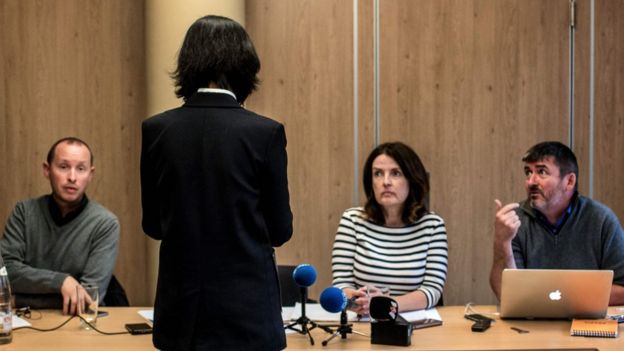
Meng Hongwei: Wife of ex-Interpol chief seeks France asylum

The wife of Meng Hongwei, the Interpol president held in China since September, has sought asylum in France for herself and her twin children.

Grace Meng and the seven-year-olds live in Lyon, the international police agency’s headquarters. Meng Hongwei disappeared during a visit to China.

In October the Chinese authorities said Mr Meng was being investigated over suspected bribe-taking.

His wife and children are under police protection, having received threats.

Quoted by France Inter radio on Friday, she said, “I fear they will kidnap me.”

“I’ve received strange phone calls. Even my car was damaged. Two Chinese – a man and woman – followed me to the hotel,” she said.

In media interviews she has refused to show her face, fearing for her safety.

On the day her husband went missing, she said he had sent her a social media message telling her to “wait for my call”, before sending a knife emoji, signifying danger.

Grace Meng with journalists, 7 Oct 18Image copyrightAFP
Image captionGrace Meng does not reveal her face on camera

What is known about Meng Hongwei?

Since his disappearance on 25 September no details have emerged about his prison conditions or the charges against him.

The 65-year-old’s job as Interpol president was largely ceremonial and did not require him to return to China often.

He was also one of six powerful vice-ministers in China’s public security ministry and had 40 years of experience in China’s criminal justice system. He previously worked under security czar Zhou Yongkang, one of the most powerful figures to be taken down in President Xi’s anti-corruption campaign that has targeted more than a million officials.

Meng Hongwei was elected Interpol president in November 2016, the first Chinese person to take up the post, and was scheduled to serve until 2020.

China’s new National Supervision Commission – an anti-corruption agency – said Mr Meng was being investigated for “violation of laws”.

But unlike in other high-profile detentions, it did not mention a charge of “violating party rules”.

China has not presented any evidence to justify the allegation against Mr Meng.

How did Interpol react?

China said Mr Meng had written a resignation letter and Interpol Secretary-General Jürgen Stock acknowledged that he had received it on 7 October. “There was no reason for me to (suspect) that anything was forced or wrong,” he said.

Quoted by the Associated Press news agency, Mr Stock said Interpol’s rules did not allow him to investigate Mr Meng’s disappearance. Interpol accepted the resignation letter without further comment.

In November Interpol elected South Korean Kim Jong-yang as its new president, rejecting a Russian candidate who had been tipped to succeed Mr Meng.

What is Interpol?

The International Criminal Police Organisation was founded in 1923 in Vienna, and its original members included Germany, France and China.

The UK and US did not join until later.

In 1956, it became officially known as Interpol and has since grown into a network of 194 member countries.

Its primary aim is to promote co-operation and share intelligence between police forces.

The general secretariat oversees its day-to-day work. It focuses on crimes such as terrorism, drug-trafficking, people-smuggling, child pornography and money-laundering.

Source: The BBC

16/01/2019

Exclusive – Modi’s party wants expansionary economic policy ahead of India election

NEW DELHI (Reuters) – Indian Prime Minister Narendra Modi’s ruling party is in favour of an expansionary economic policy and does not consider the government’s plan to keep the fiscal deficit to 3.3 percent of GDP as “sacrosanct”, a party spokesman told Reuters.

Ahead of a general election that must be held by May and after a string of losses in recent state polls, the government run by Modi’s Bharatiya Janata Party (BJP) has announced several stimulus measures for the countryside where millions of farmers are grappling with low crop prices. Other fiscal moves have been aimed at helping small businesses.

The measures are likely to be a drain on finances in Asia’s third-biggest economy, though the Modi administration is expected to get the Reserve Bank of India to agree to transfer an interim dividend of 300-400 billion rupees (£3.36 billion-£4.51 billion) to the government by March, Reuters reported last week quoting sources.

Weak consumer spending and the fragile farm sector have already been a drag on economic growth, creating a headache for Modi as he struggles to meet ambitious job creation targets.

India lost 11 million jobs last year, with around 83 percent in rural areas, according to independent think-tank the Centre for Monitoring Indian Economy, as operational costs surged for small businesses. Those costs were boosted by the launch of a national sales tax in 2017 and the economic impact of an earlier ban on high value currency notes.

SPONSORED

ADVERTISING

“There’s a demand, there’s a debate – all my colleagues are saying what’s the need of keeping the fiscal deficit in check when there is a distress in a particular sector,” said Gopal Krishna Agarwal, the economic affairs spokesman for the Hindu nationalist BJP, referring to the farm sector.

“Even think-tanks associated with us are talking in this sense. Very few people domestically are talking about fiscal prudence. Only foreign think-tanks are talking fiscal prudence, fiscal prudence. I strongly believe an expansionary policy can benefit the party,” he said in an interview on Tuesday night.

India’s 10-year benchmark bond yield IN071728G=CC rose 4 basis points to 7.53 percent after the news, its highest since Jan. 8 on worries about the fiscal deficit. The rupee INR=D4 also weakened to 71.23 to the dollar from its previous close of 71.03.

Agarwal, a chartered accountant who is a director at state-run Bank of Baroda (BOB.NS) and a member of a government committee on small and medium-sized businesses, said Modi was aware of his party colleagues’ thinking but that no final decision had been taken.

D.S. Malik, a spokesman for the Ministry of Finance, did not respond to calls and emails seeking comment. Finance Minister Arun Jaitley, who is in the United States for a medical check-up, said in a Facebook post on Tuesday that India’s “fiscal discipline during the past five years has been amongst the best as compared to any preceding period”.

NEED TO REACH LANDLESS

Agarwal said the government understands that farmers are in distress and that directly transferring money to their bank accounts was an option to help them out. He said the government was, however, trying to figure out how to distribute funds to landless tillers to make sure any such transfer programme was effective and didn’t just benefit those with land.

The government is studying a programme launched by the eastern state of Odisha under which farmers with landholdings of up to 5 acres would get cash assistance to buy seeds, pesticides, fertilisers and pay for labour. Sharecroppers, who cultivate rented land will also get the benefits, which include life insurance coverage.

Agarwal said Modi and many financial institutions were not in favour of waiving farm loans, as done by states recently won by the main opposition Congress party, because doing so mainly helps banks and not so much farmers in duress.

“There’s definitely a suggestion to give interest-free loans to farmers. Banks won’t have to pay, it has to be incorporated into the budget,” he said.

“And what’s the so sacrosanct issue about keeping the fiscal deficit at less than 3.5 percent? If you don’t adopt an expansionary economic policy, then the government alone can’t create demand by just spending on infrastructure. It has to come from both public and the private sector. The economy will grow only when demand will be created.”

He said increasing the income tax exemption limit for individuals was also being considered for the interim budget to be presented on Feb. 1 by Jaitley.

William Foster, vice president at Moody’s Investors Service, said that it expects the country’s fiscal deficit to slip to 3.4 of GDP this fiscal year ending March 31 due to revenue shortfalls from goods and services tax, lower excise duty and below-target receipts from sale of government assets.

“Increased expenditure on income transfers, farm loan waivers or other forms of subsidies would weigh further on government finances,” Foster told Reuters.

Reporting by Krishna N. Das and Aftab Ahmed; Additional reporting by Suvashree Dey Choudhury; Edited by Martin Howell

Source: Reuters

16/01/2019

Peng Liyuan attends performance with Finnish first lady

CHINA-BEIJING-PENG LIYUAN-JENNI HAUKIO-PERFORMANCE (CN)

Peng Liyuan (R, front), the wife of Chinese President Xi Jinping, attends a show including poetry reading and musical performances with Jenni Haukio, wife of Finnish President Sauli Niinisto, in Beijing, capital of China, Jan. 15, 2019. (Xinhua/Zhai Jianlan)

BEIJING, Jan. 15 (Xinhua) — Peng Liyuan, the wife of Chinese President Xi Jinping, attended a performance with Jenni Haukio, wife of Finnish President Sauli Niinisto, on Tuesday.

The show, which included poetry reading and musical performances, was held in the stylish bookstore Page One situated in the Qianmen area, a significant symbol of old Beijing.

After having strolled around the bookstore and learning about the history of the bookstore and the surrounding block, Peng and Haukio enjoyed wonderful performances on the top floor. Peng also briefed Haukio on the history and recent renovation of the historic district of Dashilar.

During the show, students majoring in Finnish read Haukio’s award-winning poems, catching her by surprise.

Young ladies dressed in ancient costumes sang traditional Chinese poems with the accompaniment of piano and Chinese zither, a traditional Chinese instrument.

The performance ended with a violinist and a pianist playing a piece work composed by Finnish composer Jean Sibelius.

The show was performed by teachers and students from the Beijing Foreign Studies University and the China Conservatory of Music.

Haukio is in Beijing accompanying President Niinisto who is paying a state visit to China from Sunday to Wednesday.

Source: Xinhua

13/01/2019

Rivals unite in Indian state in bid to beat Modi in elections

NEW DELHI/MUMBAI (Reuters) – Two political rivals in the northern Indian state of Uttar Pradesh will form an alliance in a bid to defeat Prime Minister Narendra Modi’s Bharatiya Janata Party (BJP) in national election scheduled for May, leaders of the parties said.

The Samajwadi Party (SP) and the Bahujan Samaj Party (BSP), both of whom command large support bases among Uttar Pradesh state’s working class and are led by former chief ministers, will contest the election as a team, they said.

Uttar Pradesh is India’s most populous state and accounts for about a sixth of all members of the parliament, the highest by a single state. Barring a couple of exceptions in the 1990s, the party winning the most number of seats there has helped form the federal government.

Out of the 80 seats in the state, SP and BSP will nominate candidates for 38 seats each, BSP chief Mayawati Das said at a joint press conference with SP chief Akhilesh Yadav on Saturday.

They will not contest the other four seats, which include two that have historically been held by the country’s main opposition party, Congress.

Congress, which ruled India for nearly four decades since its independence from Britain in 1947, has also been working to build a “grand alliance” with other parties ahead of the polls.

Mayawati, however, said Congress would not be a part of the BSP-SP alliance in Uttar Pradesh. “We can surely stop the BJP from coming to power with this alliance with SP,” she said.

On Friday, Yadav had told news channel NDTV: “We can give Congress two seats they have always held”, referring to the constituencies from where Congress President Rahul Gandhi and his mother Sonia Gandhi have contested in the past.

Mamata Banerjee, head of Trinamool Congress party and chief minister of eastern India’s West Bengal state who has been pushing to create a mega alliance of regional parties to defeat the BJP, welcomed the announcement in a tweet.

“I welcome the alliance of the SP and the BSP for the forthcoming Lok Sabha elections,” Banerjee tweeted.

Akhilesh Yadav, Chief Minister of the northern state of Uttar Pradesh and Samajwadi Party (SP) President, addresses a news conference before resigning from his post in Lucknow, India, March 11, 2017. REUTERS/Pawan Kumar

“Let us cherish the ‘idea of India’ for which our freedom fighters laid down their lives. Our people and our great institutions must strive to remain “independent”, in the true sense of the word.”

OPPOSITION GETS A FILLIP

Opposition parties across the country received a fillip last month, when India’s ruling party lost power in three states and dealt Modi his biggest defeat since he took office in 2014.

The BJP, SP and BSP contested against each other during the state elections in March 2017, which the BJP comfortably won, but political analysts say a BSP-SP alliance could affect the ruling party’s prospects.

The BJP had a 40 percent vote share in the state polls, the BSP and SP put together accounted for 44 percent. To be sure, voting patterns could be different when the world’s largest democracy goes to polls.

The BJP, however, is confident of winning elections in Uttar Pradesh. “We will win 74 out of the 80 seats in Uttar Pradesh,” president Amit Shah said in a televised address on Friday.

Despite the strategic significance and having been ruled by different parties since independence, Uttar Pradesh remains one of India’s most backward states.

It is notorious for its crime rate and unlicensed gun use, has below-average literacy levels, an abysmally low human development index and worrying levels of population growth.

13/01/2019

2019 Lok Sabha Elections: Congress drops a bombshell, to contest all 80 seats in UP

Amethi is Congress president Rahul Gandhi’s parliamentary constituency and Rae Bareilly is that of UPA chairperson Sonia Gandhi.

SNS Web | New Delhi | 

Breaking the suspense over its election plans in the state of Uttar Pradesh for the upcoming 2019 Lok Sabha elections, the Congress on Sunday announced that it will be fielding candidates on all the 80 Lok Sabha seats.

This was informed by senior party leader Ghulam Nabi Azad, who is also the Leader of Opposition in the Rajya Sabha.

“We will fight all 80 seats in Uttar Pradesh in the Lok Sabha elections. We are fully prepared. And just like the Congress emerged the number one party in Uttar Pradesh in 2009 Lok Sabha elections, it will happen again in 2019,” said Azad while interacting with the media in UP capital Lucknow.

Also Read: Mayawati, Akhilesh Yadav announce BSP-SP alliance for 2019 Lok Sabha polls | Slam ‘arrogant’ BJP

“We had earlier also said that we are ready to walk with every party that wants to defeat the BJP. But we can’t force anyone. They have (SP-BSP) closed this chapter, so we will continue this fight to defeat the BJP on our own,” he added.

On Saturday, the Bahujan Samaj Party (BSP) and Samajwadi Party (SP) had officially announced their alliance ahead of the 2019 Lok Sabha elections, keeping the Congress out.

While BSP and SP will contest on 38 Lok Sabha seats each, they have left two seats for other parties. “We have left Amethi and Rae Bareilly for Congress, which is not part of our alliance,” Mayawati had said addressing the media at Lucknow’s Hotel Taj on Saturday.

Amethi is Congress president Rahul Gandhi’s parliamentary constituency and Rae Bareilly is that of UPA chairperson Sonia Gandhi.

“BSP and SP are not going to get any benefit from an alliance with Congress. Our experience is that we do not get votes on seats we leave and they go to the BJP. Congress benefits from us but honest parties like us do not get any benefit,” Mayawati had said, drawing attention to the BSP’s alliance with the Congress in 1996 and SP’s in 2017.

Azad was speaking after a meeting at the party’s state headquarters in Lucknow.

12/01/2019

Rivals unite in Indian state in bid to beat Modi in elections

NEW DELHI/MUMBAI (Reuters) – Two political rivals in the northern Indian state of Uttar Pradesh will form an alliance in a bid to defeat Prime Minister Narendra Modi’s Bharatiya Janata Party (BJP) in national election scheduled for May, leaders of the parties said.

The Samajwadi Party (SP) and the Bahujan Samaj Party (BSP), both of whom command large support bases among Uttar Pradesh state’s working class and are led by former chief ministers, will contest the election as a team, they said.

Uttar Pradesh is India’s most populous state and accounts for about a sixth of all members of the parliament, the highest by a single state. Barring a couple of exceptions in the 1990s, the party winning the most number of seats there has helped form the federal government.

Out of the 80 seats in the state, SP and BSP will nominate candidates for 38 seats each, BSP chief Mayawati Das said at a joint press conference with SP chief Akhilesh Yadav on Saturday.

They will not contest the other four seats, which include two that have historically been held by the country’s main opposition party, Congress.

Congress, which ruled India for nearly four decades since its independence from Britain in 1947, has also been working to build a “grand alliance” with other parties ahead of the polls.

Mayawati, however, said Congress would not be a part of the BSP-SP alliance in Uttar Pradesh. “We can surely stop the BJP from coming to power with this alliance with SP,” she said.

On Friday, Yadav had told news channel NDTV: “We can give Congress two seats they have always held”, referring to the constituencies from where Congress President Rahul Gandhi and his mother Sonia Gandhi have contested in the past.

Mamata Banerjee, head of Trinamool Congress party and chief minister of eastern India’s West Bengal state who has been pushing to create a mega alliance of regional parties to defeat the BJP, welcomed the announcement in a tweet.

“I welcome the alliance of the SP and the BSP for the forthcoming Lok Sabha elections,” Banerjee tweeted.

Akhilesh Yadav, Chief Minister of the northern state of Uttar Pradesh and Samajwadi Party (SP) President, addresses a news conference before resigning from his post in Lucknow, India, March 11, 2017. REUTERS/Pawan Kumar

“Let us cherish the ‘idea of India’ for which our freedom fighters laid down their lives. Our people and our great institutions must strive to remain “independent”, in the true sense of the word.”

OPPOSITION GETS A FILLIP

Opposition parties across the country received a fillip last month, when India’s ruling party lost power in three states and dealt Modi his biggest defeat since he took office in 2014.

The BJP, SP and BSP contested against each other during the state elections in March 2017, which the BJP comfortably won, but political analysts say a BSP-SP alliance could affect the ruling party’s prospects.

The BJP had a 40 percent vote share in the state polls, the BSP and SP put together accounted for 44 percent. To be sure, voting patterns could be different when the world’s largest democracy goes to polls.

The BJP, however, is confident of winning elections in Uttar Pradesh. “We will win 74 out of the 80 seats in Uttar Pradesh,” president Amit Shah said in a televised address on Friday.

Despite the strategic significance and having been ruled by different parties since independence, Uttar Pradesh remains one of India’s most backward states.

It is notorious for its crime rate and unlicensed gun use, has below-average literacy levels, an abysmally low human development index and worrying levels of population growth.

Law of Unintended Consequences

continuously updated blog about China & India

ChiaHou's Book Reviews

continuously updated blog about China & India

What's wrong with the world; and its economy

continuously updated blog about China & India