Chindia Alert: You’ll be Living in their World Very Soon
aims to alert you to the threats and opportunities that China and India present. China and India require serious attention; case of ‘hidden dragon and crouching tiger’.
Without this attention, governments, businesses and, indeed, individuals may find themselves at a great disadvantage sooner rather than later.
The POSTs (front webpages) are mainly 'cuttings' from reliable sources, updated continuously.
The PAGEs (see Tabs, above) attempt to make the information more meaningful by putting some structure to the information we have researched and assembled since 2006.
BEIJING, Dec. 20 (Xinhua) — Chinese State Councilor and Minister of National Defense Wei Fenghe met with Deputy Defense Minister of the Russian Federation and Chief of Main Directorate for Political-Military Affairs of the Russian Armed Forces Andrey Kartapolov in Beijing Thursday.
Wei spoke highly of recent exchanges and cooperation between the two militaries.
“China is willing to work jointly with Russia, taking the opportunity of the 70th anniversary of diplomatic ties between the two countries next year to resolutely implement the consensus reached by the two heads of states and promote the two sides’ military cooperation to continuously score new achievements,” Wei said.
Kartapolov said Russia would strengthen cooperation with China in the military and other fields, and keep pushing the relationship between the two countries and their militaries to a new level.
BEIJING (Reuters) – China denounced the United States on Thursday for passing a new law on restive Tibet, saying it was “resolutely opposed” to the U.S. legislation on what China considers an internal affair, and it risked causing “serious harm” to their
relations.
U.S. President Donald Trump on Wednesday signed into law the Reciprocal Access to Tibet Act.
The law seeks to promote access to Tibet for U.S. diplomats and other officials, journalists and other citizens by denying U.S. entry for Chinese officials deemed responsible for restricting access to Tibet.
Beijing sent troops into remote, mountainous Tibet in 1950 in what it officially terms a peaceful liberation and has ruled there with an iron fist ever since.
Chinese foreign ministry spokeswoman Hua Chunying told a daily briefing that the law “sent seriously wrong signals to Tibetan separatist elements”, as well as threatening to worsen bilateral ties strained by trade tension and other issues.
“If the United States implements this law, it will cause serious harm to China-U.S. relations and to the cooperation in important areas between the two countries,” Hua said.
The United States should be fully aware of the high sensitivity of the Tibet issue and should stop its interference, otherwise the United States would have to accept responsibility for the consequences, she added, without elaborating.
Rights groups say the situation for ethnic Tibetans inside what China calls the Tibet Autonomous Region remains extremely difficult. The U.N. High Commissioner for Human Rights said in June conditions were “fast deteriorating” in Tibet.
All foreigners need special permission to enter Tibet, which is generally granted to tourists, who are allowed to go on often tightly monitored tours, but very infrequently to foreign diplomats and journalists.
Hua said Tibet was open to foreign visitors, as shown by the 40,000 American visitors to the region since 2015.
At the same time, she said it was “absolutely necessary and understandable” that the government administered controls on the entry of foreigners given “local geographic and climate reasons”.
Tibetan rights groups have welcomed the U.S. legislation.
The International Campaign for Tibet said the “impactful and innovative” law marked a “new era of American support” and was a challenge to China’s policies in Tibet.
Third Canadian detained in China amid Huawei dispute
“The U.S. let Beijing know that its officials will face real consequences for discriminating against Americans and Tibetans and has blazed a path for other countries to follow,” the group’s president, Matteo Mecacci, said in a statement.
Next year marks the sensitive 60th anniversary of the flight into exile in India of the Dalai Lama, the highest figure in Tibetan Buddhism, after a failed uprising against Chinese rule.
China routinely denounces him as a dangerous separatist, although the Dalai Lama says he merely wants genuine autonomy for his homeland.
Last week’s electoral losses in five states for India’s ruling party has led to speculation that its agenda of promoting hardline Hindu politics has backfired. The BBC’s Priyanka Pathak reports.
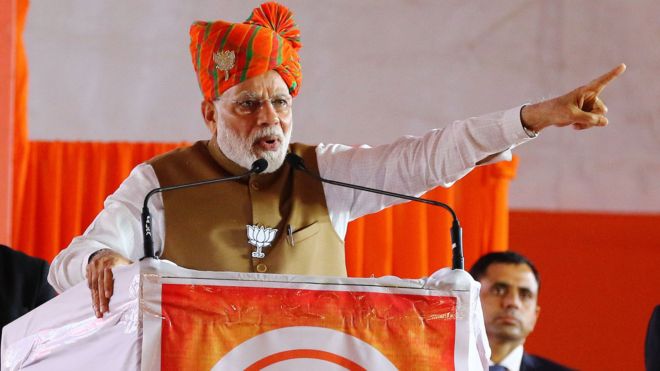
Prime Minister Narendra Modi’s Bharatiya Janata Party (BJP) lost to the main opposition Congress party in the Hindi-speaking heartland states of Madhya Pradesh, Rajasthan and Chhattisgarh, all of which they previously governed. Local parties swept up the other two states – Telangana and Mizoram – putting the BJP in a tough place ahead of general elections next year.
It appears that after winning no less than 13 state elections since coming to power in 2014, the BJP’s seemingly invincible electoral juggernaut is losing steam.
There is a great deal of introspection within and outside the party. And the main question is: has the BJP’s recent pursuit of a hardline Hindu agenda – known locally as Hindutva – backfired? Will a departure from an inclusive, development agenda to a polarising, communal one cost the BJP general election too?
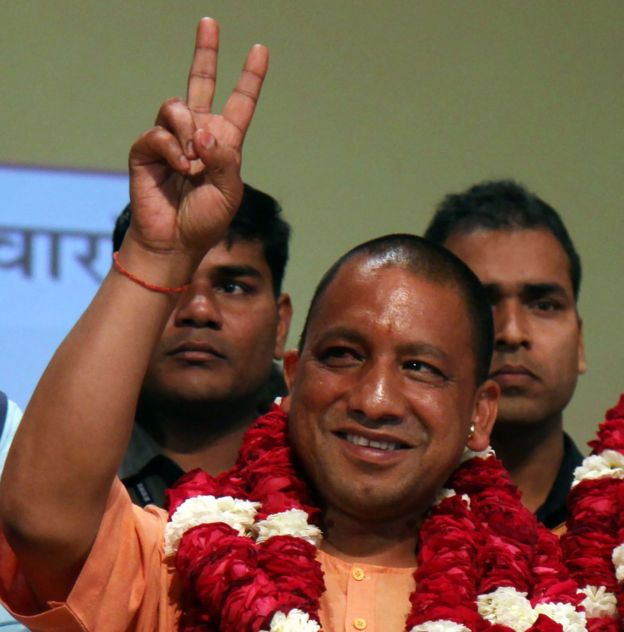
These are legitimate questions because the party deployed the chief minister of the northern state of Uttar Pradesh, Yogi Adityanath, as its star campaigner in the five states that went to polls.
He addressed 74 election rallies while Mr Modi, who is usually his party’s star campaigner, addressed just 31.
Image copyrightAFPImage captionYogi Adityanath is seen as a “poster child” for a hardline Hindu agenda
Mr Adityanath also spent the past few months courting the Sangh Parivar – a “family” of Hindu nationalist organisations including the Rashtriya Swayamsevak Sangh (RSS), a hardline Hindu organisation with umbilical ties to the BJP.
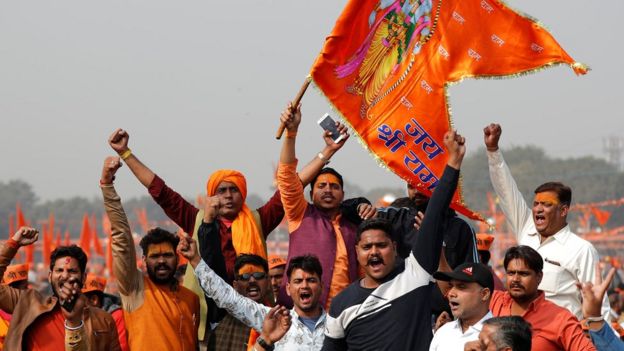
The Sangh Parivar also includes the Vishwa Hindu Parishad (VHP), which has been at the forefront of a movement demanding the construction of a Hindu temple on the site of a 16th Century mosque that was torn down by Hindu mobs in 1992, provoking widespread riots that left thousands dead.
Hindus believe Ayodhya, situated in Mr Adityanath’s Uttar Pradesh state, is the birthplace of their revered deity Lord Ram, and say an older temple existed at the site before the mosque was constructed.
Mr Adityanath has announced the construction of a giant statue of Ram in the state, and changed the name of the historical city of Allahabad to the more “Hindu” sounding Prayagraj ahead of the forthcoming Ardh Kumbh Mela, one of the world’s largest religious gatherings.
But if Mr Adityanath was hoping to prove to the VHP leadership that he is a more willing pursuer of the Hindutva agenda and, therefore, a potential alternative to Mr Modi, the recent electoral defeats do not advance his case.
Many observers believe that the BJP’s defeats are because the party deviated from the development agenda that swept them to power in 2014. The pursuit of Hindutva has backfired, they say.
Image copyrightREUTERSImage captionHindus believe the disputed religious site of Ayodhya is the birthplace of one of their most revered deities
But some in the Sangh Parivar disagree, insisting that it is actually the opposite that is true. “Just the way people feel disenchanted with the economic policies of the government, the people have also lost faith in this government’s commitment to build the Ram temple. If the VHP and RSS have to come to the street to warn the government about it, what does it tell you? What does it tell the electorate?” one of them said.
They chanted a striking slogan directly targeting Mr Modi’s stated development-first agenda: “Pehle Ram ko aasan do, phir humko sushasan do (First give Ram a throne, then give us good governance)”.
But it must be noted that while Mr Modi has never openly supported these hardline elements, his silence on issues such as an increasing number of attacks on Muslims over various issues like eating beef – cows are considered sacred in Hinduism and their slaughter is banned in many Indian states – is interpreted as a tacit approval for muscular Hindu politics.
But he now faces pressure to do more.
His government already leads a lacklustre economy. And this renewed pressure to recommit to Hindutva, despite its apparent failure as an electoral agenda, puts Mr Modi’s government in a difficult place.
There is also the fact that the RSS played a vital role in the BJP’s 2014 election victory by mobilising and galvanising voters. They are also credited for Mr Modi’s rise from state chief minister to a national figure. Apart from spearheading a sophisticated online and digital campaign in his favour, cadres also held 600 district-level meetings across the country to make Mr Modi a familiar name among the rural population.
Clearly, they cannot be ignored or offended.
So even as the liberals suggest that Hindutva has backfired and demand that the government refocus on the economy, there are voices within the BJP which are demanding a more strident return to the party’s “core” agenda – including the construction of the Ram temple and renewed focus on efforts to protect cows – to reassure their base that the BJP has not abandoned them.
The less-than-satisfactory economic performance will also make the Hindutva agenda more important, they say.
BEIJING (Reuters) – The wives of four of China’s most prominent rights lawyers and activists shaved their heads on Monday in protest over what they called the “persecution” of their husbands by the government.
Liu Ermin, wive of a prominent Chinese rights lawyer, has her head shaved in protest over the government’s treatment of her husband in Beijing, China, December 17, 2018. REUTERS/Thomas Peter
Since taking office in 2012, Chinese President Xi Jinping has overseen a crackdown on dissent, with hundreds of rights lawyers and activists being detained, arrested and jailed.
Four wives of lawyers detained during a July 2015 sweep known as the 709 crackdown gathered in the central park of a sleepy Beijing apartment complex and cut off their hair in front of neighbours and a small group of invited foreign journalists.
The women took turns shaving each other’s heads, placing the hair in see-through plastic boxes alongside pictures of them with their husbands, before heading to China’s Supreme People’s Court to petition over their husbands’ treatment.
Li Wenzu, who says she has been unable to visit her husband, rights lawyer Wang Quanzhang, since he went missing in the 2015 crackdown, told reporters that the act was to protest against the way her husband’s case was being handled.
Li said judges in Wang’s trial had unlawfully delayed proceedings and prevented her from appointing a lawyer of her choosing.
Wang is being held in Tianjin on suspicion of subverting state power, but both Li and seven lawyers she has appointed to try and represent Wang have been unable to visit him, she said.
“We can go hairless, but you cannot be lawless,” they announced at the end of the ceremony, a pun in Chinese, as the words for “hair” and “law” sound similar.
Requests for comment faxed to China’s Supreme People’s Court and the Tianjin Number 2 Intermediate People’s Court, where Wang’s case is set to be heard at an unknown date, went unanswered.
Li, Wang and other family members of rights lawyers and activists who have been detained or jailed have in recent years taken up their loved ones’ causes and attempting to keep pressuring the government into allowing their release.
The authorities have responded using “soft” detention measures, such as house arrest, to keep family members from getting their message out, rights activists have said.
BEIJING, Dec. 16 (Xinhua) — The General Office of the Communist Party of China (CPC) Central Committee has issued a trial regulation on how leading Party members groups discuss and decide the punishment of Party members.
According to the regulation, leading Party members groups should fulfil the main responsibility of ensuring the strict and full governance over the Party. Discipline inspection groups, sent by the CPC Central Commission for Discipline Inspection and the National Supervisory Commission, have the responsibility of supervision.
A discipline inspection group stationed at a department is responsible for filing and investigating cases of discipline violations committed by city-level officials of the department, the regulation said.
The discipline inspection group propose a preliminary suggestion for punishment and discuss the suggestion with the department’s leading Party members group. The case is then transferred to central discipline inspection and supervision authorities for a trial after the two groups reach a consensus, it said.
Cases of discipline violations by county-level officials of a department can be investigated and tried by the Party committee and the discipline inspection commission of the department.
The punishment should be discussed and decided by the department’s leading Party members group, and advised by the discipline inspection group stationed at the department, according to the regulation.
The regulation will go into effect on Jan. 1, 2019.
BEIJING, Dec. 16 (Xinhua) — Chinese authorities, including the Ministry of Agriculture and Rural Affairs, have launched a nationwide campaign to crack down on substandard and counterfeit food products in rural areas.
The operation aims to effectively address six types of major crime before the Chinese Lunar New Year, which falls on Feb. 5, 2019.
Law enforcement agencies will target instant food, snacks, alcohol, condiments as well as dairy and meat products, consumption of which is large in rural areas, while fake label information, knock-offs and substandard products are high on the campaign agenda.
“We will leave no stones unturned in tracking useful tips to bust as many illegal factories and workshops as possible,” said Han Changfu, Minister of Agriculture and Rural Affairs. “Those found responsible of related crimes will receive industry access bans and be transferred to the police if needed.”
The Congress was a clear winner in Chhattisgarh state, and fell one seat short of a majority in both Rajasthan and Madhya Pradesh. Two of them, Chhattisgarh and Madhya Pradesh, had been ruled by the BJP for 15 years.
Assembly elections results: The Congress emerged clear winner in three states – Madhya Pradesh, Rajasthan, Chhattisgarh(Vipin Kumar/ Hindustan Times)
The Congress’s win in three heartland states ruled by the BJP is a victory against the ruling party’s negative politics, UPA chairperson Sonia Gandhi said on Wednesday, her comeback to the many attacks hurled at her during election campaigning by top BJP leaders.
“I am happy with 3-0 score line… It is a victory against BJP’s negative politics,” Sonia Gandhi told reporters outside Parliament after results to five state elections were declared.
The Congress was edged out of Mizoram and didn’t make an impact in Telangana despite a grand alliance with Chandrababu Naidu’s TDP and other parties. But in the three politically-crucial BJP states, the Congress is set to form a government.
The Congress was a clear winner in Chhattisgarh state, and fell one seat short of a majority in both Rajasthan and Madhya Pradesh. Two of them, Chhattisgarh and Madhya Pradesh, had been ruled by the BJP for 15 years.
The victories are seen as a sign of a turnaround of the political fortunes of the Congress under Rahul Gandhi, who took over as party president from his mother, Sonia Gandhi, and a stinging rejoinder to his critics that he could not lead the party’s revival.
It is a point that Prime Minister Narendra Modi and BJP chief Amit Shah repeatedly underlined in their election speeches, listing all the state elections that had taken place after 2014 and how the BJP had won most of them.
Gandhi has been leading from the front ever since he was named Congress president on December 11, 2017. Days before his elevation, he launched a spirited campaign in Gujarat where the party threw a tough challenge to the BJP. Though the BJP won the elections, the Congress managed to restore some pride in the home state of Prime Minister Narendra Modi and his trusted lieutenant, Amit Shah.
Later in Karnataka, Gandhi had led the election campaign in Karnataka where the party moved quickly to form a post-poll alliance with HD Kumaraswamy’s Janata Dal Secular and let the smaller partner take the chief minister’s chair.
Observers contend that he still faces the challenge of reviving the Congress in key states such as Uttar Pradesh, Bihar, Andhra Pradesh, Telangana, Tamil Nadu, Odisha and West Bengal, where it has lost its political space.
Some of this might have to wait till after the 2019 elections, given how Gandhi is going to focus on firming up state-specific alliances to prevent division of the opposition vote.
Congress workers celebrate outside the party office as the party appeared to be on the road to victory in BJP-ruled Chhattisgarh and possibly Rajasthan and was locked in a close fight in Madhya Pradesh, in Raipur on Dec 11, 2018. (Photo: IANS)
The counting of votes finally concluded in Madhya Pradesh as the Election Commission of India declared the results with Congress winning 114 seats, one short of halfway mark in the 230 seat assembly. The BJP was close behind with 109 seats, Bhujan Samaj Party 2, Samajwadi Party 1 and the Independents 4.
Madhya Pradesh proved to be a marathon cliffhanger as the state witnessed a see-saw battle between the BJP and the Congress till midnight.
In a late night drama, the Congress had declared that they had won the state with a clear majority. In a press conference held at 2:30 am, top Congress leaders Kamal Nath, Jyotiraditya Scindia and Digvijaya Singh said they had written a letter to the Governor to invite them to prove their majority.
“With utmost happiness, I wish to inform you that Congress has won clear majority. We have written a letter to the Governor to invite us so that we can prove our majority before him,” he told media.
Kamal Nath had sought an appointment with Governor Anandiben Patel but was asked to wait till the final results came in.
BEIJING, Dec. 12 (Xinhua) — China on Wednesday issued a white paper on progress in human rights since its reform and opening up drive.
The white paper, titled “Progress in Human Rights over the 40 Years of Reform and Opening Up in China,” said reform and opening up has helped liberate and develop social productive forces, opened up a path of socialism with Chinese characteristics, and ushered in a new chapter in the development of human rights.
Over the four decades, the Chinese people have worked hard as one under the strong and coherent leadership of the Communist Party of China (CPC), the white paper said. Huge changes have taken place, and living standards have significantly improved.
The CPC has always prioritized the people’s interests, ensuring that reform is conducted for the people and by the people, and that its benefits are shared by the people, it added.
China has showed respect for, protected and promoted human rights in the course of reform and opening up, blazing a trail of human rights development that conforms to the national conditions, and created new experiences and made progress in safeguarding human rights, it said.
China has summed up its historical experience, drawn on the achievements of human civilization, combined the universal principles of human rights with the realities of the country, and generated a series of innovative ideas on human rights, it said.
China has brought into being basic rights that center on the people and prioritize their rights to subsistence and development, and proposed that China should follow a path of comprehensive and coordinated human rights development under the rule of law.
The white paper said China has carried out extensive exchanges and cooperation in the field of human rights and earnestly fulfilled its international human rights obligations.
BEIJING, Dec. 12 (Xinhua) — A white paper released Wednesday by the State Council Information Office said China has firmly established a governance principle of respecting and protecting human rights.
“It is the determination and ultimate goal of the Communist Party of China (CPC) and the Chinese government to respect and protect human rights,” said the document, titled “Progress in Human Rights over the 40 Years of Reform and Opening Up in China.”
Since the launch of reform and opening up in 1978, “respecting and protecting human rights” has been written into the reports to CPC National Congresses, the Constitution of the People’s Republic of China, the Constitution of the CPC, and strategies and plans for national development, becoming an important principle of governance for the CPC and the Chinese government, it said.
According to the white paper, that the state respects and protects human rights has been established as an important principle of the Constitution of China.
Also, the CPC pursues human rights protection in its governance, the document said.
The white paper noted that it has become a core goal of national development to respect and protect human rights.




 CHINDIA ALERT: You'll be living in their world, very soon