Archive for ‘Politics’

13/01/2017

India’s Massive Aadhaar Biometric Identification Program – The Numbers – Briefly – WSJ

The rollout of India’s new biometric identification system is not without problems as outlined in a story in The Wall Street Journal Friday.

One of the biggest reasons there are still issues with the biometric IDs–which are already being used widely to distribute subsidies for food and fuel–is the sheer scale of Aadhaar.

Here are a few of the numbers that point to the size of the program which is leading to the problems.

1.1 BILLION

The number of Aadhaar cards issued. Enrollment started in 2009, and now the system can process 1.5 million applications a day. That still leaves out about 150 million Indians without cards.

86%

The percentage of all Indians who hold Aadhaar cards. For those older than 18 the percentage is 99.5%. Most of those left out are infants, because fingerprint recognition isn’t reliable until a certain age. Still the government has already started to assigning numbers to newborns.

15 MILLION

The number of transactions per day involving Aadhaar. That is a five-fold rise from a year ago when there were 3 million a day.

4 BILLION

The total number of times the Aadhaar system has been used so far for authentication and identification.

377 MILLION

Number of Aadhaar number linked to bank accounts. Going forward, the connection to bank accounts will make transactions smoother and allow bank clients to move funds just by using their fingertips.

Source: India’s Massive Aadhaar Biometric Identification Program – The Numbers – Briefly – WSJ

Tags:
12/01/2017

Amazon Yanks Indian-Flag Doormats as New Delhi Threatens Punishment – India Real Time – WSJ

Amazon.com Inc. pulled doormats emblazoned with the Indian flag from its Canadian website after the South Asian nation’s foreign minister threatened to oust the Seattle company’s employees.

This is unacceptable,” Sushma Swaraj, India’s foreign minister, wrote on Twitter Wednesday in response to a posting from a user showing an image of the doormats for sale.

Ms. Swaraj, who has 7 million followers on the platform, called on Amazon to remove the “insulting” products and threatened to rescind visas for Amazon’s foreign staff in India if action wasn’t taken.Her three tweets on the issue garnered more than 19,000 retweets and more than 30,000 likes, with some users calling on “all angry Indians” to email Amazon founder Jeff Bezos directly.

Source: Amazon Yanks Indian-Flag Doormats as New Delhi Threatens Punishment – India Real Time – WSJ

12/01/2017

Service With a Smile in Xi’an – China Real Time Report – WSJ

In China’s ancient capital Xi’an, police are taking charm lessons from high-end innkeepers.

The Public Security Bureau in the city’s Chang’an district sent more than 20 officers to a nearby luxury hotel to study “Smiling Services” on Sunday, a few days after a local TV news program aired footage criticizing police and other local bureaucrats for poor customer service.

It’s a rare case of public agencies turning to private companies for working advice in a country where officialdom has long enjoyed the superior status.

The news report focused on difficulties people have in getting a Hukou, an essential local residence certificate in China, and the service they received from desk officers at the local police station.

The report came on the heels of a pledge by new Xi’an’s municipal party secretary, Wang Yongkang, that he would serve as a “five-star waiter” for local residents, and drew a sharp response from local Communist Party officials.

“We are all the waiters for the people. We should not only serve people well, but also should serve them better than five-star hotels and try to devote wholeheartedly to become people’s ‘Five-star Waiters,’” an article posted on the website of the Xi’an Communist Party’s municipal committee said.Chinese people have long complained about poor service from bureaucrats, with many saying their sole focus is on pleasing their superiors, not the people they are paid to help.

Mr. Wang’s “five-star pledge” has resonated throughout Xi’an and appears to have inspired the undercover news report on police services. The same news program aired a similar report targeting bureaucrats in the city’s business registration offices two days before it took on the police.In the wake of the latest news story, Public Security Bureau officials said they held emergency meetings to watch the program and criticize involved officials before coming up with a plan to seek advice from a local five-star hotel, which wasn’t identified.

The police officers received a PowerPoint presentation on the hotel staff’s serving standards and observed their work on site, according to sanqin.com, a local media site which was allowed to tag along at the sessions. Public Security Bureau officials declined to comment to The Wall Street Journal.

A photo posted on Chang’an Public Security’s social-media account showed police officers smiling behind the hotel desk counters, attending to “guests” played by hotel employees. Another photo showed police officers listening attentively to lectures and carefully taking notes.

The effort didn’t impress everyone, judging by responses in social and traditional media.“The timely response of local authorities toward local media exposure is worthy of praise,” Nanfang Daily commented, but it went on to question the value of the charm lessons. “Smiling shouldn’t be a fake smile. It’s better to come from the heart.”

One commentator on social media said people would simply be happy if bureaucrats did their jobs correctly.

“Citizens don’t ask you to extend warm welcome and farewell or deliver some star-level service,” this person said. “What we ask for is only that you answer questions and solve problems according to the rules.”

Source: Service With a Smile in Xi’an – China Real Time Report – WSJ

06/01/2017

The high economic costs of India’s demonetisation | The Economist

MOST economists might hazard a guess that voiding the bulk of a country’s currency overnight would dent its immediate growth prospects. On November 8th India took this abstruse thought experiment into the real world, scrapping two banknotes which made up 86% of all rupees in circulation. Predictably, the economy appears indeed to have been hobbled by the sudden “demonetisation”. Evidence of the measure’s costs is mounting, while the benefits look ever more uncertain.

At least the new year has brought a semblance of monetary normality. For seven weeks queues had snaked around banks, the main way for Indians to exchange their old notes for new ones or deposit them in their accounts. That is over, largely because the window to exchange money closed on December 30th. The number of fresh notes that can be withdrawn from ATMs or bank counters is still curtailed, but the acute cash shortage is abating, at least in big cities.

As data trickle through, so is evidence of the economic price paid for demonetisation. Consumers, companies and investors all wobbled in late 2016. Fast-moving consumer goods, usually a reliable growth sector, retrenched by 1-1.5% in November, according to Nielsen, a research group. Bigger-ticket items seem to have been hit harder. Year-on-year sales at Hero Motocorp, the biggest purveyor of two-wheelers, slid by more than a third in December.AdvertisementA survey of purchasing managers in manufacturing plunged from relative optimism throughout 2016 to the expectation of mild contraction. Firms’ investment proposals fell from an average of 2.4trn rupees ($35bn) a quarter to just 1.25trn rupees in the one just ended, according to Centre for Monitoring Indian Economy, a data provider. As a result, corporate-credit growth, already anaemic, has reached its lowest rate in at least 30 years (see chart).

All this amounts to “a significant but not catastrophic” impact, says Shilan Shah of Capital Economics, a consultancy. Annual GDP growth forecasts for the fiscal year ending in March have slipped by around half a percentage point, to under 7%, from an actual rate of 7.3% in the last full quarter before demonetisation. Other factors, such as the rise in the oil price and the surge in the value of the dollar after the election of Donald Trump, are also at play.

Whether the costs of the exercise justify the benefits depends, of course, on what those benefits are. In his speech announcing the measure, Narendra Modi, the prime minister, highlighted combating corruption and untaxed wealth. Gangsters and profiteers with suitcases full of money would be left stranded. But reports suggest that nearly 15trn rupees of the 15.4trn rupees taken out of circulation are now accounted for. So either the rich weren’t hoarding as much “black money” as was supposed, or they have proved adept at laundering it. The Indian press is full of tales of household staff paid months in advance in old notes, or of bankers agreeing to exchange vast sums illegally.

Fans of demonetisation point to three beneficial outcomes.

First, banks, laden with fresh deposits, will lend this money out and so boost the economy. Big banks cut lending rates this week (quite possibly nudged by government, the largest shareholder of most of them). But their lending recently has not been constrained by a lack of deposits, so much as by insufficient shareholder capital to absorb potential losses, and by the over-borrowed balance-sheets of many industrial customers.

Second, Indians will move from living cash in hand into the taxed formal economy. Mr Modi has recently promoted the idea of a cashless, or “less-cash”, India (not something mentioned at the outset), as one reason for demonetisation. Progress towards getting Indians to pay for things electronically is indeed being made, but from an abysmally low base.

The third upshot is the most controversial. Now that the demonetised bank notes are worthless, the government is intent on in effect appropriating the proceeds. The procedure requires trampling on the credibility of the Reserve Bank of India (RBI), the central bank, which must first agree to dishonour the promise, on all banknotes, to “pay the bearer” the value. If it does so, “extinguishing” the notes and its liability for them, it can transfer an equivalent amount to the government budget.

With so much cash handed in at banks, the amount remitted to government by the RBI might amount to perhaps 0.2-0.3% of GDP. Proceeds from a tax-amnesty scheme for cash-hoarders may swell the figure. Even so, it will not be enough to justify the costs of demonetisation—or even, perhaps, the damage to the reputation of the RBI, which is already facing questions about its independence. But having imposed the costs, Mr Modi will be keen to trumpet whatever benefits he can find.

Source: The high economic costs of India’s demonetisation | The Economist

06/01/2017

Xi Jinping is busy arranging a huge reshuffle | The Economist

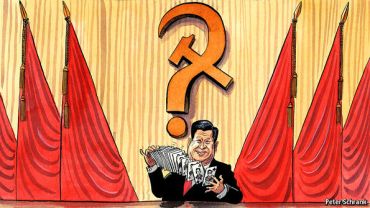
EVERY four years the United States holds an election that can change national policy and unseat many decision-makers. Every five years China holds a selection process that can do the same thing. Communist Party officials tout it as evidence of a well-ordered rhythm in their country’s politics. This year it may turn out as unpredictable as America’s election in 2016.

The people up for re-selection are the 350-odd members of the party’s Central Committee, the political elite, along with its decision-taking subsets: the Politburo, the Politburo’s Standing Committee (a sort of inner cabinet) and the army’s ruling council. The choice of new leaders will be made at a party congress—the 19th since the founding one in 1921—which is expected to be held in Beijing in October or November, and at a meeting of the newly selected Central Committee which will be held directly afterwards.

Party congresses, which are attended by more than 2,000 hand-picked delegates, and the Central Committee meetings that follow them, are little more than rubber-stamp affairs. But they are of huge symbolic importance to Chinese leaders. They matter for three reasons.

First, they endorse a sweeping reshuffle of the leadership that is decided in advance during secretive horsetrading among the elite. The coming congress will be Mr Xi’s first opportunity to pack the Central Committee with his own allies; the outgoing one was picked in 2012, when he took over, not by him but by the people then running the country, including his two predecessors. After previous congresses held five years into a leader’s normally ten-year term—that is, those convened in 2007 and 1997—it became clear who that leader’s successor was likely to be. If the coming meetings are like those earlier ones—a big if—they will give a strong clue to Mr Xi’s choice of successor and start the transition from one generation of leaders to another.

Second, congresses can amend the party’s constitution. China’s leaders like the document to give credit to their favourite ideological themes (and Mr Xi is particularly keen on ideology). When Jiang Zemin stepped down as party chief in 2002 his buzzwords were duly incorporated; so too were those of his successor, Hu Jintao, five years later. Mr Xi’s contribution to party-thought—such as on the need to purge it of corruption while strengthening its grip—is likely to gain similar recognition.

Third, congresses are the setting for a kind of state-of-the-union speech by the party leader, reflecting an elite consensus hammered out during the circulation of numerous drafts. In the coming months, Mr Xi will be devoting most of his political energy to ensuring that his will prevails in all three of these aspects. His authority in the coming years will hugely depend on the degree to which he succeeds. Preparations for the gatherings are under way. They involve a massive operation for the selection of congress delegates. On paper, this is a bottom-up exercise. Party committees down to village level are choosing people who will then choose other representatives who, by mid-summer, will make the final pick. Thousands of party members are also scrutinising the party’s charter, looking for bits that might need changing.It may sound like a vast exercise in democratic consultation, but Mr Xi is leaving little to chance. Provincial party bosses are required to make sure that all goes to (his) plan. Over the past year, Mr Xi has appointed several new provincial leaders, all allies, who will doubtless comply.

Hands up who likes XiT

hose chosen to attend the congress will follow orders, too, especially when it comes to casting their votes for members of the new Central Committee. And the newly selected committee will stick even closer to script. The processes that lead to its selection of the party’s and army’s most senior leaders are obscure—a bit like the picking of cardinals in the Vatican. But an account in the official media of what happened in 2007 suggests that at some point in the summer, Mr Xi will convene a secret meeting of the current Central Committee and other grandees for a straw poll to rank about 200 potential members of the new Politburo (which now has 25 members). This is called “democratic recommendation”, although those taking part will be mindful of who Mr Xi’s favourites are.

Candidates for the Politburo must fulfil certain criteria, such as holding ministerial rank. For the coming reshuffle, Mr Xi has added a new stipulation: faithful implementation of his policies. For all his power, Mr Xi has struggled with widespread passive resistance to his economic reforms. To ram home the importance of obedience, Mr Xi recently held what he called a “democratic life session” at which Politburo members read out Mao-era-style self-criticisms as well as professions of loyalty to Mr Xi as the “core” leader (as the party decided last October to call him).

By August, when Mr Xi and his colleagues hold an annual retreat at a beach resort near Beijing, the initial lists of leaders will be ready. Probably in October, the Central Committee will hold its last meeting before the congress to approve its documents. The “19th Big” will start soon after, and will last for about a week. The first meeting of the new Central Committee will take place the next day, followed immediately by the unveiling before the press of Mr Xi’s new lineup (no questions allowed, if officials stick to precedent).

The process is cumbersome and elaborate, but over the past 20 years it has produced remarkably stable transfers of power for a party previously prone to turbulent ones. This has been helped by the introduction of unwritten rules: a limit of two terms for the post of general secretary, and compulsory retirement for Politburo members if they are 68 or over at the time of a congress. Mr Xi, however, is widely believed to be impatient with these restrictions. He has ignored the party’s hallowed notion of “collective leadership”, by accruing more power to himself than his post-Mao predecessors did.

If precedent is adhered to, five of the seven members of the Politburo’s Standing Committee, six of its other members and four of the 11 members of the party’s Central Military Commission (as the army council is known) will all start drawing their pensions. In addition, roughly half the 200-odd full members of the Central Committee (its other members, known as alternates, do not have voting rights) will retire, or will have been arrested during Mr Xi’s anti-corruption campaign. This would make the political turnover at this year’s gatherings the biggest for decades, akin to changing half the members of the House of Representatives and three-quarters of the cabinet.

Until late in 2016 there was little to suggest any deviation from the informal rules. But in October Deng Maosheng, a director of the party’s Central Policy Research Office, dropped a bombshell by calling the party’s system of retirement ages “folklore”—a custom, not a regulation.

The deliberate raising of doubts about retirement ages has triggered a round of rumour and concern in Beijing that Mr Xi may be considering going further. The main focus is his own role. Mr Xi is in the middle of his assumed-to-be ten-year term. By institutional tradition, any party leader must have served at least five years in the Standing Committee before getting the top job. So if Mr Xi is to abide by the ten-year rule, his successor will be someone who joins the Standing Committee right after the coming congress.

But there is widespread speculation that Mr Xi might seek to stay on in some capacity when his term ends in 2022. He might, for instance, retire as state president (for which post there is a clear two-term limit) but continue as party general-secretary. He faces a trade-off. The more he breaks with precedent, the longer he will retain power—but the more personalised and therefore more unstable the political system itself may become. Trying to square that circle will be Mr Xi’s biggest challenge in the politicking of the year ahead.

Source: Xi Jinping is busy arranging a huge reshuffle | The Economist

06/01/2017

‘Yeti’ Prints Suggest Humans Settled in Tibet More Than 7,000 Years Ago – China Real Time Report – WSJ

A cluster of ghostly hand- and footprints on a mountain north of Lhasa offers evidence that humans scratched out a permanent existence in the thin air of Tibet much earlier than commonly thought, according to a new study.
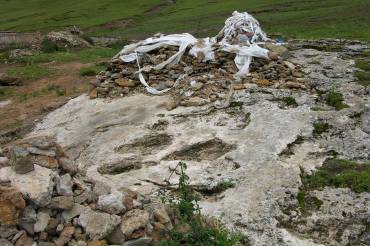
Some locals believe the prints, pressed into an ancient slab of limestone located 14,000 feet above sea level near the present-day village of Chusang, were left behind by mythical beasts. A team of researchers say that the impressions were left by people and that they offer intriguing clues to the puzzle of Tibetans’ ethnic origins.The researchers, whose latest findings are published in the latest issue of Science, say they’ve now developed a clearer picture of the site’s significance. According to their calculations, Chusang was very likely used by inhabitants of a nearby year-round settlement between 7,400 and 12,700 years ago — at least 2,200 years before permanent villages are believed to have been established elsewhere on the Tibetan Plateau.The researchers used radiocarbon dating and other, more advanced tests to determine the age of rock and dirt samples taken near the prints, according to the report.

There are no other reliably dated sites on the central, high-elevation part of the plateau,” said Mark Aldenderfer, a University of California, Merced who lead the study along with geologist Michael Meyer, from the University of Innsbruck.

By positing an earlier date of settlement on the Tibetan plateau, the study is likely to be controversial in Chinese archaeological circles. It could also irk Communist Party officials, for whom the question of where Tibetans came from is freighted with political significance.

Pushing back against advocates for Tibetan independence, the Chinese government recently began arguing that Tibet has been a part of China, not just during the imperial era, but “since ancient times.” The effort to prove that claim has led state-affiliated scholars to reach past China’s first, and some say largely mythical, dynasty, the 4,000-year-old Xia, to a neolithic culture called the Yangshao that existed in China’s Yellow River basin between 7,000 and 5,000 years ago.

Some pottery shards and other artefacts found on the Tibetan Plateau appear similar to remnants of the late Yangshao — proof, these government-backed scholars say, that China and Tibet are branches of the same civilization.“Early history has abruptly become of far greater importance to the issue, and specifically to the Chinese side,” said Robert Barnett, director of the modern Tibet studies program at Columbia University. Previously, Mr. Barnett said, the government had dated its claims over Tibet to the Yuan Dynasty, established by Mongolian leader Kublai Khan in 1271.

A 2015 paper on human settlement of the Tibetan Plateau written by Chinese archaeologists, also published in Science, supports the Yangshao timeline. It says that people didn’t start living in year-round settlements on the plateau until the development of agriculture and herding in what is now Qinghai province around 3,000 B.C.The new paper, however, suggests that migrants bearing pottery and other elements of Yangshao culture into the Tibetan regions would have encountered indigenous inhabitants, according to Mr. Aldenderfer.

“Our argument is fairly simple: There were people on the Tibetan Plateau before these ceramics and other influences came in from lower elevation locations,” he said.

There are 19 handprints and footprints of various sizes pressed into the Chusang limestone, which is believed to have formed by deposits from a now extinguished hot spring. The site was discovered in 1996 by University of Hong Kong geographer David Zhang, who was not part of the Aldenderfer team.

An image of one of the hand prints, taken in 2006. PHOTO: MARK ALDENDERFER“

Locals took me there and said [the prints] were left by a yeti,” Mr. Zhang told China Real Time, referring to the mythical creature better known in the west as the Abominable Snowman.

Mr. Zhang, who said he had seen a copy of the report but not its supplementary material,  disagreed with the conclusions of the new study. He cited tests he conducted that measured when quartz crystals from an ancient hearth found near the prints were last exposed to light. From that, he concluded that the evidence of settlement is closer to 20,000 years old.

Chusang was most likely one of several seasonal sites that people traveled to from primary settlements at lower elevations, he said.

Mr. Aldenderfer said Mr. Zhang’s measurements, taken in 2002, came from a different part of the Chusang site and that his testing methods were outdated. He said it would have taken an improbably long time to travel on foot from Chusang to a base camp at a low elevation.

The existence of smaller handprints suggests children also spent time at the site, he said.

Life would have been hard, with people forced to survive by hunting and foraging wild barley in temperatures only slightly warmer than they are now, but the area also would have had its advantages, Mr. Aldenderfer said.

A view to the north of the valley below the hot springs.
A view to the north of the valley below the hot springs. PHOTO: MARK ALDENDERFER

“It’s a really cool place. It’s perched on a mountainside, and when you’re sitting at the hot spring that has the hand- and footprints, it has an absolutely fabulous view of the valley below,” he said. The hot spring would have offered warmth, and possibly even a chance to bathe, he said.

Source: ‘Yeti’ Prints Suggest Humans Settled in Tibet More Than 7,000 Years Ago – China Real Time Report – WSJ

Tags: ,
21/12/2016

China seizes an underwater drone and sends a signal to Donald Trump | The Economist

IT WAS an operation carried out with remarkable cool. On December 15th, less than 500 metres away from an American navy ship, a Chinese one deployed a smaller boat to grab an underwater American drone. The object was then taken to the Chinese ship, which sailed off with it. Point deftly made.

The incident occurred in the South China Sea, in which China says the Americans have no business snooping around. By seizing the drone, it has made clear that two can play at being annoying. Mercifully no shots were fired. After remonstrations by the Americans, China agreed to give the drone back “in an appropriate manner”. It chose its moment five days later, handing the device over in the same area where it had snatched it. The Pentagon, though clearly irritated, has downplayed the drone’s importance, saying it cost (a mere) $150,000 and that most of its technology was commercially available. The drone was reportedly carrying out tests of the water’s properties, including salinity and temperature.

But it may turn into less of a game. Relations between the two nuclear powers, never easy at the best of times, are under extra strain as Donald Trump prepares to take over as president on January 20th. Mr Trump has already angered China by talking on the phone to Taiwan’s president, Tsai Ing-wen, and challenging China’s cherished “one-China” policy, crucial to which is the idea that Taiwan is part of it.

The capture of the drone took place on the outer perimeter of China’s expansive claim to the sea, about 50 miles (80km) from the Philippine port of Subic Bay, which was once home to a large American naval base (see map).

It appeared calculated to show China’s naval reach, with only minimal risk of any conflict—the American ship that was operating the drone, the Bowditch, is a not a combat vessel. Once in office, however, Mr Trump could face tougher challenges, exacerbated by China’s growing presence in the South China Sea: it appears to be installing weapons on islands it has been building there.

His two predecessors were each tested by a dangerous military standoff with China in their first months in office. With George Bush it involved a mid-air collision in April 2001 between an American spy-plane and a Chinese fighter-jet off China’s southern coast. The Chinese pilot was killed and the disabled American plane made an emergency landing at a Chinese airfield. There the crew of 24 was released after 11 days of painstaking diplomacy. The aircraft, full of advanced technology, was returned—in pieces—months later.

In March 2009 it was Barack Obama’s turn. According to the Pentagon, an American surveillance ship, the Impeccable, was sailing 75 miles from China’s coast when it was buzzed by Chinese aircraft and then confronted by five Chinese ships. First the Chinese forced it to make an emergency stop, then they scattered debris in front of the American ship as it tried to sail away. They also attempted to snatch sonar equipment it was towing. The Impeccable soon returned—this time in the reassuring company of an American destroyer.

For now, feuding between Mr Trump and China is less nail-biting. In Twitter messages, Mr Trump bashed China for taking the drone and later said China should keep it. Chinese media have in turn bashed Mr Trump. One newspaper said he had “no sense of how to lead a superpower”. Global Times, a nationalist newspaper in Beijing, said that China would “not exercise restraint” should Mr Trump fail to change his ways once in the White House. He would be wise to study the form.

Source: China seizes an underwater drone and sends a signal to Donald Trump | The Economist

18/12/2016

China to return seized US underwater drone, Pentagon says – BBC News

The Pentagon says it has “secured an understanding” with China that it will return an underwater drone seized in the South China Sea.China captured the US vessel in international waters on Thursday. It has not explained why and accused the US of “hyping-up” the incident.US President-elect Donald Trump accused the Chinese of “stealing”.

“We should tell China that we don’t want the drone they stole back – let them keep it!” he tweeted.

The incident is among the most serious military confrontations between the two powers for decades.

The Pentagon said the drone, known as an unmanned underwater vehicle (UUV), was being used to carry out scientific research at the time it was captured and demanded its immediate return. It warned China not to repeat such a move in the future.

But a spokesman said later on Saturday that an agreement had been reached.”Through direct engagement with Chinese authorities, we have secured an understanding that the Chinese will return the UUV to the United States,” Pentagon spokesman Peter Cook said in a statement.

The Chinese defence ministry said the vessel would be returned in an “appropriate manner”. It is not clear when this might happen.

It criticised the earlier US response, calling it “inappropriate and unhelpful”.

Source: China to return seized US underwater drone, Pentagon says – BBC News

16/12/2016

Taiwan fears becoming Donald Trump’s bargaining chip | The Economist

BY THE end of this month, say Chinese officials, work will be completed on a big upgrade of facilities at a monument to one of the scariest moments in the recent history of relations between China and the United States: an upsurge of tensions in the Taiwan Strait in the mid-1990s that saw the two nuclear powers inching towards the brink of war.

The structure is a concrete tower on an island in the strait, just off the Chinese coast. Atop it more than 100 generals watched a mock invasion of Taiwan by China’s army on a beach below. “Unite the motherland, invigorate China”, says a slogan in gold characters down the side of the building. The meaning of these words at a place where tanks and troops once stormed ashore with warplanes streaking overhead is: we want Taiwan back, by force if necessary.

The building work involves an expansion of the tower’s car park, improvements to the road up to it and other changes to make the place on Pingtan Island in Fujian province more tourist-friendly. The timing may be fortuitous. On December 11th America’s president-elect, Donald Trump, in an interview with Fox News, questioned what China regards as a sacred underpinning of its relationship with America: the principle that there is but “one China” (which, decoded, means that the government of Taiwan is illegitimate). China, bristling with rage, may well seek to remind its citizens, as well as America, of what happened when that principle was last challenged by the United States with a decision in 1995 by its then president, Bill Clinton, to allow his Taiwanese counterpart, Lee Teng-hui, to pay a private visit to America. Handy, then, that Pingtan will be able to handle extra busloads of visitors to that hilltop where China’s brass surveyed the pretend assault.

Relations between China and America are far less precarious than they were during those tense months, when China fired dummy missiles near Taiwan and America sent two aircraft-carrier battle groups close to the island to warn China not to attack it. China, though enraged by Mr Trump’s remarks (and a congratulatory call he took from Taiwan’s president, Tsai Ing-wen, on December 2nd), is unlikely to take retaliatory action unless Mr Trump continues to challenge the notion of one China after his inauguration on January 20th.

The chip is down

Taiwan has been in the doghouse anyway since Ms Tsai took office in May. China has cut off channels of communication with the island to show its displeasure with her own refusal to embrace the one-China idea. But Ms Tsai may have reservations herself about the way Mr Trump phrased his one-China scepticism. “I don’t know why we have to be bound by a one-China policy unless we make a deal with China having to do with other things, including trade,” he said. Mr Trump listed ways in which America was being “badly hurt” by China, such as by the fall in the value of its currency and its island-building in the South China Sea. He accused China of “not helping us at all with North Korea”.

Many Taiwanese worry that this could mean their island will be treated by Mr Trump as a bargaining-chip. Memories are still fresh in Taiwan of secretive dealings between America and China during the cold war, which resulted in America severing diplomatic ties with the island in 1979. Ms Tsai’s government has avoided direct comment on Mr Trump’s remarks. Apparently to avoid raising tensions with China, she has also avoided public crowing over her phone call with Mr Trump.

Mr Trump’s remarks would have riled the Chinese leadership at any time. But they are particularly unwelcome at this juncture for China’s leader, Xi Jinping. He is absorbed by preparations for crucial meetings due to be held late in 2017 at which sweeping reshuffles of the Politburo and other Communist Party bodies will be announced. Those trying to block his appointments would be quick to seize on any sign that he is being soft on America over such a sensitive matter as Taiwan. Should Mr Trump persist in challenging the one-China idea, the risk of escalation will be even greater than usual in the build-up to the conclaves—all the more so, perhaps, given Mr Xi’s insistence that differences between China and Taiwan “cannot be passed on from generation to generation”. Hawkish colleagues may say that it is time to settle the issue by force.

Street protests in China against America or Taiwan would also make it more difficult for Mr Xi to compromise: he would fear becoming a target himself of Chinese nationalists’ wrath. But the risk of this may be low. Since Mr Xi took over in 2012 there have been no major outbreaks of nationalist unrest, partly thanks to his tightening of social and political controls (including locking up ever more dissidents).

Sun Zhe of Tsinghua University says people are unlikely to demonstrate over Taiwan “because they understand the new rules, the new emphasis on political discipline in the last few years.” He says a lot of people in China still admire Mr Trump for his wealth and his unexpected political success. They think that “he wants to make a deal with China.”

In Taiwan, some take comfort in the difficulty Mr Trump would face in changing the terms of America’s relations with Taiwan, such as by announcing a permanent end to arms sales. These are guaranteed by the Taiwan Relations Act, which was passed by Congress in 1979 to reassure Taiwan that America still had an interest in the island’s defence, despite the severance of official ties. Many Republicans sympathise with Taiwan and would be reluctant to support any change to that law (itself a challenge to the one-China idea with which China has—very grudgingly—learned to live).

They might also take solace in what appears to be a change in the Chinese government’s tone since the war games 20 years ago. In April Global Times, a newspaper in Beijing, published a poll showing that 85% of respondents supported unifying China with Taiwan by force, and that 58% agreed the best time would be within the next five years. It was reportedly chastised by China’s internet regulator for “hyping sensitive events” by running such a survey.

Source: Taiwan fears becoming Donald Trump’s bargaining chip | The Economist

16/12/2016

China upset as Dalai Lama meets President Pranab Mukherjee | Reuters

China expressed dissatisfaction on Friday after exiled Tibetan spiritual leader the Dalai Lama met President Pranab Mukherjee, saying it hoped India would recognise the Nobel Peace Prize winning monk as a separatist in religious guise.

Mukherjee hosted the Dalai Lama and other Nobel Peace laureates at a conference on children’s rights at the presidential palace on Sunday.

Those who attended, and spoke, included Princess Charlene of Monaco and the former president of East Timor, Jose Ramos-Horta.

The Indian government had ignored China’s “strong opposition and insisted” on arranging for the Dalai Lama to share the stage with Mukherjee, and meet him, Foreign Ministry spokesman Geng Shuang told a daily news briefing in the Chinese capital.

“China is strongly dissatisfied and resolutely opposed to this,” he said, adding that the Dalai Lama used the guise of religion to engage in separatist activities and China opposed any form of official contacts with him.China wanted India to recognise the “anti-China, separatist essence of the Dalai Lama clique and take steps to banish the negative impact of this incident” to avoid disrupting ties between the Asian giants, Geng said.

While the Dalai Lama has had private meetings with Indian leaders, Sunday’s conference was the first public event, said the political head of the Tibetan government in exile based in the hill town of Dharamsala.

“There are many European governments shying away from hosting His Holiness,” he told Reuters. “Here you have the president of India hosting His Holiness. I think is a powerful message to the world, and particularly to Beijing.”

China regards the Dalai Lama as a separatist, though he says he merely seeks genuine autonomy for his Himalayan homeland Tibet, which Communist Chinese troops “peacefully liberated” in 1950.

The Dalai Lama fled into exile in India in 1959 after a failed uprising against Chinese rule.

China also expressed displeasure with India this month over the visit to a sensitive border region of another senior Tibetan religious figure, the Karmapa Lama, Tibetan Buddhism‘s third-most-senior monk, who fled into exile in India in 2000.India is home to a large exiled Tibetan community.

Source: China upset as Dalai Lama meets President Pranab Mukherjee | Reuters

Law of Unintended Consequences

continuously updated blog about China & India

ChiaHou's Book Reviews

continuously updated blog about China & India

What's wrong with the world; and its economy

continuously updated blog about China & India