Archive for ‘Politics’

16/06/2016

U.S., India and Japan Begin to Shape a New Order on Asia’s High Seas – India Real Time – WSJ

From the waters of the Philippine Sea this week emerged a partial outline of Washington’s vision for a new Asian maritime-security order that unites democratic powers to contend with a more-assertive and well-armed China.

A U.S. Navy aircraft-carrier strike group along with warships from India and Japan jointly practiced anti-submarine warfare and air-defense and search-and-rescue drills in one of the largest and most complex exercises held by the three countries.

The maneuvers were being tracked by a Chinese surveillance vessel, a U.S. Navy officer aboard the carrier USS John C. Stennis said on Wednesday. Last week, China’s Foreign Ministry spokesman Hong Lei said Beijing hoped the training “will be conducive to regional peace, security and stability.

”Washington and Tokyo have long cooperated closely on defense. And the U.S. has been working to deepen strategic ties with India and to encourage New Delhi to play a more active role, not just in the Indian Ocean but also in the Pacific, as China’s rise shifts the regional balance of power.

Americans are looking for those who can share the burden,” said C. Raja Mohan, director of the Carnegie Endowment for International Peace’s India center. A strengthened three-way partnership among the U.S., Japan and India is “an important strategic shift.”

Source: U.S., India and Japan Begin to Shape a New Order on Asia’s High Seas – India Real Time – WSJ

15/06/2016

India Police Probe Trade in Human Organs – India Real Time – WSJ

Police in India’s capital Delhi have uncovered a complex network illegally trading in kidneys. Suryatapa Bhattacharya report.

Earlier this month, a woman marched into a police station in India’s capital to file a domestic-abuse complaint and then made another allegation: that her husband was involved in illegal organ-trafficking.

Police said that accusation sparked a probe that had yielded 12 arrests as of Tuesday after authorities said they uncovered a complex nationwide network that was illegally trading in kidneys.

Donors, mostly poor residents of rural areas, were paid about $6,000 to give their kidneys to wealthier people in need of transplants, police said. The recipients paid more than $37,000. Traffickers produced counterfeit documents to make it appear as though the donors and recipients were related, police said. A 1994 law outlawed organ sales but permitted donations between family members.

The suspects—including five middlemen and four people who allegedly sold their own kidneys—were held on suspicion of trafficking in human organs and forgery, police said. They were in custody and couldn’t be reached for comment. It was unclear if they had legal representation.

Most countries prohibit organ selling, in part because of fears the poor and sick will be exploited by unscrupulous brokers.

Source: India Police Probe Trade in Human Organs – India Real Time – WSJ

12/06/2016

Indian Home Ministry Rejects Google Street View Proposal – India Real Time – WSJ

Virtually roaming through India’s streets using Google Street View may not be possible anytime soon, after a government official said the company had been blocked from rolling out its street-mapping feature.

A spokesman for the Home Ministry said Friday that it has rejected a plan from Alphabet Inc.’s Google to expand its maps feature that provides 360-degree panoramic images in the country, citing security concerns.

The spokesman didn’t elaborate on the worries but noted that the final decision on whether to permit Street View in India could come, “hopefully during this year,” once other governmental bodies have had their say.

A Google spokesman declined to comment.

Source: Indian Home Ministry Rejects Google Street View Proposal – India Real Time – WSJ

10/06/2016

Is China Rattled By the India-U.S. Love-In? – India Real Time – WSJ

Indian Prime Minister Narendra Modi has made strengthening ties with the U.S. one of his key foreign-policy objectives, as the two countries seek to counterbalance China’s growing footprint in Asia.

In a speech to a joint meeting of the U.S. Congress Wednesday, the conclusion of a three-day trip to the country, Mr. Modi didn’t directly mention China, but said: “In Asia, the absence of an agreed security architecture creates uncertainty.

”A strong India-U.S. partnership can “help ensure security of the sea lanes of commerce and freedom of navigation on seas,” he added.

So is the beefed-up alliance between the two countries making Beijing uncomfortable? The country’s press provides some clues.

Source: Is China Rattled By the India-U.S. Love-In? – India Real Time – WSJ

09/06/2016

India plans expanded missile export drive, with China on its mind | Reuters

India has stepped up efforts to sell an advanced cruise missile system to Vietnam and has at least 15 more markets in its sights, a push experts say reflects concerns in New Delhi about China’s growing military assertiveness.

Selling the supersonic BrahMos missile, made by an Indo-Russian joint venture, would mark a shift for the world’s biggest arms importer, as India seeks to send weapons the other way in order to shore up partners’ defenses and boost revenues.

The government of Prime Minister Narendra Modi has ordered BrahMos Aerospace, which produces the missiles, to accelerate sales to a list of five countries topped by Vietnam, according to a government note viewed by Reuters and previously unreported.

The others are Indonesia, South Africa, Chile and Brazil.The Philippines is at the top of a second list of 11 nations including Malaysia, Thailand and United Arab Emirates, countries which had “expressed interest but need further discussions and analysis”, the undated note added.

A source familiar with the matter would only say the note was issued earlier this year.New Delhi had been sitting on a 2011 request from Hanoi for the BrahMos for fear of angering China, which sees the weapon, reputed to be the world’s fastest cruise missile with a top speed of up to three times the speed of sound, as destabilizing.

Indonesia and the Philippines had also asked for the BrahMos, which has a range of 290 km and can be fired from land, sea and submarine. An air-launched version is under testing.

Source: India plans expanded missile export drive, with China on its mind | Reuters

08/06/2016

U.S. Firm to Build Six Nuclear Reactors in India – India Real Time – WSJ

The U.S. and India agreed to move ahead with the construction of six nuclear reactors in India by an American company, the first such move since the countries signed a landmark civil nuclear deal in 2008.

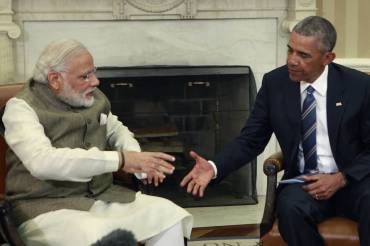
The breakthrough capped a wide-ranging White House meeting on Tuesday between President Barack Obama and Indian Prime Minister Narendra Modi, who are seeking closer cooperation as Washington wants to boost New Delhi’s role in counterbalancing China.

The meeting, which included lunch at the White House, will be followed on Wednesday by a speech by Mr. Modi to Congress, wrapping up the Indian leader’s fourth visit to the U.S. as part of an increasingly close relationship that has been sought by both governments.

The warming Indian relationship is backed by the lure of accelerating growth in that country, signs of improvement in the business climate, shared democratic values and some overlapping strategic goals.

By contrast, recent U.S. interactions with China, a far bigger Asian economy and U.S. trading partner whose growth appears to be slowing down, have been marked by strains and warnings over economic and security issues.

Source: U.S. Firm to Build Six Nuclear Reactors in India – India Real Time – WSJ

07/06/2016

Here’s How Indians Are Rating Narendra Modi’s Programs – India Real Time – WSJ

Two years into his five-year term, Indian Prime Minister Narendra Modi is asking his countrymen to rate a series of initiatives undertaken by his government.

Among the top scorers so far: an effort expand and modernize the railways and a program to build more roads. Toward the bottom of the favorability rankings: Mr. Modi’s Clean India campaign, which, among other things, aims to get people to use toilets instead of defecating outside.

Mr. Modi has become known for introducing a series of high-profile initiatives, from Make in India, which seeks to promote manufacturing, to pledges to build scores of so-called smart cities across the country.Of 21,770 respondents who had participated in the online survey on the government’s mygov.in website as of Tuesday morning, 70% gave a five-star rating to the government’s efforts to upgrade the rail system. People are asked to grade programs on a scale of one to five.

In the latest federal budget, the government earmarked $17 billion to improve the state-run railroad. Wi-Fi services are being rolled out at stations. And late last year, a deal was struck with Japan to help build India’s first high-speed rail line between Mumbai and Ahmedabad.

The government’s efforts to build more highways and improve the condition of roadways have also been popular with the people. More than 65% of the respondents to the survey gave these initiatives a five-star rating. The target this year is to build 9,300 miles of highways.People taking the survey also seemed satisfied by the government’s attempts to make electricity more accessible.

One of the worst performing programs, according to the current results of the survey, which is ongoing, is Swachh Bharat Abhiyaan, or the Clean India Mission. Only 33% of the respondents gave it a five-star rating. About 16% gave it score of one or two.

India’s Competitiveness and Prosperity Rankings Rise Under ModiIn October, a year into the program, another national survey also hinted at the public’s disappointment with its impact. More the 70% of those polled in that survey said the availability of public toilets hadn’t improved and their cities hadn’t become cleaner.

Mr. Modi is no stranger to crowdsourcing. He regularly encourages Indians to submit their thoughts for his weekly radio show. Prior to delivering his speech on India’s Independence Day last year, he asked citizens to submit their suggestions on what they’d like to hear him speak about. And they did, in hordes.

Source: Here’s How Indians Are Rating Narendra Modi’s Programs – India Real Time – WSJ

04/06/2016

Dam completion signifies growing Indian influence in Afghanistan | Reuters

Prime Minister Narendra Modi visited Afghanistan on Saturday to mark the completion of a nearly $300 million hydroelectric dam project, the latest symbol of Indian investment in its South Asian neighbour.

The dam, originally built in western Herat province in 1976 before being damaged during the civil wars of the 1990s, was rebuilt by some 1,500 Indian and Afghan engineers, according to the Indian Ministry of External Affairs.

“It is symbol of our friendship and would usher in hope, light up homes, nourish the fertile fields of Heart and bring prosperity to the people of the region,” Modi said in a social media post as he departed for Afghanistan, the first stop on a five-country trip.

Afghan President Ashraf Ghani has nurtured closer ties with India in the past year as relations with Pakistan have deteriorated in the face of continued insurgent attacks and border tensions.

Afghanistan has walked a fine line as it accepts Indian aid, with Pakistan historically wary of any Indian influence in Afghanistan.

Salma Dam is another big step in deepening and broadening the relationship between Afghanistan and India,” Ghani said in a post on Twitter.

At more than 100 metres (330 feet) high and 540 metres (1,770 feet) wide, the dam is designed to generate 42 megawatts of power and help irrigate 75,000 hectares of land, according to Modi.

India has poured more than $1 billion into Afghanistan reconstruction projects and humanitarian aid, making it one of the largest donors to the war-torn country.

A new national assembly building in Kabul and major power line and road construction have been among the main projects funded by India.

Source: Dam completion signifies growing Indian influence in Afghanistan | Reuters

23/05/2016

Doubling down | The Economist

“A COLOSSAL roller-coaster” is how a senior engineer described it. He was talking about the railway that China plans to build from the lowlands of the south-west, across some of the world’s most forbidding terrain, into Tibet. Of all the country’s railway-building feats in recent years, this will be the most remarkable: a 1,600-kilometre (1,000-mile) track that will pass through snow-capped mountains in a region racked by earthquakes, with nearly half of it running through tunnels or over bridges. It will also be dogged all the way by controversy.

Chinese officials have dreamed of such a railway line for a century. In 1912, shortly after he took over as China’s first president, Sun Yat-sen called for a trans-Tibetan line, not least to help prevent Tibet from falling under the sway of Britain (which had already invaded Tibet from India a decade earlier). Mao Zedong revived the idea in the 1950s. In the years since, many exploratory surveys have been carried out.

But it is only after building the world’s second-longest railway network—including, in the past few years, by far the biggest high-speed one—that China’s government has felt ready to take on the challenge. It had a warm-up with the construction of the first railway into Tibet, which opened in 2006. That line, connecting Lhasa with Golmud in Qinghai province to the north (and extended two years ago from Lhasa to Tibet’s second city, Shigatse), was proclaimed to be a huge accomplishment. It included the highest-altitude stretch in the world, parts of it across permafrost. It required ingenious heat-regulating technology to keep the track from buckling. Advertisement: Replay Ad China further honed its skills with the opening of a high-speed line across the Tibetan plateau in 2014—though in Qinghai province, rather than in Tibet proper. But neither track had anything like the natural barriers that the Sichuan-Tibet line will face. It will be just under half as long again as the existing line to Tibet, but will take three times longer to build. The second line’s estimated cost of 105 billion yuan ($16 billion) is several times more than the first one. Lhasa is about 3,200 metres (10,500 feet) higher than Chengdu, yet by the time the track goes up and down on the way there—crossing 14 mountains, two of them higher than Mont Blanc, western Europe’s highest mountain—the cumulative ascent will be 14,000 metres. The existing road from Chengdu to Lhasa that follows the proposed route into Tibet is a narrow highway notable for the wreckage of lorries that have careered off it. Some Chinese drivers regard the navigation of Highway 318 as the ultimate proof of their vehicles’, and their own, endurance. Work on easier stretches of the railway line, closest to Lhasa and Chengdu respectively, began in 2014. Now the government appears to be getting ready for the tougher parts. A national three-year “plan of action”, adopted in March for major transport-infrastructure projects, mentions the most difficult stretch: a 1,000km link between Kangding in Sichuan and the Tibetan prefecture of Linzhi (Nyingchi in Tibetan). The plan says this should be “pushed forward” by 2018. It will involve 16 bridges to carry the track over the Yarlung Tsangpo river, known downstream as the Brahmaputra. Dai Bin of Southwest Jiaotong University in Chengdu says the Chengdu-Lhasa line could be finished by around 2030.

Source: Doubling down | The Economist

18/03/2016

Deep in a pit | The Economist

COMMUNIST Party give us back our money”, “We want to live, we need to eat!” Such were the slogans daubed on banners that were displayed on March 12th during a protest by thousands of coal miners in the dingy streets of Shuangyashan, a city in Heilongjiang province near the border with Russia.

The demonstrators gathered outside the headquarters of Longmay, the largest mining company in the north-east and Heilongjiang’s biggest state-owned enterprise (SOE). They demanded wages which they said they had not received for at least two months. Some protesters blocked railway lines; others scuffled with police wearing riot gear. Internet censors deleted pictures of the unrest (such as the one shown) as they spread across social media.

The protest was one of the biggest by workers at an SOE for many years. It was an indication of the problems that China’s government will probably face as it seeks to cut excess capacity among SOEs like Longmay and reduce their enormous losses. In February the labour minister, Yin Weimin, said that 1.3m coal workers and 500,000 steel workers could lose their jobs over the next five years.

Other estimates say 3m-5m people may be thrown out of work in these industries as well as in aluminium production and glassmaking. That is far fewer than the tens of millions who lost their jobs during SOE restructuring in the late 1990s. But the economies of some cities, including Shuangyashan, are driven by a handful of large SOEs. In these, downsizing will be traumatic and possibly turbulent.

Labour unrest is rising everywhere as economic growth slows (see chart). Many firms, like Longmay, are reacting to financial distress by paying wages late or not at all. According to China Labour Bulletin, a Hong Kong-based NGO, there were 2,700 strikes last year, twice the number in 2014. In the two months leading up to China’s lunar new-year holiday in early February, there were over 1,000 strikes and protests, 90% of them related to the non-payment of wages. Three days after the protest in Shuangyashan, an almost equally large one began at Tonghua Steel in neighbouring Jilin province, also over wage arrears.

In Shuangyashan (its name, meaning Double Duck Mountains, refers to the shape of two nearby peaks), the authorities have tried to soothe the protesters by giving them overdue pay. Some mine workers say they have now begun receiving their salaries for January, and that they have been assured their pay packets for February will be coming soon. But the government remains nervous of further unrest. On March 15th police were still ubiquitous, on the streets of Shuangyashan as well as outside a nearby mine. In the city centre, a row of women who said the men in their families all worked in mines sat holding placards offering their services as cleaners or house painters. “We have no money to eat. What do they expect us to do?” said one woman angrily before being told by police to stop talking. A man who identified himself as a government official followed your correspondent everywhere.

The protests in Shuangyashan were particularly embarrassing for the party, occurring as they did during the 12-day annual session of China’s parliament, the National People’s Congress (NPC), which ended on March 16th. Every year during the NPC session, officials try even more strenuously than usual to prevent street unrest, lest it tarnish the image of political unity and national prosperity that they want the NPC to project (see article). Party bosses in Heilongjiang will get their knuckles rapped by leaders in Beijing for failing to anticipate this outbreak, which followed months of grumbling among Longmay’s workers about lay-offs and overdue pay. In September, the company said it would shed 100,000 of its 240,000 staff.

Source: Deep in a pit | The Economist

Law of Unintended Consequences

continuously updated blog about China & India

ChiaHou's Book Reviews

continuously updated blog about China & India

What's wrong with the world; and its economy

continuously updated blog about China & India