Archive for ‘Politics’

19/10/2014

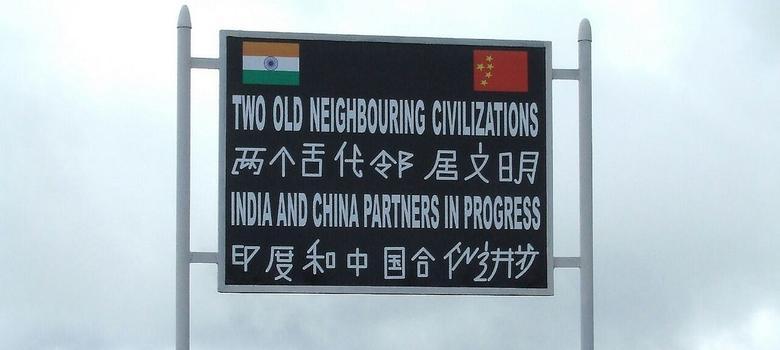
After border row, India, China plan counter-terror drills to build trust | Reuters

India, which under Prime Minister Narendra Modi has struck an assertive national security posture, also agreed to China’s request to move next month’s exercises away from the border with Pakistan with which China shares a close relationship.

The manoeuvres will come just weeks after thousands of Indian and Chinese soldiers confronted each other on their de facto border in the western Himalayas, accusing each other of building roads and observations posts in disputed territory.

“The exercises are a confidence-building measure, it is in everyone’s interest,” Jayadeva Ranade, the China specialist on India’s National Security Advisory Board, told Reuters.

“It doesn’t mean anyone is conceding anything.”

The row in the Chumar sector of the Ladakh region erupted just as China’s President Xi Jinping was visiting New Delhi for his first summit with Modi since the Indian leader’s election in May. The leaders of the Asian giants aim to ramp up commercial ties.

India sees the anti-terrorism collaboration with China as a way to highlight the threat they both face from Islamist militants in Pakistan.

It had arranged for the Chinese to practise mock assaults in Bhatinda, about 110 km (70 miles) from the Pakistan border.

via After border row, India, China plan counter-terror drills to build trust | Reuters.

04/10/2014

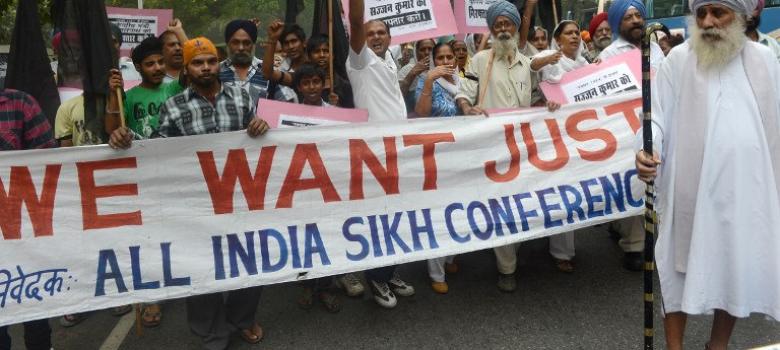
1984 anti-Sikh riots were an organised massacre, says ‘Caravan’ article

Avtar Singh Gill, the former petroleum secretary, alleged that Rajiv Gandhi aide Arun Nehru had sanctioned the violence.

Did disparate groups of rioters act spontaneously during the anti-Sikh riots of 1984, or was the violence orchestrated at the behest of the top leadership of the Congress? This question has dogged Congress governments since Delhi’s Sikh comunity was devastated by one the bloodiest bouts of communal carnage after Independence. The Congress has long maintained that the violence was an unplanned response to the assassination of Prime Minister Indira Gandhi by two Sikh bodyguards on October 31, 1984. The riots continued until November 3.

Now, a recent statement by a senior government official of the time has added credence to the allegation that the violence was indeed orchestrated, and that the clearance came from the top. Avtar Singh Gill, the former petroleum secretary, has told Caravan magazine that Arun Nehru, a cousin and confidant of Rajiv Gandhi, had given clearance for Sikhs to be attacked and killed in Delhi.

In an article by the magazine’s political editor Hartosh Singh Bal in the latest issue, Gill is quoted as saying that on November 1, 1984, “Lalit Suri of Lalit Hotels, who used to come and see me often, dropped by. He was the errand boy for Rajiv Gandhi, and since he often needed some work done, he was close to me. He came to me in the ministry and said, ‘Clearance has been given by Arun Nehru for the killings in Delhi and the killings have started.  The strategy is to catch Sikh youth, fling a tyre over their heads, douse them with kerosene and set them on fire. This will calm the anger of the Hindus.”

Gurudwara lists

Gill is also quoted as saying that Suri “told me that I should be careful even though my name is not in the voters’ list, the Delhi Gurdwara voters’ list. ‘They [the rioters] have been provided this list. This will last for three days. It has started today, it will end on the third [of November].’”

Gill’s revelations also appear to put to rest the long-term speculation about Arun Nehru’s role in the violence. “That Arun Nehru had a role in the violence has long been widely rumoured, but Gill’s statement marks the first time a senior government official has put the accusation on record,” writes Bal. “His story offers the first coherent explanation for the nature of the violence in Delhi,”

Gill and Nehru

Gill’s revelations have greater significance because he was often consulted by Arun Nehru on Punjab and Sikh issues. “As one of the few Sikhs in a senior position in the government – even though I was clean shaven, he [Nehru] wanted to know my views,” the former petroleum secretary is quoted as saying.

Gill’s also explains – again for the first time – how rioters could easily identify Sikh houses. Lawyer HS Phoolka, who is leading the legal battle to secure justice for the victims of the 1984 riots, is quoted in the article saying “the ease with which Sikh houses were identified would make sense if Gurdwara voters’ lists were available”.

Gurdwara voter lists contain the names of people eligible to vote in the elections to the Delhi Sikh Gurdwara Management Committee. That these lists were already available to “people in the higher ranks” is made clear by another contention Phoolka makes in this article.

via 1984 anti-Sikh riots were an organised massacre, says ‘Caravan’ article.

04/10/2014

Meet the Hong Kong teenager who’s standing up to the Chinese Communist Party

Joshua Wong Chi-fu is Hong Kong’s most prominent pro-democracy student leader.

Political movements often conjure images of passionate university-goers championing progressive views they learned on campus. But the long, storied history of Hong Kong’s student-led political movements is taking a different turn: The most prominent student leader of the territory’s pro-democracy protests is only 17 years old.

Sporting heavy black glasses and a bowl cut, Joshua Wong Chi-fung doesn’t exactly cut a menacing figure. But his activism against what many in Hong Kong perceive to be the Chinese Communist Party’s encroachment onto their freedoms has already attracted Beijing’s attention. Mainland authorities call him an “extremist.” A party document on national security identifies Wong by name as a threat to internal stability. Pro-Beijing newspapers in Hong Kong, meanwhile, accuse him of working for the US Central Intelligence Agency to infiltrate Hong Kong schools. (Wong denies the charges.)

Joshua Wong’s fight against ‘brainwashing’

Wong got his start in 2011, when he and fellow students founded a group called “Scholarism,” which they thought was catchier than the direct translation of the Chinese, meaning “scholarly trends.” Wong and Scholarism rose to prominence in 2012, when the Hong Kong government tried to roll out Communist Party-approved “patriotic” education in Hong Kong’s public schools, to replace civics classes. The curriculum included textbooks like one titled “The China Model,” which characterised China’s Communist Party as “progressive, selfless and united,” and criticized multi-party systems like Hong Kong’s while avoiding major (unflattering) events – notably, the Great Leap Forward, the Cultural Revolution and the Tiananmen Square massacres of 1989 – reports the New York Times (paywall).

One Hong Kong journalist likened the move to a Trojan horse that dissolved Hong Kong’s identity; Wong called it “brainwashing,” an attempt to require students to “develop an emotional attachment to China,” as he put it in this video by the South China Morning Post (paywall). In Sep. 2012, Wong and Scholarism mobilized more than 120,000 people to demonstrate (paywall) against the education programme, including a slew of students who went on hunger strike. Within days, the Hong Kong government scrapped the plan for mandatory implementation.

Wong’s next battle: ‘universal suffrage’

But Wong and Scholarism knew that as long as Hong Kong lacks representative government, both the education issue and the Chinese government’s failed 2003 attempt to impose US Patriot Act-style rules on Hong Kong would eventually resurface. So they began researching the controversy that’s now galvanising the Umbrella Revolution: universal suffrage.

This issue is really confusing – and, as even Wong admits, “really boring.” The background goes something like this: Hong Kong is governed by what’s called the Basic Law, which legal scholars from the then-British colony and the mainland wrote up prior to the 1997 handover. The law promises Hong Kong a “high degree of autonomy” until 2047 (after which, it is assumed, it will merge with the People’s Republic of China for good). It also indicates, although vaguely, that the ultimate objective is for the chief executive and the congress to be elected by universal suffrage by Hong Kong’s seven million people.

That’s not how it is at the moment. Hong Kong’s chief executive is currently chosen by an “election committee” made up of 1,193 members selected to represent “functional constituencies,” such as business and labor groups. Beijing controls who is on the committee, and, in turn, whom the committee elects; the committee also decides who runs. Ultimately, since the Chinese government still has to officially “appoint” the chosen candidate, it has veto power over the chief executive.

In 2007, the National People’s Congress, China’s legislature, promised that by 2017, Hong Kong’s chief executive “may be implemented by the method of universal suffrage.” Some in Hong Kong read that to mean by 2017, they’d have fully democratic elections. But the NPC, evidently, had something else in mind: that each and every Hong Kong citizen would be allowed to vote – but only for one of three candidates selected by the (Communist Party-picked) “electoral committee.”

via Meet the Hong Kong teenager who’s standing up to the Chinese Communist Party.

03/10/2014

Hong Kong protests: No exit | The Economist

IT IS a challenge unlike anything Chinese leaders have seen since Tiananmen Square in 1989; a city roiled by days of unauthorised protests led by students demanding democracy. On October 1st, the 65th anniversary of Communist rule in China, anti-government demonstrations in Hong Kong, which had begun nine days earlier with class boycotts, swelled to include well over 100,000 people. Protesters, conveniently armed with the umbrellas that have become their rallying symbol, endured downpours of rain to jeer the territory’s leader, Leung Chun-ying, as he presided over the raising of the national flag. A few raised their middle fingers towards it.

The “umbrella revolution”, as the movement has been dubbed, is the nightmare Communist Party leaders in Beijing have long feared from Hong Kong and the “one country, two systems” arrangement it has enjoyed since its handover from Britain in 1997. It is the first large-scale student-led protest for democracy to erupt in any Chinese city since 1989. And it presents unusual challenges. The authorities in Hong Kong are reined in by a legal system bequeathed by the British; they cannot, as officials commonly do in mainland China, handle unrest with a combination of astute bargaining, thuggish violence, ruthless treatment of ringleaders and tight controls over media and the internet. Xi Jinping, China’s president, is constrained by a desire to keep Hong Kong stable and prosperous: a botched response could badly damage one of the world’s wealthiest economies and China’s image.

But if the protests continue far beyond the public holiday on October 1st and 2nd, leaders in Beijing will doubtless become impatient for tougher action. On October 1st the party’s newspaper, the People’s Daily, called on Hong Kong residents to support “resolute” action by the police against the demonstrators, who it said would “reap what they have sown”. The party does not want Hong Kong’s protests to fan dissent elsewhere. Chinese censors on the mainland have been working hard to make sure they do not (see article). So too have China’s police, who have rounded up dozens of activists on the mainland for expressing sympathy with the protests. Some tour groups have reportedly been denied permits to go to Hong Kong on their usual shopping extravaganzas. Despite the party’s efforts, however, news of Hong Kong’s defiance is spreading in China.

The protesters’ main demand is that the people of Hong Kong be allowed to vote for any candidate of their choosing in elections for the post of chief executive in 2017 (the first in which citizens would have such a vote). Mr Xi has made clear he does not want any Western-style democracy within China’s borders. The current election plan, which China proposed on August 31st, calls for candidates to be screened by a committee stacked with party supporters.

Several protest movements have converged to challenge this. Until recently the best-known was Occupy Central with Love and Peace, which is modelled on Occupy Wall Street and named after an important business district in the heart of Hong Kong. But even Occupy Central’s leaders, who teach at local universities, wondered whether they could muster meaningful numbers. Then came the students, both from universities and schools, thousands of whom began boycotting classes on September 22nd. On the evening of September 26th the police inflamed their passions by arresting Joshua Wong, the 17-year-old leader of a movement called Scholarism, which two years ago led successful protests against an effort to introduce party-backed “patriotic” teaching in schools. Mr Wong was released on September 28th, but in the early hours of that day Benny Tai, one of the leaders of Occupy Central, announced that its protest, which had been scheduled for October 1st, would begin immediately.

via Hong Kong protests: No exit | The Economist.

02/10/2014

Hong Kong’s protests: A tough test for China’s leaders | The Economist

IT IS a most unusual sight on Chinese soil, and most unsettling for leaders in Beijing. On September 28th and 29th tens of thousands of demonstrators surrounded government offices and filled major thoroughfares around Hong Kong, braving rounds of tear gas from riot police to call for democracy and demand the resignation of Leung Chun-ying, the territory’s Beijing-backed chief executive. One image broadcast and shared around the world, of a lone protester holding his umbrella aloft in a cloud of tear gas (pictured above), has given the non-violent protests a poetic echo of “tank man” from the crackdown at Tiananmen Square in 1989.

Umbrella man

It also captures precisely what Communist Party leaders in Beijing fear from Hong Kong and its special status under the “one country, two systems” arrangement it has enjoyed since the territory’s handover from Britain in 1997. Not only are its people willing (and allowed by law) to challenge their government openly, but they also could become an inspiration for protests elsewhere in China. The spread of news and images of the protests has been blocked or heavily censored on the mainland, but as the protests carry on, the risk of contagion rises. In that sense this marks one of the most difficult tests of Chinese rule since Tiananmen.

Compounding the difficulty is the lack of a middle ground. The protesters’ main demand is that the people of Hong Kong be allowed to vote for any candidate of their choosing in elections for the post of chief executive in 2017 (the first in which citizens would have such a vote). President Xi Jinping has made clear he will have nothing resembling full Western democracy within China’s borders. The current election plan, put forward by the central government on August 31st, gives the central government an effective veto over nominees to ensure that Hong Kong remains firmly under its control.

Several protest movements have converged to challenge that control. Until recently the best-known movement had been Occupy Central with Love and Peace, which is modelled on Occupy Wall Street and named after an important business district at the heart of Hong Kong. But even Occupy’s leaders wondered whether they could muster meaningful numbers.

The biggest drivers of these protests have been university students and secondary school students, thousands of whom boycotted classes last week. On the evening of September 26th the leader of the secondary school students, 17-year-old Joshua Wong of Scholarism, was arrested—a move that, along with the use of pepper spray by police, was credited with swelling the popularity of the protests over the weekend (Mr Wong was released on Sunday). In the early hours of September 28th Benny Tai, one of the leaders of Occupy Central, announced that its protest, which had been scheduled for October 1st, China’s national day holiday, would begin immediately.

Mr Leung has shown no sign of bending. On the afternoon of September 28th, at a press conference held inside the government headquarters while thousands of protesters surrounded the building, Mr Leung repeated his endorsement of the election plan. It calls for chief executive candidates to be screened by a committee stacked with Communist Party supporters (he was elected by a similar committee in 2012, collecting 689 votes along with the derisive nickname “689”). Mr Leung acknowledged that the plan may not have been the “ideal” that some wanted, but he called it progress nonetheless. He said it had given Hong Kong citizens the “universal suffrage” they had been promised. Mr Leung said he welcomed “rational” dialogue but that the government would be “resolute” in dealing with the “unlawful” demonstrations. Asked whether the Chinese army would ever be used, Mr Leung expressed his confidence in the police. The tear gas canisters began flying shortly afterward, surprising protesters who exclaimed variations of “are you kidding?” and “shame on you”. Many donned goggles and unfurled umbrellas to protect themselves against the gas, while some raised their hands and yelled, “don’t shoot”. The protests did not become violent, but they grew and spread to other areas. The calls for Mr Leung’s resignation became louder.

via Hong Kong’s protests: A tough test for China’s leaders | The Economist.

01/10/2014

Hong Kong democracy protesters and officials mark uneasy National Day | Reuters

Thousands of pro-democracy protesters thronged the streets of Hong Kong on Wednesday, some of them jeering National Day celebrations, as demonstrations spread to a new area of the city, ratcheting up pressure on the pro-Beijing government.

Protesters sit under umbrellas at a main street at Mongkok shopping district after thousand of protesters blocked the road in Hong Kong October 1, 2014.  REUTERS/Tyrone Siu

There was little sign of momentum flagging on the fifth day of the student-led protest, whose aim has been to occupy sections of the city, including around the Central financial district, in anger at a Chinese decision to limit voters’ choices in a 2017 leadership election.

Many had feared police would use force to move crowds before Wednesday’s start to celebrations marking the anniversary of the Communist Party’s foundation of the People’s Republic of China in 1949. Those fears proved unfounded.

The crowds have brought large sections of the Asian financial hub to a standstill, disrupting businesses from banks to jewelers. There were no reports of trouble by mid-afternoon on Wednesday, but witnesses said the number of protesters was swelling.

Riot police used tear gas, pepper spray and baton charges at the weekend to try to quell the unrest but tensions have eased since then as both sides appeared prepared to wait it out, at least for now.

Protests spread from four main areas to Tsim Sha Tsui, a shopping area popular with mainland Chinese visitors on the other side of the harbor. It would usually do roaring trade during the annual National Day holiday.

Underlining nervousness among some activists that provocation on National Day could spark violence, protest leaders urged crowds not to disturb the flag-raising ceremony on the Victoria Harbour waterfront.

Proceedings went ahead peacefully, although scores of students who ringed the ceremony at Bauhinia Square overlooking the harbor booed as the national anthem was played.

via Hong Kong democracy protesters and officials mark uneasy National Day | Reuters.

30/09/2014

Obama-Modi Meeting Offers Chance to Reset U.S.-India Ties – Businessweek

President Barack Obama and Indian Prime Minister Narendra Modi’s meetings in Washington give the two leaders to chance to reinvigorate an economic relationship that both see crucial to growth and security.

Indian Prime Minister Narendra Modi

The two days of talks, which began with a private dinner for Modi at the White House last night, are pivotal, U.S. officials said ahead of the summit. In addition to Obama’s sessions with Modi, Vice President Joe Biden and Secretary of State John Kerry will host today a luncheon for the Indian leader.

This is the first time Obama and Modi have met, and it also is Modi’s first visit to the U.S. since he was denied a visa in 2005 over anti-Muslim riots in his state of Gujarat three years earlier. Modi won a landslide election win in May, and the U.S. is seeking to repair relations while India is wooing foreign investors to revive its economy.

“The U.S. is eagerly trying to move forward with Modi in order to put the past behind them,” Milan Vaishnav, an associate in the South Asia program at the Carnegie Endowment for International Peace in Washington, said in a phone interview. “The two sides have a foundation in terms of a bilateral government-to-government relationship and a people-to-people relationship to build on. In terms of a leader-to-leader relationship, this is almost like starting anew.”

via Obama-Modi Meeting Offers Chance to Reset U.S.-India Ties – Businessweek.

30/09/2014

China’s Norinco Is Defense Giant on Global Growth Path – Businessweek

At the Africa Aerospace and Defence expo in September, weapons buyers from across the continent descended on Air Force Base Waterkloof in the South African capital of Pretoria for a bit of shopping. There they were wooed by Chinese defense gear giant Norinco, which has honed its pitch to an art.

China's New Export: Military in a Box

Namibia Deputy Defense Minister Petrus Iilonga, wearing Prada sunglasses and a Lenin pin, studied models of battle tanks before representatives from Norinco, a state-controlled conglomerate also known as China North Industries Group, ushered him into a room marked VIP for some personal salesmanship. Nearby, the Tanzanian military chief, General Davis Mwamunyange, furrowed his brow while a company official in a charcoal suit and orange tie described a truck with a radar device mounted on the back. “Just about a month ago, we did a live test on this one,” the Chinese official confided.

Norinco has even devised a novel way to make buying weapons easier: It bundles together starter kits of basic defense gear—everything from rifles to howitzers, laser-guided bombs, armored personnel carriers, tanks, and drones—for governments that want to quickly outfit their armed forces. Chinese state media has dubbed the package a “military set meal.”

STORY: Why Japan’s Controversial Shrine Infuriates China and Korea

More than three decades after Chinese leader Deng Xiaoping and the Communist Party founded Norinco, in the wake of a humiliating border war with Vietnam that ended in a stalemate, the company sits atop a military-industrial complex that increasingly rivals the U.S. war machine in firepower and influence.

via China’s Norinco Is Defense Giant on Global Growth Path – Businessweek.

30/09/2014

Centripetal and Centrifugal Forces at Work in the Nation-State | Stratfor

“Here begins our tale: The empire, long divided, must unite; long united, must divide. Thus it has ever been.” This opening adage of Romance of the Three Kingdoms, China’s classic novel of war and strategy, best captures the essential dynamism of Chinese geopolitics. At its heart is the millennia-long struggle by China’s would-be rulers to unite and govern the all-but-ungovernable geographic mass of China. It is a story of centrifugal forces and of insurmountable divisions rooted in geography and history — but also, and perhaps more fundamentally, of centripetal forces toward eventual unity.

Tibetan Settlement in India

This dynamism is not limited to China. The Scottish referendum and waves of secession movements — from Spain’s Catalonia to Turkey and Iraq’s ethnic Kurds — are working in different directions. More than half a century after World War II triggered a wave of post-colonial nationalism that changed the map of the world, buried nationalism and ethnic identity movements of various forms are challenging the modern idea of the inviolable unity of the nation-state.

Yet even as these sentiments pull on the loose threads of nations, in China, one of the most intractable issues in the struggle for unity — the status of Tibet — is poised for a possible reversal, or at least a major adjustment. The long-running but frequently unnoticed negotiations have raised the possibility that the Dalai Lama, Tibet’s spiritual leader, may be nearing a deal that would enable him to return to his Tibetan homeland. If it happens, it would end the Dalai Lama’s exile in Dharamsala, India — an exile that began after the Tibetan uprising in 1959, nine years after the People’s Republic of China annexed Tibet. More important, a settlement between Beijing and the Dalai Lama could be a major step in lessening the physical and psychological estrangement between the Chinese heartland and the Tibetan Plateau.

Read rest of article via Centripetal and Centrifugal Forces at Work in the Nation-State | Stratfor.

30/09/2014

Stand-off continues, Chinese army refuses to withdraw from Chumar


The standoff between the Indian Army and their Chinese counterparts continued on Monday at the Chumar sector in eastern Ladakh, along the Line of Actual Control. At one of the eight spots in the Chumar sector, the Indian Army made a tactical retreat in the face of a heavy Chinese presence. Despite diplomatic interventions on Monday, both sides continue to hold their tactical positions against each other. The standoff has continued primarily because of China’s unwillingness to stop its road-building exercise to the Line of Actual Control and India’s refusal to demolish structures built in the area to shelter troops.

via Scroll.in – News. Politics. Culture..

Law of Unintended Consequences

continuously updated blog about China & India

ChiaHou's Book Reviews

continuously updated blog about China & India

What's wrong with the world; and its economy

continuously updated blog about China & India