29/04/2020
- Hardline politicians want president to fulfil promise to overhaul constitution to reflect the self-ruled island’s political reality
- A petition calls for two referendums on the issue – proposing it either be replaced with a new one or revised
The push for constitutional change could lead to a cross-strait conflict. Photo: Handout
Taiwanese President Tsai Ing-wen is under growing pressure from the hardline camp to push for constitutional change to reflect the self-ruled island’s independent status – something observers say could provoke a cross-strait conflict.
With Tsai due to be sworn in for a second four-year term next month after a landslide victory in January’s election, hardline pro-independence politicians want her to fulfil a 2015 campaign promise: to overhaul the constitution so that it reflects Taiwan’s political reality. The process has been stalled since Tsai’s first term, which began in 2016.
Leading the charge is the Taiwan New Constitution Foundation, a group formed last year by a Tsai adviser and long-time independence advocate Koo Kwang-ming.
The foundation launched a petition at the end of March calling for two referendums on the constitution – proposing that it either be replaced with a new one or revised.
The existing constitution was adopted when Kuomintang leader Chiang Kai-shek and the KMT fled to Taiwan and set up an interim government in 1949 following their defeat by Mao Zedong’s communists in mainland China.
Drawn up in 1947, the constitution still puts the mainland and Mongolia under the Republic of China jurisdiction – Taiwan’s official name for itself. In reality, its jurisdiction extends only to Taiwan and its outlying islands of Penghu, Matsu and Quemoy, which is also known as Kinmen.
Taiwan’s constitution was adopted when KMT leader Chiang Kai-shek fled to the island in 1949. Photo: Handout
“We have garnered more than 3,000 signatures from the public for the first phase of initiating the proposals to hold two referendums asking the president to push for constitutional change,” Lin Yi-cheng, executive director of the Taiwan New Constitution Foundation, said on Wednesday.
He said they would propose that voters be asked two questions in the referendums: “Do you support the president in initiating a constitutional reform process for the country?”
And: “Do you support the president in pushing for the establishment of a new constitution reflecting the reality of Taiwan?”
“We’re ready to send the two referendum proposals to the Central Election Commission on Thursday,” he said.
Confusion prompts call for China Airlines name change in Taiwan, but at what cost?
Under Taiwan’s Referendum Act, the process for holding a referendum involves three stages: a proposal, endorsement and voting.
Lin said there should be no problem for the commission to approve the proposal stage since they had gathered far more than the minimum 1,931 signatures needed under the act.
The endorsement stage requires a minimum of 290,000 signatures, and if the referendum is held, they will need at least 5 million votes.
Lin said if the process went smoothly, he expected a referendum could be held in August next year, allowing time for review and making the necessary arrangements.
He said if the referendum questions got enough public support, Tsai would need to deal with the issue.
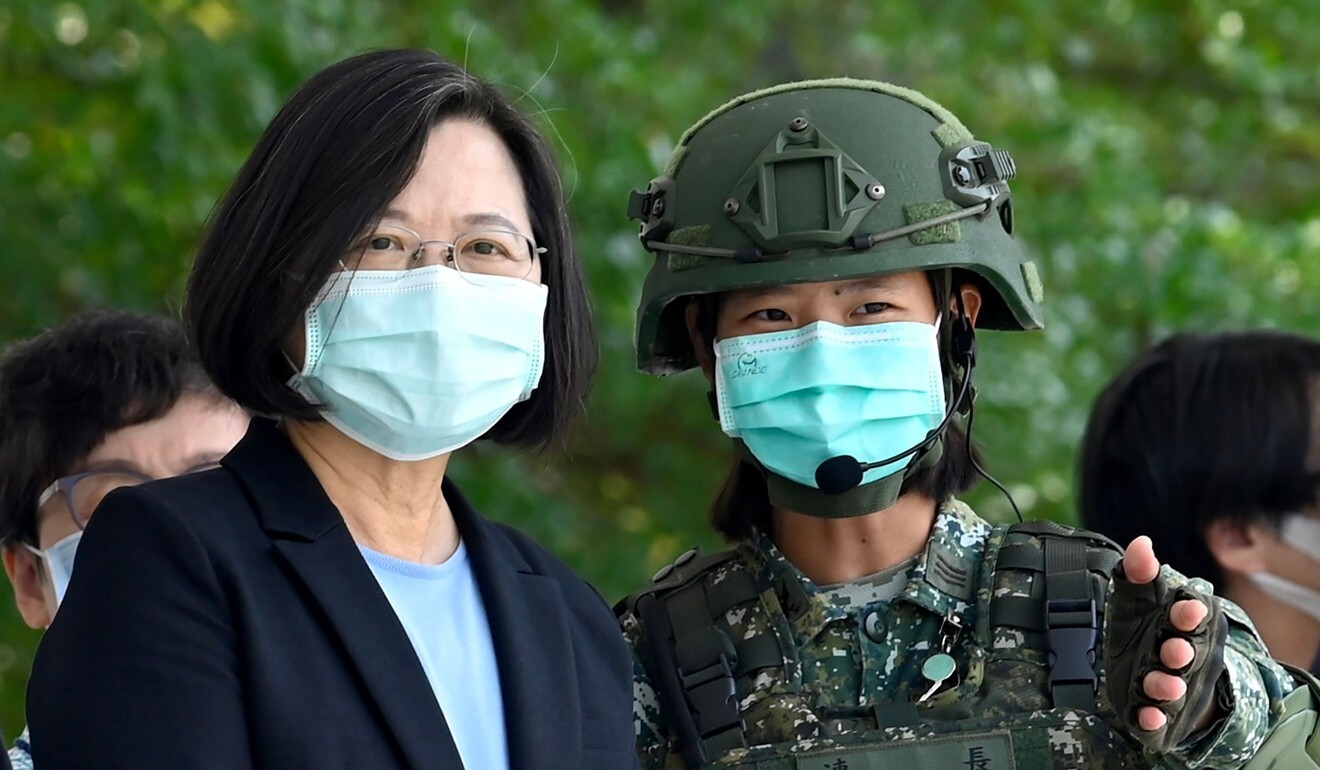
Tsai Ing-wen visits a military base in Tainan earlier this month. The pressure for constitutional change creates a dilemma for the president. Photo: AFP
Tsai’s Democratic Progressive Party government has been tight-lipped over the constitutional change issue, which Beijing sees as a move for the island to declare formal independence from the mainland.
Beijing considers Taiwan a wayward province that must be returned to the mainland fold, by force if necessary, and it has warned Tsai against declaring formal independence.
A DPP official said the foundation’s push would put Tsai in a difficult position.
“If she ignores the referendums, she will come under constant pressure from the hardline camp, and if she seriously considers taking action and instituting a new Taiwan constitution, she will risk a confrontation with Beijing, the consequence of which could be a cross-strait conflict,” said the official, who requested anonymity.
On Tuesday, Zhu Fenglian, a spokeswoman for the mainland’s Taiwan Affairs Office, warned the island against holding any referendum on constitutional revision, saying it would be doomed to end in an impasse and would ultimately fail.
“It will only push Taiwan towards an extremely dangerous abyss and bring disasters to Taiwanese compatriots,” she said.
Chinese air force’s drill ‘aimed at signalling deterrent around Taiwan’
But according to Wang Kung-yi, a political science professor at Chinese Culture University in Taipei, Tsai should not be too worried about the hardline camp move.
“The hardline camp has been marginalised greatly in the past several years as reflected by the poor showing in the legislative elections in January,” Wang said, adding that he expected Tsai to continue her relatively moderate cross-strait policy of not sharply provoking the mainland.
Source: SCMP
Posted in 1949, 2015, 2016, also known as, amid, August, be replaced, Beijing, by force, call for, calls for, campaign, Central Election Commission, Change, Chiang Kai-shek, China Airlines, Communists, confusion, considers, Constitution, constitutional, creates, cross-strait conflict, declare, defeat, Democratic Progressive Party, dilemma, earlier, either, Election, endorsement, fled, formal independence, four-year term, Hardline politicians, independent, island, islands, issue, January’s, jurisdiction, Kinmen, KMT, Kuomintang, mainland, Mainland China, Mao Zedong’s, March, marginalised, Matsu, military base, Mongolia, move for, name change, necessary, new one, next month, next year, observers, outlying islands, overhaul, Penghu, Petition, political reality, political science professor, politicians, President, pressure, pro-independence, promise, prompts, proposal, proposing, provoke, push for, Quemoy, Referendum Act, referendums, Republic of China, returned, revised, second, sees, self-ruled, status, sworn, Tainan, Taipei, Taiwan, Taiwan Affairs Office, Taiwan New Constitution Foundation, Taiwanese President, this month, Thursday, tight-lipped, to fulfil, to reflect, Tsai, Tsai Ing-wen, two, Uncategorized, under pressure, Voting, warned, wayward province |
Leave a Comment »
21/05/2019
Supreme Court dismisses new petition on verifying all votes with VVPAT, says ‘let country elect its government’
INDIA Updated: May 21, 2019 14:54 IST
Calling the petition a “nuisance”, the court said, “We won’t entertain such a plea over and over again.(HT Photo)
The Supreme Court on Tuesday dismissed a new petition that sought matching of all voter verifiable paper audit trail (VVPAT) slips with electronic voting machines (EVMs) during the counting of votes on May 23.
Calling the petition a “nuisance”, the court said, “We won’t entertain such a plea over and over again. Can’t come in the way of people electing their representatives. Let country elect its government.”
A vacation bench headed by Justice Arun Mishra refused to entertain the plea filed by a Chennai-based organisation ‘Tech for All’ saying that a larger bench headed by Chief Justice Ranjan Gogoi had already dealt with the matter and passed an order, news agency PTI reported.
The top court had on April 8 directed the Election Commission to increase random matching of VVPAT slips with EVMs from one to five polling booths per assembly segment in Lok Sabha polls, saying it would provide greater satisfaction not just to political parties but also to the entire electorate.
Source: Hindustan Times
Posted in all votes, Andhra Pradesh Chief Minister, dismisses, Election Commission (EC), Electronic Voting Machines (EVMs), Lok Sabha, N. Chandrababu Naidu, Petition, polls, Supreme Court, Uncategorized, verifying, voter verifiable paper audit trail (VVPAT) |
Leave a Comment »
22/07/2013
SCMP: “Several incidents of violence have been reported in Beijing in the aftermath of the attempted suicide by an aggrieved petitioner at the capital’s international airport on Saturday.

On Monday, a man armed with a knife went on a rampage at a Carrefour shopping centre, in Beijing’s western district, wounding at least four people. Police have arrested a Beijing-native surnamed Wang, born in 1963 at the scene, local police said in a statement.
One child was among those wounded, Beijing News reported on its microblog. The report did not say what triggered the attack.
Last Thursday, a knife-yielding man stabbed two people, including one US woman, to death, in a similar incident.
In two unrelated incidents, Beijing police arrested two men for “threatening to carry bombs and attempting to disturb social order” in the capital.
Four hours after petitioner Ji Zhongxing caused an explosion at Beijing Capital International Airport on Saturday, a 39-year-old man surnamed Wang from Beijing’s Miyun county threatened to set off explosives at a Beijing airport to protest against land seizures, according to a statement by Beijing police.
Only one hour later, a 31-year-old man surnamed Liu from Jiangsu province, threatened to detonate explosives at a video arcade, police said. Both men have since been arrested.
Many Chinese netizens blamed a “butterfly effect” and criticised the government for failing to address petitioners’ grievances. “If the government continues in its corrupt ways, everybody will become Ji Zhongxing,” said one Weibo user. “Using lives to protest is the last way for ordinary people to seek changes,” wrote another.
via Knife attacks and bomb threats follow Beijing airport explosion | South China Morning Post.
Posted in China alert, Petition, Politics, public protest, social media |
Leave a Comment »
18/05/2013
FT: “Even in China, David sometimes beats Goliath – though it’s sometimes hard to be sure.

This week, residents of Songjiang – a suburb of Shanghai which has gained fame around the world for having over 10,000 dead pigs floating in its water supply – found that though they could not vanquish the porcine invader, they had scared away an intruder from the corporate world. Shanghai Guoxuan High-Tech Power Energy company said it was abandoning plans for a battery factory in Songjiang, after residents protested on the streets and on the internet against it.
In a statement broadcast on local TV, the company said it would return the land allocated by local government and “will not seek any compensation”. It said it was halting its existing operations and pulling out of the area completely.
Residents staged street protests against the plant regularly since late April and more than 10,000 signed a petition against the project with many others voicing their opposition to it on the internet. At least one protester was reported to have been injured by police.
But Chinese citizens know that plants vanquished in one location in China, by “not in my backyard” or “nimby” protests, often pop up in someone else’s backyard. Residents of neighbouring Jinshan, another industrial area on the outskirts of Shanghai, now fear that the plant will end up on their doorstep.
“We already have so many chemical plants. We really cannot tolerate one more battery plant. Shall we protest together?” asks one user on a Jinshan property owner’s online forum.
Ordinary Chinese are less and less ready to pay the environmental price for economic development – or rather, more and more ready to see someone else pay it. This week, up to a thousand people protested in Kunming, in southwest China, the second large demonstration this month against plans to produce paraxylene (PX), a chemical used in making fabrics and plastic bottles, at a plant in the town.
Protestors complained that the environmental impact assessment for the project was suspect, because it was done by one subsidiary of China National Petroleum Corp, the country’s largest oil and gas producer and supplier, while the plant would be operated by another. That is the equivalent of “grandson assessing Grandpa,” said one Weibo user.
Last November, the eastern city of Ningbo suspended a petrochemical project after days of street protests. The year before, big protests against a PX plant in the northeastern city of Dalian forced the city government to suspend it.”
via China’s protesters: winning battles? | beyondbrics.
Posted in China alert, Economics, Petition, Politics, public protest |
Leave a Comment »
08/05/2013
China Daily: “Anti-graft officials vow protection of whistle-blowers from retaliation
Officials with China’s top anti-graft authority expressed firm opposition on Tuesday to the detention of petitioners.
Authorities are not allowed to detain petitioners at any level of petition offices and at public venues, said Zhang Shaolong, deputy director of the office of letters and calls of the Central Commission for Discipline Inspection of the Communist Party of China.
It is a legal channel for petitioners to submit whistle-blowing materials face to face to the anti-graft authorities, and the petitioners should receive a warm welcome from anti-corruption agencies, he said.
Zhang made the remarks on Tuesday during an online interview with two other anti-graft officials from the commission.
Under the administrative mechanism in most places, the leading officials will not get promoted if too many petitioners appeal to higher authorities.
Many corrupt officials were exposed by online posts, Zhang said, adding that some inaccurate online information has also made the investigations of corrupt officials difficult.
Among all the cases investigated by the commission last year, about 41.8 percent of the clues were collected from the public whistle-blowers through online reports, letters and calls, Zhang said.
Guo Hongliang, Zhang’s colleague who also attended the online interview, said that the commission has received 301,000 online whistle-blowing reports from 2008 to 2012.
The commission established 12388.gov.cn, its online whistle-blowing website, in October 2009, and the Internet has become one of the most important channels for the commission to collect information, he said.
Deng Jixun, another colleague of Zhang who attended the interview, said that real-name whistle-blowing activities should be encouraged to promote the efficiency of anti-corruption work.
The anti-graft authorities should protect real-name whistle-blowers from being victims of retaliation, he said.
Zhang acknowledged that some officials try to prevent people from petitioning to higher levels of government, and these officials’ behavior should be firmly opposed.
A report in People’s Daily revealed that many petitioners had been detained by the government of Hai’an county in Jiangsu province since March when they tried to visit the anti-graft officials from an inspection team sent by the provincial government.”
via Detention of petitioners denounced |Politics |chinadaily.com.cn.
Posted in Censorship, China alert, Freedom, Good news, Human rights, Illegal practices, Internal politics, Justice, Petition, Politics, public protest, Reform, Rule of law |
Leave a Comment »
13/02/2013
Rule of Law over personal edicts starts to hold sway. About time too.
Posted in China alert, Good news, Human rights, Petition, Reform, Rule of law |
Leave a Comment »
09/02/2013
China seems determined to allow its citizens to petition central government and to stop local authorities from preventing this from happening.
Reuters: “China will compensate a woman who was held in a disused morgue as punishment for going to Beijing to petition against her husband’s jailing, state media said on Friday, in an unusual case of the government overturning an extra-judicial detention.
Chen Qingxia was held for three years in an abandoned bungalow once used to store bodies in northeast China’s Heilongjiang province after being abducted from Beijing by security officials, the official Xinhua news agency reported.
She had gone to the capital to seek redress for her husband, Song Lisheng, whom she said had been mistreated while serving an 18-month sentence at a re-education through labor camp, Xinhua added.
While China routinely dismisses Western criticism of its human rights record, the government does respond to some abuses, especially the more egregious ones reported by domestic media, in an effort to show that authorities are not above criticism
Chen’s plight came to public attention in December after media reported that people found posters she had put on a window of the building pleading for help, it said.
Four officials, including three police officers, had been fired in connection with the case, Xinhua added.
The government will pay medical bills and living expenses for her and her husband and step up efforts to find their young son, who became separated from Chen when she was abducted in Beijing, it said.
The amount of compensation has yet to be decided.
Chen’s case is the second reported in a week of the authorities taking action over illegally detained petitioners. A court in Beijing sentenced 10 people to up to two years in jail for illegally detaining petitioners from another city, state media said on Tuesday.
Petitioners often try to take local disputes ranging from land grabs to corruption to higher levels in Beijing, though only small numbers are ever able to get a resolution.
In many instances, they are rounded up by men hired by provincial authorities to prevent the central government from learning of problems in outlying regions, forced home or held in “black jails“, unlawful secret detention facilities.”
via China to compensate woman for detention in old morgue | Reuters.
Posted in China alert, Good news, Human rights, Illegal practices, Justice, labour camp, Petition, Politics, public protest, Reform, Rule of law |
1 Comment »
25/01/2013
BBC News: “China detains woman at disused mortuary for three year
A Chinese woman who petitioned the authorities over the treatment of her husband at a labour camp has been detained at a disused mortuary for the past three years, state media report.

An SVG map of China with Heilongjiang province highlighted in orange and Yichun city highlighted in red Legend: File:China map legend.png (Photo credit: Wikipedia)
Chen Qingxia had already served 18 months at a re-education camp for her campaign, but continued to fight and so was confined to the mortuary.
Reports of her ordeal in the province of Heilongjiang have triggered an outcry on social media.
Ms Chen is said to be in poor health.
But correspondents say that it looks likely that restrictions on her will be relaxed soon – a committee has been formed in the city of Yichun to re-examine her case.
There has also been some speculation in recent weeks that the Chinese authorities might reform or rethink its system of re-education through labour.
Ms Chen’s ordeal began in 2003 when her husband was imprisoned for attempting to breach a quarantine during a Sars epidemic, according to the Global Times newspaper.
After he was freed, media reports say, his body was bruised and his mental health had deteriorated so much that Ms Chen decided to travel to the capital, Beijing, to complain to the central authorities about the treatment he had received.
The move led to her being put through a re-education camp for 18 months. After finishing the sentence, she was kept in the mortuary because she was still determined to continue her campaign.
A China National Radio report says that Mrs Chen has been allowed minimal contact with relatives.
Her husband was eventually admitted to hospital for treatment for his mental-health problems, the Global Times said.
The Communist Party’s district chief has been quoted by local television as saying local officials should bear responsibility for Mrs Chen’s treatment.”
via BBC News – China detains woman at disused mortuary for three years.
Posted in China alert, Human rights, Illegal practices, Justice, Petition, Politics, Reform, Rule of law, social media |
Leave a Comment »
14/01/2013
Central government appears determined to let the people’s voice be heard and not censored by local authorities. Good news – if enforced.
Posted in Censorship, China alert, Illegal practices, Openness, Petition, Politics |
Leave a Comment »
31/12/2012
This research report confirms what has been obvious for several years: the power of the Internet over formal communications channels.
China Daily: “Micro blogs, like the social networking site Sina Weibo, have improved authority’s efficiency in handling anti-corruption cases, but also pose challenges in distinguishing true from false, according to a recently released report by Shanghai Jiao Tong University’s Public Opinion Research Lab.
Of the 24 widespread micro blog reports this year, nine have been confirmed as frauds, the report said.
“The micro blog plays a major role in fighting corruption nowadays, but posts online need to be carefully sifted to find what is reliable information,” the report said.
As more netizens become familiar with and participate in fighting corruption, more messages spread each day that await authorities’ attention, said Xie Yungeng, an expert in public opinion and new media at Shanghai Jiao Tong University.
“A regulation should be established on what kind of reports discipline authorities should respond to and set time limits for their response,” he said.
“The new way of fighting corruption is testing the wisdom and ability of disciplinary bodies,” said Zhu Lijia, a senior researcher at the Chinese Academy of Governance.”
via Report confirms blog’s power in fighting graft[1]|chinadaily.com.cn.
Posted in China alert, corruption, Digital communications, food safety, Illegal chemicals, Inequalities, Petition, public protest, social media |
1 Comment »





 CHINDIA ALERT: You'll be living in their world, very soon