Archive for ‘Political asylum’

29/05/2020

Under shadow of Beijing’s security law, Taiwan president thanks Hong Kong bookseller for supporting democracy

  • Tsai Ing-wen visited exiled Hong Kong bookseller a day after NPC voted in favour of legislation
  • Lam Wing-kee said fleeing Hongkongers saw Taiwan as a step towards applying for asylum in the West

President Tsai Ing-wen (centre) shows her support for Hong Kong bookseller Lam Wing-kee (right) with Lin Fei-fan, deputy secretary general of the ruling Democratic Progressive Party. Photo: Taiwan presidential office/AFP
Taiwan’s President Tsai Ing-wen visited exiled Hong Kong bookseller Lam Wing-kee
on Friday in a show of support for Hongkongers amid Beijing’s plan to introduce a controversial national security law.
Her visit came a day after China’s legislature, the National People’s Congress, voted in favour of a resolution to initiate the legal process for a national security law to be imposed on Hong Kong, despite concerns from the United States, the European Union and elsewhere that the move would erode human rights, freedom and autonomy in the city.
“We want to thank the bookstore boss Lam Wing-kee for his persistent support of human rights, freedom and democracy in Hong Kong from the past to the present stage,” Tsai told Lam, who recently reopened the now-defunct Hong Kong Causeway Bay Books in Taipei.

Tsai said on behalf of all Taiwanese people, she welcomed Lam to stay in Taiwan where he could bolster the island’s efforts to further freedom and democracy.

Hongkongers who want to flee to Taiwan ‘will go through strict screening’

28 May 2020

Lam, one of the five shareholders and staff at Hong Kong’s Causeway Bay Books, fled to Taiwan in April last year after he was detained by Chinese agents for eight months in 2015 for selling books critical of the Chinese leadership.

All five went missing

between October and December that year and it emerged they had been detained on the Chinese mainland.
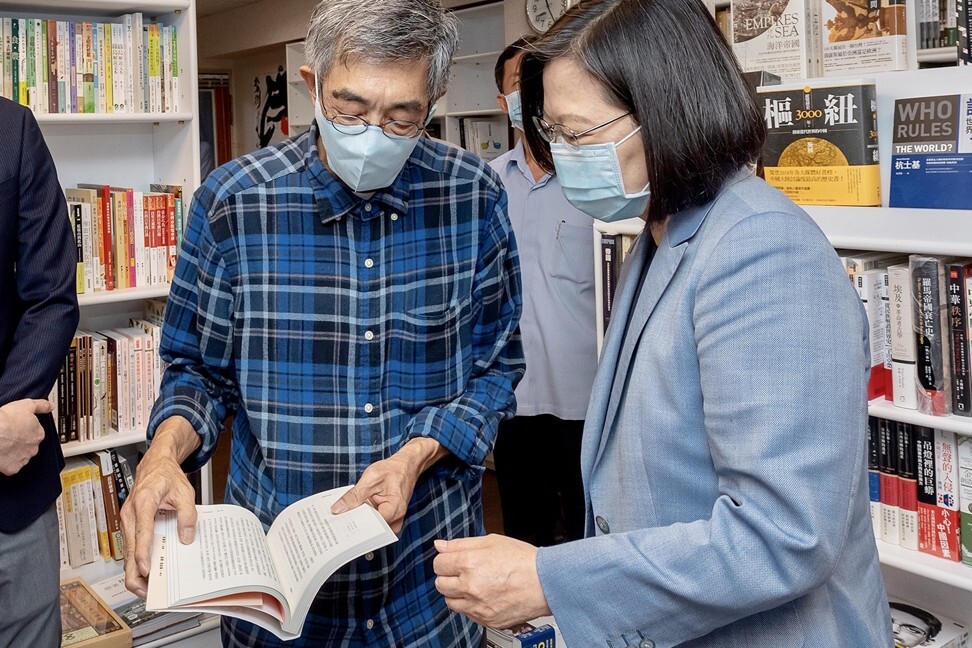
President Tsai Ing-wen looks at a book while visiting Lam Wing-kee on Friday. Photo: Taiwan presidential office/AFP
Lam later said he had been detained and blindfolded by police after crossing the border into mainland China from Hong Kong in October 2015.

The case triggered a huge controversy and raised fears of growing Chinese control in the city.

Seeing Lam as a representative of Hongkongers fleeing to Taiwan to avoid political persecution, Tsai said she wanted to understand what challenges these exiles faced and what help they needed during their stay on the self-ruled island.

“I want to tell Boss Lam [Wing-kee] and our Hong Kong friends that the government here has set up an ad hoc committee to offer help to them very soon,” she said.

On Wednesday, Tsai called for the government to set up an ad hoc committee to work out a “humanitarian help action plan” for Hong Kong people seeking to live in Taiwan or immigrate to the island. It was borne out of concern they would be arrested or prosecuted for taking part in months of anti-government protests triggered last year by the now-shelved extradition bill.

Chen Ming-tong, head of the Mainland Affairs Council, the island’s top mainland policy planner, said on Thursday his council would draft the measures for cabinet’s approval in a week.

Under the plan, the Mainland Affairs Council would issue special measures and coordinate with the island’s authorities on how to help Hongkongers relocate to Taiwan and take care of them.

Bookseller Lam told Tsai what Hongkongers needed most was to have their stay in Taiwan extended.

Lam said that currently, because of the absence of a political asylum law, Hongkongers could only apply to live in Taiwan through study, work, investment, their professional skills or close relatives.

He said fleeing Hongkongers usually came to Taiwan on tourist permits, which at most allowed them to stay for up to six months, giving them not enough time to apply for long-term residence in Taiwan.

“It would be better if they can stay for nine months and preferably one year,” he said.

Lam said some fleeing Hongkongers saw Taiwan as an intermediary base as they hoped to apply for asylum in the West, but it took a long time for Western countries to screen and approve their asylum requests.

Meanwhile, Premier Su Tseng-chang said Article 18 of the Laws and Regulations Regarding Hong Kong and Macau Affairs was good enough to deal with the current crisis in the absence of a political asylum law in Taiwan.

That article states that “necessary help shall be provided to Hong Kong or Macau residents whose safety and liberty are immediately threatened for political reasons”.

Source: SCMP
19/01/2019

Meng Hongwei: Wife of ex-Interpol chief seeks France asylum

The wife of Meng Hongwei, the Interpol president held in China since September, has sought asylum in France for herself and her twin children.

Grace Meng and the seven-year-olds live in Lyon, the international police agency’s headquarters. Meng Hongwei disappeared during a visit to China.

In October the Chinese authorities said Mr Meng was being investigated over suspected bribe-taking.

His wife and children are under police protection, having received threats.

Quoted by France Inter radio on Friday, she said, “I fear they will kidnap me.”

“I’ve received strange phone calls. Even my car was damaged. Two Chinese – a man and woman – followed me to the hotel,” she said.

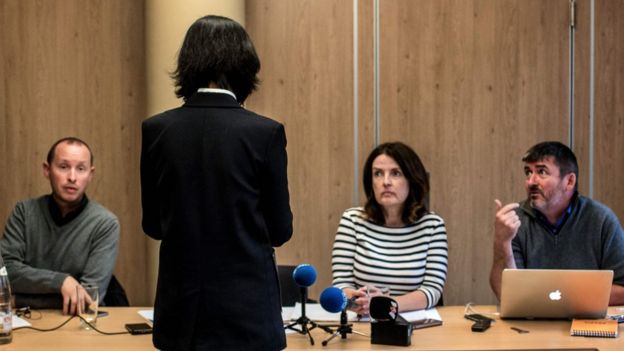
In media interviews she has refused to show her face, fearing for her safety.

On the day her husband went missing, she said he had sent her a social media message telling her to “wait for my call”, before sending a knife emoji, signifying danger.

Grace Meng with journalists, 7 Oct 18Image copyrightAFP
Image captionGrace Meng does not reveal her face on camera

What is known about Meng Hongwei?

Since his disappearance on 25 September no details have emerged about his prison conditions or the charges against him.

The 65-year-old’s job as Interpol president was largely ceremonial and did not require him to return to China often.

He was also one of six powerful vice-ministers in China’s public security ministry and had 40 years of experience in China’s criminal justice system. He previously worked under security czar Zhou Yongkang, one of the most powerful figures to be taken down in President Xi’s anti-corruption campaign that has targeted more than a million officials.

Meng Hongwei was elected Interpol president in November 2016, the first Chinese person to take up the post, and was scheduled to serve until 2020.

China’s new National Supervision Commission – an anti-corruption agency – said Mr Meng was being investigated for “violation of laws”.

But unlike in other high-profile detentions, it did not mention a charge of “violating party rules”.

China has not presented any evidence to justify the allegation against Mr Meng.

How did Interpol react?

China said Mr Meng had written a resignation letter and Interpol Secretary-General Jürgen Stock acknowledged that he had received it on 7 October. “There was no reason for me to (suspect) that anything was forced or wrong,” he said.

Quoted by the Associated Press news agency, Mr Stock said Interpol’s rules did not allow him to investigate Mr Meng’s disappearance. Interpol accepted the resignation letter without further comment.

In November Interpol elected South Korean Kim Jong-yang as its new president, rejecting a Russian candidate who had been tipped to succeed Mr Meng.

What is Interpol?

The International Criminal Police Organisation was founded in 1923 in Vienna, and its original members included Germany, France and China.

The UK and US did not join until later.

In 1956, it became officially known as Interpol and has since grown into a network of 194 member countries.

Its primary aim is to promote co-operation and share intelligence between police forces.

The general secretariat oversees its day-to-day work. It focuses on crimes such as terrorism, drug-trafficking, people-smuggling, child pornography and money-laundering.

Source: The BBC

14/04/2013

* China Makes Inroads in Nepal, Stemming Tibetan Presence

NY Times: “The wind-scoured desert valley here, just south of Tibet, was once a famed transit point for the Tibetan yak caravans laden with salt that lumbered over the icy ramparts of the Himalayas. In the 1960s, it became a base for Tibetan guerrillas trained by the C.I.A. to attack Chinese troops occupying their homeland.

Prayer wheels at a temple in the Mustang area of Nepal. The Chinese are trying to restrain the flow of disaffected Tibetans fleeing to Nepal and to enlist the help of the Nepalese authorities.
These days, it is the Chinese who are showing up in this far tip of the Buddhist kingdom of Mustang, northwest of Katmandu, Nepal. Chinese officials are seeking to stem the flow of disaffected Tibetans fleeing to Nepal and to enlist the help of the Nepalese authorities in cracking down on the political activities of the 20,000 Tibetans already here.

China is exerting its influence across Nepal in a variety of ways, mostly involving financial incentives. In Mustang, China is providing $50,000 in annual food aid and sending military officials across the border to discuss with local Nepalese what the ceremonial prince of Mustang calls “border security.”

Their efforts across the country have borne fruit. The Nepalese police regularly detain Tibetans during anti-China protests in Katmandu, and they have even curbed celebrations of the birthday of the Dalai Lama, the Tibetan spiritual leader, according to Tibetans living in Nepal.

via China Makes Inroads in Nepal, Stemming Tibetan Presence – NYTimes.com.

28/04/2012

* Chinese Activist Chen Guangcheng Escapes House Arrest in China

New York Times: “The dramatic nighttime escape of a blind rights lawyer from extralegal house arrest in his village dealt a major embarrassment to the Chinese government and left the United States, which may be sheltering him, with a new diplomatic quandary as it seeks to improve its fraught relationship with Beijing.

The lawyer, Chen Guangcheng, one of the best-known and most politically savvy Chinese dissidents, evaded security forces surrounding his home this week and, aided by an underground network of human rights activists, secretly made his way about 300 miles to Beijing, where he is believed to have found refuge in the American Embassy, according to advocates and Chinese officials. An official in the Chinese Ministry of State Security on Friday said that Mr. Chen had reached the United States Embassy, but American officials would not confirm reports that Mr. Chen had found shelter there.

Mr. Chen’s escape represents a significant public relations challenge for the Chinese government, which has sought to relegate him to obscurity, confining him to his home in the remote village of Dongshigu and surrounding him with plainclothes security guards, even though there are no outstanding legal charges against him.

The case also poses a major new diplomatic test for the United States. In February, the Obama administration was thrust into an internal Chinese political dispute when Wang Lijun, the former top police official from the region of Chongqing, sought refuge in the American Consulate in Chengdu. Mr. Wang revealed details about the killing of a British businessman, setting off a cascade of events that led to the downfall of Bo Xilai, who was the party chief in Chongqing and a member of China’s Politburo. American diplomats said they had determined that Mr. Wang’s case did not involve national security, and he was turned over to Chinese officials, prompting criticism from some in Washington about their handling of the case. Both sides insist Mr. Wang left of his own accord.”

via Chinese Activist Chen Guangcheng Escapes House Arrest in China – NYTimes.com.

Law of Unintended Consequences

continuously updated blog about China & India

ChiaHou's Book Reviews

continuously updated blog about China & India

What's wrong with the world; and its economy

continuously updated blog about China & India