Archive for ‘press freedom’

18/03/2020

China to restrict US journalists from three major newspapers

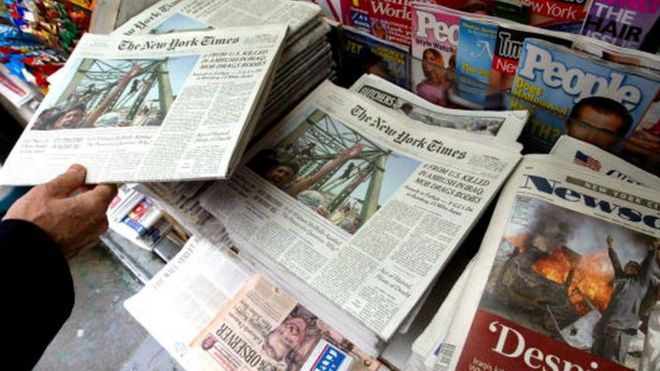
US newspapersImage copyright GETTY IMAGES

China has effectively expelled journalists from three US newspapers in retaliation for restrictions on its news outlets in the US.

Its foreign ministry ordered reporters from the New York Times, the Washington Post and the Wall Street Journal to return media passes within 10 days.

The ministry also demanded information about their operations in China.

The measures were in response to “unwarranted restrictions on Chinese media agencies” in the US, it said.

China’s action also prohibits the newspapers’ journalists from working in the semi-autonomous regions of Hong Kong and Macau, where there is greater press freedom than on the mainland.

Earlier this month, the Trump administration imposed limits on the number of Chinese citizens who could work as journalists in the US – the latest move in a tit-for-tat row over press freedoms.

“What the US has done is exclusively targeting Chinese media organisations, and hence driven by a Cold War mentality and ideological bias,” China’s foreign ministry said in a statement on Tuesday.

US Secretary of State Mike Pompeo urged Beijing to reconsider its decision, calling the move “unfortunate”.

“I regret China’s decision today to further foreclose the world’s ability to conduct the free press operations that, frankly, would be really good for the Chinese people in these incredibly challenging global times, where more information, more transparency are what will save lives,” Mr Pompeo said.

Presentational grey line

Great loss for Chinese journalism

Zhaoyin Feng, BBC Chinese

All foreign correspondents in China are required to renew their press credentials annually, which usually happens at the year end.

This means most American reporters of the three US major publications have an expiring visa and will need to leave China under the new rules. We don’t know the exact number of affected journalists yet, but it’s believed to be close to a dozen.

The expulsions will lead to a major personnel loss in these three media organisations’ China operation, especially for the Wall Street Journal, which had already seen three reporters expelled from China last month.

Critics say it’s an even greater loss for China, as the draconian measures come at a time when the country and the rest of the world need high-quality journalism on China more than ever.

It’s still unclear whether the US publications can send new correspondents, American citizens or not, to fill in the positions in China.

In the midst of a dangerous pandemic, the world’s two superpowers are locked in an escalating war with multiple fronts. By fighting over media, the origin of the coronavirus, and technology and trade, the US and China are competing to prove the superiority of their own political model.

Presentational grey line

At the beginning of March, the US state department said five media outlets, including China’s official news agency Xinhua, would be required to reduce their total number of staff to 100 from 160.

The move was seen as retaliation for China’s expulsion of two US journalists for the Wall Street Journal over a coronavirus editorial in February.

The row over media access is the latest episode in an increasingly acrimonious dispute between China and the US.

Disagreements over trade, intellectual property rights and 5G networks have damaged relations in recent years.

The coronavirus pandemic has been a source of tension too, with Washington and Beijing both accusing each other of spreading misinformation.

On Tuesday, US President Donald Trump angered China by referring to the coronavirus as “Chinese”.

A foreign ministry spokesman accused the US of stigmatising China, where the first cases of Covid-19 were recorded in the city of Wuhan in late 2019.

However, last week a Chinese foreign ministry spokesman shared a conspiracy theory, alleging the US Army had brought it to the region.

The unfounded accusation led Mr Pompeo to demand China stop spreading “disinformation” as it tried “to shift blame” for the outbreak.

Source: The BBC
19/02/2020

Coronavirus: China expels Wall Street Journal journalists for article it deemed racist

Three journalists with the Wall Street Journal have been told to leave China in five daysImage copyright GETTY IMAGES
Image caption The Wall Street Journal said the journalists were ordered to leave China in five days

China has ordered three foreign journalists of the Wall Street Journal to leave the country over an opinion piece it said was “racist”.

The article published on 3 February criticised the country’s response to the deadly coronavirus outbreak.

The Chinese foreign ministry said it had asked the newspaper to apologise several times but it had declined.

The newspaper said the journalists – who had not written the opinion piece – were given five days to leave China.

The article called the authorities’ initial response “secretive and self-serving” and said global confidence in China had been “shaken”.

China’s Foreign Ministry spokesman Geng Shuang said the article was “racist” and “denigrated” China’s efforts to combat the outbreak that has killed more than 2,000 people in the country.

“The Chinese people do not welcome media that publish racist statements and maliciously attacks China,” Mr Geng said, without naming the journalists being expelled.

The Wall Street Journal identified the reporters as two US citizens – Josh Chin, who is the deputy bureau chief, and Chao Deng – as well as Australian citizen Philip Wen. The newspaper has not yet commented.

It is the first time in more than two decades that journalists holding valid credentials have been ordered to leave China, the BBC’s John Sudworth in Beijing reports.

The Foreign Correspondents Club of China called the decision “an extreme and obvious attempt by the Chinese authorities to intimidate foreign news organizations”.

The measure comes a day after the US said it would begin treating five Chinese state-run media outlets that operate in the country in the same way as foreign embassies, requiring them to register their employees and properties with the US government.

The decision affects the Xinhua News Agency, China Global Television Network and China Daily Distribution Corp.

Presentational grey line

Press freedom in China

Presentational grey line

Last year, the government declined to renew the credentials – necessary for the work of foreign journalists in the country – of another Wall Street Journal reporter.

The journalist, a Singaporean national, had co-written a story that authorities in Australia were looking into activities of one of China’s President Xi Jinping’s cousins suspected of involvement in organised crime and money laundering.

And in 2018, the Beijing bureau chief for BuzzFeed News Megha Rajagopalan was unable to renew her visa after reporting on the detention of Muslim minority Uighurs and others in China’s Xinjiang region.

Meanwhile, two Chinese citizen journalists who disappeared last week after covering the coronavirus in Wuhan, the epicentre of the outbreak in Hubei province, remain missing.

Fang Bin and Chen Qiushi had been sharing videos and pictures online from inside the quarantined city.

Media caption Footage appearing to show people held in quarantine in a makeshift facility in Wuhan, has been shared across social media

Source: The BBC

12/02/2014

India Among the Worst for Press Freedom – India Real Time – WSJ

The world’s largest democracy remains one of the most restrictive places for the press.

In a report published Wednesday, Reporters Without Borders, a Paris-based think tank, ranked India 140th out of 180 countries surveyed for the free speech it affords the media. This was a one-point jump from the country’s 2013 ranking, when it recorded its steepest fall on the annual-list since 2002.

On Monday, acting on an agreement chalked out by a Delhi court, one of India’s largest publishing houses withdrew a 2009 book that reinterprets Hinduism, the latest instance of a book being removed from circulation in the country.

The authors of Wednesday’s report singled out the insurgency in the disputed territory of Kashmir, where channels of communications, including telephone lines, satellite televisions and the Internet, are routinely suspended in response to unrest, as well as the killings of eight journalists in 2013, for India’s lowly press freedom ranking.  The killings included those of Jitendra Singh, a freelancer in the eastern state of Jharkhand, who documented Maoist activists in the state, and that of Rakesh Sharma, a Hindi newspaper reporter who was shot dead in Uttar Pradesh, India’s most populous state, in August.

The People’s Liberation Front of India, a naxalite group, claimed responsibility for Mr. Singh’s death in April. A probe into the shooting of Mr. Sharma is ongoing.

“Those responsible for threats and physical violence against journalists, who are often abandoned by the judicial system and forced to censor themselves, include police and security forces as well as criminal groups, demonstrators and political party supporters,” the think tank said in the report.

The Indian government has also been under fire in recent years for its clampdown on social media.

India’s Supreme Court for instance is currently hearing a defamation suit against tech giants Google and Facebook, a case that’s been pending before courts since 2011. And in 2012, the government sought to block Twitter accounts of some prominent journalists and news organizations, arguing the content was stoking communal tensions. The same year, a Mumbai court charged cartoonist Aseem Trivedi, who likened the national Parliament to a toilet on his website, with sedition, a charge that was later dropped. These, among other reasons, led to India slipping nine places to 140th in Reporters Without Borders’s 2013 press ranking, which surveyed 179 countries.

via India Among the Worst for Press Freedom – India Real Time – WSJ.

Enhanced by Zemanta
Law of Unintended Consequences

continuously updated blog about China & India

ChiaHou's Book Reviews

continuously updated blog about China & India

What's wrong with the world; and its economy

continuously updated blog about China & India