Archive for ‘Reform’

29/03/2012

* BRICS flexing muscle – to set up joint bank, call for dialogue on Iran & Syria

Times of India: “Seeking to reinforce their growing economic heft with diplomatic clout, the BRICS grouping Thursday pitched for a bigger say in global governance institutions, including the UN and the IMF, and told the West that dialogue was the only way to resolve the Iranian nuclear issue and the Syria crisis.

Brazil, Russia, India, China and South Africa, which comprise nearly half the world’s population and a growing share of global GDP, signed two pacts to spur trade in their local currencies. They also agreed to set up a working group for a joint development bank to promote mutual investment in infrastructure.

Prime Minister Manmohan Singh of India and Presidents Hu Jintao China, Dmitry Medvedev Russia, Dilma Rousseff Brazil and Jacob Zuma South Africa ended the fourth BRICS summit by renewing the pitch for reforming global governance institutions and closer coordination on global issues.The five leaders stressed on the restructuring of the world order to accommodate emerging economies and developing countries and for promoting sustained and balanced global economic growth.”

via BRICS to set up joint bank, call for dialogue on Iran & Syria – The Times of India.

16/03/2012

* India: ‘Need for urgent reforms as corruption, civil society activism delay decisions’

The Hindu: “The government on Thursday gave a clarion call for urgent economic reforms while conceding that corruption scandals and compulsions of coalition politics have slowed down the decision-making process, as a result of which it is faced with fiscal slippages in 2011-12.

Making a strong pitch for raising tax resources and higher compliance, the Economic Survey 2011-12, tabled in Parliament on Thursday in tandem with the Reserve Bank in its mid-quarter policy review, expressed serious concern over the deteriorating state of government finances and stressed the need for fiscal consolidation if inflation is to be tamed.

Highlighting inflation and fiscal slippages as among the major challenges confronting the economy, the Survey said a slackening in the pace of reforms and high-profile corruption scandals along with “welcome civil society activism” have led to delay in decision-making by civil servants.

Tabled in the Lok Sabha by Finance Minister Pranab Mukherjee, the Survey said “coalition politics and federal considerations played their roles in holding up economic reforms on several fronts, ranging from diesel and LPG pricing to FDI in retail” and also pointed to the economic slowdown partly resulting from domestic issues “like pressures of democratic politics.”

In concert with the apex bank on the need for fiscal consolidation, the Survey said: “The principal way in which this has to be achieved is by raising tax-GDP ratio and cutting down wasteful expenditures.”

The Survey noted that the dismal economic performance this fiscal should be a “wake-up call” but, at the same time, expressed cautious optimism that the GDP growth in 2012-13 would go up to 7.6 per cent following a moderation in inflation and consequent low interest rates.

“The growth rate of real GDP [is expected] to pick up to 7.6 per cent [plus or minus 0.25 per cent] in 2012-13 and faster beyond that,” the Survey said and noted that economic expansion this fiscal would moderate to a three-year low at 6.9 per cent. Arguing out a case for fiscal consolidation, tax reforms, opening of the multi-brand retail to global chains, freeing of diesel prices and the need for honesty among political leaders and policy-makers, the Survey said that although government’s fiscal deficit was likely to significantly go off the target of 4.6 per cent of GDP this fiscal, it would narrow down to 4.1 per cent in 2012-13 on the strength of a pick-up in economic activities. After tabling the pre-budget document, the Finance Minister said: “It [the Survey] charts economic development and challenges faced during the fiscal year. It is a vital input for the preparation of the budget.”

At a press briefing later during the day, Chief Economic Adviser Kaushik Basu, prime architect of the document, said growth in manufacturing and agriculture sectors were likely to be key drivers in the next fiscal. “There could be one more year of a slight slowing down of investment and saving rates. We expect… rates to pick up handsomely after that,” he said.”

via The Hindu : News / National : ‘Need for urgent reforms as corruption, civil society activism delay decisions’.

Related page: https://chindia-alert.org/political-factors/indian-tensions/

16/03/2012

* India changes strategy to stay competitive globally in IT sector

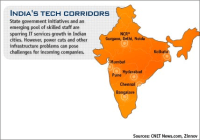
extract from The Hindu: “Competition to India’s information technology and IT-enabled services (ITeS) companies from other cost-effective nations and protectionist moves of some key markets like the U.S. have caught the attention of the government. As a result, the government is not only changing its strategy to stay competitive globally but also taking initiatives to promote growth of the sector by increasing IT adoption within the country. …

As per industry estimates, India’s IT and BPO sector (excluding hardware) revenues were $87.6 billion in 2011-2012 (a growth of 14.8 per cent) – $68.7 billion exports and $19 billion domestic, while it generated direct employment for nearly 2.8 million people and indirect for around 8.9 million people.

As a proportion of national GDP, IT and ITeS sector revenues have grown from 1.2 per cent in 1997-98 to around 7.5 per cent in 2011-12. “Consistent demand from the U.S., which increased its share from 61.5 per cent to 62 per cent, characterised 2011-12. Emerging markets of the Asia Pacific and the rest of the world also contributed to overall growth,” the Survey pointed out.

Referring to future strategy for the sector, the Survey said the government had been a key catalyst for increased IT adoption – through sector reforms that encouraged IT acceptance, National e-Governance Plan (NeGP), and the Unique Identification Development Authority of India (UIDAI) programme that created large-scale IT infrastructure and promoted corporate participation.

Talking about electronics hardware production, the Survey said it was expected to grow by 27.6 per cent in 2011-12 and cross Rs.1.55-lakh crore ($33 billion). Electronics hardware exports is expected to grow by 12.8 per cent and cross Rs.47,090 crore ($10 billion) in 2011-12 as against Rs.41,721 core ($8.86 billion) in 2010-11. In its recently released draft, the National Policy on Electronics (NPE), the government projected that the electronics system design and manufacturing industry was likely to reach a turnover of $400 billion by 2020, involving investment of about $100 billion, besides creating 28 million jobs.”

via The Hindu : News / National : Centre changes strategy to stay competitive globally in IT sector.

14/03/2012

* Premier Wen says China needs political reform, warns of another Cultural Revolution if without

Extract from Xinhua: “Premier Wen Jiabao said Wednesday that China needs not only economic reform but also political structural reform, especially the reform of the leadership system of the Party and the government.

Wen warned at a press conference after the conclusion of the annual parliamentary session that historical tragedies like the Cultural Revolution may happen in China again should the country fail to push forward political reform to uproot problems occurring in the society. …

He noted although after the crackdown on the Gang of Four, the Party adopted resolutions on many historical matters, and decided to conduct reforms and opening-up, the mistake of the Cultural Revolution and feudalism have yet to be fully eliminated. …

As the economy continues to develop, Wen said, such problems as income disparity, lack of credibility and corruption, have occurred.

“I’m fully aware that to resolve these problems, we must press ahead with both economic structural reforms and political structural reforms , in particular reforms on the leadership system of the Party and the country,” he said. …”

via Wen says China needs political reform, warns of another Cultural Revolution if without – Xinhua | English.news.cn.

Over the past year or two Premier Wen has become very outspoken (for a senior Chinese politician) about issues normally not aired in public. For instance, the Cultural Revolution seldom features in speeches and if it does, it is not usually put in clearly negative terms.

In some ways this reminds me of the (in-)famous speech by Chairman Mao when he launched the ‘let the 100 flowers bloom‘ campaign in 1957. This was soon followed by the dreadful ‘anti-right’ campaign when too many intellectuals and party members took Mao’s ‘let 1000 thoughts contend’ exhortation at face value. 

But, this time, the whole circumstances and environment are very different. So, hopefully, the next step will not be another anti-right campaign, but genuine discourse and debate with a (relatively) open mind.

Related page: https://chindia-alert.org/prognosis/chinese-challenges/

07/03/2012

* Indian state assembly votes shakes Congress’ Gandhi dynasty

The Times, London: “Voters in India’s most populous state decisively rejected Rahul Gandhi yesterday, dealing a blow to his hopes of becoming the fourth generation of the Nehru dynasty to rule the country.

The 41-year-old son of Rajiv Gandhi, the assassinated former Prime Minister, led the Congress party’s campaign in Uttar Pradesh (UP), spending nights with the poorest villagers to counter accusations that he is too privileged to understand their concerns.

But Congress suffered devastating results in four of five state elections. It came fourth in UP, lost control in Goa, failed to win Punjab, was neck and neck in Uttarakhand and managed a clear victory only in the remote northeastern state of Manipur.

The poor showing will make it harder for the weakened ruling party to force through national reforms that could boost economic growth, which has slipped below 7 per cent, in the teeth of opposition from its coalition allies. The Indian stock market slumped at the prospect of two more years of “policy paralysis”.

Congress had been pinning its hopes of winning the national election due in 2014 on the youthful appeal of Mr Gandhi, who has been carefully insulated from the troubles that dog the national Government led by 79-year-old Manmohan Singh.”

Indian vote shakes Gandhi dynasty | The Times.

Just when India needs more reform, the Congress party falters badly in four out of five state elections.  This was to be the forerunner to 2014 national elections. So Congress has a little over a year to catch up.

05/03/2012

* China lowers growth target to 7.5%

(Reuters) – Chinese Premier Wen Jiabao cut his nation’s 2012 growth target to an eight-year low of 7.5 percent and made boosting consumer demand the year’s first priority as Beijing looks to wean the economy off its reliance on external demand and foreign capital. …

“We aim to promote steady and robust economic development, keep prices stable, and guard against financial risks by keeping the total money and credit supply at an appropriate level, and taking a cautious and flexible approach,” Wen said in his annual work report to the National People’s Congress (NPC), China’s annual parliamentary session. …

His annual state-of-the-nation report to parliament dwelled on the institutional and income barriers the government must break to build a more balanced economy that relies less on exports and shares more wealth with hundreds of millions of poor farmers and migrant workers who are reluctant to spend. …

Shifting that balance is a key goal for Wen and Hu, both 69, as they near the end of a decade in power which has seen China become the world’s second-largest economy after the United States, contributing more to global growth than any other nation, while seeing a chasm widen between rich and poor. The number of Chinese billionaires nearly doubled in 2011 to 146 from 2010, Forbes said.

Stability, steady growth and spreading wealth are core justifications for more than 60 years of one-party rule by the Communist Party, which will install a new cohort of leaders by the end of 2012. …

The last year in power for Wen and Hu has shuddered with anxieties about inflation, a feverish property market, local government debt, stubborn inequality and social strains from protesting villages to ethnic tensions in western regions. …

Critics, including prominent policy-advisers, have said the Chinese government can foster healthy long-term growth only by taking on bolder reforms to rein in state-owned conglomerates and other entrenched interests — reforms that ultimately spill into sensitive issues of curbing the party’s own powers.

Wen has stood out among China’s leaders as the most persistent advocate of measured political relaxation, and has cast himself as a passionate advocate for farmers struggling with economic insecurity and land lost to developers.

“We should care more deeply for rural migrant workers and provide more services to them,” he said. “We will place farmland under strict protection.”

http://www.reuters.com/article/2012/03/05/us-china-economy-idUSTRE82400120120305?feedType=RSS&feedName=topNews&utm_source=feedburner&utm_medium=feed&utm_campaign=Feed%3A+reuters%2FtopNews+%28News+%2F+US+%2F+Top+News%29&utm_content=Google+Feedfetcher

27/02/2012

* World Bank report: China needs a new economic strategy

AP: “China needs a new economic strategy after three decades of rapid growth and must reduce the dominance of state companies and promote free markets to achieve its goal of becoming a high-income society, the World Bank and Chinese researchers said Monday.

The recommendations in a report on development of the world’s second-largest economy through 2030 come amid debate in the ruling Communist Party over the future course of reform as a new generation of leaders prepare to take office this year.

The report’s emphasis on curbing state industry clashes with Beijing’s strategy over the past decade of building government-owned champions in fields from banking to technology and is likely to provoke opposition.”

http://www.google.com/hostednews/ap/article/ALeqM5hjJGRvwM6JjBM3uh8Wn0w1OPkONQ?docId=05fed039a6b94f9b8c31ca96f94e4734

This report is cleverly timed to coincide with the top leadership changes later in the year.

23/02/2012

* China finally realises that migrant workers are not a transient matter

China Daily: “China has clarified its residence policies to facilitate domestic migrants’ settling in small and medium-size cities as permanent residents, a move intended to further push theurbanization drive.

In cities of county-level or below, people who have stable jobs and residences may apply forpermanent residence permits, along with their spouses, unmarried children, and parents,according to a State Council circular posted online late Thursday.

In medium-size cities, people who have stable jobs for three years, stable residences, and havepaid social security insurance for at least one year, can also apply for permits to live in the citypermanently, the circular said.

That means many of China’s millions of migrant workers may be formally accepted as urbanresidents, giving them more access to public services including welfare housing and medicalinsurance, which are currently only open to holders of permanent residence permits in manycities.

Ushered in some 30 years ago, China’s reform and opening-up drive established a pattern oflabor flowing from rural to urban areas, and the country now has more than 200 million ruralmigrants working in cities.

Meanwhile, the circular said China will continue efforts to control the population of major cities,including those directly under jurisdiction of the central government, many of which are alreadyover-populated based on their existing facilities and services.”

http://www.chinadaily.com.cn/china/2012-02/24/content_14687152.htm

Some would regards these moves as a natural progression towards recognising the needs  and rights of this important 20% of the Chinese population. Others, more cynically, would ask: “Why now?” and come to the conclusion that in the year of top leadership change, minimising the causes of internal conflict is of prime importance.

18/02/2012

* 30% of Indian MPs have criminal charges and every MP under 30 ‘inherited’ seat;

Telegraph, June 2009: “A total of 153 of the 543 politicians elected in the biggest democratic election history have criminal cases pending, including nine ministers, according to a study by two non-governmental organisations, the Association of Democratic Reforms (ADR) and National Election Watch (NEW)

… there is a possibility that some of the charges were brought by political opponents …”

http://www.telegraph.co.uk/news/worldnews/asia/india/5422967/One-third-of-Indian-MPs-have-criminal-charges-filed-against-them.html

Patrick French, in researching for his book  ‘India: A Portrait’, found that every Indian MP under 30 has in effect ‘inherited’ a seat from a family member. Not quite as non-representative as the composition of the Chinese people’s national assembly, but …

17/02/2012

* Death sentence for ex-tycoon fuels debate over private lending, and over capital punishment

China Daily: “Death sentence for ex-tycoon fuels debate over private lending, report Li Jing and He Na in Beijing, and Xu Junqian in Zhejiang.

Wu Ying used to be one of the richest women in China. Today the former billionaire is on death row.

In the eyes of many people, particularly the judge who threw out her appeal last month, Wu is a fraudster who swindled her friends and business partners out of 770 million yuan ($122 million).

Yet, others oppose the sentence and say her case highlights a major issue in China: the reliance among small- and medium-sized enterprises on high-interest loans from private lenders.

From loan sharks and underground banks to pawnshops and auction houses, the private lending chain is huge and diverse, according to economists, who blame the situation largely on the struggles experienced by entrepreneurs in getting startup funds through authorized channels.

After 30 years of ongoing reforms, experts are now adding their voices to calls for China’s financial sector to be opened up even further.”

http://www.chinadaily.com.cn/cndy/2012-02/14/content_14597676.htm

China has reduced the list of crimes for which capital punishment applies from 68 to 55. Even so, many of these are for economic crimes, reminescent of the times (18th century)when European countries would execute or deport these criminals (eg Jean Val Jean of Victor Hugo’s Les Miserables and Mr Micawber of Charles Dickens’ David Copperfield). Crime and punishment is cultural. Hence in some Muslin countries adulterers can be stoned to death (or at least the female partner can).

In my personal opinion it is also a facet of developing human consciousnes: the more ‘enlightened’ a society is the less likely will it favour capital punishment.

Law of Unintended Consequences

continuously updated blog about China & India

ChiaHou's Book Reviews

continuously updated blog about China & India

What's wrong with the world; and its economy

continuously updated blog about China & India