Archive for ‘superpower’

24/09/2019

China 70th anniversary: Pigeon ban and lockdowns as countdown begins

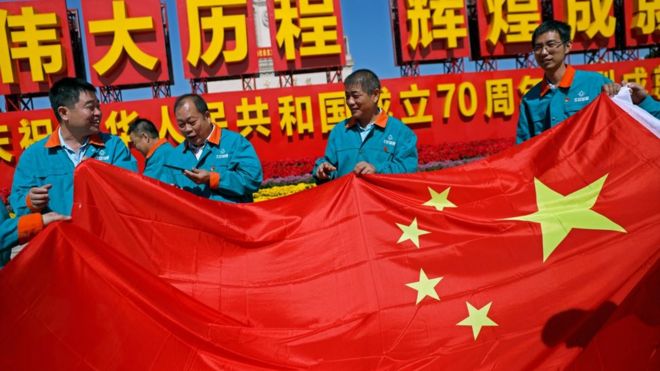
Chinese workers with Chinese flagImage copyright EPA
Image caption China is getting dressed up for its big birthday party

One week from now, the People’s Republic of China will mark its 70th anniversary with celebrations on a scale not seen in China in decades.

Beijing is pulling out all stops and 1 October will be flush with fireworks, fanfare and a huge military parade.

To ensure it goes smoothly, authorities have been ramping up security in the capital – and online – for weeks.

But with yet more protests expected in Hong Kong, the territory might just rain on China’s parade.

What is it all about?

The birth of modern China was declared on 1 October 1949, after the communists under Mao Zedong won the civil war that followed World War Two.
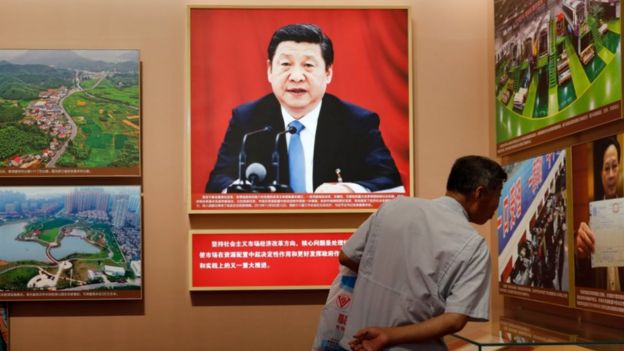
Portrait of Xi JinpingImage copyright EPA
Image caption Exhibitions are highlighting the achievements of the Communist Party

The date is marked every year, but celebrations for this 70th anniversary are expected to eclipse previous events.

It’s the first big anniversary since China has emerged as a global power. While 10 years ago China was a superpower in the making, it is now the world’s second largest economy, almost eye-to-eye with the United States.

What to expect?

The main celebrations will take place in the capital, Beijing, where there will be a grand military parade with “advanced weapons” on display, followed by a “mass pageant”.

President Xi Jinping – considered the most powerful Chinese leader since Mao – will address the Chinese people. His speech is expected to celebrate China’s rapid growth and which will be closely watched for any indication of the country’s direction in the coming years.

The president will also hand out honours for contributions to the country and in the evening there will be a grand gala and fireworks show.

All official Chinese celebrations are carefully choreographed and the success of this one is particularly important to the government.

The Dos and Don’ts

The parade – open to invited guests only – will take place around Tiananmen Square in central Beijing. The surrounding area will be practically under lockdown, and in fact has been so several times already.

During rehearsals leading up to the big day, hotels near Tiananmen Square told guests that for several hours each day, no-one would be able to leave the hotel or return to it should they be out, leading to much travel chaos and rebookings.

Many shops and restaurants in the centre are also closed or have shortened hours and some subway stations are temporarily shut.
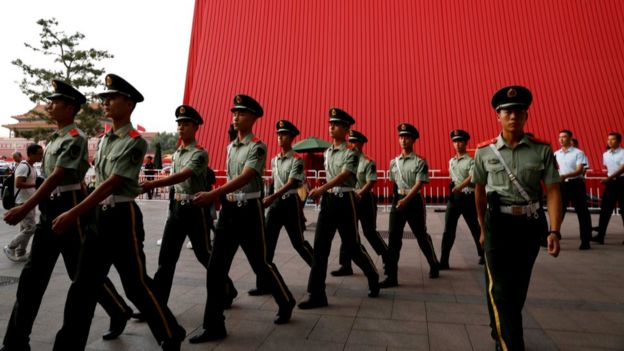
Chinese paramilitary policeImage copyright EPA
Image caption Security is tight ensure the party goes to plan

Trains to Beijing are running numerous safety checks on their passengers and vehicles going into the city are also being tightly watched.

On the big day itself, areas around Tiananmen Square will be blocked and guarded. Local residents will need to identify themselves if they want to pass.

To ensure the sun will shine brightly on the celebration in notoriously polluted Beijing, several coal plants and construction sites in and around the city have been ordered to stop work for the duration.

There’s also a ban on any low-flying aerial vehicles in place. That means anything from light aircraft to drones, balloons and even racing pigeons.

Censorship galore

Across much of the city centre, there are national flags set up at every door. Voluntary inspectors are monitoring the streets and locals have told the BBC they’re being questioned after having even brief conversations with foreigners

One person said she was asked by an inspector: “Who were those foreigners? Why were they here?”

The tight control naturally extends online as well. Popular social media platform Weibo said it was deleting content that “distorts” or “insults” the country’s history ahead of the anniversary.
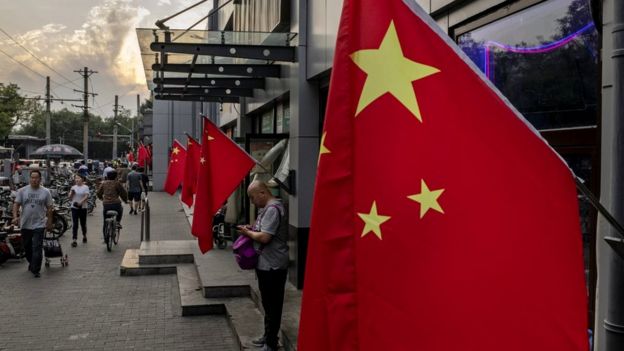
Chinese flags outside a row of shopsImage copyright GETTY IMAGES
Image caption Every house and every shop is sporting a national flag

Chinese journalists are always expected to toe the party line anyway, but starting in October they will have to pass an extra test to prove they are versed particularly in Xi Jinping’s teachings, officially called Xi Jinping Thought on Socialism with Chinese Characteristics, which has been written into the constitution.

Whether or not they pass the exam will then determine whether they’ll be accredited as journalists.

“The fundamental point with this ‘training’ and indoctrination process isn’t so much about the content,” David Bandurski of China Media Watch told the BBC.

“It is about reinforcing the message and understanding among journalists that they work, first and foremost, for the Chinese Communist Party, and serve its agenda.”

So not only will the events be choreographed – the domestic coverage of them will also be tightly guarded.

What about Hong Kong?

Despite Beijing’s determination to let its achievements shine on 1 October, there’s a good chance Hong Kong will pull focus.

Anti-Beijing protests always take place in Hong Kong on China’s National Day, but this time, the activists know that the world is watching.

Anti-government protests have rocked the city for months and the situation shows no sign of dying down.

Clashes between police and activists have been becoming increasingly violent, with police using tear gas and activists storming parliament.
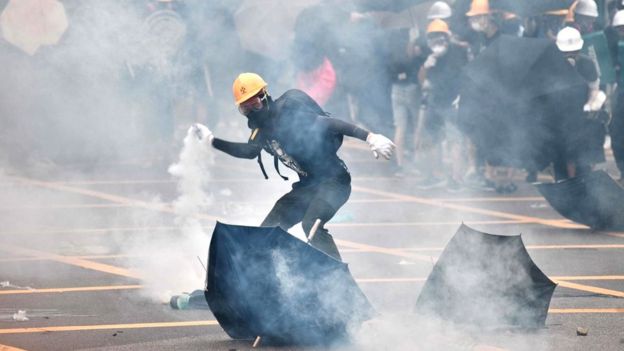
Protester throwing a tear gas can back at the policeImage copyright AFP
Image caption The protests have often escalated into violent clashes

That means two things for 1 October: official celebrations in the territory are being toned down to avoid clashes – the annual fireworks display has been cancelled – while at the same time, activists are planning to step up their protests.

On Sunday 29 September, a “Global Anti Totalitarianism March” is scheduled to take place at various locations around the world in support of Hong Kong.

On 1 October itself, a march in central Hong Kong is planned with everyone asked to wear black.

If the past weeks’ demonstrations are anything to go by, the smiles and celebrations in Beijing will be competing for media space with pictures of tear gas and angry young protesters in Hong Kong.

Source: The BBC
14/08/2019

Chinese engineers follow the Sea Dragon with new submersible that can ‘fly’ through water like a plane in the air

  • Developers say their prototype craft could dive to 1,000 metres in five minutes
  • Liu Kaizhou, who also worked the Jiaolong submersible, says ‘We are in uncharted water’
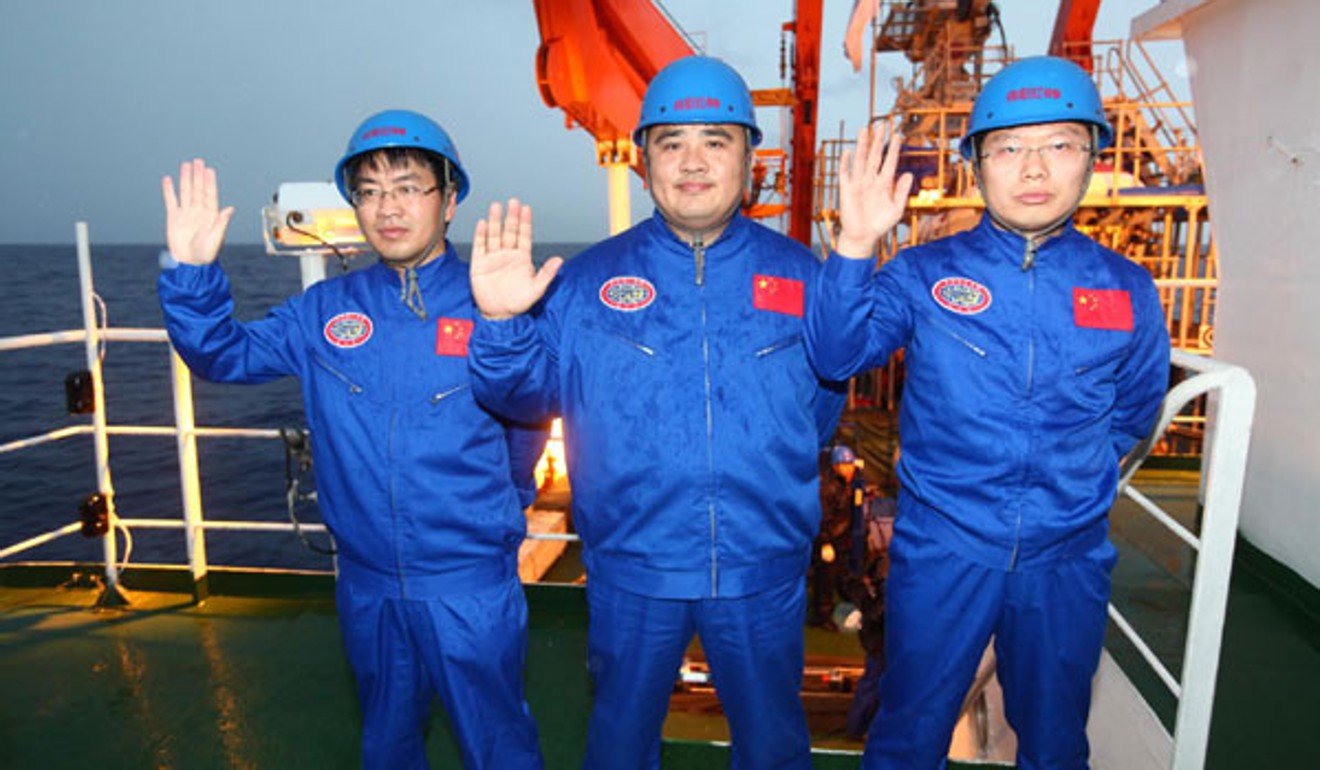
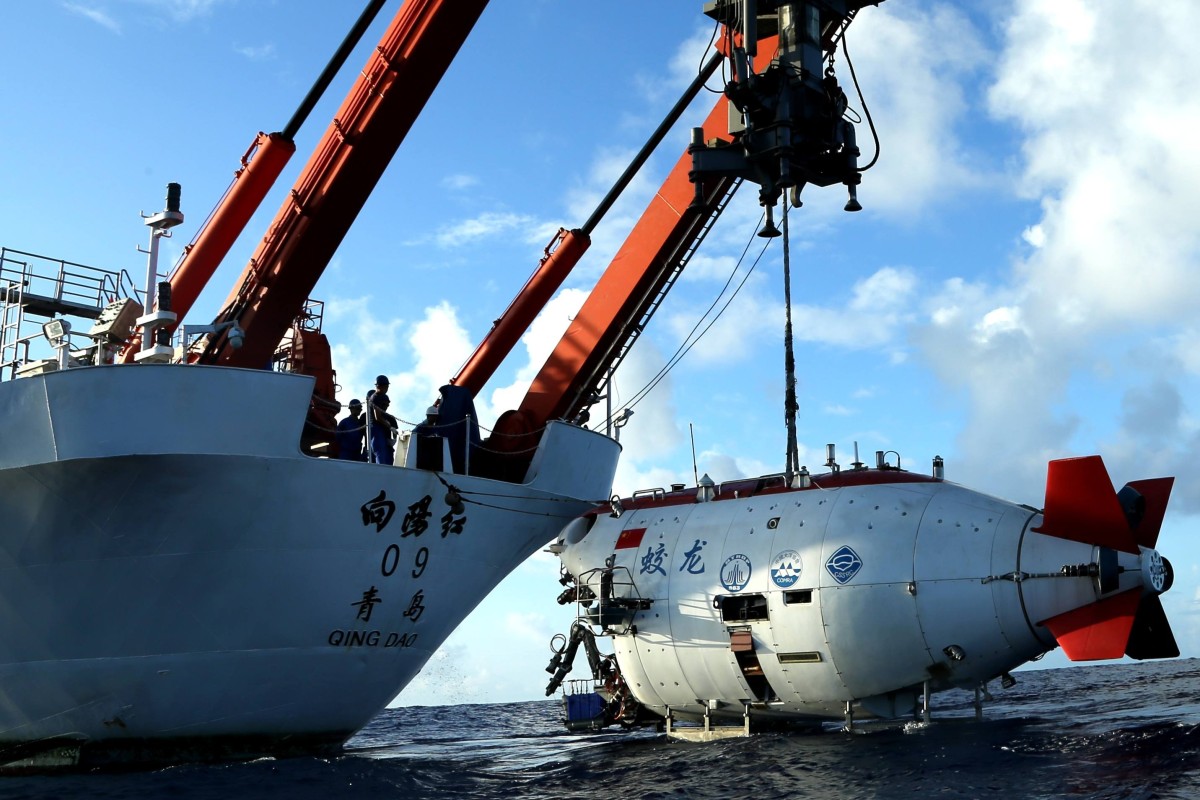
Professor Liu Kaizhou, who developed the autopilot for China’s manned Jiaolong submersible, says his team has designed a vessel that can move through water like a plane moves through the air. Photo: Xinhua
Chinese engineers say they are developing a radical design for a super-fast robot submersible which the project leader, who worked on the manned deep-sea vessel Jiaolong, or Sea Dragon, claims can “fly” in water like a plane travels through the air.

At 3 metres (9.8ft) long, the prototype consists of a cigar-shaped body, with a guidance system in the bow and a jet plane style rudder and a propeller in the stern.

Outriggers house batteries and two more propellers. These are attached to the body by wing-like planes that the developers said will give the vessel the kind of lift in water that takes an aeroplane into the air and back to the earth.

Developers said the prototype will be capable of 10 knots and could dive to a depth of 1,000 metres (3,281 feet) – or surface from that depth – at about three metres a second, taking about 5½ minutes.

Professor Liu Kaizhou, lead scientist of the project at the Shenyang Institute of Automation, part of the Chinese Academy of Sciences in Liaoning province, said the design had great potential.

If a traditional submarine was like an air balloon, he said, the prototype was like an aircraft. “It is technically flying, fast and freely, like a plane for the water.”

The prototype has 20 major components on board, including a computer, and communications and surveillance equipment. These were all developed and tested by the team, but getting them to work together posed some unexpected challenges, Liu said, meaning the transition to operations in a tough marine environment was some time away.

Underwater station could be a game changer, Chinese scientist says

“We aim to make the first open sea test in about a year,” he said.

The submersible can be powered by conventional batteries or a chemical engine that mixes lithium and sulphur hexafluoride to produce heated steam for electrical generators – an energy source often used by torpedoes.

Funded by the Ministry of Science and Technology from 2017, the project was driven by China’s growing ambition to become a superpower in the world’s oceans.

The team said their submersible had the potential to become the backbone of China’s search-and-rescue operations at sea, naval intelligence gathering, high-precision sea floor mapping, or to transport minerals from the seabed to the surface.

Professor Liu Kaizhou (left) with colleagues Ye Cong and Yang Bo, was instrumental in the success of China’s Jiaolong manned submersible. Photo: Xinhua

Professor Du Tezhuan, a researcher in fluid dynamics at the Institute of Mechanics of the Chinese Academy of Sciences in Beijing, said the design was a bold one but it posed the research team many hard questions.

The density of water was much higher than that of air, he said, which meant the vessel would encounter more drag and would need a strong power source.

“Without sufficient speed, the lift will be weak, and to reach high speeds, lots of energy will be needed. Flying in water is not as easy as flying in the air,” said Du, who was not involved in the project.

Why Beijing is speeding up underwater drone tests in the South China Sea

“But in theory it should work. It is worth a try.”

Liu – who led the design of the autopilot system that can take the Jiaolong to depths of more than 7,000 metres (23,000 ft) – said that after tests on the prototype were complete, other innovations were possible. These included covering the vessel with air bubbles to reduce friction.

“This technology is brand new,” he said. “We are in uncharted water and we are excited by the challenges.”

Source: SCMP

30/03/2014

Americans Must Adjust to a World Dominated by China – Fed’s Bullard – China Real Time Report – WSJ

This post originally appeared on Real Time Economics.

It won’t be long until the U.S. is eclipsed economically by China—and Americans need to start thinking about how to adjust to such a world.

That’s according to Federal Reserve Board of St. Louis President James Bullard, who spoke to the Wall Street Journal on the sidelines of a conference during a recent visit to Hong Kong.

“Attitudes in the U.S. are going to have to change, because the U.S. will not permanently be the global leader,” Mr. Bullard said.

China is already the largest economy in the world after the United States, and is growing much faster than the U.S. Not too far in the future — estimates range from as soon as 2016 to as “distant” as 2028 — it will surpass the American economy in size.

Most likely, China will eventually match the U.S. in per capita income terms as well. With a population about four times as large as America’s, that would imply a massive shift in the global balance of power.

In that case, “the U.S. would be playing a role to China similar to the role the U.K. plays to the U.S. today,” Mr. Bullard said. “People think it’s 50-75 years away but it’s probably only 25 or 20 years away, something like that.”

China’s economy currently is a little more than half the size of America’s, IMF data show, clocking in at $8.9 trillion in 2013 versus $16.7 trillion for the U.S.

But China’s economy is growing much more quickly, targeting growth of about 7.5% this year. In contrast, the U.S. economy will be lucky to grow by 3%.

Then there’s India, another economy of a billion-plus people that’s also growing quickly. Eventually, Mr. Bullard said, he can foresee a tri-polar world in which China and India are the major economic powers, counterbalanced by a bloc of the United States, Europe and Japan, whose populations together will total about one billion people.

“We’ve said the U.S. is a superpower, an economic superpower. But these are giants, they’re bigger than a superpower,” he said. “What would that world be like, both economically and politically? I think that’s really hard to understand. How much would the Western bloc be willing to cooperate politically to be a counterbalance to China and India?”

Mr. Bullard offered few specifics of what such a world would look like, but did acknowledge that it might require some adjustment on the part of ordinary Americans like those he serves in the heartland.

via Americans Must Adjust to a World Dominated by China – Fed’s Bullard – China Real Time Report – WSJ.

Enhanced by Zemanta
16/01/2014

China confirms hypersonic missile carrier test | Reuters


China has flight-tested a hypersonic missile delivery vehicle in a move that was scientific in nature and not targeted at any country, the Defence Ministry said on Wednesday.


A Chinese military build-up has raised regional jitters. Many countries in Asia have welcomed a stated U.S. intention to shift more attention and military assets back to the region. They are beefing up military spending and ties with Washington.


\”Our planned scientific research tests conducted in our territory are normal,\” the Beijing Defence Ministry said in a faxed response to Reuters. \”These tests are not targeted at any country and at any specific goals.\”


The statement confirmed a report by the online Washington Free Beacon newspaper that the hypersonic glide vehicle (HGV) was detected flying at 10 times the speed of sound over China last week.


A spokesman for the Pentagon said it was aware of the test.


\”We routinely monitor foreign defence activities and we are aware of this test,\” said Lieutenant Colonel Jeffrey Pool, a Pentagon spokesman:


via China confirms hypersonic missile carrier test | Reuters.


Enhanced by Zemanta
18/12/2013

Reimagining India: Unlocking the Potential of Asia’s Next Superpower – McKinsey & Co

India’s rising economy and burgeoning middle class have earned it a place alongside China as one of the world’s indispensable emerging markets. But what is India’s true potential? And what can be done to unlock it?

Reimagining India

In Reimagining India: Unlocking the Potential of Asia’s Next Superpower, McKinsey brings together leading thinkers from around the world to explore and debate the challenges and opportunities facing the country. The book’s contributors include CNN’s Fareed Zakaria; Microsoft cofounder Bill Gates; Google chairman Eric Schmidt; Mukesh Ambani, the CEO of India’s largest private conglomerate; Harvard Business School dean Nitin Nohria; and Nandan Nilekani, cofounder of Infosys and chairman of the Unique Identification Authority of India, as well as a host of other leading executives, entrepreneurs, economists, foreign-policy experts, journalists, historians, and cultural luminaries.

As the foreword notes, “While McKinsey consultants have contributed a few essays to this volume, Reimagining India is not the product of a McKinsey study; neither is it meant as a ‘white paper’ nor coherent set of policy proposals. Rather, our aim was to create a platform for others to engage in an open, free-wheeling debate about India’s future.”

http://www.mckinsey.com/features/reimagining_india_book

Simon & Schuster (US) | Executive editors: Clay Chandler and Adil Zainulbhai

Law of Unintended Consequences

continuously updated blog about China & India

ChiaHou's Book Reviews

continuously updated blog about China & India

What's wrong with the world; and its economy

continuously updated blog about China & India