Archive for ‘Territorial dispute’

29/08/2012

* China’s aircraft carrier: in name only

Reuters: “When Japanese activists scrambled ashore on a disputed island chain in the East China Sea this month, one of China’s most hawkish military commentators proposed an uncharacteristically mild response.

A half-built Chinese-owned aircraft carrier Varyag, which is to be converted into a floating casino in China, is towed and escorted by a flotilla of tugboats and pilot ships past the Leandros Tower built in 419 B.C. on the Bosphorus Straits in Istanbul November 1, 2001. REUTERS-Fatih Saribas-Files

Retired Major General Luo Yuan suggested naming China’s new aircraft carrier Diaoyu, after the Diaoyu islands in the East China Sea. It would demonstrate China’s sovereignty over the islands known as the Senkakus in Japanese, he said.

For a notable hardliner, it was one of the least bellicose reactions he has advocated throughout a series of territorial rows that have soured China’s ties with its neighbors in recent months.

More typical was General Luo’s warning in April that the Chinese navy would “strike hard” if provoked during a dispute with the Philippines over Scarborough Shoal in the South China Sea.

One possible reason for General Luo’s restraint, military analysts say, is he knows it could be towards the end of the decade before China can actually deploy the new carrier to the disputed islands or any other trouble spot.

Despite public anticipation in China that the carrier — a refitted, Soviet-era vessel bought from Ukraine — will soon become the flagship of a powerful navy, defense experts say it lacks the strike aircraft, weapons, electronics, training and logistical support it needs to become a fighting warship.

“There is considerable uncertainty involved, but it could take anything from three to five years,” said Carlo Kopp, the Melbourne, Australia based co-founder of Air Power Australia, an independent military think tank.”

via Analysis: China’s aircraft carrier: in name only | Reuters.

See also: China’s military presence
12/08/2012

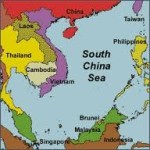
* Beijing Reasserts Its Claims in South China Sea

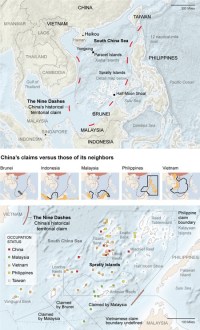
NY Times: “China does not want to control all of the South China Sea, says Wu Shicun, the president of a government-sponsored research institute here devoted to that strategic waterway, whose seabed is believed to be rich in oil and natural gas. It wants only 80 percent.

Mr. Wu is a silver-haired politician with a taste for European oil paintings and fine furniture. He is also an effective, aggressive advocate for Beijing’s longstanding claim over much of the South China Sea in an increasingly fractious dispute with several other countries in the region that is drawing the United States deeper into the conflict.

China recently established a larger army garrison and expanded the size of an ostensible legislature to govern a speck of land, known as Yongxing Island, more than 200 miles southeast of Hainan. The goal of that move, Mr. Wu said, is to allow Beijing to “exercise sovereignty over all land features inside the South China Sea,” including more than 40 islands “now occupied illegally” by Vietnam, the Philippines and Malaysia.

In the past several weeks, China has steadily increased its pressure, sending patrols with bigger ships and issuing persistent warnings in government-controlled newspapers for Washington to stop supporting its Asian friends against China.

The leadership in Beijing appears to have fastened on to the South China Sea as a way of showing its domestic audience that China is now a regional power, able to get its way in an area it has long considered rightfully its own. Some analysts view the stepped-up actions as a diversion from the coming once-a-decade leadership transition, letting the government show strength at a potentially vulnerable moment.

The Obama administration, alarmed at Beijing’s push, contends that the disputes should be settled by negotiation, and that as one of the most important trade corridors in the world, the South China Sea must enjoy freedom of navigation. The State Department, in an unusually strong statement issued this month intended to warn China that it should moderate its behavior, said that Washington believed the claims should be settled “without coercion, without intimidation, without threats and without the use of force.”

Washington was reacting to what it saw as a continuing campaign on the South China Sea after Beijing prevented the Association of Southeast Asian Nations, at its summit meeting in Cambodia in July, from releasing a communiqué outlining a common approach to the South China Sea.

The dispute keeps escalating. On July 31, the 85th anniversary of the founding of the People’s Liberation Army, the Chinese Defense Ministry heralded the occasion by announcing “a regular combat-readiness patrol system” for the waters in the sea under China’s jurisdiction.

The government then said it had launched its newest patrol vessel: a 5,400-ton ship. It was specifically designed to maintain “marine sovereignty,” said People’s Daily, the Communist Party’s leading newspaper.””

via Beijing Reasserts Its Claims in South China Sea – NYTimes.com.

20/07/2012

* ASEAN to claim common ground on South China Sea, but no communiqué

Reuters: “Southeast Asian states have reached a “common position” on the disputed South China Sea, but will not resurrect a joint communiqué aborted after unprecedented discord over the issue at a summit last week, Indonesia’s Foreign Minister said on Friday.

Marty Natalegawa sought to put a positive gloss on two days of shuttle diplomacy that failed to rally members of the Association of Southeast Asian nations (ASEAN) behind a belated, face-saving communiqué.

They had failed to agree the customary end-of-summit joint statement last Friday for the first time in the bloc’s 45-year history. The divisions follow a rise in incidents of naval brinkmanship involving Chinese vessels in the oil-rich waters that has sparked fears of a military clash.

Natalegawa told Reuters the 10 members had agreed on the components of an ASEAN “instrument” that would be issued by chair Cambodia later on Friday and would detail what was agreed upon during last week’s ASEAN Regional Forum in Phnom Penh, including the maritime dispute.

“We are trying so that other decisions made by the foreign ministers will be formulated in a different instrument for follow up,” Natalegawa told Reuters.

“The non-existence of a joint communiqué is behind us,” he said, adding that the customary communiqué was aborted last week because one of the four paragraphs relating to the South China Sea in the 132-paragraph draft could not be agreed on.

Disputes over how to address the increasingly assertive role of China – an ally of several ASEAN states – in the strategic waters of the South China Sea has placed the issue squarely as Southeast Asia’s biggest potential military flashpoint.

China has territorial claims over a huge area covering waters that Vietnam and the Philippines say they also have sovereignty over. All three countries are eager to tap possibly huge offshore oil reserves.

The failure to issue the communiqué and the bitter rows behind closed doors over what words to use and what to exclude have been a huge embarrassment for a 10-member bloc planning to form an EU-style economic community by 2015.

The row illustrated how Southeast Asian nations have been polarized by China’s rapidly expanding influence in the region and the economic dependence on Beijing that some of ASEAN’s poorer states now have, among the Cambodia, this year’s chair.”

via ASEAN to claim common ground on South China Sea, but no communiqué | Reuters.

13/07/2012

* SE Asia meeting in disarray over sea dispute with China

Reuters: “Southeast Asian nations have failed to reach agreement on a maritime dispute involving China, ending a foreign ministers’ summit in disarray after Beijing appeared to split the 10 countries over the contentious issue.

The Philippines said in a statement on Friday that it “deplores” the failure of the Association of Southeast Asian Nations (ASEAN) summit to address the worsening row, and criticized Cambodia in unusually strong language for its handling of the issue.

China has been accused of using its heavy influence over summit chair Cambodia and several other ASEAN members to block regional-level discussions on the issue and attempts to agree a binding maritime Code of Conduct.

The Philippines said it took “strong exception” to Cambodia’s statement that the non-issuance of a communiqué was due to “bilateral conflict between some ASEAN member states and a neighboring country”.

It said it had only requested that the communiqué mention the recent standoff between Chinese and Philippine ships at the Scarborough Shoal, a horseshoe-shaped reef in waters that both countries claim.

“The Chair has consistently opposed any mention of the Scarborough Shoal at all in the Joint Communiqué and today announced that a Joint Communiqué ‘cannot be issued’,” the Philippine statement said.

The failure to issue a joint statement marks a sharp deterioration in efforts to cool tensions following recent incidents of naval brinkmanship over the oil-rich waters.

China, whose trade and investment ties with Cambodia have surged in recent years, has warned that “external forces” should not get involved in the dispute. Vietnam, Malaysia, Brunei and Taiwan also lay claim to parts of the South China Sea.”

via SE Asia meeting in disarray over sea dispute with China | Reuters.

Despite good intentions, territorial imperatives overcame desire for resolution.

See also: China’s external tensions

Law of Unintended Consequences

continuously updated blog about China & India

ChiaHou's Book Reviews

continuously updated blog about China & India

What's wrong with the world; and its economy

continuously updated blog about China & India