Archive for ‘Territorial dispute’

19/10/2014

After border row, India, China plan counter-terror drills to build trust | Reuters

India, which under Prime Minister Narendra Modi has struck an assertive national security posture, also agreed to China’s request to move next month’s exercises away from the border with Pakistan with which China shares a close relationship.

The manoeuvres will come just weeks after thousands of Indian and Chinese soldiers confronted each other on their de facto border in the western Himalayas, accusing each other of building roads and observations posts in disputed territory.

“The exercises are a confidence-building measure, it is in everyone’s interest,” Jayadeva Ranade, the China specialist on India’s National Security Advisory Board, told Reuters.

“It doesn’t mean anyone is conceding anything.”

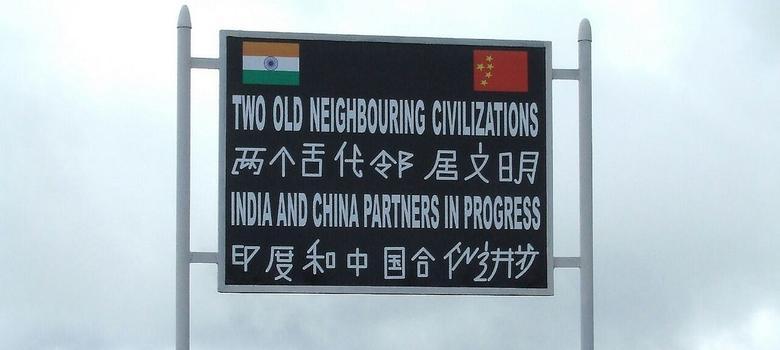
The row in the Chumar sector of the Ladakh region erupted just as China’s President Xi Jinping was visiting New Delhi for his first summit with Modi since the Indian leader’s election in May. The leaders of the Asian giants aim to ramp up commercial ties.

India sees the anti-terrorism collaboration with China as a way to highlight the threat they both face from Islamist militants in Pakistan.

It had arranged for the Chinese to practise mock assaults in Bhatinda, about 110 km (70 miles) from the Pakistan border.

via After border row, India, China plan counter-terror drills to build trust | Reuters.

30/09/2014

Stand-off continues, Chinese army refuses to withdraw from Chumar


The standoff between the Indian Army and their Chinese counterparts continued on Monday at the Chumar sector in eastern Ladakh, along the Line of Actual Control. At one of the eight spots in the Chumar sector, the Indian Army made a tactical retreat in the face of a heavy Chinese presence. Despite diplomatic interventions on Monday, both sides continue to hold their tactical positions against each other. The standoff has continued primarily because of China’s unwillingness to stop its road-building exercise to the Line of Actual Control and India’s refusal to demolish structures built in the area to shelter troops.

via Scroll.in – News. Politics. Culture..

20/09/2014

To engage with China, India must stop peddling myths about the Line of Actual Control

Nehru’s hubris about his own statesmanship, coupled with a refusal to discuss the matter reasonably since 1962, has led us to the present tangle.

Political commentators have been gushing over the possibilities of strengthened economic and strategic relations between China and India, but the unresolved border dispute remains alive and can always play spoiler in the future. A border is, after all, more than a line on the map or a series of military posts on the ground; it is a reflection of how the political elite of a nation-state thinks about its security.

Chinese-controlled Aksai Chin is claimed by India as part of Jammu and Kashmir, and Indian-controlled Arunachal Pradesh is claimed by China. The only feasible solution is to accept the status quo and transform the Line of Actual Control into an international boundary. There have been several rounds of talks since the 1990s, but a resolution remains distant. Despite its parliamentary majority, Prime Minister Narendra Modi’s government will be unable to sell a permanent boundary settlement without being accused of ceding territory in Aksai Chin, though in reality it will only be giving up its claim over a territory India never controlled.

This raises a pertinent question: what precisely is the border upon which India and China cannot agree?

New neighbours

Through history, China and India have not been neighbours. The current de facto border has its genesis in a line drawn on a map by Henry McMahon during a secret treaty between Britain and Tibet in March 1914. Both entities, British India and Tibet, are no more: one has been transformed into postcolonial India and the other was occupied and colonised by communist China. Yet India and China, both of whom have overthrown the mantle of Western imperialism, are jostling over the same imperialists’ line – and have completely militarised and destroyed the traditional zone of contact that the border regions were.

The border is a legacy of a few dynamics, including the expansionist policies of the British in the Himalayan regions of India, the disappearance of the traditional Tibetan state, which had political and sacral hegemony over much of the region, and the modern nationalisms in postcolonial India and revolutionary China, which are keen on implementing a rigid notion of sovereignty in the border regions and legitimising the primacy of militarised security over the religious, cultural and human rights of the people inhabiting the region.

Stuck in the middle

The primary loser in the dispute is neither India nor China but Tibet. China has occupied most of Tibetan territory, while India has occupied the Tawang tract, which was historically part of Tibet. The Tibetan state had given up the Tawang region to British India in 1914 on the understanding that they would get friendship and assistance to protect their independence from China. When China went on to occupy Tibet in 1949-’50, India reneged on that understanding, preferring the diplomatically attractive Hindi-Chini-bhai-bhai rhetoric over a strategically sound and morally defensible Indo-Tibetan friendship.

Despite reluctantly hosting the Tibetan exile community today, India did not offer any tangible help to the Tibetans in their struggle for independence. Today, as Modi and Xi plan collaborations on various fronts, Tibetans are reminded that in this world of realpolitik, morality and human rights are subservient. Tibetans are perceived as strategic assets or liabilities in bargaining with China, not people of an occupied land for whom India should raise its voice. For India, it is the border matters, not the border inhabitants.

Myths peddled by India

The popular as well as strategic approach of many in India towards the border dispute is jaundiced by the myths the Indian state peddled about the humiliating war of 1962. After the 1962 defeat, there was no credible reflection at the policy level in India. Indians accepted as real the myths that Indian territorial claims were legitimate and sacrosanct, and that the Chinese were duplicitous and stabbed gullible India in the back. The reality could not be further from this. The first Survey of India Map in 1950 showed the boundary as undefined in Aksai Chin and as undemarcated in the north east. It was only in the summer of 1954 that Jawaharlal Nehru gave personal orders for all old maps to be withdrawn and destroyed and to remove qualifiers and show the McMahon Line in bold, as if that was the de jure boundary.

Nehru later claimed innocence, insisting that there was no boundary disagreement and that Chinese claims were surprising. Since 1959, India rejected all the diplomatic overtures of Zhou Enlai and said negotiations could only take place if China withdrew from Aksai Chin, though India would not offer anything in return. Since 1961, the Indian military followed a “forward policy” in the border regions that was not only provocative but based on the assumption that China would not retaliate.

A great unresolved mystery from the time is why the best Indian minds working in intelligence, military and diplomacy accepted this assumption without a murmur of protest. It can be explained by Nehru’s hubris in his own capacity as a statesperson, bureaucracies subservient to him, and the inability of the civilian and military elite to be independent-minded. Macho posturing was the order of the day. The Indianisation of the top brass in the military occurred only after independence in 1947, so they were inexperienced as leaders. Faced with an army that had its genesis in revolutionary wars, the Indian army, which had been servant to an imperial power, failed to perform its basic duty of protecting the country.

via Scroll.in – News. Politics. Culture..

18/09/2014

After Modi-Xi meeting, China agrees to quickly settle border dispute, demarcate LAC – Hindustan Times

Prime Minister Narendra Modi and Chinese President Xi Jinping on Thursday agreed to quickly resolve the border dispute and demarcate the Line of Actual Control to improve peace and cooperation between both countries.

Addressing the media after the conclusion of one-on-one meeting with visiting Chinese President Xi Jinping, Modi said India is concerned about the frequent incursions along the border. The Line of Actual Control should be demarcated soon to ensure peace and tranquility in the area, he said.

President Xi, in response, said that China will work to settle the border issue at the earliest date. Since the border is not demarcated there will be some incidents, but both countries are capable of settling it at various levels without causing a bigger impact, he said.

President Xi said both countries would be respectful and sensitive to each others concerns. “We also have the sincerity to work with India to maintain peace and tranquility in the border areas before we are finally able to settle the border question,”he said.

The latest incident India was referring to was the  fresh incursion by the Chinese army in Chumar area, even as talks were on between both the leaders.

via After Modi-Xi meeting, China agrees to quickly settle border dispute, demarcate LAC – Hindustan Times.

20/08/2014

Why decades of India-Pakistan negotiations have not resulted in any real progress

It’s simple. Pakistan wants something India has, but can offer nothing in return that India desires.

It took less than three months for the candle of hope lit by Narendra Modi and Nawaz Sharif at the Indian prime minister’s inaugural ceremony in Delhi to be extinguished. India has cancelled foreign secretary-level talks scheduled to be held in Islamabad next week because Abdul Basit, the Pakistani High Commissioner, met a few separatist leaders. It’s not as if Basit did anything illegal or novel. Kashmir being the apple of discord between India and Pakistan, it is natural for Pakistan’s envoy to consult with secessionist Kashmiris before an important round of bilateral discussions. It has been done many times before. On this occasion, though, the Modi government threw a hissy fit, which is being spun by pliant commentators as a “tough approach”.

The extinguishing of hope was predictable, and followed directly from the mistake of inviting Nawaz Sharif to Delhi. The two prime ministers should have met only when they had something serious to decide upon, after the spadework for an agreement, however minor, had been completed. The euphoria of the inauguration handshake created expectations difficult to fulfill, considering the deeply entrenched and entirely incompatible views of the opposing sides.

The fact that Narendra Modi is no Atal Behari Vajpayee turned Mission Difficult into Mission Impossible. Vajpayee was committed to a legacy-defining vision of securing lasting peace with Pakistan. There was a tiny possibility that he might have accepted the sacrifices essential for it, and convinced his party and the nation to go along. In the reign of Modi, whose idea of India is the most aggressive of any leader since independence, such a sacrifice is inconceivable.

Give and take

Any successful negotiation requires give and take from both sides. The stumbling block to resolving the Kashmir issue is that Pakistan wants something India has, but can offer nothing in return that India desires. Although the official positions of the two sides indicate that each is in occupation of territory that rightfully belongs to the other, in reality India has no use for that part of Kashmir we call POK. Nor has anybody in POK expressed a will to secede from Pakistan and join India. In any conceivable deal, then, India can only lose territory. The abstract peace dividend doesn’t provide anything close to adequate compensation for this physical loss. Which is why India has negotiated in bad faith for decades.

In 1972, the two nations signed the Simla Agreement, resolving not to wage further wars, and to address speedily the issue of Kashmir. In 1999, through the Lahore Declaration, we agreed essentially to the same things, tacking on a promise not to nuke each other. But for over 40 years, through cycles of violent insurrection and relative calm, through dozens of horrific terrorist attacks and thousands of peaceful demonstrations, through periods of sectarian amity and passages of ethnic cleansing, India’s position on the issue hasn’t budged an inch, down to the proscription of any maps that show Pakistani Kashmir for what it really is.

Why would any Indian politician risk negotiating in earnest, when it is clear that Indians in general do not give a fig for what Kashmiris actually want? We are happy to let our security forces commit crimes shielded by the Armed Forces Special Powers Act. We are content to pour billions of rupees into defending an icy wasteland where our soldiers regularly die of exposure. We are barely moved by the discovery of unmarked graves in which thousands of Kashmiris were secretly and hastily buried.

via Scroll.in – News. Politics. Culture..

14/08/2014

War of Words Erupts Between India and Pakistan – India Real Time – WSJ

An all-to-familiar war of words has erupted between India and Pakistan, threatening to undo efforts to bridge the gap between the estranged neighbors, who have fought three wars since independence from Britain 67 years ago.

The latest rhetorical salvo was fired Wednesday by India’s foreign ministry, which said “mere denials or selective approaches toward terrorism” by Pakistan wouldn’t assuage Indian concerns about what it sees as backing from Islamabad for Islamic terror attacks on Indian soil.

This week’s bickering started when Indian Prime Minister Narendra Modi, on a visit to the disputed state of Jammu and Kashmir on Tuesday, said Pakistan, too weak to fight a conventional war, was using terror groups to wage a “proxy war against India.”

Pakistan’s Foreign Ministry the next day denounced Mr. Modi’s criticism as “baseless rhetoric.”

“It would be in the larger interest of the regional peace that instead of engaging in a blame game, the two countries should focus on resolving all issues through dialogue,” Pakistan’s foreign ministry said.

It wasn’t supposed to be like this. When Indian Prime Minister Narendra Modi invited his Pakistani counterpart, Nawaz Sharif to Delhi for his swearing-in ceremony, it ignited hope for better relations between the estranged neighbors.

The two countries’ foreign secretaries are scheduled to meet in Islamabad on Aug. 25 to “look at the way forward” in the bilateral relationship. But the current spat could cast a shadow over the meeting.

That poses a problem. Deep-rooted suspicion between India and Pakistan has stymied attempts at achieving greater economic integration and better connectivity in the region. Relations between India and Pakistan, a close ally of neighbouring China, also have a major impact on regional stability.

via War of Words Erupts Between India and Pakistan – India Real Time – WSJ.

17/07/2014

With Tensions Rising, Japanese Investment in China Plummets – Businessweek

Another consequence of the worsening Sino-Japanese relations: Japanese investment into China dropped by nearly half in the first six month of 2014, according to a new report by China’s Ministry of Commerce. As recently a 2012, Japanese investment posted growth of 16.3 percent, reaching $7.28 billion. The decline actually started last year, with a 4.3 percent drop.

Zhang Jifeng, director of the Japanese economy department in the Chinese Academy of Social Sciences, told the China Daily that Japan’s entrepreneurs are “waiting and watching.” He added: ”They’re profoundly aware of the connection between the political climate and their commercial performance [in China]. They don’t want to put their assets at risk.”

English: Yasukuni Shrine in Tokyo.

English: Yasukuni Shrine in Tokyo. (Photo credit: Wikipedia)

China and Japan are in a dispute over the ownership of the uninhabited Diaoyu Islands in the East China Sea. Japanese Prime Minister Shinzo Abe further angered Beijing in December when he visited Tokyo’s Yasukuni shrine, a temple that honors Japanese soldiers but also its war criminals. Earlier this month Japan’s cabinet passed a resolution reinterpreting its pacifist constitution so its military can defend its allies.

via With Tensions Rising, Japanese Investment in China Plummets – Businessweek.

15/07/2014

In First Meeting, Modi and Xi Discuss Decades-Long Border Disputes – India Real Time – WSJ

In their first one-on-one meeting, Chinese President Xi Jinping and Indian Prime Minister Narendra Modi spoke about finding a resolution to the long-standing boundary dispute between the Asian neighbors, a goal that has eluded the two countries for decades.

In talks lasting 80 minutes, Mr. Modi told Mr. Xi that “it is necessary to resolve the boundary question,” Syed Akbaruddin, a spokesman for India’s foreign ministry, said in a televised interview after the meeting in Brazil on the sidelines of a summit of BRICS countries. Pending that, Mr. Modi said, “peace and tranquility need to be maintained on the border,” according to Mr. Akbaruddin.

Mr. Xi called for “negotiated solutions” to the dispute at an early date, China’s official Xinhua News Agency reported. He also said the two countries “should join hands in setting global rules so as to raise the voice of developing countries,” Xinhua said.

China has reached out to the new Indian administration, led by Mr. Modi, at a time when its ties with other Asian countries including Japan and the Philippines have soured over territorial disputes. The Chinese foreign minister visited New Delhi last month, and Beijing’s premier was the first foreign leader to talk to Mr. Modi after his swearing-in as prime minister earlier this year, following national elections.

Ties between India and China have long been characterized by mistrust, and the sentiment appears to linger. More than seven in 10 Indians are concerned that territorial disputes between China and its neighbors will lead to military conflict, according a Pew Research Center survey published Monday.

Nearly half of all Indians think China’s growing economy is a bad thing for their country, and only 31% of Indians had a favorable view of China, the survey showed. By comparison, 55% of Indians had a favorable view of the U.S. and 43% had a favorable view of Japan.

Tensions between India and China boiled over into a brief war in 1962, following which China gained control of a 14,600-square-mile territory known as Aksai Chin. China claims another 35,000 square miles in Arunachal Pradesh, a state in India’s northeast. Relations worsened last year when India alleged that Chinese troops had crossed into Indian-held territory in the Himalayan region of Ladakh, triggering a weekslong standoff.

On the campaign trail during national elections earlier this year, Mr. Modi promised to be tough on security issues. In a speech in February he warned China against having an “expansionist mindset.” In Mr. Modi’s first few weeks in office, his government has taken steps to boost infrastructure and connectivity on the Chinese border.

Mr. Modi’s China policy remains unclear, as does his ability and willingness to negotiate a border settlement, a process that has gone on for three decades. Special representatives appointed to work out a solution have so far held 17 rounds of talks.

The two countries signed an agreement last October aimed at easing hostilities on the disputed and ill-defined border, known as the Line of Actual Control, including commitments to ensure that patrols don’t escalate into military confrontations. But the agreement failed to impress security analysts in India, who said it was little more than a statement of intentions.

India is also worried about China’s growing influence in South Asia where New Delhi sees itself as the regional power. Mr. Modi has moved to revitalize India’s neighborhood ties, inviting South Asian leaders to his swearing-in and choosing Bhutan for his first foreign visit.  The government is also pushing to close India’s $40 billion trade deficit with China.

via In First Meeting, Modi and Xi Discuss Decades-Long Border Disputes – India Real Time – WSJ.

09/07/2014

World Review | China and India ignore border tensions to forge economic ties

CHINA and India have been attempting to ‘reset’ their bilateral relationship for years.

China and India ignore border tensions to forge economic ties

While the countries stand to gain much from improved cooperation, political animosity and territorial disputes dating back to the 1962 Sino-Indian Border Conflict have undermined progress, writes World Review guest expert Vaughan Winterbottom.

But just weeks after India’s newly-elected Prime Minister Narendra Modi took office, he has set in place plans to forge closer ties with neighbouring China.

This indicates that decades of cool relations may thaw between the world’s two most populated nations and realise Mr Modi’s election promises of reviving a flagging economy.

Early signs, however, indicate that New Delhi will continue its hard-line approach to territorial disputes with China.

Both countries are keen to separate business and politics and, as they pursue different agendas for diversifying their economies, bilateral trade may grow significantly.

In the 1950s, Beijing and New Delhi positioned themselves as leaders of the developing world. They jointly penned the ‘Five Principles of Peaceful Coexistence’ in 1954, a set of lofty doctrines which the two countries’ leaders saw as guiding post-colonial diplomacy.

But in 1962, the neighbours engaged in a fierce, month-long conflict over disputed mountain borders drawn by the British. China came to administer Aksai Chin, which India claims as part of Jammu and Kashmir, while India held Arunachal Pradesh, which China asserts is a region of Southern Tibet.

The 1962 war has had a profound impact on subsequent Sino-Indian ties.

India remembers it as a national humiliation, and has been suspicious of Chinese strategic intentions ever since.

For China, the war is less significant to the national psyche, though India’s continuing to host the Tibetan government in exile is viewed as interfering in Beijing’s internal affairs.

Skirmishes along the Line of Actual Control, a de facto border negotiated by the two countries in 1993 and 1996, continue to this day.

Despite tensions, hopes for a cooperative relationship remain. The two countries inaugurated a ‘Year of Friendship’ in January 2014, and proposed initiatives to boost economic, cultural and people-to-people links.

This year also marks the 60th anniversary of the Five Principles of Peaceful Coexistence. Beijing held a conference in June 2014 to mark the occasion. Both Chinese President Xi Jinping and Indian President Shri Pranab Mukherjee attended. They spoke of the importance of the Principles – and completely ignored the territorial disputes.

Beijing responded enthusiastically to the electoral victory of Narendra Modi in May 2014. However, old sticking points remain: just days before the Five Principles anniversary conference, four Chinese People’s Liberation Army speedboats crossed into the Indian-controlled side of Pangong Lake in Jammu and Kashmir. The boats were pushed back by Indian troops.

On the day of the anniversary conference, China published a new map which shows Arunachal Pradesh as Chinese territory and a large area of Jammu and Kashmir as part of China.

Even assuming these incidents are aberrations on the path to closer ties, early signs from Mr Modi do not suggest a China-policy rethink.

Mr Modi told a rally in Arunachal Pradesh in February 2014, ‘China should give up its expansionist attitude and adopt a development mindset… No power on earth can take away even an inch from India.’

Mr Modi’s National Democratic Alliance plans to spend US$830 million to settle areas close to the contested border in Arunachal Pradesh were announced on June 20. The region’s governor, Nirbhay Sharma, said that without greater settlement along the border, ‘a gradual assimilation of our area by China is on the cards’.

Given Mr Modi’s record of support for India’s territorial claims and his openly nationalistic politics, a Sino-Indian rapprochement is unlikely.

However, Mr Modi has presented himself as a pro-business leader keen to reform India’s stagflating economy.

On this point, he may find common ground with Beijing, which is no stranger to separating economics from politics in its dealings with foreign governments.

Mr Modi has already outlined a vision to turn India into a knowledge-based society with a large service sector.

A positive sign for future economic cooperation between India and China emerged at the end of June 2014 when Mr Modi’s cabinet approved a plan to set up Chinese industrial parks in five Indian states.

In the long run pharmaceuticals, IT, medical equipment and tourism may hold greater promise as export stalwarts.

As China’s economy edges up the value chain, India could move in to pick up the labour-intensive manufacturing slack. Doing so would require tackling India’s bloated bureaucracy, corruption and vested interests in order to free up land and labour. The task defeated former Prime Minister Manmohan Singh.

via World Review | China and India ignore border tensions to forge economic ties.

04/07/2014

BBC News – Indian PM Narendra Modi on maiden Kashmir visit

Prime Minister Narendra Modi is on his first visit to Indian-administered Kashmir amidst a protest shutdown called by separatist groups.

PM Modi flags off the first train from Katra

Mr Modi inaugurated a railway line in the Jammu region before travelling to Kashmir Valley to launch a hydro-power station and chair a security meeting.

Security is tight in the region and checkpoints have been set up to ensure the visit passes off peacefully.

Kashmir has been in the grip of an anti-India insurgency since 1989.

In recent years violence has abated from its peak in the 1990s, but the causes of the insurgency are still far from resolved.

Mr Modi arrived in Jammu on Friday morning from where he flew by a helicopter to Katra town where he flagged off a new train to Delhi.

Katra is the base camp for the Hindu pilgrimage centre of Vaishno Devi and the train will providing a direct link with Delhi.

Millions of pilgrims visit the shrine every year and railway officials say they expect the train will be popular with them.

Meanwhile, the Muslim-majority Kashmir Valley is shut down in response to calls from separatist groups to protest against Mr Modi’s visit.

In the state capital, Srinagar, shops, businesses, offices, schools and banks are closed and there is little traffic on the roads in most parts of the valley.

Mr Modi will later fly to Uri town in north Kashmir to inaugurate a hydro electrical project.

via BBC News – Indian PM Narendra Modi on maiden Kashmir visit.

Law of Unintended Consequences

continuously updated blog about China & India

ChiaHou's Book Reviews

continuously updated blog about China & India

What's wrong with the world; and its economy

continuously updated blog about China & India