Archive for ‘pork industry’

02/04/2020

China’s race to produce ‘super pigs’ destined to fail amid haphazard biosecurity, experts say

  • China’s pig herd has begun to build again after African swine fever devastated hog populations across the country 18 months ago
  • Scientists are racing to create disease-resistant pigs, but analysts say that will be undermined by basic hygiene problems in China’s pork industry
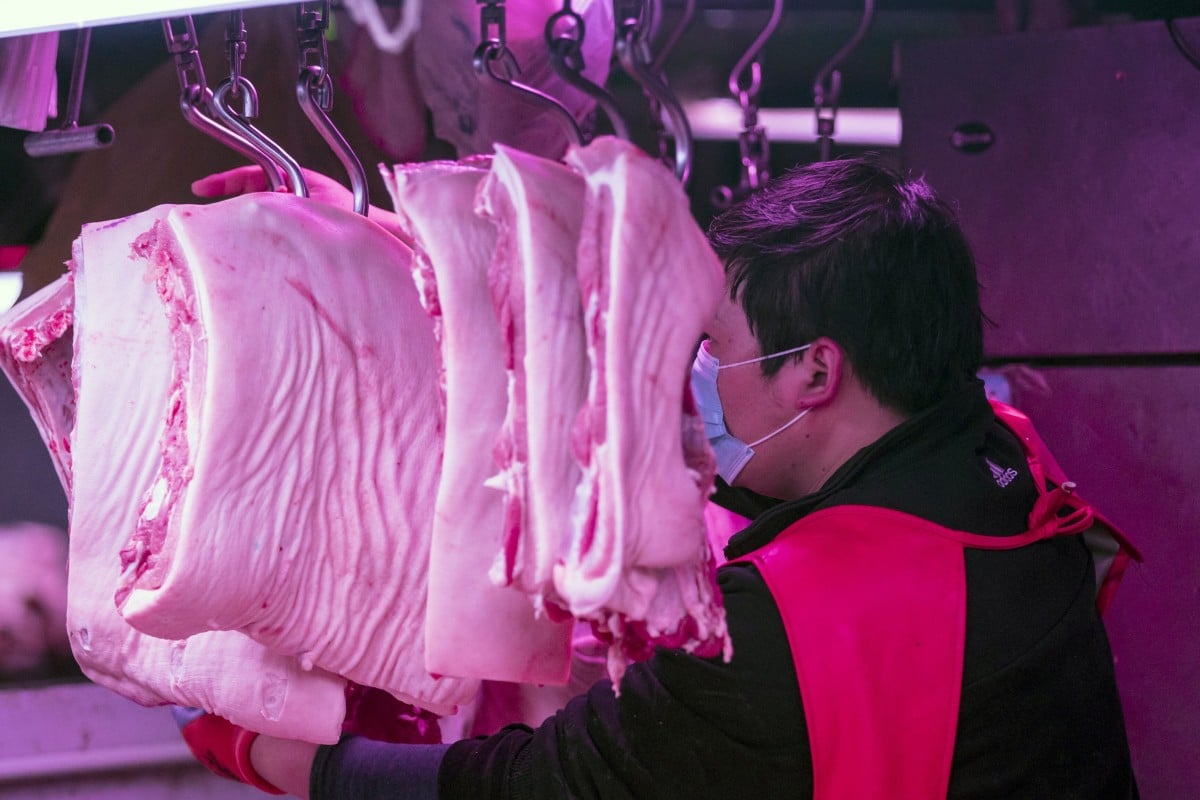
China’s pork industry has been severely dented by African swine fever disease in the past 18 months. Photo: Bloomberg

China should focus less on developing disease-resistant “super pigs” to protect its hog herd from infection and do more to improve basic biosecurity, analysts say, as several companies claim to be close to a breakthrough treatment for African swine fever.

China’s hog herd has begun to steadily rebuild after swine fever spread across the country a year and a half ago, killing or forcing the culling of 60 per cent of the pig population, according to authorities.

But poor biosecurity – including the transport of pigs in filthy trucks and a lack of disinfection at farms – still threaten the industry, observers said.

There is no commercially available vaccine for the disease – which is not harmful to humans – but a number of researchers claim they are close.

Swine fever could kill 25% of the world’s pigs, scientists say
China’s Harbin Veterinary Research Institute, the country’s top research body on animal diseases, said last month it had developed a vaccine for African swine fever (ASF) that laboratory testing showed was safe and effective. However, it did not give a timetable on when it would be available for commercial use.

Meanwhile,Shandong Landsee Genetics, a company in China’s eastern Shandong province, was reported this week to have successfully bred ASF-resistant pigs. The pigs, called Lansibai-2, are from the large white breed, one of the most common raised in China.

When approached for comment, a spokeswoman for the company said the research was confidential and she was not authorised to speak to media.

Despite the apparent progress, analysts are generally sceptical that a silver bullet to prevent the disease will be developed on a large scale any time soon.

“Because this disease has been found in many countries, I don’t think there has been major progress [when it comes to eliminating the disease],” said Chenjun Pan, senior analyst for animal protein at Rabobank. “There have been some vaccines, but the effectiveness of the vaccines is not that satisfactory. So far there haven’t been any solutions from a medical perspective.”

There have been some vaccines, but the effectiveness of the vaccines is not that satisfactory – Chenjun Pan

China’s swine fever problem was complicated by an unwillingness from local governments to diagnose and report ASF cases, said E.W. Johnson, of Enable AgTech Consulting in Beijing. It was also complicated by basic hygiene problems, he added.

“Pigs with ASF are sold to slaughter every day, and dirty trucks are going everywhere, spreading the disease as much as they did when the ASF outbreak began,” Johnson said.

“There is no doubt that people are very excited and extremely zealous about these super-pigs. [But] China seems intent on living with ASF rather than getting rid of it.”

“The most important problem now is how to control the ASF epidemic, and this is not the way to do it,” said Feng Yonghui, chief analyst at pork industry website Soozhu.com. “The whole global industry recognises that the greatest preventive measure is improving biosecurity.”

he whole global industry recognises that the greatest preventive measure is improving biosecurity – E.W. Johnson

Improved hygiene can lower the risk of disease in production, said Feng, including sickness caused by bacteria and viruses, like transmissible gastroenteritis, a coronavirus found in pigs.
“It’s a system – you can’t just do one step in the process,” he said. “The whole industry has to study it, and we still need time to improve.”
Basic controls – like keeping pig transport trucks clean, or disinfecting protective equipment used by workers on pig farms – is simple but comes at a price, and some smaller pig farms are struggling to keep up.
China’s outbreak of African swine fever pushes pork off the Lunar New Year menu
“What we’re worried about are the people on the lower rungs of the ladder who aren’t able to keep up with better practises,” Feng said. “If we are to get pig stocks back up to where they were before the outbreak within three years, this is the key issue that stands in the way.”
China’s pork industry is at a turning point in production unlike at any other time in history, he said.
“In the past, when it came to upgrading production, or when the industry went into loss, all producers big and small began again at the same starting line,” he said. “That’s because there was no threat of disease. Now, those with money get to run first.”
Pork prices in China, the world’s top consumer and producer of pork, have surged since AFS began cutting back supply, driving margins up for both domestic and imported pork.
The world’s biggest pork processor, Hong Kong-listed WH Group, reported a 32 per cent jump in profits last year as record high pork prices in China boosted the value of the company’s exports from the United States and lifted margins on its China sales.
China’s deadly African swine fever epidemic is spreading across Asia
China’s total pork production in 2019 was 42.55 million tons, a decrease of 21.3 per cent from 2018, data from the National Bureau of Statistics showed. In 2018, the total pork output was 54.037 million tons, down 0.9 per cent from 2017.
While researchers race to find a cure for swine fever, new cases keep cropping up across the country. On Wednesday, the Ministry of Agriculture and Rural Affairs said local authorities in Sichuan had detected infections in piglets transported from outside the province.
Another outbreak was recorded in Inner Mongolia, where local authorities detected the disease in a herd of 200 piglets on a farm in Ordos city, which killed 92 of the animals, according to the agriculture industry.
Authorities are also monitoring cases of ASF in piglets smuggled into the country and would launch a 60-day investigation into illegal transport of hogs this month.
Source: SCMP
06/09/2019

Chinese medicine herbs could defeat devastating cotton virus, study suggests

  • Scientists find some chemicals can kill the cotton leaf curl Multan virus and others can boost cotton plants’ immunity to it
  • It is feared the virus could wreak havoc in China’s Xinjiang region, which produces most of the country’s cotton
A cotton picker in Xinjiang, where cases of the virus have been reported. Photo: Xinhua

Chinese scientists have found chemicals in medicinal herbs that could tame a destructive plant virus threatening the cotton industry in its western Xinjiang region.

Some small-molecule chemicals in herbs commonly used in Chinese medicine can effectively suppress cotton leaf curl Multan virus, according to ongoing research led by Professor Ye Jian at the Institute of Microbiology in Beijing.

By targeting WRKY20, a gene in the virus’ DNA, the chemicals could disrupt the viral infection and transmission, Ye’s team found.

Some early findings from their research were published last month in the journal Science Advances.

The leaf curl virus – a species of Begomovirus, the largest genus of plant viruses – poses a significant threat to the world’s cotton plantations, causing leaf curling, stunted growth and lower yields of cotton fibre. It costs the cotton industry in the Indian subcontinent about US$1 billion a year, according to a press release about the study from the Chinese Academy of Sciences.

Were there to be a pandemic in China, the drop in output and measures to contain it could cost the cotton farming industry 50 billion yuan (US$7 billion), according to some researchers’ estimates, the academy added.

The first known cases of the virus in China over the past decade were limited to coastal areas in the country’s east, but several cases have now been reported in Xinjiang Uygur autonomous region.

“We are running out of time,” Ye told the South China Morning Post.

Cotton is a pillar industry in Xinjiang, which provides more than 80 per cent of China’s total cotton production. The industry also contributes up to 50 per cent of the income of farmers involved in it, according to government statistics.

Exact figures for infections in the region are not available, but outbreaks so far remain isolated, according to Ye and other researchers with knowledge of the situation.

Double threat to China’s cotton industry: warmer weather and mirid bug

However, Professor Gao Feng, cotton researcher at the Agricultural College of Shihezi University in Xinjiang, warned that leaf curl virus could reduce cotton production in an infected field to almost zero.

“A large-scale outbreak has not occurred yet, but the threat is very serious and people are very nervous,” Gao told the Post. “We are in desperate need of a solution.”

The challenges facing China’s pork industry highlight the danger viruses can pose to the domestic market. A swine fever outbreak that has wiped out 100 million pigs caused pork prices to rise, forcing China to look to new countries to import from, such as Portugal and Argentina.

Its biggest overseas supplier of cotton is the United States, with which it is locked in a protracted trade war. In July, the government allowed some Chinese companies to buy a total of 50,000 tonnes of cotton from the US without tariffs being charged.

The central and regional governments fear that falling incomes caused by the impact of an outbreak on the cotton industry would increase the risk of ethnic conflict, social instability and anti-government thoughts.

Ye’s team adopted two approaches to fighting the virus.

How trade war with the US is changing China’s cotton industry

Some chemicals they discovered could improve cotton plants’ immunity against the infection by stimulating them to generate an antibody that killed the virus. The other chemicals they found could target the virus, directly reducing its intensity.

“They can be used as sprays,” Ye said, adding that he planned to reveal the chemical composites and related herbs in a paper to be published in a peer-reviewed journal in the coming months.

The discovery could offer an environmental benefit, too. Cotton farmers in Xinjiang use pesticides to deter the whiteflies that transmit the virus, but their overuse has affected Xinjiang’s delicate ecology, which in its desert areas is particularly vulnerable to disturbance.

In the agricultural research community, there is growing concern that some whitefly species will become resistant to pesticides. “If that happens, we will have a major problem,” Ye said.

He said the chemicals identified in the ongoing study would not harm the environment.

“These chemicals come from plants, so the negative impact to the environment would be minimal,” he said.

The study also found that it may be possible to use the cotton leaf curl Multan virus to benefit farmers. It stimulates cotton plants to generate a chemical that is harmful to other insects, such as the bollworm, that compete with whiteflies for food, meaning that it could be genetically modified into a pest control agent.

Most cotton species in commercial plantations are genetically modified to produce an insecticide to kill bollworm. Ye said a man-made virus could reduce the dependence on genetically modified plants.

Source: SCMP

Law of Unintended Consequences

continuously updated blog about China & India

ChiaHou's Book Reviews

continuously updated blog about China & India

What's wrong with the world; and its economy

continuously updated blog about China & India