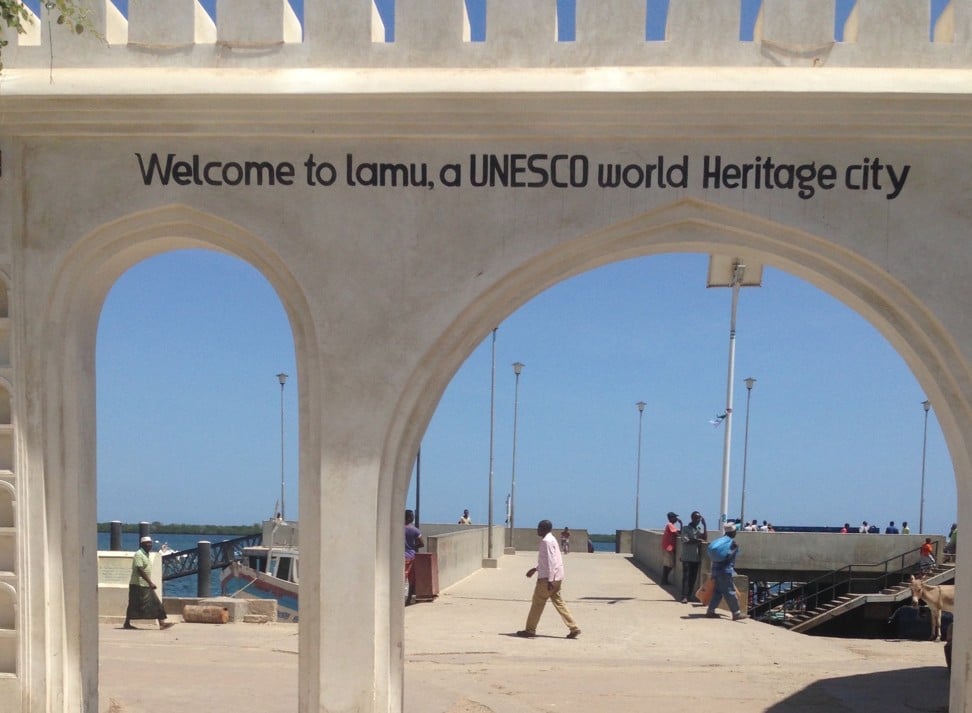
Lamu Old Town’s Unesco status helps to support its tourism and fishing industries. Photo: Handout
However, the project’s future is uncertain after a Kenyan court, the National Environment Tribunal, ordered on June 26 that a fresh environmental impact assessment be carried out. The tribunal, which oversees decisions made by the National Environment Management Authority, also revoked the licence issued by the authority to Amu Power.
A lack of public consultation to date, as well as the environmental risks, were cited by the court, whose ruling is binding on the government. Unesco has urged Amu Power to proceed with the impact assessment, which in turn could have an impact on perceptions of Beijing’s signature transcontinental infrastructure strategy, the
.
Two days after the court’s verdict, Wu Peng, the Chinese ambassador to Kenya, met groups opposed to the building of the coal plant, days after they had been dispersed by police when they tried to protest at the embassy. Wu acknowledged the need to develop a different approach to hear the public’s views.
Anti-coal campaigners have been demanding China back out. Of the plant’s estimated US$2 billion cost, US$1.2 billion is coming from the Industrial Commercial Bank of China.
The three Chinese companies – Sichuan Electric Power Design and Consulting, China Huadian, and Sichuan No 3 Power Construction – teamed up with Kenya’s Centum Investments and Gulf Energy in a venture to form Amu Power. Another Chinese firm, Power Construction (PowerChina), was contracted to build the plant, which is expected to generate 1,050 megawatts of electricity.
The Chinese embassy in Nairobi said it had asked the Chinese investors to wait for Kenya’s decision on whether it should go ahead.
“Our position is that the Kenyan people are the final decision makers in this project and the Chinese government respects that,” embassy spokeswoman Huang Xueqing said.
Despite committing to cutting China’s reliance on coal, Beijing is still funding several coal-powered plants around the world. Both China and Kenya signed the
on climate change in 2016, promising to cut carbon emissions.
China may be providing a market for its coal by outsourcing its fossil fuel use to other countries, according to 350.org, which campaigns to prevent climate change and works to end use of fossil fuels.
Yossi Cadan, a senior campaigner for the organisation, said many people looked to China to be the new world leader in addressing climate change, given its government’s ambitious initiative to reduce emissions domestically. US President Donald Trump, by contrast, made the controversial decision to
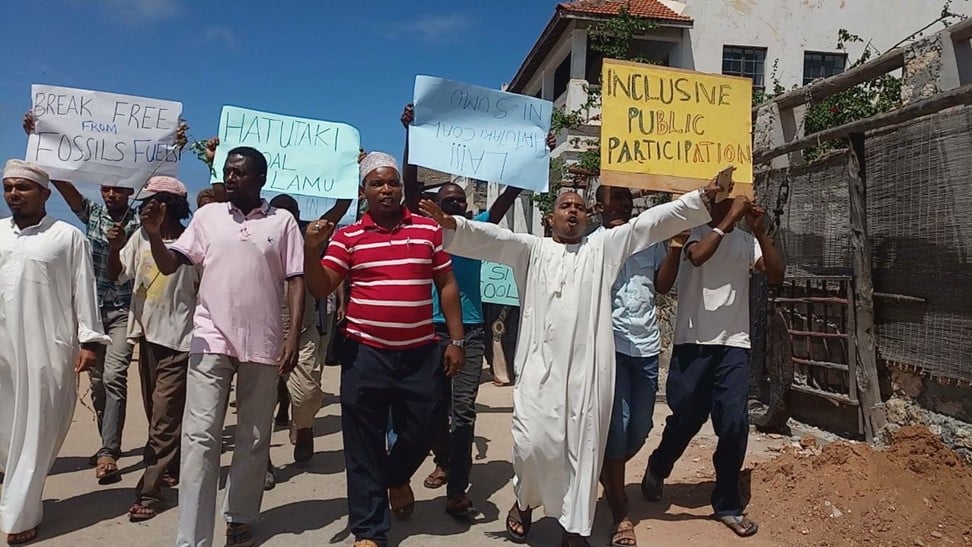
Activists and Lamu residents have protested about the coal plant. Photo: Handout
“While China seems determined to meet its Paris climate agreement targets at home, it undermines those efforts to reduce global emissions by simultaneously investing in coal projects across the world,” Cadan said.
According to Cadan, cancellations and delays of coal projects in China left a desperate Chinese coal industry looking elsewhere, assisted by Chinese financial institutions.
He argued that if China was serious about being a global leader in reducing emissions and tackling the climate crisis, it must apply the same restrictions it was
to coal financing outside China.
Analysts said that if the Lamu coal project were to be abandoned, other Chinese-funded coal power projects in Africa would come under the spotlight.
China is funding eight coal-powered projects in Africa, including Egypt’s Hamrawein plant, which has an estimated cost of US$4.2 billion and is expected to generate six gigawatts of power.
Omar Elmawi, campaign coordinator at deCOALonize, was among the campaigners who met ambassador Wu two weeks ago.
“Other African countries could take a cue from [the Kenyan situation],” he said. “Already key financial institutions are coming up with policies that are either cutting back on or refusing to fund new coal plant projects. This will add to the pressure on China to abandon coal projects.”
Lauri Myllyvirta, lead analyst at Greenpeace’s air pollution unit, said the Lamu case could spur the Chinese government to adapt its criteria for supporting overseas energy projects. This could include requiring coal-fired power projects overseas to meet more stringent emissions standards.
“Currently, essentially all of the overseas coal-fired power projects with involvement from Chinese banks and firms plan to use much weaker emissions control technology than is allowed in China, leading to much worse air quality impacts and public health impacts – which was the case in Lamu,” Myllyvirta said.
“It’s hard to see how [a weaker emissions standard] fits with the Chinese leadership’s objectives of greening the belt and road, and projecting a positive, technologically advanced image of China overseas.”
Source: SCMP



 CHINDIA ALERT: You'll be living in their world, very soon