Archive for ‘Premier Li Keqiang’

24/09/2019

Exhibition opens to mark 70th anniversary of PRC founding

CHINA-BEIJING-PRC-70TH FOUNDING ANNIVERSARY-EXHIBITION-OPENING (CN)

Chinese Premier Li Keqiang, also a member of the Standing Committee of the Political Bureau of the Communist Party of China (CPC) Central Committee, delivers a speech during the opening ceremony of a grand exhibition of achievements in commemoration of the 70th anniversary of the founding of the People’s Republic of China (PRC) at the Beijing Exhibition Center in Beijing, capital of China, Sept. 23, 2019. (Xinhua/Rao Aimin)

BEIJING, Sept. 23 (Xinhua) — A grand exhibition of achievements in commemoration of the 70th anniversary of the founding of the People’s Republic of China (PRC) opened Monday at the Beijing Exhibition Center.

Premier Li Keqiang, also a member of the Standing Committee of the Political Bureau of the Communist Party of China (CPC) Central Committee, attended the opening ceremony and delivered a speech.

The exhibition comprehensively reflects the practices, achievements and experience of the past 70 years, which witnessed great improvements in the country’s economy and people’s living conditions, said Li.

It also records the continuous rise of China’s international status and influence, as well as China’s contribution to the cause of world peace and development, according to Li.

Noting that China remains the largest developing country in the world, Li called for more efforts to secure even greater victories in the future.

The country should work for high-quality development, comprehensively deepen reform, and build a market-oriented international business environment based on the rule of law, said Li, adding that it will implement a proactive policy of opening up to the outside world and promote economic globalization.

The opening ceremony was presided over by Wang Huning, a member of the Standing Committee of the Political Bureau of the CPC Central Committee and a member of the Secretariat of the CPC Central Committee.

About 1,000 people attended the opening ceremony.

Source: Xinhua

12/09/2019

China welcomes more Japanese investments: Premier Li

BEIJING, Sept. 11 (Xinhua) — Premier Li Keqiang on Wednesday expressed his expectation for the Japanese economic community to seize the opportunities of China’s opening up, increase investment in China and expand bilateral cooperation areas to promote more achievements in trade and the economy.

Li made the remarks in a meeting with a delegation from Japan’s business community, led by president of the Japan-China Association on Economy and Trade Shoji Muneoka, chair of the Japan Chamber of Commerce and Industry Akio Mimura, and Nobuyuki Koga, chairman of the Board of Councilors of the Japan Business Federation.

China-Japan relations have returned to the right track since last year thanks to the joint efforts of the two sides, and the trade and economic cooperation between the two countries has been steadily advanced and the prospects for bilateral cooperation are broad, said Li.

When China-Japan relations encountered difficulties, the Japanese economic community made important efforts and contributions to maintain their healthy and steady development as well as accelerate pragmatic cooperation between the two countries, the Chinese premier said.

According to Li, China and Japan are two of the world’s major economies, and should give full play to their complementary advantages and work together to deepen cooperation, which will not only benefit the two countries, but also conducive to regional and global economy, as well as the prosperity and stability of the world.

Noting that economic globalization is irreversible, and economic and trade exchanges should not be blocked by national borders, Li pointed out that promoting the healthy development of globalization is the way of progress.

“China has always firmly upheld the multilateral trading system with the World Trade Organization at its core and promotes the liberalization and facilitation of trade and investment,” Li said, stressing China will unswervingly promote all-round opening up, and strive to optimize the business environment.

China welcomes the Japanese economic community to seize the opportunity brought forth by China’s opening up and increase investments in China, expand cooperation areas, and promote more cooperation achievements in trade and economic areas between the two countries, he said.

While expressing congratulations on the 70th anniversary of the founding of the People’s Republic of China, the Japanese economic delegation said that Japan and China have witnessed progress in bilateral ties since last year, and close high-level exchanges have facilitated the two countries’ economic and trade cooperation.

The Japanese economic community firmly supports free trade and hopes China and the United States will resolutely resolve their trade disputes through negotiation, they said.

Speaking highly of China’s efforts in promoting trade and investment liberalization, expanding market access and improving the business environment, they said that the Japanese economic community is willing to boost cooperation with the Chinese side in science and technology innovation, climate change, health care and third-party markets.

They also expressed their expectation of concluding the negotiations for the Regional Comprehensive Economic Partnership (RCEP), a proposed free trade agreement between the 10 ASEAN (the Association of Southeast Asian Nations) members and Australia, China, India, Japan, South Korea and New Zealand, by the end of the year.

Source: Xinhua

11/09/2019

Chinese premier exchanges views with U.S. entrepreneurs on trade

CHINA-BEIJING-LI KEQIANG-U.S. ENTREPRENEURS ON TRADE-MEETING (CN)

Chinese Premier Li Keqiang meets with an American delegation visiting China for a dialogue with Chinese entrepreneurs and exchanges views with them on China-U.S. trade relations in Beijing, capital of China, Sept. 10, 2019. The delegation consists of U.S. business entrepreneurs and some former high-level officials. (Xinhua/Yao Dawei)

BEIJING, Sept. 10 (Xinhua) — Premier Li Keqiang on Tuesday met with American delegation visiting China for a dialogue with Chinese entrepreneurs and exchanged views with them on China-U.S. trade relations.

The delegation consists of U.S. business entrepreneurs and some former high-level officials.

This year marks 40th anniversary of the establishment of diplomatic relations between the People’s Republic of China and the United States. Over the past 40 years, the two countries have witnessed forward-moving economic and trade ties with win-win results, Li said.

While stressing the importance of extensive common interests between China and the U.S., Premier Li suggested that both sides, in accordance with the consensus reached by the two heads of state, should follow principles of equality and mutual respect, seek common ground and continue to explore approaches accepted by both sides to resolve differences.

China will open only wider to the outside world, and is committed to creating a market-oriented, law-based international business environment where domestic and foreign enterprises are treated equally and protection of intellectual property is given priority to.

China has fully liberalized its manufacturing sector and accelerated the opening up of its service sector, the premier said.

“China has a vast market. We welcome enterprises from all countries, including those from the United States, to expand economic, trade and investment cooperation with China and achieve mutually beneficial results,” Li added.

The American entrepreneurs said that U.S. companies, which were inspired by China’s new measures to open up, are looking at the current U.S.-China trade frictions from a long-term perspective, opposing actions to weaken economic relations with China and economic decoupling between the two countries.

They also voiced their hope that bilateral economic and trade consultations will gain ground with an agreement being reached at an early date.

Source: Xinhua

07/09/2019

Hong Kong protests: China’s premier backs government to end ‘chaos’

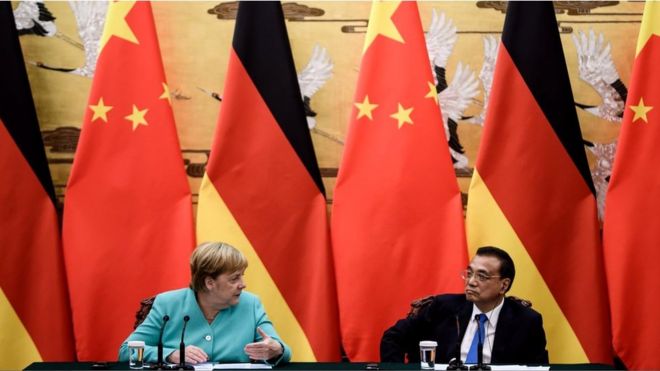
Angela Merkel and Li KeqiangImage copyright EPA
Image caption Ms Merkel calls for dialogue while Mr Li says China can handle its own matters

China’s Premier Li Keqiang has said Beijing supports the Hong Kong government “to end the violence and chaos”.

He is the most senior Chinese official to comment on the unrest which has rocked Hong Kong for months.

His comments came during a joint press conference with German Chancellor Angela Merkel in Beijing.

Hong Kong has seen months of often-violent protests calling for democracy and less influence from China.

The protests were sparked by changes to a law that would allow extradition to mainland China, but have since widened to include calls for an independent inquiry into police brutality and demands for greater democracy.

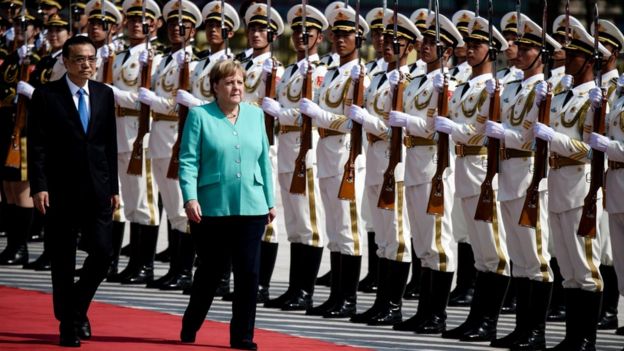
Li Keqiang and Angela MerkelImage copyright EPA
Image caption Hong Kong activists hope for Western support

On Wednesday, embattled Chief Executive Carrie Lam withdrew the controversial extradition bill but that has failed to appease the activists.

Instead, protests continued on Friday evening, when clashes erupted between police and the demonstrators outside a subway station on the Kowloon peninsula.

Riot police fired both tear gas and rubber bullets at protesters before clearing the nearby streets as the crowd of protesters was forced to retreat.

What did the Chinese premier say?

In August, China had likened to protests to terrorism, warning activists not to “underestimate the firm resolve” of the Beijing government.

Li Keqiang, China’s second highest-ranking leader, told reporters on Friday: “The Chinese government unswervingly safeguards ‘one country, two systems’ and ‘Hong Kong people govern Hong Kong people’.”

He said China backed Hong Kong “to end the violence and chaos in accordance with the law, to return to order, which is to safeguard Hong Kong’s long-term prosperity and stability”.

He said the world “needs to believe that the Chinese people have the ability and wisdom to handle their own matters well”.

Merkel calls for dialogue

German Chancellor Angela Merkel said a peaceful solution was needed for Hong Kong, urging that “in the current situation, violence must be prevented”.

Media caption How Hong Kong got trapped in a cycle of violence

She said there were signs Ms Lam would invite the necessary dialogue.

“I hope that materialises and that demonstrators have the chance to participate within the frame of citizens’ rights.”

She also stressed that the “rights and freedoms” for the people of Hong Kong “have to be granted”.

Soyrce: The BBC

07/09/2019

Germany’s Merkel presses for peaceful Hong Kong resolution

WUHAN, China (Reuters) – German Chancellor Angela Merkel renewed calls for a peaceful solution to unrest in Hong Kong on Saturday during her trip to China.

The Hong Kong protests have overshadowed a three-day visit Merkel had planned to use to press for greater access to Chinese markets for German businesses suffering a slowdown at home.

“I have advocated that conflicts be resolved without violence and that anything else would be a catastrophe from my point of view,” Merkel said.

After talks with President Xi Jinping and Premier Li Keqiang, Merkel said Beijing had listened to her views.

“This is important,” she added.

Hong Kong leader Carrie Lam announced concessions this week to try to end the protests, including formally scrapping a hugely unpopular extradition bill, but many said these were too little, too late.

Joshua Wong, a leader of pro-democracy protests in 2014 that were the precursor to the current unrest, thanked Merkel for addressing the topic with Beijing but said her comments fell short.

“Germany’s business interest should not override the universal values in which we believe,” Wong said in an interview with Germany’s mass-circulation Bild am Sonntag newspaper.

“If the Chancellor wants to do something, she must help to urge President Xi to respond to the demand for free elections.”

Source: Reuters

23/08/2019

Premier Li calls for enhancing cooperation with ROK, Japan

CHINA-BEIJING-LI KEQIANG-ROK-JAPAN-FMS-MEETING (CN)

Chinese Premier Li Keqiang meets with Foreign Minister of the Republic of Korea (ROK) Kang Kyung-wha and Japanese Foreign Minister Taro Kono, who are here to attend the ninth meeting of foreign ministers of China, Japan and the ROK, in Beijing, capital of China, Aug. 22, 2019. (Xinhua/Shen Hong)

BEIJING, Aug. 22 (Xinhua) — China attaches great importance to cooperation with the Republic of Korea (ROK) and Japan and is ready to make joint efforts to pursue a higher level of trilateral cooperation with its two neighbors, Premier Li Keqiang said Thursday.

Premier Li made the remarks when meeting with ROK Foreign Minister Kang Kyung-wha and Japanese Foreign Minister Taro Kono, who are here to attend the ninth meeting of the three countries’ foreign ministers held Wednesday.

While congratulating the successful holding of the meeting, Premier Li said that China, the ROK and Japan, being geographically close to each other and enjoying cultural affinity, have highly complementary economies and great potential for cooperation.

He said amid the increasing instability and uncertainty of the global economy and the growing downward pressure on the global economy and trade, cooperation among the three countries not only benefits their own development, but also works as a stabilizer and engine of the regional and global economy.

Li called on the three countries to safeguard the rules-based multilateral trading system with the WTO at its core, and work on reaching a comprehensive and high-level free trade agreement at an early date to promote the liberalization and facilitation of trade and investment.

The Chinese premier also called on the three countries to jointly promote technological innovation to share development opportunities and innovative achievements, work together to advance development and prosperity to push forward East Asian cooperation, and jointly maintain regional peace and stability to contribute to a political resolution to the Korean Peninsula issue, so as to achieve denuclearization and lasting peace on the peninsula.

Li also called for increased people-to-people exchanges to improve mutual understanding of the three peoples and cement foundation for trilateral cooperation.

Kang Kyung-wha commended the progress of the meeting and wished the meeting among leaders of the three countries, which is due to be held in China later this year, a success. The ROK is confident of the prospects for cooperation with China, she added.

Taro Kono said Japan is ready to closely work with China and the ROK to guarantee the success of the leaders’ meeting and his country is willing to work with China to promote a lasting, healthy and stable development of bilateral relations.

Source: Xinhua

10/07/2019

China’s producer prices stall in June, fuel deflation worries

The producer price index (PPI) showed no growth in June from a year earlier, the National Bureau of Statistics (NBS) said on Wednesday. That compared with a 0.6% rise in May and a gain of 0.3% forecast by economists in a Reuters poll.

The June PPI reading was the lowest since August 2016 when the index last fell year-on-year. Factory gate prices slowed from May as well, falling 0.3%.

On the other hand, June consumer price growth in annual terms matched a 15-month high seen in May as supply shortages triggered by the African swine fever outbreak and extreme weather conditions continued to push up pork and fruit prices.

A cooling in producer prices, seen as a gauge of industrial demand that gives momentum to investment and profits in the Chinese economy, may rekindle worries about deflation and prompt the authorities to launch more aggressive stimulus.

“The bigger picture is inflation, apart from food inflation, is actually pretty weak and with the economy continuing to cool, I think the return to factory-gate deflation is very likely,” said Julian Evans-Pritchard, senior China economist at Capital Economics.

Tommy Xie, China economist at OCBC Bank in Singapore, also said he saw the risk of produce prices contracting in annual terms as early as next month.

Upstream sectors were particularly weak, with prices for oil and natural gas extraction down 1.8% from a year earlier, the NBS data showed. Price gains in the coal mining sector also eased.

Although Beijing and Washington reached another truce in their trade war last month, economists expect continuing pressure on the Chinese economy as manufacturers shift more production abroad to avoid U.S. tariffs on China-made goods.

China’s factory activity shrank more than expected in June as tariffs and weaker domestic demand hit new orders for goods.

Beijing is fast-tracking more infrastructure projects but prices for some construction materials remain lacklustre.

Spot prices for steel rebar in June lingered below the levels of a year earlier and may worsen due to seasonal slackening of construction activity amid high temperatures and rainfall in summer.

Premier Li Keqiang pledged earlier this month to implement financing tools including reserve requirement ratio (RRR) cuts to support small and private firms, adding to expectations for further stimulus measures.

At the same time, however, he and other top policymakers have reiterated that China will not resort to large-scale stimulus.

Evans-Pritchard from Capital Economics said the government could adopt more monetary easing and off-budget fiscal support to bolster the economy.

“But I think the days of big drastic stimulus are probably over. The most we can hope for is really it (more government support) helps to dampen the headwinds and prevent the economy from slowing too sharply.”

CPI STILL ELEVATED

The consumer price index (CPI) in June rose 2.7% in annual terms, driven by higher food prices. Fruit prices surged 42.7% from a year earlier while pork prices rose 21.1%.

Analysts polled by Reuters expected consumer prices to rise 2.7%, matching the pace seen in May.

Some economists said consumer inflation may accelerate due to dwindling pig stocks, but others contended price rises will cool.

“CPI may have peaked in June and could come off steadily in the second half,” said Wang Jun, Beijing-based chief economist at Zhongyuan Bank. “There are deflationary risks but the overall pressure is not big, because deflationary risk is only restricted to manufacturing products.”

Core inflation that strips out volatile food and energy prices was at 1.6% in June from a year earlier, the same annual pace as in May.

On a month-on-month basis, CPI fell 0.1% in June after no change in May.

Source: Reuters

08/04/2019

China pledges to remove ‘unreasonable barriers and restrictions’ to help SMEs amid trade war

  • The mainland government will also seek to create a level playing field for businesses, most of which are privately-owned, in terms of market entry and regulation
  • Small and medium-sized firms are vulnerable to trade disputes and an economic slowdown even though they contribute the majority of growth and employment
China plans to make it easier and cheaper for businesses to access credit through subsidies and certain bank loans, according to a comprehensive policy guidelines jointly released by the Central Committee and the State Council on Sunday. Photo: Alamy
China will “remove all sorts of unreasonable barriers and restrictions” to help small and medium-sized enterprises which are seen as vital to help employment and economic growth amid the trade war with the United States.
Beijing plans to make it easier and cheaper for businesses to access credit through subsidies and certain bank loans, according to a comprehensive policy guidelines jointly released by the Central Committee of the Communist Party of China and the State Council on Sunday.
The mainland government will also seek to create a level playing field for businesses, most of which are privately-owned, in terms of market entry and regulation.

“Small and medium-sized enterprises is an dynamic power for national economic and social important and is critical for expanding employment, improving people’s livelihood, and to foster innovation,” the guidelines said. “For now, they are facing problems of rising production costs, difficulty in obtaining credit and insufficient capabilities to innovate – these issues demand high attention.”

China will “remove all sorts of unreasonable barriers and restrictions, trying to ensure fair competition and provide sufficient market in terms of market entry, licensing, bidding and the military-civil infusion,” it added.

While most of the policies are not completely new, the move to pull them together into a larger policy document, which will serve as a guideline for local authorities, shows China’s intention to stabilise the domestic economic situation as its trade disputes with the US continues.

Beijing has also designed a variety of financial policy tools, including targeted required reserve ratio cuts and the use of small and medium-sized enterprise loans as collateral for medium-term lending facilities granted by the central bank, meaning banks will have more incentives to offer financing.

To further boost lending, it will also offer some exemptions for interest received from value added tax, while also providing tax breaks for small firms and start-ups, a lower social security contribution ratio and an increase in government procurement, according to the guidelines.

Small and medium-sized enterprises is an dynamic power for national economic and social important and is critical for expanding employment, improving people’s livelihood, and to foster innovation.New guidelines

The need for the Chinese government to support small businesses became even more obvious last summer when it began its trade was with the US. Small private businesses are more vulnerable to trade disputes and an economic slowdown than state-owned enterprises, which are often bigger and enjoy favourable treatments from the government and banks, even though they contribute the majority of growth and employment.
Employment is the top priority on the agenda of Premier Li Keqiang this year, as shown in his government work report revealed last month. China has vowed to create 11 million new urban jobs this year and cap the surveyed urban unemployment rate at 5.5 per cent.
Morgan Stanley economists noted that China’s real gross domestic product growth may slow to 6.2 per cent in the first quarter.
“The main drag is slower investment growth, led by property construction and manufacturing [capital expenditure] amid still-subdued export and business sentiment,” Morgan Stanley economists Robin Xing, Jenny Zheng and Zhipeng Cai said.
The National Bureau of Statistics is due to release the first quarter economic data on April 17.
Source: SCMP
04/04/2019

China Focus: Premier Li’s Europe visit to inject impetus to China-EU ties

BEIJING, April 3 (Xinhua) — Chinese Premier Li Keqiang’s upcoming visit to Europe will intensify cooperation between China and European countries and provide new impetus to the China-EU comprehensive strategic partnership, a Foreign Ministry official said Wednesday.

Li’s visit, scheduled for April 8 to 12, will take him to Brussels for the 21st China-EU leaders’ meeting, and Croatia for an official visit and the eighth leaders’ meeting of China and Central and Eastern European countries (CEEC), Vice Foreign Minister Wang Chao said at a press briefing.

This is the first overseas trip to be made by Li this year as well as another significant high-level exchange between China and Europe after Chinese President Xi Jinping’s successful state visits to Italy, Monaco and France in March, demonstrating the importance that China attaches to its relations with Europe, Wang noted.

A SIGNIFICANT MEETING FOR CHINA AND EUROPE

“The China-EU leaders’ meeting, a high-level platform for strategic communication between the two sides, has played a leading role in deepening China-EU relations and promoting dialogue and cooperation,” Wang said.

He stressed that this year’s meeting, the fifth co-chaired by Premier Li, European Council President Donald Tusk and European Commission President Jean-Claude Juncker, will be the last China-EU leaders’ meeting during the tenure of the current EU institutions, thus bearing transitional significance.

China and the EU are enjoying sound development of ties, close high-level connections, deepening cooperation and robust people-to-people exchanges, he added.

“We share broad common interests in deepening win-win practical cooperation, common positions on upholding multilateralism and free trade, and common goals in improving global governance and maintaining world peace and stability.”

Leaders of the two sides will exchange views on bilateral ties and major international and regional issues of common concerns, and witness the signing of cooperation documents on energy, competition policies and other areas, Wang said.

“We believe that this meeting will inject new impetus to the China-EU comprehensive strategic partnership, take our dialogue and cooperation across the board to a new level, and strengthen the stability, reciprocity and strategic significance of our relations,” Wang said.

A BOOST FOR 16+1 COOPERATION

Wang Chao said China-CEEC cooperation (16+1 cooperation) was a beneficial mechanism of regional cooperation between China and Central and Eastern European (CEE) countries, and has provided a platform for China and CEE countries to deepen traditional friendship and enhance mutually beneficial cooperation.

Initiated in 2012, the 16+1 cooperation has gained broad support and active participation from 16 CEE countries, and has built up an all-round and multi-tiered cooperation framework, said Wang, adding that the 16+1 cooperation has played a positive role in promoting trade and expanding pragmatic cooperation across-the-board between China and other countries.

This year marks the 70th anniversary of the founding of the People’s Republic of China. Some CEE countries also established diplomatic relations with China 70 years ago.

Wang said this year’s meeting, to be held in Croatian city Dubrovnik, was of important significance to the promotion of the steady, long term development of 16+1 cooperation as well as China-Europe relations.

Noting the theme of this year’s meeting of building new bridges of openness, innovation and partnership, Wang said leaders attending the meeting would review new progress of 16+1 cooperation, have insightful discussions on key future work directions, and announce a series of new measures on pragmatic cooperation.

China hopes that the 16+1 cooperation will become a bridge of openness, innovation and partnership through enhancing exchanges and cooperation of mutual benefit and win-win results, he said.

According to the vice minister, outcome documents charting 16+1 cooperation will be released after the meeting and related parties will ink cooperation agreements on infrastructure construction, trade, finance, education, quality inspection, personnel exchanges, and mutual recognition of driving licenses.

China believes this year’s meeting will inject new impetus to relations between China and the CEE countries and the development of the China-Europe comprehensive strategic partnership, he said.

CHINESE PREMIER’S FIRST VISIT TO CROATIA

“Li’s visit will be the first ever by a Chinese premier to Croatia since the establishment of diplomatic ties. Therefore, it is significant in consolidating traditional friendship and advancing our comprehensive cooperative partnership as well as China-EU relations,” Wang Chao said.

Hailing Croatia as an important member of CEE countries and a key stop on the ancient Silk Road, Wang said relations between China and Croatia had been growing rapidly with the development of the Belt and Road Initiative and 16+1 cooperation.

In addition to close top-level exchanges, fruitful cooperation in trade, investment and infrastructure construction, and ever-deepening friendship between the two peoples, China-Croatia relations face a broad space for future development, he added.

During Li’s visit, the two sides will issue a joint statement summarizing any important consensus reached by their leaders and mapping out future cooperation. The prime ministers of the two countries will witness the signing of government cooperation documents and commercial contracts covering multiple sectors.

China hopes the visit will help synergize both countries’ development strategies, enhance mutual understanding and political trust, deepen cooperation and bring bilateral ties to a higher level, Wang said.

15/03/2019

Li Keqiang says decoupling from US ‘not realistic’, denies China would ask tech firms to spy

  • Premier refutes spying suggestion, saying it is ‘not how China behaves’ and that Beijing would never require Chinese companies to do so
  • He says ‘the whole world would like to see’ resolution to tariff war with mutually beneficial outcomes
Premier Li Keqiang admitted relations between China and the US had seen some “twists and turns”, particularly over trade. Photo: Simon Song
Premier Li Keqiang on Friday said economic decoupling from the United States was “not realistic”, while refuting claims that Beijing would ever require Chinese tech companies to spy on foreign governments or individuals.
During a news conference in Beijing at the end of the annual legislative meetings, Li admitted relations between China and the US had recently seen “twists and turns”, particularly over trade, but said he hoped ongoing negotiations to resolve the tariff war would deliver mutually beneficial outcomes.
“I believe that result is also what the whole world would like to see,” he said. “As two large economies, China and the US have become closely entwined through years of growing their relationship and years of cooperation. It is neither realistic nor possible to decouple the two economies.”
While the world’s two largest economies have held off on applying further tariffs this year, multiple rounds of discussion in Beijing and Washington have yet to yield a trade deal to resolve the dispute – one the US hopes will be address issues including its trade deficit with China, market access, industrial subsidies, intellectual property protection, forced technology transfers, and cybertheft. Chinese Vice-Premier Liu He spoke by phone with US Trade Representative Robert Lighthizer and Treasury Secretary Steven Mnuchin on Thursday and they made “concrete progress” towards a deal, according to state news agency Xinhua.
But as trade tensions have played out, Washington’s hawks have pushed for a “decoupling” between the two economies or at least a “partial decoupling” in the hi-tech sphere.
Premier Li Keqiang reassures Hong Kong over mainland China’s foreign investment law

Li on Friday also rejected the claim that Beijing had or would mandate Chinese tech companies to assist in spying on foreign governments or individuals, a key concern for countries considering using hi-tech equipment from China in sensitive sectors.

The premier initially sidestepped a question about Chinese technology spying, but later made a point to go back and “very explicitly respond” to it after taking a separate question about China’s economic reform.

“Let me tell you explicitly that this is not consistent with Chinese law. This is not how China behaves,” Li said. “We did not do that, and we will not do that in the future.”

His comments come as the US has been pushing for a ban on the use of Chinese telecoms giant Huawei’s technology in critical 5G networks over national security concerns, with US Secretary of State Mike Pompeo warning European countries in February that using the company’s equipment could hurt their ties with Washington.
In recent months, Huawei has come under growing scrutiny and pressure, with the US levelling serious fraud charges against the company and its executive Sabrina Meng Wanzhou related to alleged violations of US sanctions on Iran. Washington has ordered Meng be extradited from Canada, where she remains awaiting extradition proceedings.
Huawei pleads not guilty to US charges of bank fraud and violating Iran sanctions in case that triggered a global firestorm
Huawei’s founder and president Ren Zhengfei, who is also Meng’s father, has claimed in interviews that he would “definitely” refuse any requests by the Chinese government to hand over user data. But observers have been sceptical that the tech giant would be able to refuse these requests from Beijing, which has responded strongly to the actions taken against Huawei, including with what has been seen as the reciprocal detentions of two Canadians in China – former diplomat Michael Kovrig and businessman Michael Spavor.
Li’s annual press conference on Friday – an event where questions are carefully screened and planned in advance – comes after the conclusion of the yearly gathering for the National People’s Congress, a largely rubber-stamp legislative body. National delegates also voted to approve a new foreign investment law that touched on intellectual property and technology transfer concerns raised by the US, although foreign business bodies warned that the legislation was vague and pushed through quickly in light of the trade war.
As businesses and market watchers look to a proposed summit between Chinese President Xi Jinping and his US counterpart Donald Trump at the Mar-a-Lago estate in Florida to clinch a trade deal, Li stressed that China was seeking cooperation rather than confrontation.
“We need to continue to follow the principles of cooperation before confrontation, mutual respect, equality, and mutual benefit to continue to grow the China-US relationship, including their economic and trade ties,” Li said. “As for their differences and disagreements, we have confidence that people of the two countries have the wisdom and the capability to defuse their differences and manage them properly to pursue steady and sound growth of the US-China relationship.”
Source: SCMP
Law of Unintended Consequences

continuously updated blog about China & India

ChiaHou's Book Reviews

continuously updated blog about China & India

What's wrong with the world; and its economy

continuously updated blog about China & India