Archive for ‘President Xi Jinping’

21/02/2019

Xi meets Chang’e-4 mission representatives

CHINA-BEIJING-XI JINPING-CHANG'E-4 MISSION-REPRESENTATIVES-MEETING (CN)

Chinese President Xi Jinping, also general secretary of the Communist Party of China Central Committee and chairman of the Central Military Commission, delivers a speech as he meets representatives of space scientists and engineers who participated in the research and development of the Chang’e-4 mission at the Great Hall of the People in Beijing, capital of China, Feb. 20, 2019. (Xinhua/Ju Peng)

BEIJING, Feb. 20 (Xinhua) — Chinese President Xi Jinping met representatives of space scientists and engineers who participated in the research and development of the Chang’e-4 mission at the Great Hall of the People in Beijing Wednesday afternoon.

Xi, also general secretary of the Communist Party of China (CPC) Central Committee and chairman of the Central Military Commission, noted that there is no end for space exploration.

Xi called on science and technology workers and space engineers in China to ride on the wave of the Chang’e-4 mission to achieve the general goal of China’s lunar project, make more efforts to push forward the international aerospace cause and bring more Chinese wisdom, solutions and force to the peaceful use of space and the building of a community with a shared future for humanity.

Members of the Standing Committee of the Political Bureau of the CPC Central Committee Li Keqiang, Li Zhanshu, Wang Yang, Wang Huning, Zhao Leji and Han Zheng also attended the meeting.

Xi shook hands with the scientists and engineers, inquired about their work and life and took pictures with them.

In a speech addressing the meeting, Xi first extended his sincere regards to all those who have made historic contributions to the country’s space undertakings and expressed warm congratulations to all those who have contributed to the Chang’e-4 mission eminently.

“Your outstanding feats achieved in mounting the science and technology peak and exploring the universe’s mysteries have set a model for the whole Party, the whole armed forces and people of all ethnic groups in China to strive for a new era and start a new journey, for which our country and people thank you,” Xi said.

“Five years ago, we celebrated the success of the Chang’e-3 mission. Five years later, we are here to celebrate the success of the Chang’e-4 mission,” he said.

He pointed out that the Chang’e-4 mission, by adhering to independent, collaborative and open innovations, has realized the first-ever patrol and exploration on the far side of the moon by a human spacecraft and engraved Chinese “footprints” there for the first time.

“It is another vivid practice of exploring to establish a new institution that can pool the resources of the whole country,” Xi said.

“Experience tells us that great undertakings begin with dreams, and dreams are the source of vitality. China is a nation that pursues dreams bravely. The CPC Central Committee’s decision to implement the lunar exploration project is to pursue the nation’s unyielding dream of flying into the sky and reaching for the moon,” he noted.

Each bold idea and its successful implementation in lunar exploration is a full demonstration of the human capacity to gain knowledge of and utilize a celestial body, he said.

“In the journey of building a great modern socialist country and realizing the great rejuvenation of the Chinese nation, every industry and every person should dream and strive courageously and fulfill their dreams with arduous and continuous efforts, step by step and baton by baton just like in a relay race,” he emphasized.

“Experience tells us that great undertakings are based on innovation, and innovation determines the future. It won’t be a smooth path to build a leading nation in science and technology, and only innovation can help gain advantages,” he said.

“The mission has made multiple innovations come true and filled a series of international and domestic gaps, which has fully displayed the innovative spirit just as making the first move in chess or taking the initiative in battle,” he added.

China should have a grasp of the general trend of the science and technology development in the world, foster respect for science and focus on strategic, basic and pioneering sectors, said Xi.

China should shore up its weakness in certain areas, keep pace with the leaders in some areas, and strive to lead in other areas, aim for significant breakthroughs in core and key technologies, improve the overall efficiency of the national innovation system, boost science and technology strength and innovation ability, in a bid to earn itself a spot in the global hi-tech sector, he said.

“Experience tells us that great undertakings succeed in solid work,” Xi noted. He said China need to encourage more prominent scientists, leading talent, young scientists and innovation teams to lead the trend and work hard to realize the value of life by contributing to the nation’s great undertakings.

Xi pointed out that exploring the vast universe is a common dream of all humankind. China has been actively advancing international space cooperation and carried out productive cooperation with multiple countries and international organizations. The complete success of the Chang’e-4 mission, for instance, includes contributions of many countries.

China is willing to work with countries around the world and follow the principle of achieving shared growth through discussion and collaboration, so as to deepen the international exchanges on basic scientific research, boost big science projects and step up opening-up and cooperation to enhance innovation ability and push forward the development of science.

The Chang’e-4 mission had two launches. The relay satellite, named Queqiao, meaning Magpie Bridge, was launched on May 21, 2018. The Chang’e-4 probe, launched from the Xichang Satellite Launch Center in southwest China on Dec. 8, 2018, touched down on the far side of the moon on Jan. 3.

Scientific research involving multiple countries and international organizations has been carried out.

The complete success of Chang’e-4 mission marks the first-ever international organizations, patrol and exploration on the far side of the moon by a spacecraft, the first communication link between Earth and the far side of the moon and the first footprints there in the history of lunar exploration, which unveils its mysteries and opens a new chapter in mankind’s exploration of the universe.

Source: Xinhua

20/02/2019

China to deepen reforms of agriculture sector to boost rural areas

  • Policy statement outlines broad goals including plan to revive domestic soybean production
A farmer picks tea leaves in Mianxian county, Shaanxi province. Beijing’s policy document reiterated a strategy to improve income levels and living standards in China’s countryside. Photo: Xinhua
China will deepen reforms of its agriculture sector to promote its rural economy, the government said in its first policy statement of 2019, as it seeks to bolster growth and offset trade challenges.

Beijing’s statement, released late on Tuesday, comes after the world’s second-largest economy saw its weakest growth in 28 years in 2018 and remains entangled in a trade war with Washington.

“Under the complicated situation of increasing downward pressure on the economy and profound changes in the external environment, it is of special importance to do a good job in agriculture and rural areas,” the government said in the document issued by the State Council and published by official news agency Xinhua.

The biggest winners in Shenzhen, ‘China’s Silicon Valley’? Pig and chicken farmers

Known as the “No 1 document”, this year’s policy reiterated a rural rejuvenation strategy first laid out in 2017 to improve income levels and living standards in China’s countryside.

It also highlighted a plan to boost domestic soybean production but did not offer further details.

Chinese President Xi Jinping visits a farm in northeastern Heilongjiang province during an inspection tour in September. Photo: Xinhua via AP

Industry analysts said on Wednesday they were eagerly awaiting further details to assess the impact of the plan, which had already been flagged by Agriculture Minister Han Changfu earlier this month.

China has been overhauling its crop structure in recent years, reducing support for corn after stocks ballooned, and seeking to promote more planting of oilseeds that it mostly imports.

That goal has become increasingly important since a trade war with the United States, which led China to slap tariffs on soybean imports, tightening domestic supplies.

Han has previously urged authorities in China’s northeast to support soybean production through subsidies and called for rotating of soybeans with other crops including corn and wheat.

Beijing also aims to support the production of rapeseed in the Yangtze River Basin, according to the document.

The garlic case that foreshadowed the US-China trade war

As in previous years, it also called for stable grain production, but also an increase in imports of agriculture products where there are shortages in the domestic market.

“The focus now is on retaining production capacity, in the form of high quality farmland, and using the international market to make up production shortfalls,” said Even Rogers Pay, an agriculture analyst at China Policy, a Beijing-based consultancy.

The reference to imports is positive for trade partners like the United States, said Cherry Zhang, analyst with Shanghai JC Intelligence, who said it raised the likelihood that China will buy more US agriculture products.

China’s DJI turns its eye to enterprise uses like agriculture after conquering global commercial drone market

Shares of Chinese livestock companies, along with pig and poultry breeders, rose on Wednesday following the release of the policy paper.

The document also outlines plans to accelerate development of a new farm subsidy policy system and further crack down on the smuggling of agriculture products.

Additionally, the government said it plans to strengthen the monitoring and control of African swine fever outbreaks, after more than 100 cases were reported in China since August.

Other plans include continuing to tackle rural pollution and promoting recycling of agricultural waste such as manure and agricultural film.

Source: SCMP

19/02/2019

China’s top legislator vows to enhance exchanges with National Diet of Japan

Li Zhanshu (R), chairman of the National People’s Congress (NPC) Standing Committee, shakes hands with Ninoyu Satoshi, a member of Japan’s House of Councillors who heads a delegation consisting of several members of Japan’s House of Councillors, at the Great Hall of the People in Beijing, capital of China, Feb. 18, 2019. The delegation was in Beijng to attend the eighth meeting of the mechanism for regular exchanges between China’s top legislature and the upper house of the National Diet of Japan. (Xinhua/Li Tao)

BEIJING, Feb. 18 (Xinhua) — China’s top legislator Li Zhanshu on Monday met with a delegation consisting of several members of Japan’s House of Councillors, pledging to enhance the exchanges and cooperation with the National Diet of Japan, so as to promote Sino-Japanese relationship.

Li, chairman of the National People’s Congress Standing Committee, said there are important opportunities facing the two countries this year for further improvement and development of bilateral ties, as China-Japan relations were led back to the right track of development after Chinese President Xi Jinping and Japanese Prime Minister Shinzo Abe met three times last year and reached important consensus.

“The two sides should implement the consensus of the leaders of the two countries, enhance mutual trust over strategic security, expand pragmatic cooperation in such areas as the economy, culture and exchanges between the young people,” said Li.

Ninoyu Satoshi, head of the delegation and a member of Japan’s House of Councillors, said the National Diet of Japan would like to reinforce contacts and mutual understanding with the National People’s Congress of China and make more contributions to the two countries’ neighborly friendliness.

The delegation was in Beijing to attend the eighth meeting of the mechanism for regular exchanges between China’s top legislature and the upper house of the National Diet of Japan.

Source: Xinhua

17/02/2019

Li Rui: The old guard Communist who was able to criticise Xi Jinping

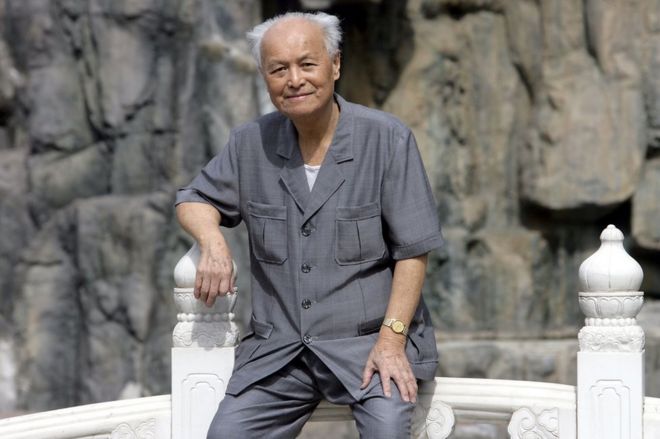
Li RuiImage copyrightAFP
Image captionLi Rui remained an activist and idealist until his death

“We are not allowed to talk about past mistakes.”

Li Rui said this in 2013, while reflecting on the similarities between China’s then-new leader Xi Jinping and the founding father of Communist China, Mao Zedong.

Mr Xi, he warned, was echoing Mao’s suppression of individual thought, and was trying to build a similar cult of personality – both things he had experienced at first hand.

Li Rui joined the Communist Party in 1937, at the start of the brutal Sino-Japanese war, and 12 years before the party won the civil war that established the People’s Republic. He was hand-picked by Mao to become his personal secretary in 1958.

But he was also imprisoned soon afterwards for criticising Mao’s Great Leap Forward, the failed modernisation programme now thought to have killed between 30 and 60 million people through torture and starvation.

Despite this turbulent history with the party, the fact that Mr Li was one of the original revolutionaries meant that he occupied a special place in contemporary China – one that allowed him a degree of freedom to talk about the ruling party’s many issues, and how he felt things should be done differently.

People may not be allowed to talk about past mistakes, but Mr Li did it anyway – and his work has helped historians understand the truth and scale of Mao’s atrocities.

Li Rui died in Beiijng on Saturday, aged 101.

An underground revolutionary

As a university student, Mr Li joined a group of idealistic Communist activists protesting against Japanese occupation. Shortly afterwards, at the age of 20, he officially joined the party. He was tortured for his communist activism.

But things changed when the party came into power in 1949, and by 1958 Mr Li had become the youngest vice minister in China.

It was also that year that he had a meeting with Mao that would change the course of his life. Mao, having seen Mr Li argue passionately against building the Three Gorges Dam on the Yangtze River, chose him to be his personal secretary.

Their relationship didn’t last long.

‘Mao put no value on human life’

In 1959, Mr Li openly criticised Mao’s Great Leap Forward – a policy that was supposed to boost China’s economic output, but instead unleashed widespread famine across the country.

For this transgression Mr Li was expelled from the Communist Party, and he was imprisoned for eight years in Qincheng, maximum security prison built for the detention of disgraced senior party officials.

“Mao’s way of thinking and governing was terrifying,” he would tell the Guardian newspaper many years later. “He put no value on human life. The deaths of others meant nothing to him.”

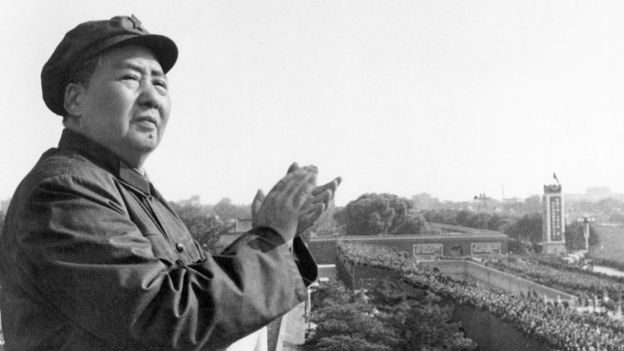
Mao ZedongImage copyrightGETTY IMAGES
Image captionLi Rui said Mao Zedong, pictured, “put no value on human life”

Following Mao’s death, the more pragmatic Deng Xiaoping came to power in 1978 and Mr Li was rehabilitated and allowed back into the party. He then became a strong advocate for political reform, and in his later years, threw himself into calling for China to move further towards a European socialist-style system.

He wrote five books on Mao, all of which were published overseas and banned in mainland China. His last book, published in 2013, called for the current “one-party, one-leader and one-ideology regime” to be overhauled. His daughter, Li Nanyang, has spoken of having her copies of his memoir confiscated at Beijing’s airport.

Aside from writing books, he worked right into his 90s as a patron of the reformist magazine Yanhuang Chunqiu – roughly translated as “China through the ages”.

Presentational grey line

Read more on other notable lives

Presentational grey line

The magazine was taken over in 2016. Its editor Wu Si was forced out, and its former staff released a statement warning that “anybody who publishes any periodicals with the title of Yanhuang Chunqiu will be nothing to do with [them]”.

Professor Steve Tsang, director of SOAS’s China Institute, tells BBC News that this affected Li Rui deeply.

“The single most important thing that Li Rui had, was the patronage that he gave to the magazine Yanhuang Chunqiu,” Professor Tsang says. “It does still exist, but it’s been completely changed it terms of management and focus. It’s practically a different magazine.”

The last idealist

But even though his writing was censored, Mr Li was not a dissident – he remained a party member until his death. And the fact that he was left to compose his memoirs from a prestigious apartment block in Beijing shows how, despite his outspoken criticism of the current leadership, he continued to be revered for his role as one of the country’s original revolutionaries.

But with Mr Li dies the idealism of the activist who joined his party eight decades ago, and spent the years since vigorously rebelling against leaders who abused their power.

“He was among the last of that generation of idealists who joined the Communist Party at the beginning, and who tried to hold the Communist Party to the rhetoric [they heard] when they were being recruited,” Prof Tsang says.

“There is probably nobody else who will hold the party now to what the party had originally said it was meant to do.”

Source: The BBC

17/02/2019

Saudi crown prince heads for Pakistan amid India tensions

ISLAMABAD (Reuters) – Saudi Arabia’s Crown Prince Mohammed bin Salman is due to arrive in Pakistan on Sunday at the start of his tour of South Asia and China, but the visit risks being overshadowed by escalating tensions between nuclear-armed rivals India and Pakistan.

The trip comes days after a suicide bomber killed 44 Indian paramilitary police in the disputed Kashmir region. New Delhi has accused Pakistan of having a hand in the bombing and vowed to punish Islamabad, which denies involvement.

Prince Mohammed had also planned to visit Indonesia and Malaysia during the Asian tour, but those trips have been postponed, according to Malaysian and Indonesian officials. No reasons for the postponements or alternative tour dates were given.

Cash-strapped and in need of friends, Pakistan is welcoming the crown prince with open arms for a visit during which he is expected to sign investment agreements worth more than $10 billion.

Saudi Arabia has in recent months helped keep Pakistan’s economy afloat by propping up its rapidly dwindling foreign exchange reserves with a $6 billion loan, giving Islamabad breathing room as it negotiates a bailout with the International Monetary Fund.

The visit marks a deepening in ties between allies whose relationship has in the past centred on oil-rich Saudi Arabia backing Pakistan’s economy during difficult periods, and in return Pakistan’s powerful army lending support to Saudi Arabia and its royal family.
As the guardians of most holy sites in the birthplace of Islam, the Saudi royal family carries vast religious clout in Pakistan, a staunchly conservative and mainly-Muslim nation of 208 million people.
“What is happening in this relationship is a renewal of Pakistan’s commitment to help protect the royal family and the order as it exists in Saudi Arabia,” said Mosharraf Zaidi, Senior Fellow at Tabadlab, a Pakistani think tank focussed on global and local public policy.
“On the flip side, there is reassurance that Saudi Arabia will not only continue to serve as a strategic friend who will help shore up Pakistan’s finances when needed, but it’s also going to become a participant in the wider investment in Pakistan.”
Pakistan is shutting down its airspace and has stepped up security in Islamabad for the crown prince, who is set to become the first guest to stay at the Prime Minister’s House. Pakistan’s new populist premier, Imran Khan, has refused to use the residence in a bid to save taxpayers’ money.
Pakistani hopes for further investment opportunities from Saudi Arabia were dealt a blow on Saturday when the government announced that the Pak-Saudi Business Conference had been “postponed”.
Pakistani officials have already flagged up that Saudi Arabia will announce eight investment agreements, including a $10 billion refinery and petrochemicals complex in the coastal city of Gwadar, where China is building a port.
But the crown prince’s arrival comes amid a vow by India to isolate Pakistan internationally following the deadliest attack in Kashmir in decades.
New Delhi is demanding Islamabad act against the Jaish-e-Mohammad (JeM) militant group, which it says has the backing of the Pakistani state, over the bombing. Islamabad denies playing a role and has called for an investigation.
In Islamabad, the crown prince is expected to meet Khan and Pakistan’s army chief, Qamar Javed Bajwa.
44 killed in worst Kashmir attack in decades
He is also set to meet representatives of the Afghan Taliban militant group to discuss peace negotiations to end the 17-year civil war in Afghanistan, Pakistani government and Taliban sources say.
“We arrived in Islamabad today Sunday and others are on their way,” one senior Afghan Taliban figure told Reuters. “As per the plan we know so far, we are going to meet Mohammed bin Salman and his delegation members today at night and then on Monday.”
Source: reuters
Law of Unintended Consequences

continuously updated blog about China & India

ChiaHou's Book Reviews

continuously updated blog about China & India

What's wrong with the world; and its economy

continuously updated blog about China & India