09/07/2019
- Ambassador to China Vikram Misri says they will be ‘meeting more and more in common waters’, and more exchanges are needed
- He also says preparations are under way for President Xi Jinping to visit India
The INS Kolkata arrives in Qingdao for PLA Navy 70th anniversary celebrations in April.
The Indian ambassador called for more communication between the two navies. Photo: Reuters
The Chinese and Indian navies should establish communication because they are increasingly operating within close proximity, according to India’s ambassador to China.
While the two nations’ militaries communicated extensively, it was mainly between their land forces, and that should be extended to the navies and air forces, Vikram Misri said.
“We need to talk about the two air forces and the two navies – especially the two navies – because we are operating in the same waters and increasingly in the coming years, we will be meeting more and more in common waters,” Misri said.
“I think it is important for us to develop those levels of understanding and communication,” he said. “There are some [navy and air force] exchanges now, but not as well developed as in the case of the land force.”
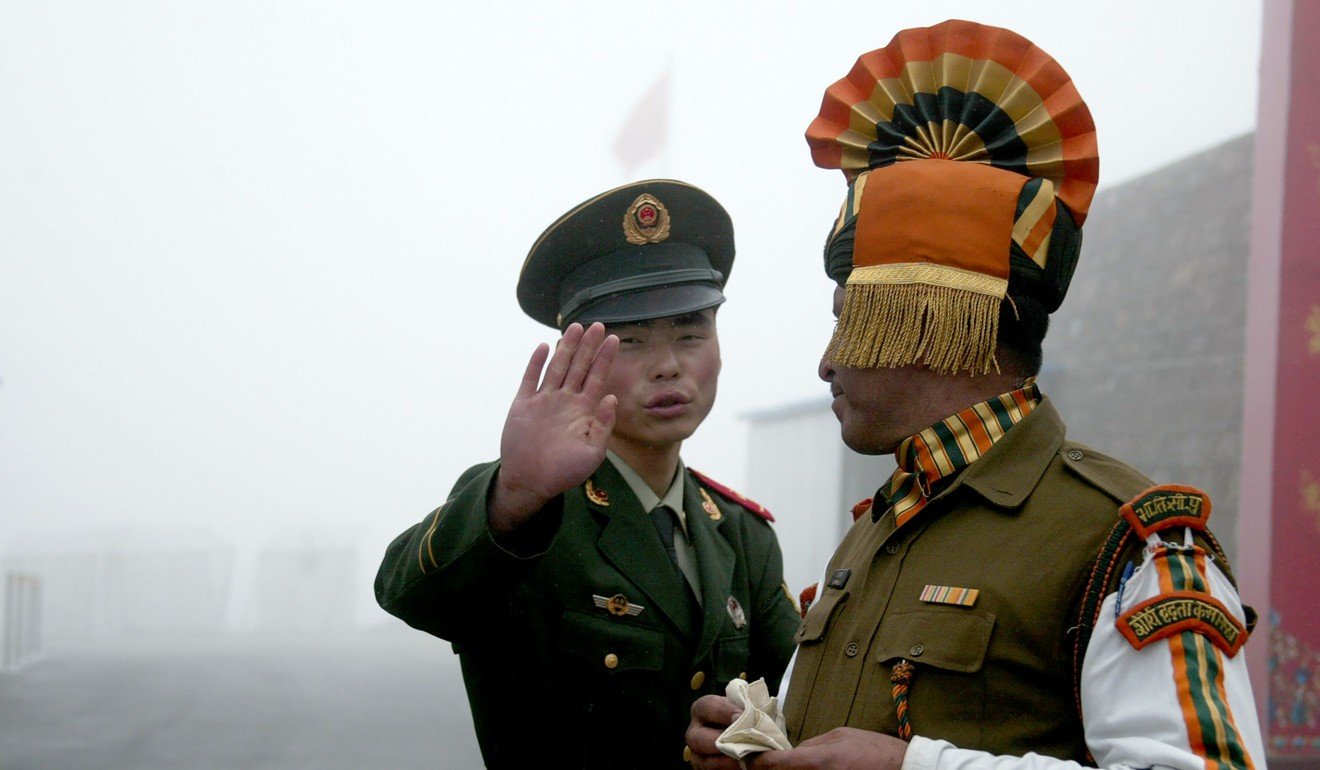
China and India have made efforts to repair their relations since a tense stand-off at the Doklam plateau two years ago, when communications between their forces along the border were seen as inadequate to contain the tension.
China and India have sought to repair relations after a tense stand-off at Doklam. Photo: AFP
Misri said the two nations had made incremental progress, and opened new points where “border personnel can meet and exchange information, or exchange views about any particular situation”.
The ambassador was visiting the Indian consulate in Hong Kong over the weekend, six months after taking up the post and six weeks after Prime Minister Narendra Modi was re-elected.
He said preparations were under way for Chinese President Xi Jinping to visit India, which was expected to happen in the fourth quarter, after they pledged earlier to strengthen cooperation.
Tensions between
have periodically flared along their 4,000km (2,485-mile) border, resulting in a brief war in 1962. Relations have also been strained by China’s ties with Pakistan, and India’s concern over China’s growing presence in the Indian Ocean.
India has also not signed on to China’s global trade and infrastructure strategy, the
, which has projects that run through the disputed Kashmir region.
“Our concerns with regards to this particular initiative are very clear, and we have continued to share them very, very frankly with our Chinese partners,” Misri said. “I think there is understanding on the part of our Chinese partners with regard to this.”
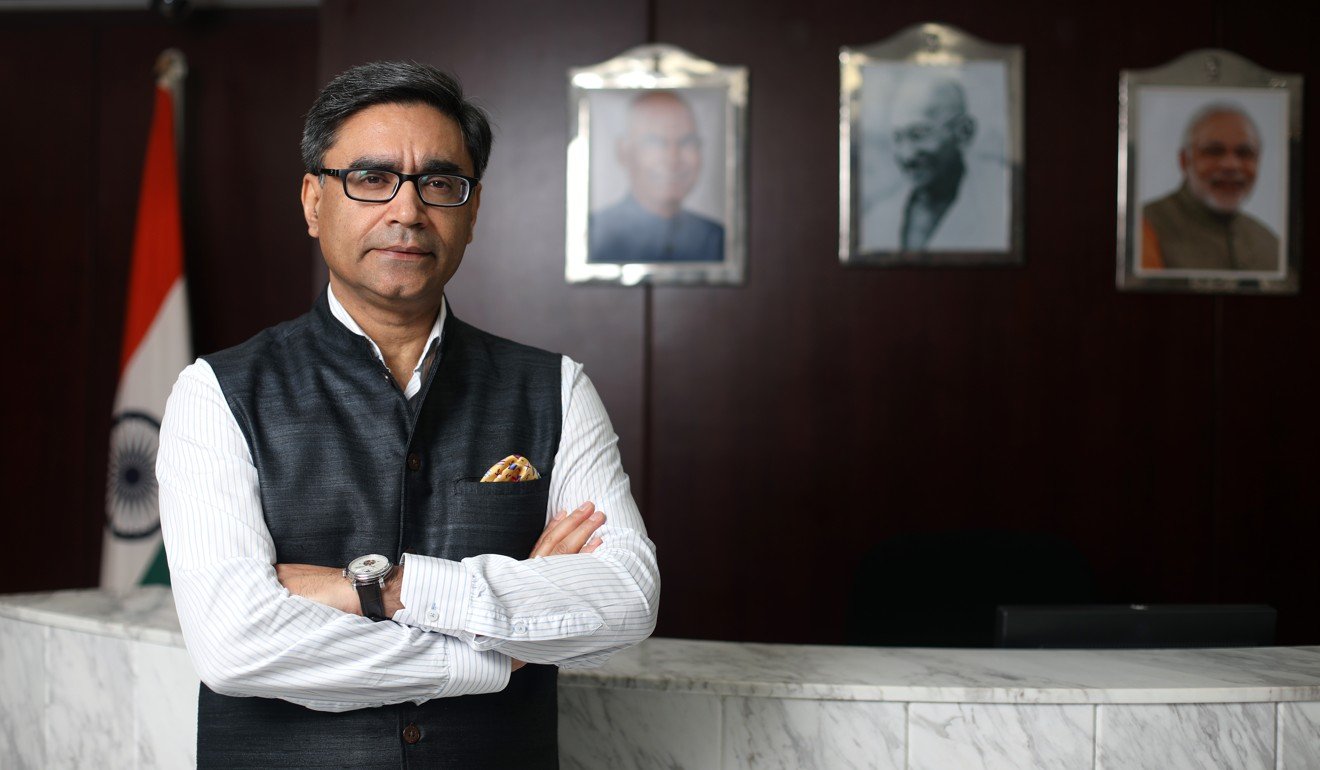
Indian ambassador to China Vikram Misri said New Delhi’s concerns on the Belt and Road Initiative were clear. Photo: Xiaomei Chen
But he said the two nations should not let their differences evolve into disputes, and they should focus on areas where they can cooperate.
One such area was maritime and investment cooperation in the Indo-Pacific region, including infrastructure and disaster response. The US in recent years has focused on the Indo-Pacific region, and has asked its allies to send naval vessels to the area as a counterbalance to Beijing.
“We have made the point that our vision of the Indo-Pacific is not a strategy, which sometimes is a concern on the part of some partners, aimed against any particular country,” Misri said. “It is definitely not a military alliance in any format.
“It is on the other hand a vision that aims at economic and development cooperation with our partners in the Indo-Pacific space,” he said, adding that India was discussing such cooperation with China.
He also said trilateral meetings between China, India and Russia would become more regular after their three leaders met on the sidelines of the
summit in Osaka, Japan last month, when they vowed to uphold multilateralism.
Those meetings would allow the nations to address challenges facing the international trading system and pushback against globalisation, but Misri said they should not be seen as a bid to counter the US, which is also involved in a trade battle with India.
India also had a trilateral meeting with Japan and the United States during the G20 summit.
“The fact that these countries seek us out also shows that they see value in engaging with India, and we have important issues to discuss in each of these settings,” he said. “None of our individual relationships is going to come at the cost of a relationship with any other partner.”
The ambassador said there could be a broader consensus on counterterrorism. Photo: AP
Misri also said there could be a broader consensus between China and India on counterterrorism. The two nations have clashed over Indian efforts to blacklist Masood Azhar, leader of the Pakistan-based terror group Jaish-e-Mohammed (JeM), at the United Nations, which China objected to for years – a move seen in India as being done at the behest of Islamabad.
Azhar was finally listed as a global terrorist by the UN in May, after JeM claimed responsibility for a deadly terror attack on Indian security forces in Pulwama in February, although the listing did not directly reference the attack.
“It could have happened earlier … but I’m glad that it did happen, and we hope to build on that – that should be taken as progress, and we hope to build on that in the coming years,” Misri said.
“Everybody is aware of the context in which the listing happened, and therefore, I don’t think it’s hidden from anybody as to what this was aimed at or who this was aimed at, or what the motivation for the action might have been.”
As for the tensions between India and Pakistan following the terror strike in Indian-controlled Kashmir, Misri said progress would be “largely dependent on Pakistan” and the actions it needed to take to address the “ecosystem of terror that prevails in different parts of that country”.
Source: SCMP
Posted in 70th anniversary, Ambassador Vikram Misri, Belt and Road Initiative (BRI), celebrations, Chinese navy, Chinese President Xi Jinping, communicate, counterterrorism, Doklam plateau, ecosystem of terror, Group of 20 (G20), Hong Kong, Indian ambassador to China, Indian consulate, indian navy, Indian-controlled Kashmir, INS Kolkata, Jaish-e-Mohammed (JeM), Japan, Masood Azhar, Osaka, pla navy, President Xi Jinping, Prime Minister Narendra Modi, Qingdao, Russia, Uncategorized, US, We need to talk |
Leave a Comment »
06/07/2019
- President Xi Jinping has made no secret of his desire for China to one day host and maybe even win football’s greatest prize
- But a few passport-switching foreigners are unlikely to be enough to make his dreams come true
China’s soccer team has high hopes, but it still has a long way to go before it can even dream of competing on the world stage. Photo: Reuters
As China targets a place at the 2022 World Cup, England-born
recently became the first foreign player to join the men’s national soccer team as a naturalised citizen.
On his identity card he is listed as ethnic Han.
Several foreign soccer players and other sportspeople have become Chinese citizens in recent years, many of them drawn by the huge financial rewards on offer.
Naturalisation has a long history in many countries, but it is a new concept in China, whose football association only publicly announced it would use it to boost its talent pool late last year. President Xi Jinping’s passion for the game and ambitions for China to host and maybe one day win the World Cup has been public knowledge since before he became leader.
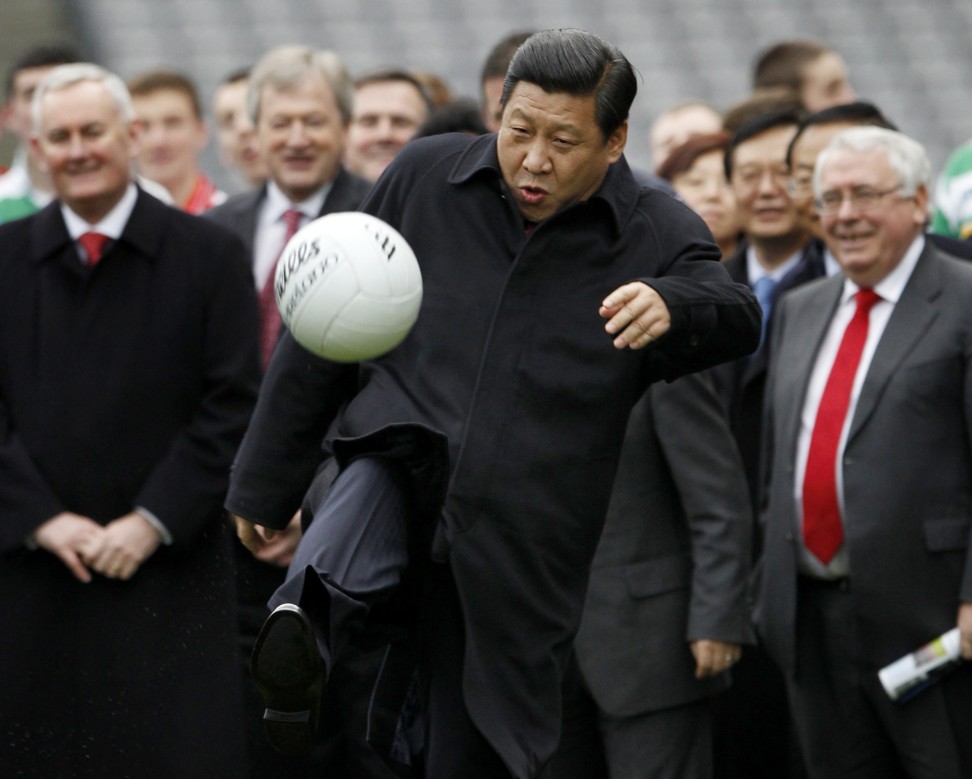
Chinese President Xi Jinping, pictured on a 2012 visit to Croke Park in Dublin while still vice-president, has big dreams for China’s soccer team. Photo: Reuters
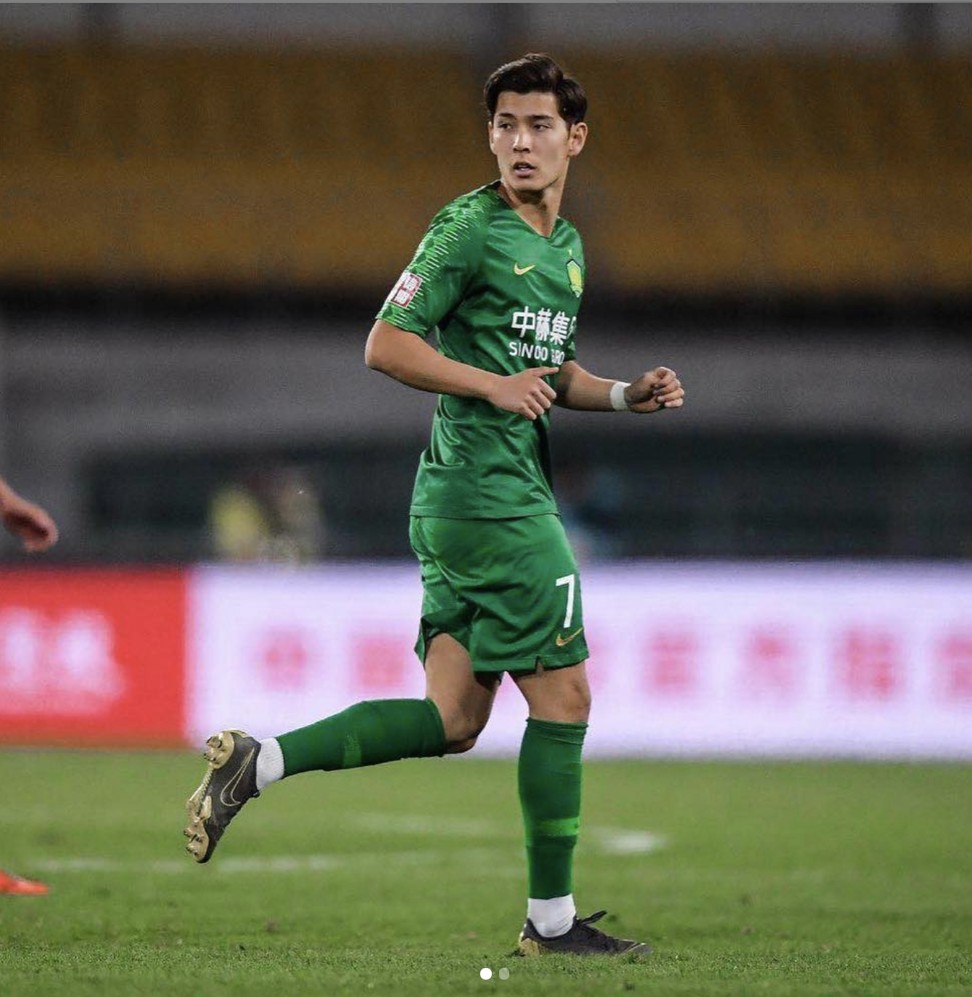
John Hou Saeter, who was born to a Norwegian father and Chinese mother, in February became the first professional footballer to switch to Chinese citizenship. The 21-year-old, now known as Hou Yongyong, plays for Beijing Sinobo Guoan, one of the top teams in the Chinese Super League.
Another English player, Tyias Browning, recently joined Guangzhou Evergrande Taobao and is set to complete the process of applying for Chinese citizenship soon, Reuters reported last month.
Yennaris’ naturalisation may help bring China into 21st century
At a work conference in December, Du Zhaocai, the Communist Party secretary of the
(CFA), promised to introduce new policies on naturalisation to help clubs attract players from overseas to join the Super League.
Professor Chen Xiyao from Shanghai University of Sport said such a move would have been unthinkable in the past.
“This is something new in China,” he said. “In the past we only saw our own athletes becoming naturalised citizens of other countries, but not foreign players coming to play for us.”
While the trend was undoubtedly prompted by Xi’s ambitions, Chen said it was also linked to the country’s growing economic prowess and wealth.
“China’s economic growth means it has become better known internationally. Everybody thinks China has money and sports clubs are spending huge sums to attract top players,” he said.
Former Everton player Tyias Browning now plays for Guangzhou Evergrande Taobao. Photo: Reuters
Mark Dreyer, founder of the China Sports Insider website, said naturalised players were motivated not only by money, but also the chance to increase their exposure and possibly play in a major tournament, which they would otherwise not get the chance to do.
“The rewards for the players are fairly clear: more money, more exposure and a shot at playing in the biggest tournaments in the world with China, which they wouldn’t have got if they’d stayed with their original countries,” he said.
“For athletes of Chinese descent, there will also be varying degrees of patriotism built into this as well.”
It is not just soccer players who are making the move top China. It is also happening in other sports, like ice hockey and figure skating.
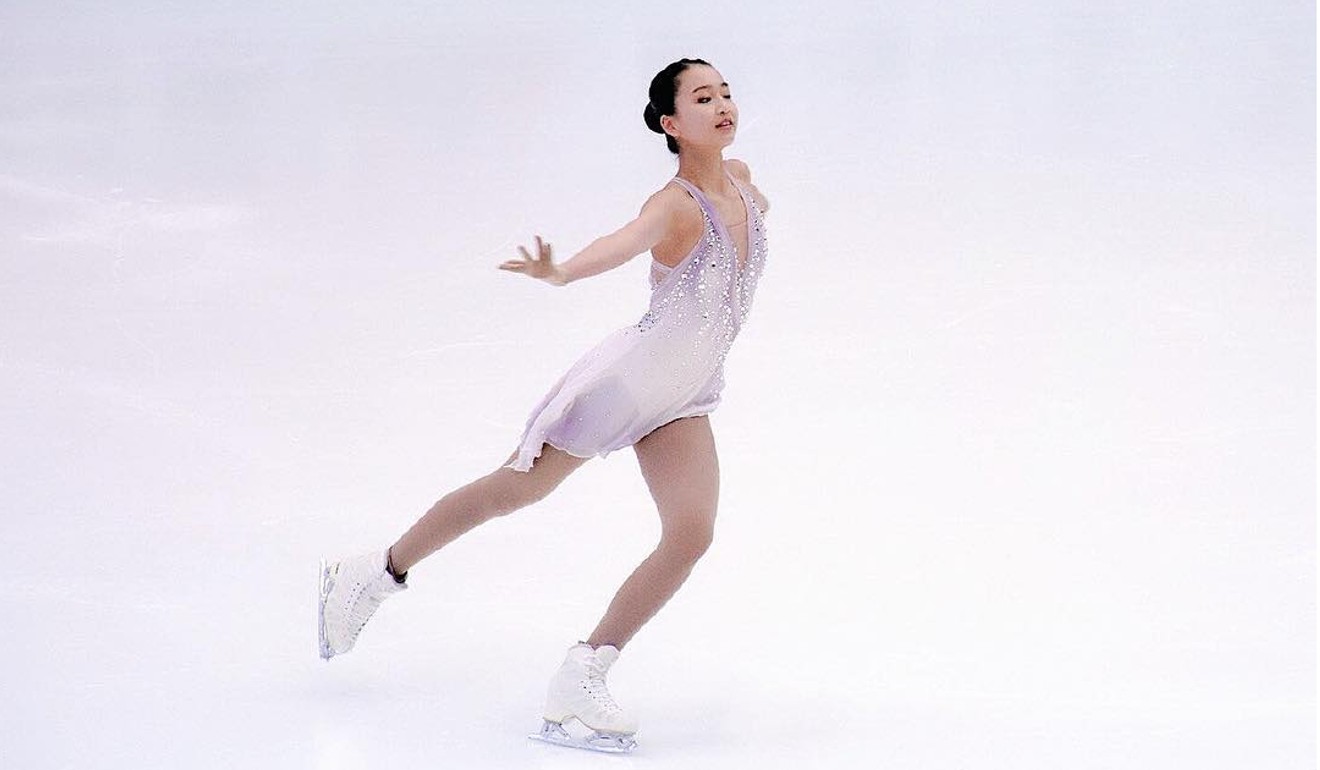
US-born Beverly Zhu, who won the 2018 US Figure Skating Championships, triggered a heated discussion in China after she joined the Chinese team last year, which means she can compete for the host nation at the Beijing 2022 Winter Olympics.
In ice hockey, a number of overseas players have also been naturalised, including Zach Yuen from Canada, who may also represent China in Beijing in 2022.
Beverly Zhu, who won the 2018 US Figure Skating Championships, joined the Chinese team last year. Photo: Instagram
Roy Chu, a lawyer with Links Law Offices in Shanghai who specialises in the sports industry, said that as China does not recognise dual nationality, foreigners have to give up their citizenship if they want to get a Chinese passport and apply for naturalisation.
“Therefore, the players to be naturalised have to be willing to represent China on the one hand, and on the other have a Chinese family background so as to simplify the legal procedures,” Chu said.
Browning’ grandfather and Yennaris’s mother are Chinese.
Dreyer said: “The players who choose to swap clearly think that the rewards outweigh the negatives of trading in their passport for a Chinese one.”
Under Chinese law, only foreigners with Chinese ancestry or those who have lived in China for at least five years can apply for Chinese citizenship. All but one of the sportsmen and women who have so far made the switch have Chinese ancestry.
The exception is Pedro Delgado, who was born and raised in Portugal but now plays for Shandong Luneng. He gained his Chinese citizenship last month and, according to the club, is the first foreign player without Chinese ancestry to become naturalised.
John Hou Saeter, who was born to a Norwegian father and Chinese mother, in February became the first professional footballer to switch to Chinese citizenship. Photo: Instagram
The naturalisation process is the same for sportspeople as it is for anyone else.
“The list of paperwork required by the Ministry of Public Security is quite short, but it doesn’t specify how long it takes to finish each step. So in that sense there is quite a lot of uncertainty,” Chu said.
“Those with Chinese ancestry will become the top targets for naturalisation in the short term so clubs can improve their talent pool, while those without may need more policy support,” he said.
London-born Nico Yennaris recently became the first foreign player to join China’s national soccer team as a naturalised citizen. Photo: AFP
Naturalised players also faced many challenges in China, especially if they did not speak the language or knew little about the culture, he said.
“Aside from settling into a completely different environment, they may also face resentment from their teammates, especially if those players lose their places in the team to the new arrivals,” Dreyer said.
“If the national team has several naturalised players, cliques could develop. We saw this in the US football team, when several German-born Americans were drafted in to play for the national team, causing internal rifts.”
And if the “foreign” players did not perform to the highest standards, the fans might also turn on them, he said.
Xi Jinping has made no secret of his desire to improve China’s and supports events at the school level. Photo: EPA
Under a
issued in March, footballers who become Chinese citizens must be also be educated to be patriotic and learn about the Communist Party. Clubs must also issue monthly reports on how the new players are settling in.
Grass-roots organisations within the Communist Party of China would be “in charge of educating such footballers on the history and basic theory of the party”, it said.
Dreyer said that while the naturalisation process might help China’s ice hockey team to perform slightly better at the 2022 Olympics than it had in the past, it was unlikely to have much of an impact on China’s international soccer ranking. China’s national team has only once qualified for the World Cup, in 2002.
“There is a reason they [naturalised players] didn’t play internationally for their original countries – they weren’t considered good enough,” he said.
“So they are not suddenly going to turn into world-beaters simply by pulling on a Chinese jersey.”
Chen agreed.
“I think it is just a short-term measure that will not truly change China’s overall performance in football or other sports,” he said. “After all, it’s an 11-person team game.”
Source: SCMP
Posted in 2018 US Figure Skating Championships, Beijing Sinobo Guoan, canada, China Sports Insider, Chinese Football Association (CFA), Chinese mother, Chinese Super League, Communist Party of China, Croke Park, Dublin, ethnic Han, figure skating, Guangzhou Evergrande Taobao, ice hockey, Links Law Offices, naturalised players, Norwegian, President Xi Jinping, Shandong Luneng, Shanghai, Shanghai University of Sport, soccer World Cup, Uncategorized |
Leave a Comment »
05/07/2019
- The city’s ambitious waste and recycling rules took effect on Monday, aiming to emulate successes of comparable policies in Japan, Taiwan and California
- President Xi Jinping has urged China – the world’s second-biggest waste producer after the United States – to sort rubbish better
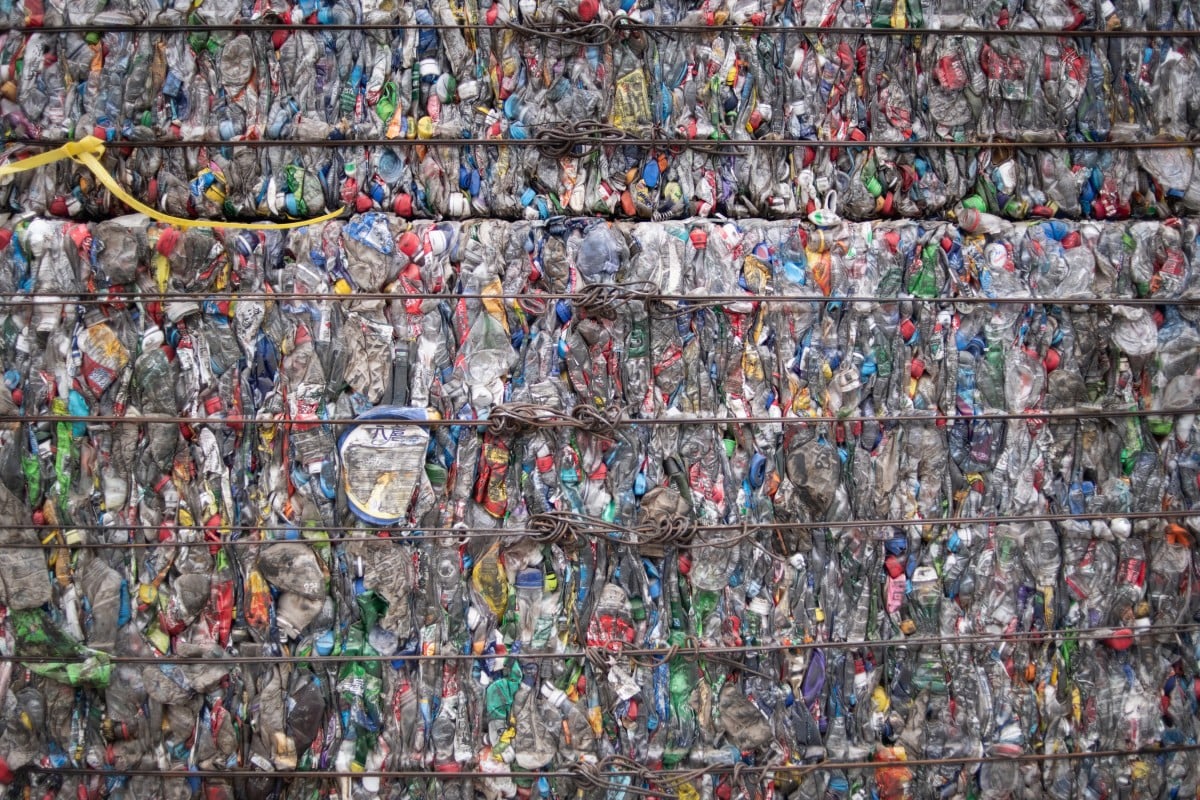
Recyclables such as plastic must be separated from wet garbage, dry garbage and hazardous waste under the new rules in Shanghai. Photo: AFP
At 9pm, Li Zhigang was sitting in front of his fruit shop on a bustling street in central Shanghai’s Xujiahui area, peeling the thin layers of plastic from rotten pears and mangoes.
“This is so much trouble!” he mumbled to himself while throwing the plastic into one trash can and the fruit into another.
In the past, Li simply threw away what could not be sold with the packaging on, but from July 1 he could be fined up to 200 yuan (about US$30) for doing so.
Like Li, many of the tens of millions of residents in the eastern Chinese city have been complaining in recent weeks that the introduction of compulsory
is making life difficult, but at the same time have been having to learn to do it.
Calls for garbage sorting have brought little progress in China in the past decade, but Shanghai is leading a fresh start for the world’s second-largest waste producer with its new municipal solid waste (MSW) regime, observers have said.
China generated 210 million tonnes of MSW in 2017, 48 million tonnes less than the United States, according to the World Bank’s What a Waste database.
“If we say China is now classifying its waste, then it’s Shanghai that is really doing it,” said Chen Liwen, a veteran environmentalist who has worked for non-governmental organisations devoted to waste classification for the past decade.
“It’s starting late, comparing with the US, Japan or Taiwan, but if it’s successful in such a megacity with such a huge population, it will mean a lot for the world,” she said.
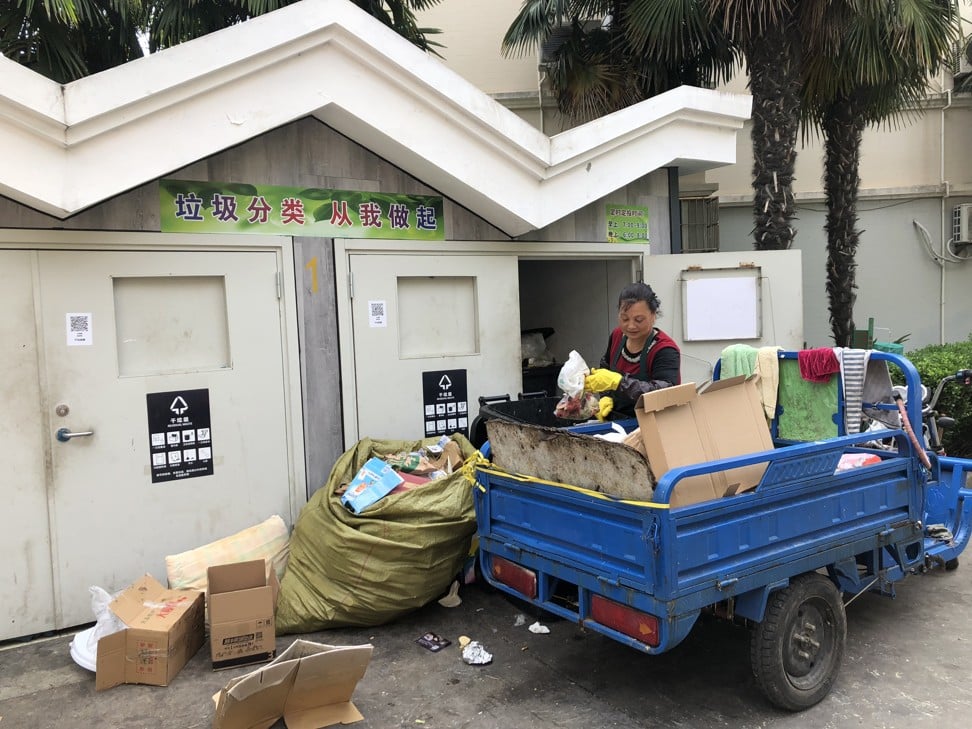
A cleaner re-sorts household waste left at a residential facility in Shanghai. Photo: Alice Yan
Household waste in the city is now required to be sorted into four categories: wet garbage (household food), dry garbage (residual waste), recyclable waste and hazardous waste.
General rubbish bins that had previously taken all types of household waste were removed from buildings. Instead, residents were told to visit designated trash collection stations to dispose of different types of waste during designated periods of the day.
Companies and organisations flouting the new rules could be fined 50,000-500,000 yuan (US$7,000-70,000), while individual offenders risked a fine of 50-200 yuan.
The city’s urban management officers will be mainly responsible for identifying those who breach the rules.
Huang Rong, the municipal government’s deputy secretary general, said on Friday that nearly 14,000 inspections had been carried out around the city and more than 13,000 people had been warned on the issue since the regulations were announced at the start of the year.
As July 1’s enforcement of the rules approached, it became a much-discussed topic among Shanghainese people. A hashtag meaning “Shanghai residents almost driven crazy by garbage classification” was one of the most popular on China’s Twitter-like Weibo platform.
“My daughter took a box of expired medicine from her workplace to the trash collection station near our home yesterday because she couldn’t find the local bin for hazardous waste,” Li said.
While the measures force a change of habits for most people, they bring opportunities for some.
Du Huanzheng, director of the Recycling Economy Institute at Tongji University, said waste sorting was crucial for China’s recycling industry.
“Without proper classification, a lot of garbage that can be recycled is burned, and that’s a pity,” he said. “After being classified, items suitable to be stored and transported can now be recycled.”
G20 set to agree on ways to reduce plastics in oceans
Shanghai’s refuse treatment plants deal with 19,300 tonnes of residual waste and 5,050 tonnes of kitchen waste every day, according to the municipal government. By contrast, only 3,300 tonnes of recyclables per day are collected at present.
Nationwide, the parcel delivery industry used more than 13 billion polypropylene woven bags, plastic bags and paper boxes as well as 330 million rolls of tape in 2016, but less than 20 per cent of this was recycled, according to a report by the State Post Bureau.
Prices of small sortable rubbish bins for home use have surged on e-commerce platforms, while bin makers are also developing smart models in response to new needs.
Some communities are deploying bins that people are required to sign in with their house number to use, and are equipped with a “big data analysis system”. The system records households have “actively participated” and which have not, so that neighbourhood management can publicise their addresses and make house visits, according to a report by Thepaper.cn.
In a residential community in Songjiang district, grocery store owner Nie Chuanguo has found something new to sell: a rubbish throwing service.
He has offered to visit homes, collect waste and throw it into the right bin at a designated time. He charges 30 yuan a month for those living on the ground and first floors, 40 yuan for those on the second and third, and 50 yuan for the fourth and fifth.
“This service will start from July 1. Many people have come to inquire about it,” he said.
According to Du, waste classification is not only about environmental impact or business opportunities. “Garbage sorting is an important part of a country’s soft power,” he said.
For China, it was an opportunity to improve its international reputation, he said. “In the past, Chinese people were rich and travelled abroad, but they threw rubbish wilfully, making foreigners not admit we are a respected powerhouse.”
He added: “It’s also related to 1.3 billion people’s health, since the current waste treatment methods – burying and burning – are not friendly to the environment.”
Shanghai’s part in tackling waste comes amid President Xi Jinping’s repeated calls for the country to sort waste better.
“For local officials, it is a political task,” said Chen, who heads a waste management programme in rural China called Zero Waste Villages.
Huang said the president had asked Shanghai in particular to set a good example in waste classification.
In March 2017, the central government set out plans for a standardised system and regulations for
, with a target for 46 major cities, including Shanghai, to recycle 35 per cent of their waste by then.
In early June, Xi issued a long statement calling for more action from local governments.
However, it was a long process that required input from individuals, government and enterprises, Du said.
“Japan took one generation to move to doing its waste sorting effectively, so we shouldn’t have the expectation that our initiative will succeed in several years,” Du said.
How China’s ban on plastic waste imports caused turmoil
“The lessons we can learn from Japan include carrying out campaigns again and again, and paying close attention to educating young pupils about rubbish classification.”
Chen echoed that Shanghai’s waste sorting frenzy now was only a beginning.
“What we can see now is that people are being pushed to sort waste by regulators, but what’s next? How shall we keep up the enthusiasm?” she asked.
She suggested that how well officials worked on garbage sorting should be included in their job appraisal, and that ultimately people should pay for waste disposal.
“The key to waste classification, going by international experience, is making polluters pay,” Chen said.
Most of Hong Kong and Taiwan’s dumped plastic bottles come from mainland
There is plenty of experience for Shanghai to learn from in California, where unrecyclable waste is charged for at twice the price of recyclables, and Taiwan, where people are charged only for disposal of residual waste, according to Chen.
Taiwan has one of the world’s most impressive recycling rates, with nearly 60 per cent of its waste between January and October last year having been recycled, according to the Taipei government.
The daily amount of garbage produced per person during that period was about 0.41kg – down substantially from 1.14kg in 1997 – the government said.
Hong Kong has tried to copy the Taipei model over the years but failed, with a recycling rate of MSW slightly above 30 per cent in recent years, according to official data.
The city has recently postponed a mandatory
until late 2020 at the earliest. Under its plan, 80 per cent of household waste will have to go into designated bags and will be priced at an average of 11 HK cents (1 US cent) per litre.
On Friday, Shanghai officials admitted that there were plenty of challenges involved in
sorting and transport.
Zhang Lixin, deputy chief of the municipal housing administration, said: “Many property management companies fear the difficulties brought by garbage sorting or are reluctant to implement the new rules.”
The administration trained the heads of more than 200 companies across the city in April, he said.
“We do find that some cleaners and rubbish trucks mix the waste, despite residents being asked to throw different types in different bins,” said Deng Jianping, head of the city’s landscaping and city appearance administration – the government department spearheading the initiative.
In the interests of curbing such practices, they could face fines of up to 50,000 yuan or even have their licences revoked, he said.
Source: SCMP
Posted in ambitious waste and recycling rules, begins, California, China eyes, cleaner image, dry garbage, environmentalist, hazardous waste, Hong Kong, household food, Japan, mainland, municipal solid waste (MSW), new waste sorting era, plastic waste imports, Plastics, President Xi Jinping, recyclables, Recycling Economy Institute at Tongji University, recycling industry, residual waste, second-biggest waste producer, Shanghai, Songjiang, sort rubbish better, Taiwan, Thepaper.cn, Uncategorized, United States, unrecyclable waste, US, wet garbage, Zero-Waste Villages |
Leave a Comment »
30/06/2019
- Veterans of Sino-Japanese war – which ended 74 years ago – among those likely to be set free, state media says
- Nine categories of convicts will be pardoned, but actual numbers will not be disclosed until cases have been reviewed by the courts
China’s amnesty will be no benefit to people like Bo Xilai, the former Chongqing party boss who was sentenced to life imprisonment for corruption in 2013. Photo: AFP
There will be no pardons for people jailed under President Xi Jinping’s sweeping anti-corruption campaign, Chinese state media said late Saturday after Beijing announced a prisoner amnesty as part of its celebrations for the 70th anniversary of the founding of the People’s Republic of China, which falls on October 1.
While the report did not give any indication of how many people would be set free – the cases must first be reviewed by the courts – it said the amnesties would be granted to those who fell into one of nine categories.
These include convicts aged 75 and above who are suffering from a physical disability, people who fought in the Sino-Japanese war – which ended in 1945 – or in the Chinese civil war, which ended in 1949 and led to the creation of modern-day China.
Other categories include prisoners sentenced as minors to terms of not more than three years, and those who were convicted of a crime while acting in self-defence and, again, sentenced to a maximum of three years.
The Communist Party declared a “crushing victory” in Xi’s war on corruption. Photo: EPA-EFE
Anyone convicted of a serious or violent crime, including murder, rape, kidnapping, corruption, arson and drug trafficking is ineligible for the amnesty, the report said. This group also encompasses those who refused to confess to their crimes or show remorse, and anyone deemed still a threat to society.
The amnesty is the second of Xi’s presidency and ninth in the country’s history. The previous seven were all during Mao Zedong’s leadership.
China considers prisoner amnesty for 70th anniversary
In 2015, about
to commemorate the 70th anniversary of the end of the Sino-Japanese war, which also marked the end of World War II. Though, as will be the case this time around, none of them were serving prison terms for corruption.
A spokesperson for the National People’s Congress, which approved the amnesty, was quoted by Xinhua as saying that Beijing hoped the pardons would have a positive political, legal and social impact.
“Considering the fight against corruption remains a challenge, and in order to maintain the pressure of the crackdown, it would be inappropriate to grant amnesties to corruption convicts,” the spokesperson said.
In December, the Communist Party declared a “crushing victory” in Xi’s war on corruption, which since 2012 has seen more than 1.3 million party officials – from powerful “tigers” to low-ranking “flies” – rounded up and convicted.
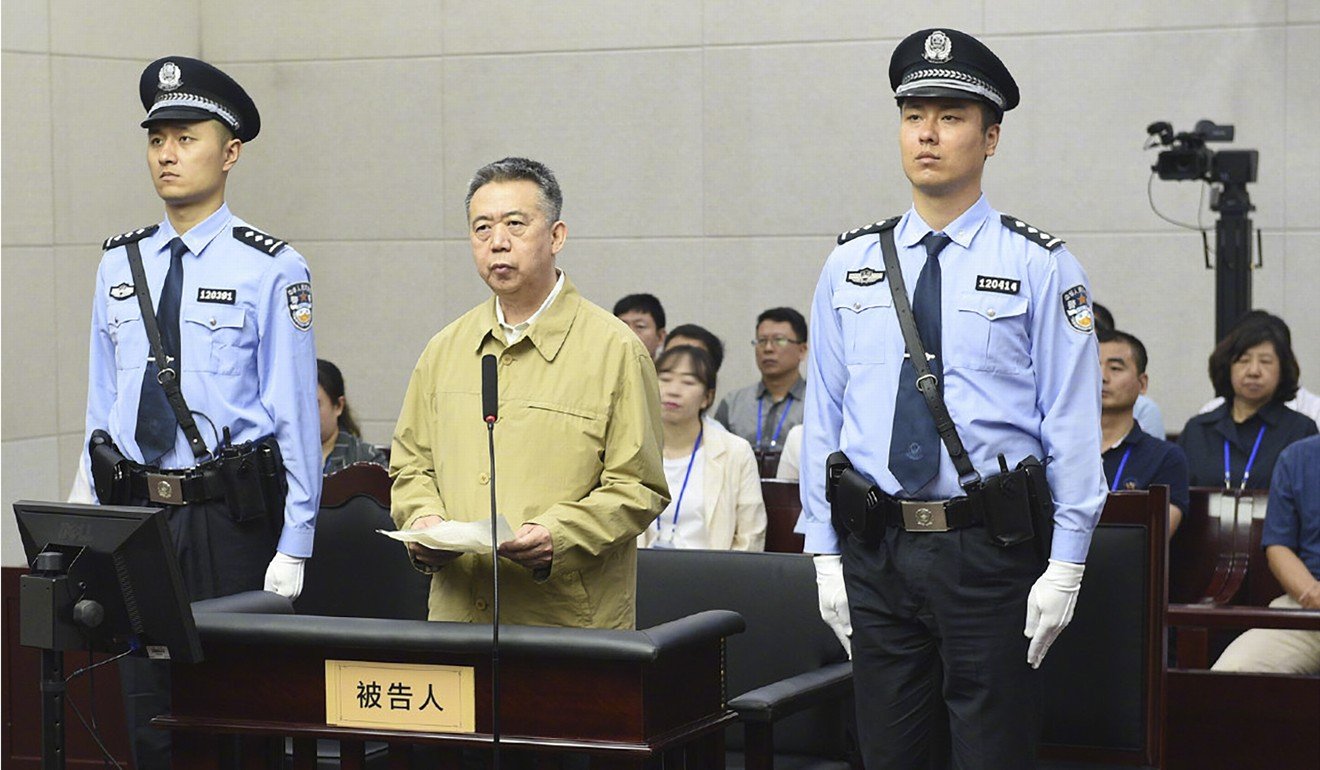
Meng Hongwei, the former president of Interpol, pleaded guilty earlier this month to taking bribes totalling more than US$2 million.
Among the most high profile officials to have been snared are former Politburo Standing Committee member and domestic security tsar
, former Politburo member
, and former vice-chairman of the Central Military Commission
.
Former Politburo member and Chongqing party boss
, who was detained just months before Xi rose to power in 2012, is also serving a life sentence for taking millions of US dollars in bribes.
, the former president of Interpol, looks set to become the latest senior official to join the convicts’ club after pleading guilty in court earlier this month to taking bribes totalling more than 14 million yuan (US$2 million).
Source: SCMP
Posted in amnesty, Bo Xilai, Central Military Commission (CMC), China announces, Chongqing party boss, Communist Party, corrupt officials, Interpol, Mao Zedong’s leadership, nation’s 70th anniversary, No joy, Politburo Standing Committee member, President Xi Jinping, to mark, Uncategorized, Veterans of Sino-Japanese war, World War II |
Leave a Comment »
23/06/2019
- Stalled denuclearisation talks also expected to be on the agenda when Chinese president meets Kim Jong-un this week
- Analysts say Korean peninsula has become intense diplomatic battleground between Beijing and Washington
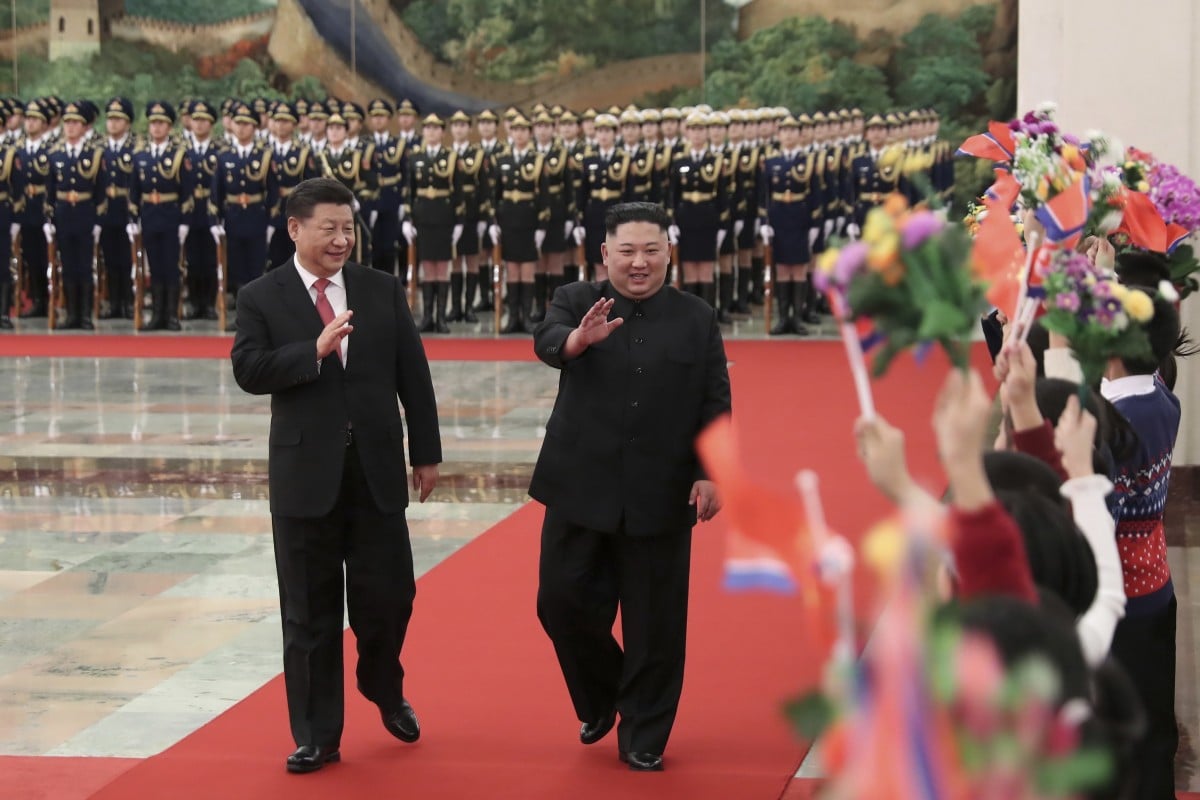
North Korean leader Kim Jong-un (right) attends a welcome ceremony in Beijing with Chinese President Xi Jinping in January. Xi will begin a visit to Pyongyang on Thursday. Photo: AP
Xi Jinping’s upcoming trip to
will be a state visit – a higher status than the last trip to the hermit kingdom by a Chinese president, highlighting the close bilateral ties between Beijing and Pyongyang.
Xi’s two-day trip, which
, is the first by a Chinese president to North Korea in 14 years and comes just a week before he is due to meet US President Donald Trump for talks on the sidelines of the Group of 20 summit in Japan.
“Leaders of the two countries will review the development of the bilateral relationship and carry out an in-depth exchange of opinions on the development of Sino-North Korean relations in the new era, and chart the future course of development,” state news agency Xinhua reported on Tuesday.
Xi’s predecessor, Hu Jintao, went to North Korea in October 2005 on a three-day trip described as an “official goodwill” visit.
Speaking at a regular press briefing in Beijing on Tuesday, foreign ministry spokesman Lu Kang said Xi’s visit aimed to “inject new impetus” into relations in the year the two countries marked the 70th anniversary of establishing diplomatic ties, and to give stalled denuclearisation talks a much needed push.
“Regarding the progress on denuclearisation, as I said, the result of the Hanoi leaders’ meeting in February was indeed a little unexpected. But after that, everyone actually looks forward to the resumption of dialogue in a good direction,” Lu said, referring to the failed talks between Trump and North Korean leader Kim Jong-un in the Vietnamese capital four months ago.
Trump hinted at the possibility of another meeting with Kim after receiving what he called “a beautiful letter” from the North Korean leader last week. On Tuesday, South Korea’s chief nuclear negotiator, Lee Do-hoon, said the US had been in contact with the North.
Life in North Korea the ‘admiration and envy’ of others, state media says
Washington will also send US Special Representative for North Korea Stephen Biegun to South Korea next week, days after Xi’s visit to Pyongyang, to fully align its position on North Korea with its ally.
Meanwhile, Trump confirmed he would meet Xi for talks in Osaka next week, saying in a tweet on Tuesday they had “a very good telephone conversation” and would hold “an extended meeting” at the G20 summit, where they are
over an almost year-long trade war.
Pyongyang has demanded the lifting of sanctions imposed on the regime following its nuclear and missile tests, while Beijing has said the livelihoods of North Koreans should not be affected. But Washington insists full sanctions should remain in place.
The US has also voiced scepticism about Chinese compliance with the sanctions. At a security summit in Singapore earlier this month, US acting Pentagon chief Patrick Shanahan – who on Wednesday stepped down from his role
– presented his Chinese counterpart Wei Fenghe with photographs and satellite images of North Korean ships transferring oil near China’s coast.
Analysts said Xi would seek to use the visit to boost China’s diplomatic leverage on the North Korean nuclear front, strengthening its hand in dealing with the US.
Exports from North Korea to China, which account for the bulk of its trade, plunged 87 per cent last year from 2017, and the country has faced other economic problems at a time when Kim has vowed to deliver on the economy.
A diplomatic source said China was expected to offer a large amount of humanitarian assistance, such as food and fertiliser, to North Korea, which could weaken the impact of sanctions.
China’s goal of denuclearisation on the Korean peninsula is unwavering and will not changeLu Chao, North Korean affairs expert at Liaoning Academy of Social Sciences
Communist Party mouthpiece People’s Daily on Tuesday said via its social media account that Xi would discuss economic and trade cooperation with Kim during the visit.
Quoting Zheng Jiyong, director of the Centre for Korean Studies at Fudan University in Shanghai, the newspaper said Pyongyang had taken steps to reform its economy and introduced China’s industrial manufacturing blueprint.
In September, Beijing proposed building a rail link from the city of Dandong, in China’s northeastern Liaoning province, to Pyongyang and then on to Seoul and Busan in the South, as well as a new road between Dandong and Pyongyang through Sinuiju.
Lu Chao, a North Korean affairs expert at the Liaoning Academy of Social Sciences, said large-scale economic cooperation between China and North Korea was unlikely because of the sanctions, but smaller moves were possible.
Chinese tourists flood North Korea as Beijing remains Pyongyang’s key ally
“For example, China may export daily necessities to North Korea. And if it’s needed, China is very likely to provide [food] assistance to North Korea,” Lu said. “I believe the UN sanctions on North Korea should change, because it has shown a more substantive approach to [achieving] denuclearisation.”
But analysts said Beijing remained firm on the need for Pyongyang to honour its pledges so that denuclearisation could be achieved.
“China’s goal of denuclearisation on the Korean peninsula is unwavering and will not change … China supports [North Korea] and the US continuing to hold talks,” Lu said.
Beijing also had an important part to play in the peace process, according to Boo Seung-chan, an adjunct professor at the Yonsei Institute for North Korean Studies in Seoul.
“China can have a positive role as a mediator to facilitate the peace process on the Korean peninsula,” Boo said.
Source: SCMP
Posted in aims, Asan Institute for Policy Studies, Beijing, Busan, Centre for Korean Studies, chinese tourists, Dandong, denuclearisation, diplomatic battleground, Fudan University, hermit kingdom, Hu Jintao, Kim Jong-un, Korean peninsula, Liaoning Academy of Social Sciences, Liaoning province, new impetus, North Korea, Patrick Shanahan, People’s Daily, President Donald Trump, President Xi Jinping, Pyongyang, Seoul, Shanghai, Singapore, Sino-North Korean relations, South Korea, State visit, ties, Uncategorized, US acting Pentagon chief, US Special Representative for North Korea, Washington, Wei Fenghe, Xinhua, Yonsei Institute for North Korean Studies |
Leave a Comment »
23/06/2019
- Leader will arrive on Thursday, ahead of G20 summit in Osaka, foreign ministry says
- He is expected to hold talks with Donald Trump on sidelines of meeting
China has confirmed that President Xi Jinping will travel to japan this week. Photo: AFP
China on Sunday confirmed that President Xi Jinping will attend the G20 summit in Osaka this week.
Xi will spend three days in Japan – his first visit to the country since coming to power in 2013 – the foreign ministry said.
He will travel to Japan on Thursday and is expected to meet his US counterpart Donald Trump on the sidelines of the meeting of leading and emerging economies, which runs from Friday to Saturday, it said.
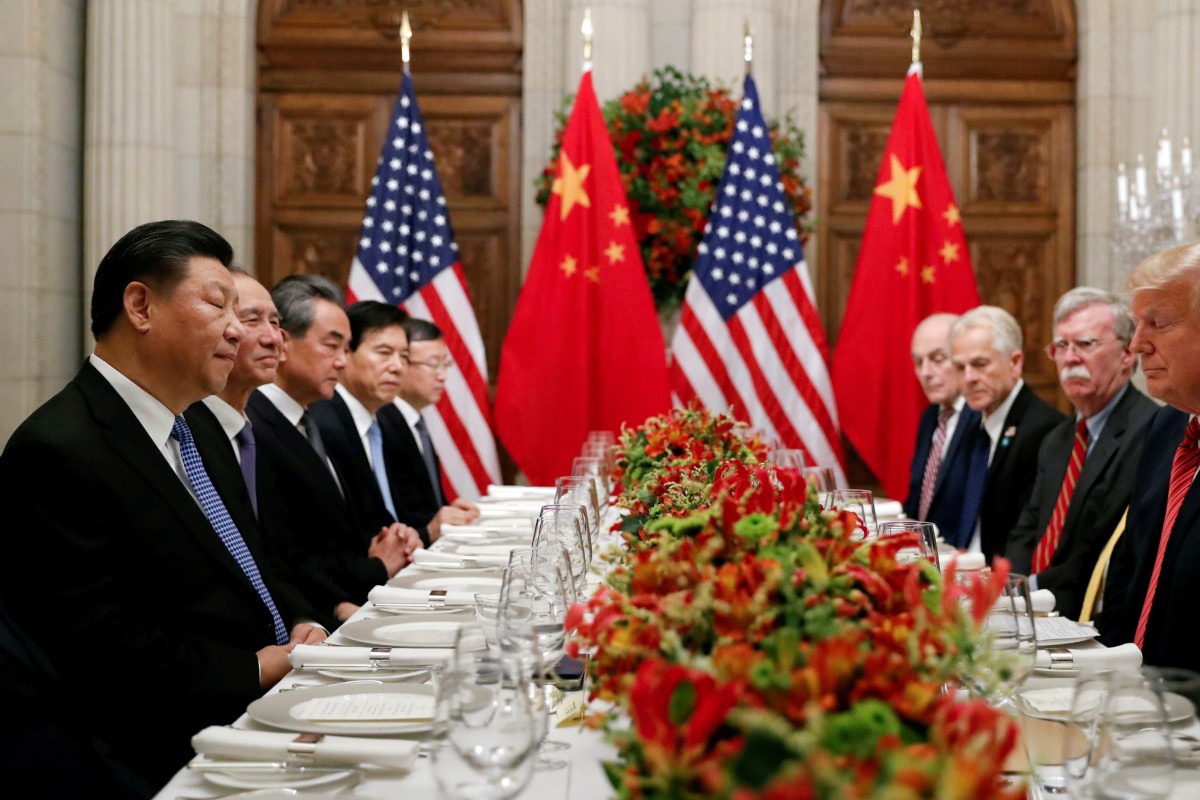
It is possible the pair will hold formal negotiations over dinner, as they did in Argentina in December at the last G20 summit.
Presidents Xi and Trump are expected to hold talks over dinner, as they did in Argentina in December. Photo: Kyodo
On Saturday, People’s Daily, the mouthpiece of China’s Communist Party said in a commentary that the trade war between China and the US could be resolved only through “equal conversation”.
“For the talks to resume … the key is to address the primary concern of the other side. The tariffs already in place must be revoked,” it said.
Trade deal ‘within reach if Xi and Trump show courage’
Meanwhile, state broadcaster CCTV on Friday criticised Washington’s decision to add five Chinese companies to its list of entities considered a threat to national security.
“The US made this move to put more pressure China ahead of the trade talks,” it said, adding that it might produce a result opposite to the one desired by Washington.
The report came after the US commerce department said it had added five Chinese firms that manufacture supercomputers and their components to the entity list, restricting their ability to do business with the US.
The blacklist effectively bars American firms from selling technology to the Chinese organisations without government approval. Last month, the commerce ministry added telecoms giant
to the list, heightening tensions with Beijing.
Xi told Trump on Tuesday he was willing to meet in Japan. Photo: AP
In a telephone conversation on Tuesday, Xi told Trump he was willing to meet in Japan and said he “agreed that the two countries’ trade delegations should keep communications going to solve their differences”, CCTV reported.
Kong Xuanyou, China’s new envoy to Japan, said on Friday that he hoped Xi would make an official visit to the country soon, ideally during the cherry blossom season next spring. The foreign ministry statement made no mention of such a visit.
Source: SCMP
Posted in CCTV, China confirms, China’s new envoy to Japan, Commerce Ministry, equal conversation, Foreign Ministry, G20 summit, Huawei, Japan, mouthpiece of China’s Communist Party, Osaka, People’s Daily, President Donald Trump, President Xi Jinping, revoked, tariffs, three-day trip, Uncategorized, Washington |
Leave a Comment »
22/06/2019
- Inadequate infrastructure and industry standards are holding the country back in the battle to save the environment, new study finds
In some extreme cases, incomplete pipework meant factories in industrial parks discharged directly into waterways. Photo: Reuters
A shortage of waste water pipelines, lax local government oversight and a lack of industry standards are holding back efforts to cut industrial water pollution in China, according to a new joint study.
The research by Greenpeace and Nanjing University also found that many of the country’s waste water treatment plants were among its biggest polluters singled out by authorities.
Researchers made the assessment by examining data and reports released by the Ministry of Ecology and Environment last year. According to the reports, 243 – or 56 per cent – of the 436 major polluters fined in 2018 for excessive discharges were waste water treatment plants.
That is despite Beijing claiming to be one of the biggest processors of industrial and household waste water by volume in the world.
Fighting water pollution is part of Beijing’s pledge to fix the country’s depleted environment by 2020, one of the priorities President Xi Jinping identified at the start of his second five-year term in late 2017.
Dong Zhanfeng, deputy director of the Environmental Policy Department at the Chinese Academy for Environmental Planning, said waste water treatment was an important part of the fight against pollution.
“It’s called a ‘critical battle’ because the work is really tough,” Dong said.
China says progress made on water pollution, but battle remains
To try to curb contamination from industry, the central government has urged provincial authorities to concentrate factories in industrial parks, where infrastructure must be built to treat waste water.
The Greenpeace-Nanjing University researchers found that by the end of the third quarter last year, 97 per cent of 2,411 industrial waste water treatment plants needed for industrial parks around the country had been constructed. But not all of the completed plants were in full use because of insufficient pipes connecting factories and the treatment plants.
In extreme examples cited by the report, incomplete pipework meant two treatment plants in Hubei laid dormant for two years, forcing factories in the industrial parks to discharge directly into waterways.
In other cases, factories not linked to industrial waste water treatment plants discharged into the general sewage system, with the effluent ending up at household waste water treatment plants that could only filter part of the industrial waste.
This was the case in the southwest province of Guizhou, where a lack of pipework meant 89 of the 128 industrial parks relied on city sewage systems to treat polluted water.
Deng Tingting, a Beijing-based campaigner with Greenpeace East Asia, said conditions were a mess.
“Brand new waste water treatment plants sit unused while waste pumps into streams and rivers.
The current state of affairs is a mess, and it keeps companies from entering the growing market for waste water treatment. The decision not to shepherd this growing industry is a risky one,” Deng said.
China admits patchy progress tackling soil, water pollution, with some rivers worsening
The Ministry of Ecology and Environment estimated last year that in all China needed 400,000km (248,550 miles) of waste water pipework, costing around 1 trillion yuan (US$145 billion). The ministry did not say how much remained to be built.
Another major problem identified by the study was the lack of treatment standards for industrial waste water plants, with many plants relying on quality standards for household waste water treatment.
In addition, the researchers highlighted the problem of local governments and industrial park administrators shirking their responsibility to enforce standards.
The study called for clear demarcation of regulatory and oversight responsibilities among local environmental watchdogs, industry, industrial parks and water treatment plants.
Source: SCMP
Posted in Beijing, China alert, clean up, factories, Greenpeace, Inadequate infrastructure, incomplete pipework, industrial parks, Ministry of Ecology and Environment, Nanjing University, President Xi Jinping, Uncategorized, waste water, waste water pipelines, waste water treatment plants |
Leave a Comment »
19/06/2019
- Osaka summit intended to pull bilateral ties away from brinkmanship that has dragged relations to lowest point in decades
- Trade war just one of the items on the agenda, analysts say, along with principles of relationship, North Korea, and Huawei
The last time the US President Donald Trump and China’s President Xi Jinping met was in Buenos Aires in December. Analysts are confident that their meeting at the G20 Summit in Osaka this month can yield a freeze in the escalation of the trade war. Photo: Reuters
When Chinese President Xi Jinping meets his US counterpart Donald Trump in Japan at the end of the month they are expected to discuss a broad range of issues, including the trade war, in an effort to stop the relationship from tilting towards sustained confrontation, analysts said.
Neither side has provided an agenda for the meeting on the sidelines of the G20 leaders summit in Osaka, despite confirmation coming from both sides that it was to take place, after weeks of speculation.
A summary of Tuesday’s phone conversation between Xi and Trump published by Xinhua, however, implied that the leaders would cover more strategic issues, leaving the nuts and bolts of a trade deal to their negotiating teams. Meanwhile, China’s foreign ministry spokesperson Lu Kang said at a regular press conference on Wednesday that the two leaders would discuss the overall direction of bilateral relations, but he did not elaborate further.
Both China and the United States have confirmed that their leaders will meet in Osaka at the end of June, at a time when US-China relations have nosedived. Photo: AP
, a former vice-minister at China’s Ministry of Commerce, predicted that Beijing would use the meeting to make clear a few principles regarding the bilateral relationship.
“It’s inevitable [for China and the US] to have problems in certain fields, but both sides should resolve the problems through dialogue on an equal footing rather than opting for a trade war, a tech war, or a financial war,” said Wei, now a vice-chair at the state-backed China Centre for International Economic Exchanges, a think tank.
He added that China would try to convince the US that it had no intention of challenging its global hegemony, but that China’s own “core interests”, including its sovereignty, territorial rights and room to develop, “must be respected”.
A government official in Beijing, who declined to be identified, said China was pinning its hopes on the leaders’ summit to ease general tensions between Beijing and Washington, even though the chances of the leaders reaching any concrete agreements in Osaka was small.
“Without a leaders’ summit, it would be difficult to push ahead the work [to reach agreements] at the ministerial or lower levels,” the source said.
Wei Jianguo, a former vice-minister at China’s Ministry of Commerce, predicted that Beijing would use the meeting to make clear a few principles regarding the bilateral relationship. Photo: Handout
The last summit between Trump and Xi in Buenos Aires in December resulted in a tariff truce and negotiations that continued until early-May. But the talks failed to achieve a deal to end the conflict, resulting in the US more than doubling tariffs on US$200 billion of Chinese imports and threatening tariffs on almost all remaining Chinese imports, valued at US$300 billion by the US government.
Tuesday’s telephone call, in which
he was willing to exchange views with Trump on “the fundamental issues” affecting China-US relations, came at a low point in recent China-US relations.
The tariff increase followed the collapse of trade talks in early-May, while hostile rhetoric has spread into the political and military spheres. The US labelled China a “strategic competitor” and accused Beijing of conducting sustained espionage to impede US’s national security, while China blamed the US for trying to thwart China’s development by targeting Huawei and infringing on China’s sovereignty over Taiwan and Hong Kong.
Zhou Rong, a senior fellow from the Chongyang Institute for Financial Studies at the Renmin University of China, said the two leaders have a long list of issues to talk about this time in addition to trade, including Taiwan, the South China Sea, as well as the treatment of Chinese companies in the US. China can offer to help on some issues but “the US should not force China to swallow bitter fruit it cannot digest”, Zhou said.
Ni Feng, a specialist in Sino-US relations at the Chinese Academy of Social Sciences, said they would discuss the “overall direction” of their bilateral relationship, including where the two nations could engage in “competition and cooperation”.
He added that North Korea may be on the agenda because “China and the US share the same goal of the denuclearisation of the Korean peninsula.”
a two-day state visit to Pyongyang on Thursday.
Another source in the Chinese government, who wished to remain anonymous, said Xi was very likely to bring up the US’ blacklisting of Huawei, China’s leading technology firm. Washington has effectively banned American companies from providing key components to the Shenzhen-based company.
Meng Wanzhou, Huawei’s chief financial officer and the daughter of founder Ren Zhengfei, is currently on bail in Canada awaiting extradition to the US to face charges that both she and Huawei violated US sanctions on Iran.
During Tuesday’s call, Xi told Trump that China “hopes the US side can treat Chinese businesses fairly”, Xinhua reported.
China’s President Xi Jinping waits for the start of the G20 summit in Buenos Aires, Argentina, Friday, Nov. 30, 2018. Photo: AP
At the same time, Trump and Xi agreed that the two countries’ trade negotiators would start to talk again before the meeting in Japan, raising prospects for a second truce in the trade war, or even a deal to end the conflict.
Matthew Goodman, a researcher at the Centre for Strategic and International Studies in Washington, wrote in a note that a Trump-Xi deal on trade-in Osaka “is certainly possible”.
The most likely outcome is similar to the one reached in Buenos Aires in December last year, when Trump and Xi “agreed to a temporary truce while trade negotiators work to hammer out a deal”, Goodman wrote. “This would postpone the worst effects of the current escalation but is unlikely to solve the deepening and dangerous rift in US-China relations”.
The South China Morning Post previously reported that the Osaka summit meeting, which is likely to take place on Saturday June 29, could also be a sit-down dinner between Trump, Xi and their top economic and security aides, as occurred in Buenos Aires. Trump tweeted Tuesday night that he would have an “extended” meeting with Xi in Japan.
Source: SCMP
Posted in Beijing, broaden agenda, Buenos Aires, Centre for Strategic and International Studies, China Centre for International Economic Exchanges, China’s Ministry of Commerce, Chinese Academy of Social Sciences (CASS), Chongyang Institute for Financial Studies, G20 summit, Japan, North Korea, Osaka, President Donald Trump, President Xi Jinping, south china morning post, Uncategorized, US-China trade war, Washington |
Leave a Comment »
17/06/2019
- President Xi Jinping’s chief US trade war negotiator did not specifically reference rising tensions with United States during surprise speech in Shanghai
- Keynote address at Lujiazui financial forum his first public appearance in three weeks since tour of Jiangxi province with Xi
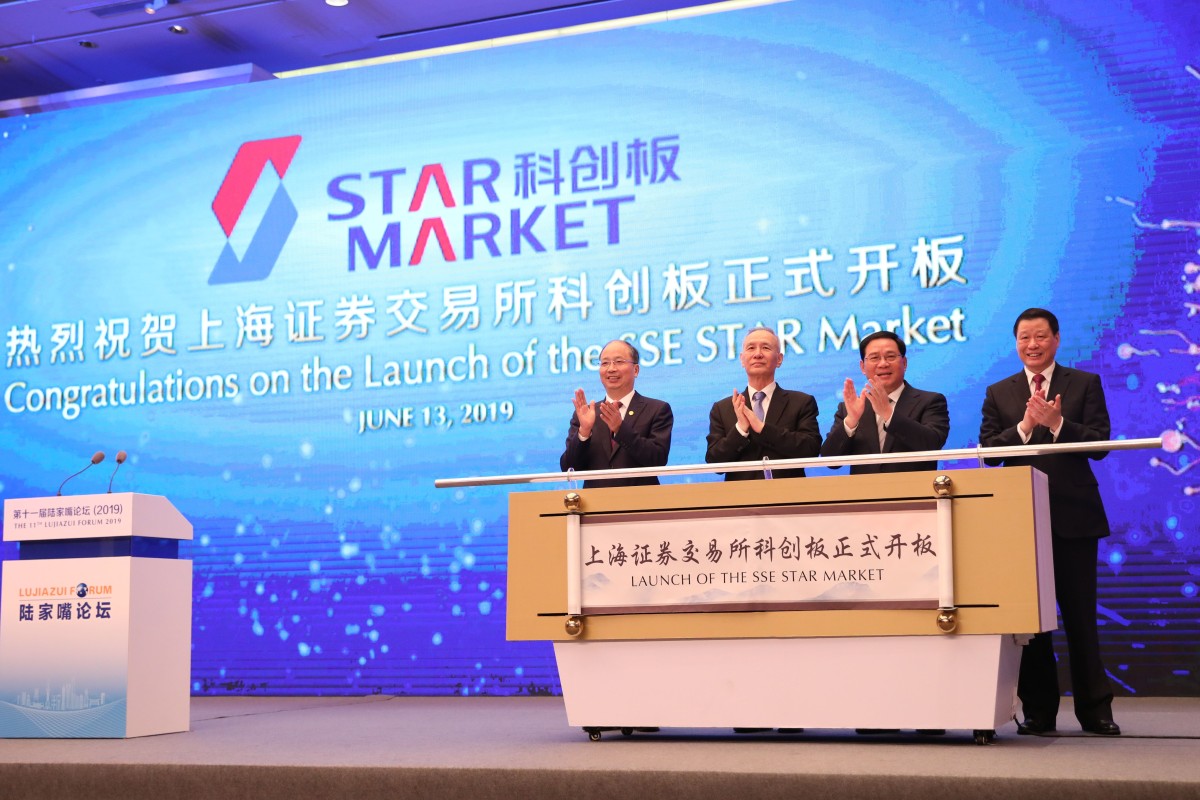
The keynote address by Liu He (second left) at the Lujiazui financial forum in Shanghai on Thursday was his first public appearance in three weeks. Photo: Xinhua
Vice-Premier Liu He believes the “external pressure” now hitting China’s economy was inevitable and could actually boost the country’s innovation and development.
Liu, the top economic aide to President Xi Jinping and chief negotiator in the trade talks with the United States, backed up comments last week from
that Beijing has sufficient policy tools to address the risks and challenges to ensure that China’s long-term growth prospects remain sound.
He did not directly mention the US-China trade war in remarks at the Lujiazui financial forum on Thursday, but said that there was ample room in China’s macroeconomic system to support growth and that recent moves by the government to cut taxes and government administrative fees were starting to have a positive impact on the economy.
“We do face some external pressure at the moment, but this is the inevitable test that China’s economic upgrade must experience,” Liu told the forum, which is an annual event organised by the Shanghai government and the People’s Bank of China. “The external pressure will help us improve innovation and self-development, speed up reform and opening up and push forward with high quality growth.”
Liu was critical of economists for focusing solely on monthly economic data that has shown signs of weakness in the Chinese economy, while neglecting positive trends that support long-term growth in the world’s second largest economy.
Chinese employment, consumer prices and the balance of payment remained at “reasonable” levels, he said, although
did rise to the highest level in 15 months in May, partly because of the rising price of pork and fresh fruit.
“No matter what happens temporarily, China’s long-term growth remains positive, which won’t change,” Liu said. “After the global financial crisis, our financial system has been stable. The rapid growth of debt in the system has been contained.”
The keynote speech, which was Liu’s first public appearance since accompanying Xi on a tour of Jiangxi province three weeks ago, was only confirmed at the last minute having initially been announced as a speech by “a State Council leader”.
The external pressure will help us improve innovation and self-development, speed up reform and opening up and push forward with high quality growthLiu He
In an unusual move, Liu used charts and slides, both in Chinese and English, to address Chinese and foreign bankers and investors as well as other Chinese officials including Banking and Insurance Regulatory Commission chairman Guo Shuqing and People’s Bank of China governor Yi.
It remains to be seen whether Liu will resume trade talks on China’s behalf, with a meeting between
at the G20 summit at the end of June yet to be confirmed after negotiations broke down in early May.
“We noticed that the US side had repeatedly expressed the hope that the two presidents could meet during the G20 summit later this month. Right now I have no new information to offer about the China-US trade talk,” said Chinese Ministry of Commerce spokesman Gao Feng during Thursday’s regular press conference.
“Nothing is agreed until everything is agreed.”
Since the last round of talks in Washington, which were attended by Liu, the US has increased tariffs on US$200 billion of Chinese goods from 10 per cent to 25 per cent, while Trump has threatened to impose tariffs on the US$300 billion worth of imports not yet covered by duties.
“The US used state power to suppress Chinese enterprises and generalise the concept of national security. These are the behaviours of distorting the market,” Gao added.
“It was the US who reneged and was dishonest in the trade talks, unilaterally escalated the trade tensions and made the negotiation fall into an impasse.”
Posted in Banking and Insurance Regulatory Commission, China’s economy, Chinese Ministry of Commerce, Chinese Vice Premier Liu He, external pressure, Jiangxi Province, Lujiazui financial forum, People’s Bank of China (PBOC), President Xi Jinping, Shanghai, Uncategorized, United States, US trade war negotiator |
Leave a Comment »
17/06/2019
- Washington has blamed Tehran for an attack on two oil tankers near the Strait of Hormuz, putting pressure on Iran’s allies like China
- Beijing usually backs its trade partner – but experts say the trade war with the US and problems with Huawei may have changed the equation
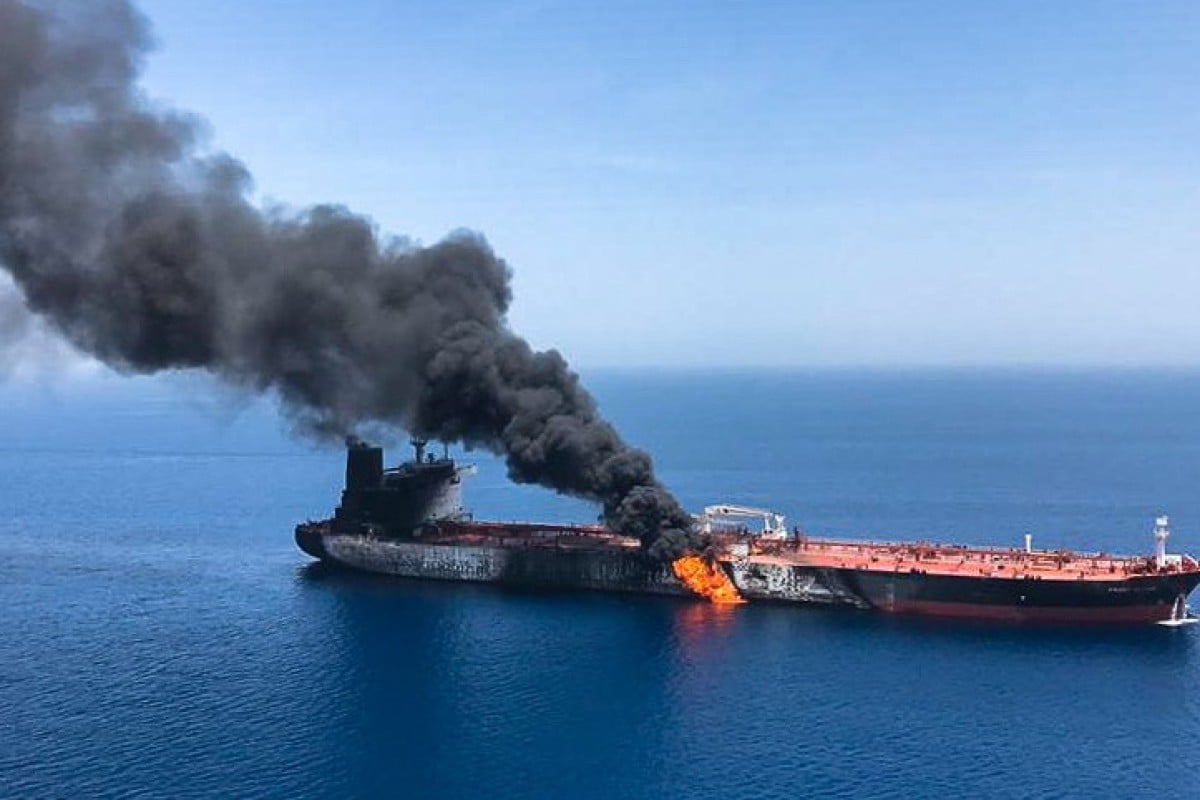
A tanker burns in the Gulf of Oman after a mystery attack that the United States has blamed on Iran. Photo: AFP
When
headed to Tehran this week for the first visit by a sitting Japanese prime minister in four decades, some in the diplomatic world imagined he could be the man to bring
back to the negotiating table with the
.
Those hopes were torpedoed on Thursday when, on the same day Abe was meeting Iran’s supreme leader Ayatollah Khamenei, explosions ripped through two oil tankers, one Japanese and one Norwegian, near the Strait of Hormuz, a strategically significant shipping lane.
The attack immediately overshadowed an earlier success for Abe, who had met President Hassan Rowhani a day before and was assured Iran would stick to the terms of a 2015 agreement limiting its nuclear activities.
Washington accused Iran of being behind the attack on the tankers, releasing a video on Friday that it said showed Iran’s revolutionary guard removing an unexploded mine from one of the ships, and warning that it would “defend its interests”.
Iranian President Hassan Rowhani and Japanese Prime Minister Shinzo Abe meet Iran’s Supreme Leader Ayatollah Ali Khamenei in Tehran. Photo: Reuters
Tehran, for its part, claimed to have been set up, with its foreign minister Mohammad Javad Zarif saying “suspicious doesn’t begin to describe” the incident. So much, then, for hopes of mediation.
US President
, who had encouraged the Japanese leader’s visit, admitted on Twitter soon afterwards that when it came to negotiating, “they are not ready, and neither are we!”
Still, the incident exposed more than just the naivety of those hoping for an Abe-led breakthrough. In raising the stakes in Washington’s confrontation with Tehran, it also threw the spotlight on Iran’s dwindling number of allies – and perhaps most significantly on its largest trading partner, China – which face mounting pressure to rethink the relationship.
Tanker attacks: world divided over Iran role as Saudi prince breaks silence
The day after the attack, China’s President
said Beijing would promote its ties with Iran “however the situation changes” – a comment made during a meeting with Iranian President Hassan Rowhani on the sidelines of the Shanghai Cooperation Organisation summit in Kyrgyzstan – but diplomatic observers question just how far China can go in accommodating its controversial trading partner.
BEST FRIENDS FOREVER?
Iran has long been able to count on support from China, which accounts for 30 per cent of the Islamic republic’s exports and imports, and its willingness to defy US pressure is a gamble at least partly based on an assumption it can continue to count on Beijing’s support.
As Iran’s largest economic partner – Chinese direct investment in Iran hit a record high of nearly US$4 billion last year, according to data analysis project ChinaMed – Beijing already plays a key role in relieving US pressure on Iran, said Mohsen Shariatinia, assistant professor of regional studies at Shahid Beheshti University in Tehran.
But experts warn that reliance will come into question as China becomes increasingly hamstrung by its own problems.
China has enough problems of its own, starting with US pressure on Huawei. Photo: EPA
Chief among Beijing’s headaches are its
with Washington and the related assault on its
giant
– which, as analysts point out, originally ignited over allegations it was defying US sanctions on Iran. Beijing will also be well aware of the need to keep
, its second-biggest oil supplier and Tehran’s critic-in-chief, happy.
On the other hand, analysts say, China will be wary of being seen to abandon its old friend, as doing so would send a message to other nations at odds with Washington that they could no longer look to China as a diversification strategy.
“This could mean Chinese investment is vulnerable to US interference,” said Esfandyar Batmanghelidj, founder of Bourse Bazaar, a media company that supports business diplomacy between Europe and Iran.
Sanctions drive Iranian students away from US towards Asia
Doing so, Batmanghelidj said, would put a question mark over one of China’s most significant foreign policies of recent years – President Xi’s signature
to fund infrastructure across Eurasia.
THE BELT AND ROAD QUESTION
Tensions between Iran and the US have reached boiling point in recent weeks, after the Trump administration last month ended waivers on sanctions for nations importing Iranian oil – a move the US says is aimed at making the republic “radioactive to the international community” and which Rowhani has described as an “economic war against Iran”.
So far, China has largely stuck by the Islamic Republic, continuing to buy fuel from it despite the latest wave of US sanctions on Iranian oil that followed Trump’s decision last year to withdraw the US from the landmark 2015 agreement curbing Tehran’s nuclear development.
The deal had been widely lauded as a triumph of multilateralism and the dawning of a new economic era for Iran.
US releases video of ‘Iranian forces removing unexploded mine’ from ship
Part of its eagerness to support Iran has stemmed from the Islamic Republic’s key position in the Belt and Road plan. In 2017 alone, China signed deals for more than US$15 billion in Iranian infrastructure investment, according to the
mouthpiece China Daily.
Planned projects include high-speed rail lines, upgrades to the nation’s electrical grid, and natural gas pipelines. The two nations have also vowed to boost bilateral trade to US$600 billion in the next seven years.
“China sees Iran as its Western gateway, where not only is it a big market in itself, but it will also be the gateway to the rest of the
and ultimately to Europe for China,” said Anoush Ehteshami, professor of international relations at Durham University in Britain.
Nisha Mary Mathew, at the Middle East Institute in Singapore, said that China’s relationship with Iran was not just economic – but primarily strategic, with both nations envisioning an international order that was no longer dominated by the US and its Western allies.
DEFIANCE, FOR NOW
If the belt and road gives China good reason to stick with Iran, there are plenty of voices urging just that action. As Andrea Ghiselli at Shanghai’s Fudan University pointed out, US sanctions until now have only strengthened the hardline factions in Iran’s government.
The combination of the US withdrawal from the nuclear deal – which had the support of the international community – along with Europe’s tepid efforts to rescue it, may have emboldened those favouring resistance over negotiation.
Xi’s supportive comments in Kyrgyzstan were only the latest in a string of remarks from China that could encourage such factions.
If Trump kills off Huawei, do Asia’s 5G dreams die?
After China’s Foreign Minister Wang Yi met Iranian Foreign Minister Mohammad Javad Zarif in Beijing last month, the ministry’s spokesman Lu Kang said China’s economic relationship with Iran was “reasonable and lawful”.
Two months prior to that, China’s Minister of Commerce Zhong Shan, while hosting his Iranian counterpart Farhad Dejpasand, had claimed China’s “determination to maintain and develop the China-Iran comprehensive strategic partnership is unshakeable”.
Chinese President Xi Jinping with Iranian President Hassan Rowhani. Photo: AFP
Even so, the pressure is getting to some. In February, Foreign Minister Zarif temporarily resigned, in what Andrea Ghiselli at Fudan University in Shanghai called a clear sign of the “changing and precarious power balance with Iran’s foreign policy establishment”.
And nowhere is the pressure felt more keenly than the economy and China’s ability to serve as a lifeline.
“The real anxiety in Iran right now is about market share,” said Bourse and Bazaar’s Batmanghelidj. “If you’re exporting zero oil and your customers are buying oil elsewhere, you lose market share.
“The government wants to know if it agreed to go back to the negotiating table and the US promised sanctions relief, that there are people who are going to buy in significant volume.”
TURNING POINT: HUAWEI
For many analysts, the event most likely to have changed the equation in Beijing’s eyes is the arrest by the Canadian authorities of
, the chief financial officer of Chinese telecom giant Huawei.
Meng’s arrest came at the request of the US government, which claimed her company had violated sanctions by selling equipment to Iran.
Many observers saw the action as Washington’s way of signalling to Chinese companies that they would face repercussions if they eased the pressure on Iran by continuing to trade.
Huawei’s chief financial officer Meng Wanzhou. Photo: Reuters
“Going after Huawei was about going after Chinese enterprises – signalling that they can no longer trade with Iran with impunity,” Batmanghelidj said.
Since then, Chinese firms have shown increased skittishness towards trading with Iran. According to China’s General Customs Administration, Chinese exports to Iran declined by more than half between October 2018 and February 2019, from over US$1 billion to just under US$500 million.
Mohammad Ali Shabani, a researcher at the School of Oriental and African Studies in London, said other countries in the region were now watching to see if China would blink in the face of US pressure. “This could have dire consequences for China’s image as a reliable partner,” he said.
NOT JUST ABOUT AMERICA
There are reasons beyond US pressure that may factor into Beijing’s thinking. It has long stated its opposition to Iranian nuclear weapons development, and Chinese Foreign Minister Wang Yi has said that China is “ready” to take on “its due responsibilities and make a greater contribution to world peace and common development”.
Trade war: here are Beijing’s options – and none look any good
Zhao Hong, at the Research School of Southeast Asian Studies at Xiamen University, said that in stepping up as a responsible world power Beijing faced a dilemma over its approach to Iran.
“Chinese leaders have to painfully balance an impulse towards economic cooperation with Iran against other vital interests, including convincing Washington that China is a responsible stakeholder,” he wrote in the Journal of Contemporary China.
Saudi Aramco’s Ras Tanura oil refinery. The country is China’s second-largest oil supplier after Russia. Photo: Reuters
Then there is China’s relationship with Iran’s chief adversary, Saudi Arabia, to consider. Riyadh is China’s second-largest oil supplier, behind Russia, and it plays a central role in Beijing’s energy strategy.
According to International Trade Centre data, more than 12 per cent of China’s imported oil came from Saudi Arabia last year, compared with just 6 per cent from Iran. Last year, Saudi Arabia shipped 56.73 million tonnes of oil to China, or 1.135 million barrels per day.
Why would Kim Jong-un trust Trump, now that he’s ripped up Iran’s nuclear deal?
This April, China imported 6.3 million tonnes of oil from Saudi Arabia, nearly twice the 3.24 million tonnes it imported from Iran, according to China’s General Administration of Customs.
Iran’s comparatively small share of China’s oil imports market and its heavy reliance on China as a trading partner add up to a deeply uneven relationship, experts say, and it is this imbalance that will encourage the US that China may be open to rethinking its ties.
As Jon Alterman, director of the Middle East programme at Washington DC think tank the Centre for Strategic and International Studies, pointed out, while China was Iran’s largest trading partner, Iran represented less than 1 per cent of China’s international trade.
“Iran needs China,” Alterman said. “But to China, Iran is expendable.”
Source: SCMP
Posted in Ayatollah Khamenei, Beijing, Belt and Road (B&R), Centre for Strategic and International Studies, Durham University in Britain, Farhad Dejpasand, Foreign Minister Wang Yi, Fudan University, General Administration of Customs, General Customs Administration, Gulf of Oman, high-speed rail lines, Huawei, iran, Iran’s ties with China, Iranian Foreign Minister Mohammad Javad Zarif, Iranian President Hassan Rowhani, Islamic Republic, Japanese Prime Minister Shinzo Abe, Journal of Contemporary China, Kyrgyzstan, Meng Wanzhou, Middle East, Middle East Institute in Singapore, Minister of Commerce Zhong Shan, Oil tanker attacks, oil tankers, President Xi Jinping, Research School of Southeast Asian Studies, Riyadh, Russia, Saudi Arabia, Saudi Aramco's Ras Tanura oil refinery, Strait of Hormuz, Tehran, torpedoed, Uncategorized, United States, US President Donald Trump, Washington, Xiamen University |
Leave a Comment »











 CHINDIA ALERT: You'll be living in their world, very soon