Archive for ‘President Xi Jinping’s’

09/04/2020

WHO rejects ‘China-centric’ charge after Trump criticism

GENEVA (Reuters) – World Health Organization officials on Wednesday denied that the body was “China-centric” and said that the acute phase of a pandemic was not the time to cut funding, after U.S. President Donald Trump said he may put contributions on hold.

The United States is the top donor to the Geneva-based body which Trump said had issued bad advice during the new coronavirus outbreak.

U.S. contributions to WHO in 2019 exceeded $400 million, almost double the 2nd largest country donor, according to figures from the U.S. State Department. China contributed $44 million, it said.

“We are still in the acute phase of a pandemic so now is not the time to cut back on funding,” Dr Hans Kluge, WHO regional director for Europe, told a virtual briefing when asked about Trump’s remarks.

Trump told a news conference on Tuesday that the United States was “going to put a hold on money spent to the WHO,” however, he appeared to backtrack later when in response to questions he said: “We’re going to look at it.”

It was not immediately clear how Trump could “block” funding for the organization. Under U.S. law, Congress, not the president, decides how federal funds are spent.

Dr Bruce Aylward, senior advisor to the WHO Director-General, also defended the U.N. agency’s relationship with China, saying its work with Beijing authorities was important to understand the outbreak which began in Wuhan in December.

“It was absolutely critical in the early part of this outbreak to have full access to everything possible, to get on the ground and work with the Chinese to understand this,” he told reporters.

“This is what we did with every other hard-hit country like Spain and had nothing to do with China specifically.”

Aylward, who led a WHO expert mission to China in February, defended WHO recommendations to keep borders open, saying that China had worked “very hard” to identify and detect early cases and their contacts and ensure they did not travel.

“China worked very, hard very early on, once it understood what it was dealing with, to try and identify and detect all potential cases to make sure that they got tested to trace all the close contacts and make sure they were quarantined so they actually knew where the virus was, where the risk was,” he said.

“Then they made it very clear that these people would not and could not travel within the country, let alone internationally,” he added.

WHO Director-General Tedros Adhanom Ghebreyesus has been lavish in his praise of China from early in the outbreak, praising President Xi Jinping’s “rare leadership”.

David Heymann, a professor at the London School of Hygiene & Tropical Medicine who led WHO’s response to the 2003 SARS outbreak, said that any U.S. funding cut would be a huge blow.

“If the WHO loses its funding it cannot continue to do its work. It works on a shoe-string budget already,” Heymann said in London. “Of course it would be disastrous for the WHO to lose funding.”

Source: Reuters
06/03/2020

China, Japan in close communication over Xi’s state visit: FM spokesperson

BEIJING, March 5 (Xinhua) — China and Japan are in close communication regarding the timing of President Xi Jinping’s state visit to Japan, a Foreign Ministry spokesperson said Thursday.

While China and Japan are making all-out efforts to fight against the COVID-19 epidemic, both sides agreed that it must be ensured President Xi’s visit shall come at the most opportune time with the right conditions and atmosphere to achieve a complete success, spokesperson Zhao Lijian told a daily news briefing in response to reports that the visit may not materialize this spring.

“Upon agreement, the two sides will maintain close communication regarding the timing of the visit,” Zhao said.

Source: Xinhua

19/02/2020

Coronavirus: China expels Wall Street Journal journalists for article it deemed racist

Three journalists with the Wall Street Journal have been told to leave China in five daysImage copyright GETTY IMAGES
Image caption The Wall Street Journal said the journalists were ordered to leave China in five days

China has ordered three foreign journalists of the Wall Street Journal to leave the country over an opinion piece it said was “racist”.

The article published on 3 February criticised the country’s response to the deadly coronavirus outbreak.

The Chinese foreign ministry said it had asked the newspaper to apologise several times but it had declined.

The newspaper said the journalists – who had not written the opinion piece – were given five days to leave China.

The article called the authorities’ initial response “secretive and self-serving” and said global confidence in China had been “shaken”.

China’s Foreign Ministry spokesman Geng Shuang said the article was “racist” and “denigrated” China’s efforts to combat the outbreak that has killed more than 2,000 people in the country.

“The Chinese people do not welcome media that publish racist statements and maliciously attacks China,” Mr Geng said, without naming the journalists being expelled.

The Wall Street Journal identified the reporters as two US citizens – Josh Chin, who is the deputy bureau chief, and Chao Deng – as well as Australian citizen Philip Wen. The newspaper has not yet commented.

It is the first time in more than two decades that journalists holding valid credentials have been ordered to leave China, the BBC’s John Sudworth in Beijing reports.

The Foreign Correspondents Club of China called the decision “an extreme and obvious attempt by the Chinese authorities to intimidate foreign news organizations”.

The measure comes a day after the US said it would begin treating five Chinese state-run media outlets that operate in the country in the same way as foreign embassies, requiring them to register their employees and properties with the US government.

The decision affects the Xinhua News Agency, China Global Television Network and China Daily Distribution Corp.

Presentational grey line

Press freedom in China

Presentational grey line

Last year, the government declined to renew the credentials – necessary for the work of foreign journalists in the country – of another Wall Street Journal reporter.

The journalist, a Singaporean national, had co-written a story that authorities in Australia were looking into activities of one of China’s President Xi Jinping’s cousins suspected of involvement in organised crime and money laundering.

And in 2018, the Beijing bureau chief for BuzzFeed News Megha Rajagopalan was unable to renew her visa after reporting on the detention of Muslim minority Uighurs and others in China’s Xinjiang region.

Meanwhile, two Chinese citizen journalists who disappeared last week after covering the coronavirus in Wuhan, the epicentre of the outbreak in Hubei province, remain missing.

Fang Bin and Chen Qiushi had been sharing videos and pictures online from inside the quarantined city.

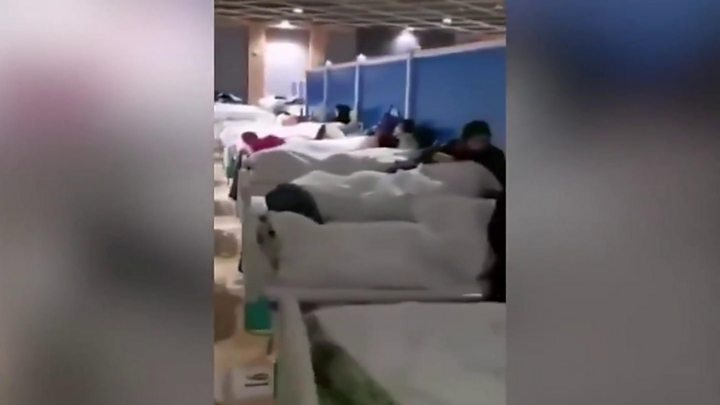
Media caption Footage appearing to show people held in quarantine in a makeshift facility in Wuhan, has been shared across social media

Source: The BBC

Law of Unintended Consequences

continuously updated blog about China & India

ChiaHou's Book Reviews

continuously updated blog about China & India

What's wrong with the world; and its economy

continuously updated blog about China & India