Archive for ‘President Xi’

25/01/2019

China’s Xi Jinping ‘most dangerous’ to free societies, says George Soros

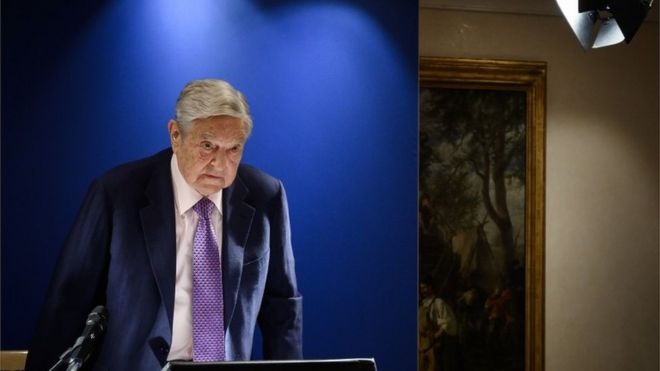
George Soros at DavosImage copyrightAFP

The billionaire philanthropist George Soros has used his annual speech at the World Economic Forum, in Davos, to launch a scathing attack on China and its president Xi Jinping.

Mr Soros warned that artificial intelligence and machine learning could be used to entrench totalitarian control in the country.

He said this scenario presented an “unprecedented danger”.

But he said the Chinese people were his “main source of hope”.

“China is not the only authoritarian regime in the world but it is the wealthiest, strongest and technologically most advanced,” he said, noting concerns too about Vladimir Putin’s Russia.

‘Security risk’

“This makes Xi Jinping the most dangerous opponent of open societies,” he said.

Mr Soros, a prominent donor to the Democratic Party in the US, also criticised the Trump administration’s stance towards China.

“Instead of waging a trade war with practically the whole world, the US should focus on China,” he said.

He urged Washington to crack down on Chinese technology companies such as Huawei and ZTE, which he said present an “unacceptable security risk for the rest of the world”.

More broadly, Mr Soros cautioned that repressive regimes could utilise technology to control their citizens, in what he called “a mortal threat to open societies”.

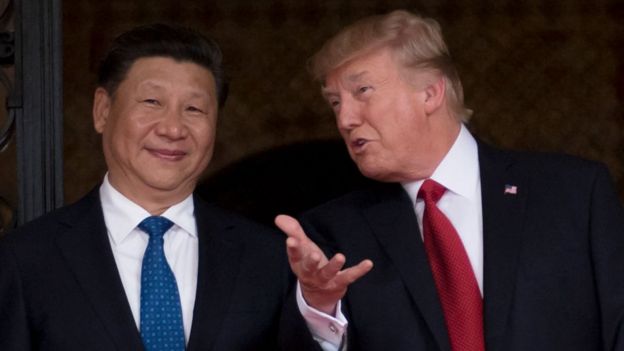
US President Donald Trump (R) welcomes Chinese President Xi Jinping (L) to the Mar-a-Lago estate in West Palm Beach, Florida.Image copyrightGETTY IMAGES
Image caption
\\
Both Xi Jinping and Donald Trump have been criticised by Mr Soros

The 88-year-old Hungarian-born Jewish businessman, who survived Nazi occupation by forging identity documents, became infamous for his involvement in the devaluation of the British pound, known as Black Wednesday.

But it is his philanthropic and political activities that have made him a divisive figure in the US, Europe and beyond.

Bribes

He has spent billions of his own money funding human rights projects and liberal democratic ventures around the world, and has become a frequent target for criticism by right-wing groups due to his support for liberal causes.

Much of the criticism aimed at him has been criticised as having anti-Semitic undertones.

Last year, a suspect package was found in a post box at his home in New York.

Mr Soros used his Davos speech last year to lambast tech giants such as Facebook, and what he considered to be their corrosive effect on democratic systems.

But this year, he directed his wrath towards Beijing, and particularly its controversial “Belt and Road” investment plan, which pays for road, rail and sea links to boost trade with countries around the world.

“It was designed to promote the interests of China, not the interests of the recipient countries,” he said.

“Its ambitious infrastructure projects were mainly financed by loans, not by grants, and foreign officials were often bribed to accept them.”

Source: The BBC

23/01/2019

Israel has enough sense and self interest to avoid efforts to drag it into US-China trade war, analysts say

  • China and Israel mark 27th anniversary of diplomatic ties at a difficult time
  • Relationship could be tested by US efforts to influence Israeli government policy
PUBLISHED : Wednesday, 23 January, 2019, 3:13pm
UPDATED : Wednesday, 23 January, 2019, 4:09pm

Uncertainty over China’s relationship with Israel is growing as the United States puts pressure on its allies to harden their stance on Beijing while trade and geopolitical tensions between the world’s biggest economies get worse.

As China and Israel prepare to mark the 27th anniversary on Thursday of diplomatic ties, analysts from both countries worry that relations, caught in the US-China crossfire, may face more difficult tests.
Like most other countries, Israel wants to maintain good relations with both the US and China and is concerned about an escalating rivalry, Gal Luft, co-director of the Institute for the Analysis of Global Security, a Washington-based think tank, said.

“Sadly, the new atmosphere in US-China relations is putting many countries – Israel included – in an extremely uncomfortable situation in which they are forced to pick sides,” he said.

Luft, a former lieutenant colonel in the Israeli Defence Force, said Israel could become a “sandwich country” like Canada, caught in the middle as Washington continued efforts to build an international coalition against Chinese telecoms giant Huawei

In recent weeks, senior US officials have increased pressure on Israel to reconsider China’s investments in infrastructure and hi-tech sectors there.

US National Security Adviser John Bolton urged Israeli Prime Minister Benjamin Netanyahu two weeks ago to tread carefully where Chinese telecommunications companies, such as Huawei and ZTE, were concerned because of national security concerns.

Bloomberg reported that US deputy secretary of energy Dan Brouillette issued a warning last week in Tel Aviv that Chinese investment in Israel’s national infrastructure, such as the port of Haifa, could compromise intelligence sharing with the US.

“The US has been abusing the idea of ‘national security,’ slandering and striking down the normal commercial activities of Chinese enterprises,” she said on Monday.

The Sino-Israeli relationship is very different from Beijing’s ties with oil-rich Middle Eastern countries such as Saudi Arabia, Qatar, Iran and Iraq, one analyst said.

Apart from its hi-tech industries, Israel has a significant military and political role in the Middle East. Beijing is seeking to increase its presence in the region as the US plans to withdraw troops from Syria and Afghanistan, Huang Jing, dean of Institute of International and Regional Studies at Beijing Language and Culture University, said.

“Israel may be small in size but is fairly influential in regional geopolitics and its long-standing special ties with Washington in particular make it uniquely important for Beijing”, which sought to steady relations with the US, he said.

Assaf Orion, a retired Israeli brigadier general and a visiting fellow at the Washington Institute for Near East Policy, said China for Israel had great potential as a market, a source of investment, a trade and tourism partner, and an infrastructure powerhouse.

“Israel’s China policy mainly seeks to balance the benefits of their bilateral economic ties on the one hand and its own strategic national security concerns on the other, with the all-but-formal strategic alliance with the US being a paramount national interest for Israel,” he said.

Ties between China and Israel have improved in recent years, especially where trade, investment, education and tourism were concerned.

During a visit to Beijing in 2017, Netanyahu said that China accounted for one-third of the investment in Israel’s hi-tech industries.

Citing a report by the Israel Venture Capital Research Centre, Reuters said Israeli tech start-ups raised US$325 million from Chinese investors in the first three quarters of 2018, up 37 per cent from the same period a year earlier.

During a visit to Jerusalem by China’s Vice President Wang Qishan in October, Netanyahu said that the two countries would complete a free trade agreement this year.

According to a report by Israel’s Institute for National Security Studies in 2017, “China is also involved in building infrastructure in Israel, such as digging the Carmel road tunnels in Haifa, laying a light railway in Tel Aviv, and expanding the Ashdod and Haifa seaports.”

Haifa is Israel’s largest port city and a berth for the US Sixth Fleet. In 2013, the Netanyahu government approved China’s Shanghai International Port Group’s plans to operate the container terminal there for 25 years beginning in 2021.

US has stepped up pressure on Israel to scrap the deal and one of the Sixth Fleet’s warships refused to dock at Haifa in October, citing security concerns that doing so could compromise US and Israeli intelligence assets.

But Luft was critical of Washington’s stance on the Haifa port project as the Chinese company was the only bidder in an open tender.

“The US government is punishing the people of Israel twice” by demanding its ally cancel the deal, Luft said. “First, by denying them competition in the port sector, which would lower their cost of living, and second the government will have to pay a large fine to China if the deal is cancelled. This fine will come at the expense of important public services.”

Despite a boost in diplomatic and trade ties and China’s interest in Israel’s military and security technologies, arms sales and military cooperation between the two countries were limited because of US pressure.

The US moved to block the export of the Phalcon airborne early warning system in 2000 and the Harpy killer drones in 2005 to China.

Orion said that while China’s diplomats often speak about win-win relationships, Israel’s challenge was to seek a win-win-win situation within a triangular relation between the two great powers and a start-up nation state.

“When much of the media discourse is pitching Israel into an exclusive ‘either/or’ choice between the two powers, Israel’s strategic concept should seek ‘precision choice’, promoting its relations with China prudently while minimising risk to itself and avoiding any harm to the US and the strategic relations with it,” he said.

But Luft also voiced concerns that as tension grew between the US and China, Washington tended to expand the definition of “national security” to include broader technology fields like microchips, telecommunication and artificial intelligence.

“This is where I foresee the next set of challenges. Israel will have to determine how far it can stretch the definition of national security and strike the right balance between its commercial needs and its relations with Washington. Israel is a sovereign country. Being a friend and ally of the US does not mean that Israel must be subservient to every whim of Washington,” Luft said.

However, Washington’s pressure campaign seemed to have worked as Israeli officials sought to reassure their American ally over the past week.

Under US pressure, Israel is mulling plans that include legislation to vet foreign investments for the first time, according to Israel’s Haaretz newspaper.

Israeli analysts also expressed dismay over China’s close relations with Iran, Israel’s arch rival in the region, and Beijing’s long-standing pro-Arab and pro-Palestinian policies, saying China often voted against motions that Israel favoured at the United Nations.

“China’s relations with the Arab World are less of a concern in the current regional landscape. However, China’s relations with Iran, which is both obsessed about Israel and committed to its destruction, are more of a worry,” said Orion.

China could do more to dissuade Iran from its aggression against China’s partners in the region: Israel, Saudi Arabia and the United Arab Emirates, he said.

“Keeping the relations good requires constant nurturing, especially at a time the US is trying pull Israel away from China,” Luft added.

Huang also said Beijing must be more careful in dealing with Iran. “The ultimate goal for Beijing should be to avoid advancing Iranian ties at the expense of Sino-Israeli relations,” he said.

He said that despite structural differences between the two countries, Israel had rarely adopted an anti-Chinese stance on issues of importance to Beijing.

“While it remains to be seen how Israel deals with mounting pressure from the US over Huawei and other Chinese telecoms companies and a host of geopolitical issues, I think Israel is shrewd enough to avoid taking sides between the US and China,” Huang said.

Source: SCMP

23/01/2019

Xi extends Spring Festival greetings to military veterans

CHINA-BEIJING-XI JINPING-MILITARY VETERANS-SPRING FESTIVAL GREETINGS (CN)

Chinese President Xi Jinping, also general secretary of the Communist Party of China Central Committee and chairman of the Central Military Commission, shakes hands with the retirees during a gala for retired military officials with Beijing-based troops in Beijing, capital of China, on Jan. 22, 2019. Xi extended his Spring Festival greetings to military veterans and retired military officials. (Xinhua/Li Gang)

BEIJING, Jan. 22 (Xinhua) — President Xi Jinping on Tuesday extended his Spring Festival greetings to military veterans and retired military officials.

Xi, also general secretary of the Communist Party of China Central Committee and chairman of the Central Military Commission, watched a gala for retired military officials with Beijing-based troops.

Xi shook hands with the retirees and asked about their health and lives.

Songs and dances about building strong armed forces and the military’s loyalty to the Party were performed.

Senior military officials including Xu Qiliang, Zhang Youxia, Wei Fenghe, Li Zuocheng, Miao Hua and Zhang Shengmin were also present at the show.

Spring Festival, the Chinese Lunar New Year, falls on Feb. 5 this year.

Source: Xinhua

21/01/2019

Xi keeps China on high alert for ‘black swan’ events – Xinhua

BEIJING (Reuters) – China must be on guard against “black swan” risks while fending off “grey rhino” events, President Xi Jinping said on Monday, adding that the economy faces deep and complicated changes, state news agency Xinhua reported.

A “black swan” event refers to an unforeseen occurrence that typically has extreme consequences, while a “grey rhino” is a highly obvious yet ignored threat.

Xi’s warning came after the release of data on Monday showed the economy posted the slowest growth in 28 years last year, hurt by faltering domestic demand and bruising U.S. tariffs.

Local governments and state organizations should find a balance between stabilizing growth and fending off risks, controlling the pace and intensity of such policies, Xi said in remarks during a meeting with provincial and department officials.

Sliding growth had pressured the government to roll out more stimulus to avert a sharper slowdown. The central bank has cut the reserve requirement ratio for banks five times in the past year.

Economic operations would be maintained within a reasonable range, Xi said, adding financing difficulties of small businesses will be resolved pragmatically while authorities would also step up support for companies to stabilise jobs.

Zombie firms – companies with a lot of debt – would be dissolved properly and resettlement of workers would be taken care of accordingly, Xi added.

China would implement long-term mechanisms that support the stable and healthy development of the property market, while making thorough evaluation of the potential impact on financial markets when drafting policies, according to Xi, who did not elaborate.

He emphasized that technology safety was an important part of national security and the country will accelerate legislation in artificial intelligence, gene editing, autonomous vehicles and drones.

Faced with complicated and difficult external environment, China would step up the protection of its overseas interests while making sure of the safety of major overseas projects and their personnel, Xi said.

Meng Wanzhou, the chief financial officer of Chinese telecommunication giant Huawei HWT.UL was arrested last month in Canada on a U.S. extradition request.

Western intelligence agencies have for years raised concerns about Huawei’s ties to China’s government and the possibility its equipment could be used for espionage.

Source: Reuters

19/01/2019

Xinhua Headlines: Xi urges new, greater progress in Beijing-Tianjin-Hebei coordinated development

CHINA-BEIJING-TIANJIN-HEBEI REGION-XI JINPING-INSPECTION (CN)

Chinese President Xi Jinping, also general secretary of the Communist Party of China Central Committee and chairman of the Central Military Commission, presides over a symposium on the coordinated development of the Beijing-Tianjin-Hebei region and makes an important speech on it. Xi made an inspection tour in the Beijing-Tianjin-Hebei region from Jan. 16 to Jan. 18. (Xinhua/Ju Peng)

BEIJING, Jan. 18 (Xinhua) — Chinese President Xi Jinping has urged more efforts to achieve new, greater progress in the coordinated development of the Beijing-Tianjin-Hebei region.

Xi, also general secretary of the Communist Party of China (CPC) Central Committee and chairman of the Central Military Commission, made the remarks during an inspection tour of the region from Wednesday to Friday.

During the tour, Xi chaired a symposium on the region’s coordinated development and made an important speech.

Vice Premier Han Zheng, also a member of the Standing Committee of the Political Bureau of the CPC Central Committee, accompanied Xi on the tour of the Xiongan New Area in Hebei Province and Beijing and attended the symposium.

THREE-DAY TOUR

On Wednesday morning, Xi visited the exhibition center for the planning of the Xiongan New Area and stressed that the creation of Xiongan is “a strategy that will have lasting importance for the millennium to come.”

China should remain committed to the new development concept and stick to the high-quality growth when building the new area, Xi said.

While visiting a government service center, Xi stressed that development of the Xiongan New Area requires concerted efforts from a large number of enterprises.

“We welcome all companies, whether they are state-owned enterprises or private companies, local firms or companies from Beijing, Chinese enterprises or overseas-funded companies, as long as they conform to the industrial development plan of the new area,” he said.

A good ecological environment represents the important value of the Xiongan New Area, he said while visiting a forestry zone in the region Wednesday afternoon.

Visiting the campus of Nankai University in Tianjin Thursday morning, Xi said it is a priority to nurture patriotism among students for them to become a new generation of capable young people well-prepared to join the socialist cause.

In a square on campus, enthusiastic students welcomed Xi, shouting greetings such as “Welcome, General Secretary” and singing a patriotic song. Xi shook hands with students and waved to others in the crowd.

At a community in Heping District in Tianjin, Xi pointed out that community work should be people-centered with an accurate grasp of people’s needs and provide targeted and elaborate services for the residents in a timely manner.

He then visited a service and administration station for veterans in the community and stressed that setting up institutions for veteran affairs is to enhance the management of veterans and better protect their welfare in order to make military service a publicly respected occupation.

Talking about the large number of unique buildings and streets of historical and cultural significance in Tianjin, Xi asked for more care for the historical and cultural heritage in cities and better coordination of development and protection.

During his visit to the Tianjin port Thursday afternoon, Xi called for efforts to develop it into a world-class smart and green port, which can better serve the coordinated development of Beijing, Tianjin and Hebei as well as joint development of the Belt and Road Initiative.

Xi then visited the Binhai-Zhongguancun Science and Technology Park, where he highlighted the pressing task to rely on self-dependent innovation for advancing high-quality development and replacing old growth drivers with new ones.

On Friday morning, while visiting the sub-center of Beijing, Xi stressed that planning should take precedence over the construction of the sub-center while quality should be the top priority.

He said the sub-center should be made another “shining name card” of Beijing.

SIX DEMANDS

Xi made six demands to promote the coordinated development of the Beijing-Tianjin-Hebei region.

Efforts should be made to relocate the non-capital functions of Beijing in an active, proper and orderly manner, he said.

He stressed high-quality and high-standard planning and development of the Xiongan New Area and called for building a number of major infrastructure projects in transportation, water conservancy and public services in the new area.

The relocation of Beijing’s municipal organs should be taken as an opportunity to pursue high-quality planning and construction of the sub-center, Xi said, adding that the spatial layout and economic structure of Beijing should be optimized.

He stressed the need to take reform and innovation as impetus to inspire high-quality development and establish independent innovation bases.

Joint efforts must be made in the improvement and protection of ecology and environment, while more clean energy should be supplied, Xi said.

He called for a people-centered approach and joint work in developing the basic public services with shared benefits, adding that all poverty-stricken counties in the region should be lifted out of poverty by 2020.

Source: Xinhua

18/01/2019

Xi Jinping inspects Tianjin

CHINA-TIANJIN-XI JINPING-INSPECTION (CN)

Xi Jinping, general secretary of the Central Committee of the Communist Party of China, Chinese president and chairman of the Central Military Commission, talks to academicians, specialists and teachers at Nankai University in Tianjin, north China, Jan. 17, 2019. Xi was on an inspection tour in Tianjin Thursday. (Xinhua/Xie Huanchi)

Source: Xinhua

17/01/2019

Xi orders efforts to promote social justice, ensure people’s wellbeing

CHINA-BEIJING-XI JINPING-CENTRAL CONFERENCE ON POLITICAL AND LEGAL WORK (CN)

Chinese President Xi Jinping, also general secretary of the Communist Party of China (CPC) Central Committee and chairman of the Central Military Commission, delivers a speech at the central conference on political and legal work in Beijing, capital of China. The conference was held in Beijing on Tuesday and Wednesday. (Xinhua/Yao Dawei)

BEIJING, Jan. 16 (Xinhua) — President Xi Jinping has ordered efforts to promote modern social governance, push forward reforms and develop a better force in political and legal work.

Xi, also general secretary of the Communist Party of China (CPC) Central Committee and chairman of the Central Military Commission, made the statement in a speech to the central conference on political and legal work held in Beijing Tuesday and Wednesday.

He instructed law enforcement and judicial agencies to enhance their revolutionary spirit, standardize their practices and improve competence.

Wang Huning, a member of the Standing Committee of the Political Bureau of the CPC Central Committee and a member of the Secretariat of the CPC Central Committee, and Vice Premier Han Zheng, also a member of the Standing Committee of the Political Bureau of the CPC Central Committee, attended the meeting.

Xi demanded more efforts to enhance law enforcement in key areas that matter to the immediate interests of the public so that they can be provided with cleaner air and water, safer food and faster traffic in a more harmonious society.

Xi underlined the need to improve the law-based social governance model under which Party committees exercise leadership, the government assumes responsibility, non-governmental actors provide assistance and the public gets involved. Thus, a social governance system based on collaboration, participation and common interests can be established, he said.

Xi stressed the principle of rule of law so that “law-abiding members of society can feel proud and elated, while lawbreakers shall find it difficult to move one step.”

Xi also spoke of the need to make more efforts on the development of crime prevention and control system, which is multifaceted and features IT application.

Describing mafia-like gangs as “the cancer of society”, Xi vowed to maintain high-handed pressure and continue to crack down on such crimes to achieve a three-year term target.

Xi urged law enforcement and judicial agencies to push for breakthrough development at a higher level and build a functional system that is optimized, coordinated and efficient.

On plans to improve the system of power checks and supervision, Xi said efforts should be focused on prominent problems that prompt the strongest public reaction and resolutely guard against slack law enforcement, miscarriage of justice, breaking the law while in charge of law enforcement and judicial corruption.

Xi called on law enforcement and judicial agencies to provide convenient, efficient, smart and targeted public services that are equitable and beneficial for all.

Efforts should be made to accelerate the establishment of legal service networks that can offer full services accessible at all times and for people from different regions, Xi noted.

Xi also stressed stepping up the building of a safety protection system to safeguard the legitimate rights and interests of the country’s overseas institutions and working staff.

Greater emphasis should be placed on strengthening competence of law enforcement and judicial officials, Xi said, urging Party organizations and leading officials at all levels to support judicial organs in exercising power in a law-based, independent and impartial way.

In his concluding remarks, Guo Shengkun, a member of the Political Bureau of the CPC Central Committee and head of the Commission for the Political and Legal Affairs of the CPC Central Committee, said it is a primary political task to study and implement the spirit of Xi’s speech.

Source: Xinhua

16/01/2019

Xi’s article on building ranks of high-quality officials to be published

BEIJING, Jan. 15 (Xinhua) — An article by President Xi Jinping on building a contingent of high-quality officials who are loyal, clean and have a strong sense of responsibility, will be carried by the second issue of Qiushi Journal, to be published on Wednesday.

Xi, also general secretary of the Communist Party of China (CPC) Central Committee and chairman of the Central Military Commission, says in the article that to unite and lead people to reach the two centenary goals and realize the Chinese Dream of national rejuvenation, the Party’s organizational line in the new era must be comprehensively implemented.

The standard of both integrity and ability must be upheld, and the appointment of officials should be fair, reads the article carried by Qiushi Journal, the flagship magazine of the CPC Central Committee.

In the article, Xi also asks for broader vision in appointing officials and more efforts to inspire officials’ enthusiasm in their work.

Source: Xinhua

15/01/2019

China Focus: China, Finland vow to write new chapter in bilateral ties

CHINA-BEIJING-XI JINPING-FINNISH PRESIDENT-TALKS (CN)

Chinese President Xi Jinping (2nd R) and his wife Peng Liyuan (1st R) pose for a group photo with Finnish President Sauli Niinisto (2nd L) and his wife Jenni Haukio in Beijing, capital of China, Jan. 14, 2019. Xi held talks with Niinisto at the Great Hall of the People in Beijing on Monday. Before their talks, Xi held a welcome ceremony for Niinisto. (Xinhua/Ju Peng)

BEIJING, Jan. 14 (Xinhua) — Chinese President Xi Jinping and his visiting Finnish counterpart Sauli Niinisto agreed to work together to write a new chapter in bilateral ties during their talks on Monday.

Hailing that China and Finland have been committed to forging a future-oriented new-type of cooperative partnership in recent years, Xi said it is not only in line with both countries’ and people’s interests but also conducive to world peace, stability and prosperity that China and Finland enhance dialogue and cooperation.

The two countries need to adhere to mutual respect and trust, be open-minded and inclusive, respect each other’s development path and take each other’s core interests into consideration so as to promote the steady development of bilateral ties, Xi told Niinisto during the talks held at the Great Hall of the People.

Xi encouraged both countries to expand cooperation in new areas driven by innovation.

China appreciated Finland’s support to the Belt and Road Initiative, said Xi, adding that the country is ready to work with Finland to enhance Belt and Road cooperation.

He suggested the two countries make the best use of the China Railway Express and other facilities to boost two-way trade, conduct third-party cooperation, discuss opportunities for cooperation on the Arctic shipping routes and jointly build the Polar Silk Road.

Xi also called for enhanced cultural and people-to-people exchanges as the two presidents would jointly launch the 2019 China-Finland Year of Winter Sports in the hope of forging a model of winter sports cooperation.

The two countries need to jointly promote the reform on global governance, enhance cooperation on international affairs, push forward the establishment of the open world economy, safeguard the multilateral trading system, and implement the Paris Agreement on climate change, Xi said.

Stressing that China has always supported the European integration, Xi said China hopes Europe will maintain unity, stability, openness and prosperity and play an active and constructive role in the international arena, calling on Finland to continue contributing to China-Europe ties.

On the Arctic affairs, Xi said China stands ready to work with Finland to enhance cooperation under the framework of the Arctic Council and boost the sustainable development in the Arctic region.

China will also maintain close contact with Nordic countries and the Nordic Council of Ministers to develop cooperation between China and Nordic countries, Xi said.

Hailing the rapid development of bilateral ties, Niinisto said that Finland speaks highly of China’s achievements, values China’s role in international affairs and cherishes its friendship with China.

The Belt and Road Initiative proposed by Xi is very important, he said, adding that Finland is willing to play a positive role to better align this initiative with the European Union (EU) to promote the connectivity of the Eurasian continent.

During Niinisto’s visit to China, the two sides are scheduled to publish a joint action plan (2019-2023) on promoting the future-oriented new-type cooperative partnership between China and Finland.

Finland is ready to work with China to implement the action plan, strengthen pragmatic cooperation in areas including trade, innovation, environment, tourism, and Arctic affairs, boost people-to-people exchanges and cement cooperation on sports, particularly winter sports, Niinisto said.

It is important for the two countries to maintain close communication and coordination on international affairs under the current situation, he said, adding that Finland applauds China’s positive role in tackling climate change and safeguarding the multilateral trading system.

Finland will assume the rotating presidency of the EU in the second half of this year. The country will take this as an opportunity to promote closer ties between the EU and China, Niinisto said.

After the talks, the two presidents witnessed the signing of cooperation agreements and attended the inaugural ceremony of the 2019 China-Finland Year of Winter Sports.

During the 1952 Helsinki Olympic Games, the People’s Republic of China made its debut at the Olympic Games, and for the first time China’s national flag was raised at the Olympic arena, Xi said.

There is huge potential for cooperation on winter sports between the two countries given the high complementarity, Xi said while addressing the inaugural ceremony.

“I believe the 2019 China-Finland Year of Winter Sports will boost the two countries’ sports cooperation, inject new vitality to people-to-people exchanges, and further advance the future-oriented new-type cooperative partnership between China and Finland,” Xi said.

Finland supports China in hosting the 2022 Beijing Winter Olympic Games, Niinisto said, adding that he is glad Finland will be the first country to launch the Year of Winter Sports with China and he believes this will further promote friendship between the two countries.

China is on its way of becoming a big power in winter sports and Finland is willing to lend a helping hand, Niinisto said.

Niinisto is paying a state visit to China from Sunday to Wednesday at the invitation of Xi.

09/01/2019

Xi honors two academicians with China’s top science award

CHINA-BEIJING-TOP SCIENCE AWARD (CN)

Chinese President Xi Jinping (C), also general secretary of the Communist Party of China (CPC) Central Committee and chairman of the Central Military Commission, presents China’s top science award to Liu Yongtan (R) and Qian Qihu during an annual ceremony to honor distinguished scientists, engineers, and research achievements at the Great Hall of the People in Beijing, capital of China, Jan. 8, 2019. Liu Yongtan, an academician of the Chinese Academy of Sciences and the Chinese Academy of Engineering (CAE), is from the Harbin Institute of Technology, and Qian Qihu, a CAE academician, is from the Army Engineering University of the People’s Liberation Army. (Xinhua/Xie Huanchi)

BEIJING, Jan. 8 (Xinhua) — President Xi Jinping presented China’s top science award to Liu Yongtan and Qian Qihu on Tuesday for their outstanding contributions to scientific and technological innovation.

Xi, also general secretary of the Communist Party of China (CPC) Central Committee and chairman of the Central Military Commission, granted award medals and certificates to them at an annual ceremony held in Beijing to honor distinguished scientists, engineers, and research achievements.

Liu Yongtan, an academician of the Chinese Academy of Sciences and the Chinese Academy of Engineering (CAE), is from the Harbin Institute of Technology, and Qian Qihu, a CAE academician, is from the Army Engineering University of the People’s Liberation Army.

Xi shook hands with them and expressed congratulations.

Other leaders, including Li Keqiang, Wang Huning, and Han Zheng, all members of the Standing Committee of the Political Bureau of the CPC Central Committee, were also present.

Tuesday’s ceremony honored 278 projects, with 38 winning the State Natural Science Award, 67 the State Technological Invention Award, and 173 the State Scientific and Technological Progress Award.

Five foreign experts won the International Science and Technology Cooperation Award.

On behalf of the CPC Central Committee and the State Council, Premier Li Keqiang extended congratulations to the award winners and thanked foreign experts for their support to China’s science and technology development.

Li said China has achieved remarkable progress in science and technology since the country’s reform and opening-up four decades ago, and the past year again witnessed excellent performance in science and technology innovation.

He called on scientific and technological workers to follow the guidance of the Xi Jinping Thought on Socialism with Chinese Characteristics for a New Era, grasp the new trend of science, technology revolutions and industrial transformation, and further implement the innovation-driven development strategy, so as to speed up the building of an innovative country and a leading power in science and technology.

Basic research should be given more priority, and receive more long-term and stable support, Li said, adding that the development of basic research, applied research, and industrialization should be integrated to build an open, coordinated and efficient research platform.

“We should deepen the reform on the scientific and technological system, innovate the scientific and technological investment policy and the fund management system, as well as expand the decision-making rights of scientists and researchers in choosing technological routes, utilizing funds, and transforming their research achievements,” Li said, while urging for the more flexible and diversified payment incentives.

He stressed the need to strengthen the role of enterprises as the main players of innovation and the integration of industries, universities and research institutes, noting that more market-driven means should be applied to encourage entrepreneurship.

China will step up building the system for IPR creation, protection, application and services, and cracking down on IPR infringement and counterfeiting, Li pledged.

Vice Premier Han Zheng presided over the ceremony, which was attended by about 3,300 people.

Before the ceremony, Xi and other leaders met with representatives of the winners.

Law of Unintended Consequences

continuously updated blog about China & India

ChiaHou's Book Reviews

continuously updated blog about China & India

What's wrong with the world; and its economy

continuously updated blog about China & India