Archive for ‘President Xi’

08/01/2019

North Korea’s Kim Jong-un visits China’s Xi Jinping

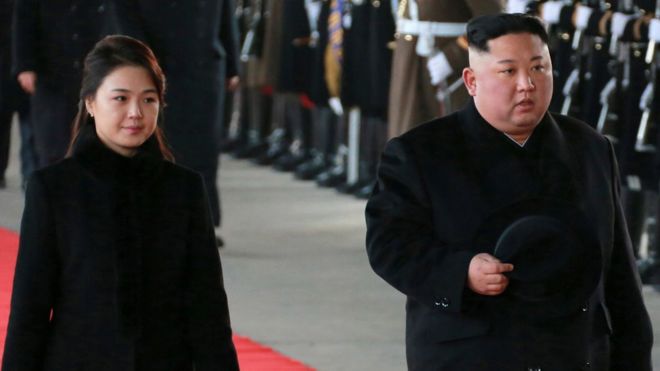
North Korean leader Kim Jong-un and his wife Ri Sol-ju as they prepare to leave for China from Pyongyang, North Korea, 7 January 2019Image copyrightEPA
Image captionMr Kim is visiting China with his wife Ri Sol-ju, state media report

North Korean leader Kim Jong-un has arrived in Beijing for an unannounced visit, at the invitation of Chinese President Xi Jinping.

Mr Kim will be in China until 10 January with his wife Ri Sol-ju, according to state media reports.

The visit comes amid reports that negotiations are under way for a second summit between Mr Kim and US President Donald Trump.

The two met last June, the first such meeting for a sitting US president.

Speculation had grown on Monday that Mr Kim was possibly making his way to China after South Korea’s Yonhap news reported that a North Korean train had been seen crossing the border.

Dozens of security vehicles and officials blocked roads around the train station in the border town of Dandong.

Hotel guests in Dandong had also not been allowed to enter rooms that faced the border, with news outlet Kyodo calling this an “apparent move to prevent the train from being seen”.

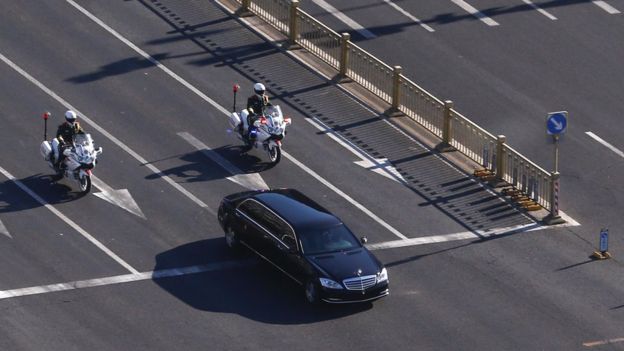
A vehicle that is part of a motorcade that is believed to be carrying North Korean leader Kim Jong Un makes its way through central BeijingImage copyrightREUTERS

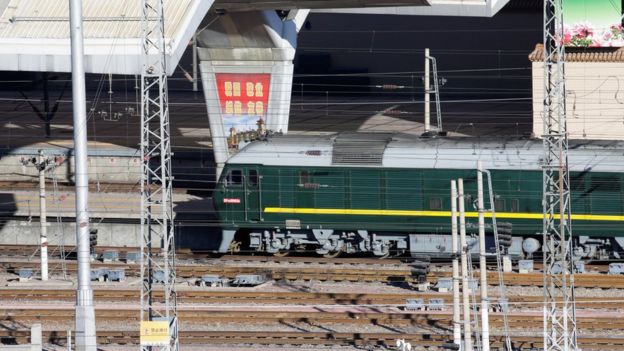
Both countries’ media confirmed the visit on Tuesday morning. Mr Kim’s distinctive green and yellow train arrived at a station in Beijing later in the day.

The train, the same one used during Mr Kim’s first visit to China, resembles the one used by his father Kim Jong-il during his visits to China and Russia in 2011.

A motorcade with heavy security was later seen driving through central Beijing.

A train believed to be carrying North Korean leader Kim Jong Un arrives at Beijing Railway Station in Beijing, China January 8, 2019.Image copyrightREUTERS
Image captionMr Kim travelled to Beijing on his distinctive personal train

Mr Kim’s visit, during which he is being accompanied by several leading North Korean officials, is his fourth to China in less than a year.

Tuesday is also reportedly Mr Kim’s 35th birthday, though his date of birth has never been confirmed by Pyongyang.

China is an important diplomatic ally for North Korea, and one of its main sources of trade and aid.

“[Mr] Kim is eager to remind the Trump administration that he does have diplomatic and economic options besides what Washington and Seoul can offer,” Harry J Kazianis, director of defence studies at the Centre for the National Interest told Reuters.

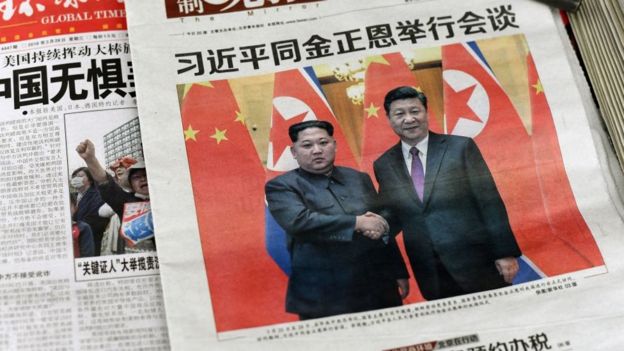
Images of Xi Jinping with Kim Jong Un, are displayed at a newspaper stand in Beijing on March 28, 2018Image copyrightGETTY IMAGES
Image captionMr Kim’s first visit to China came in March last year

Mr Kim, unusually, did not meet Mr Xi for the first six years of his leadership of North Korea.

But last year, he visited China three times. None of the trips was announced in advance.

The BBC’s Laura Bicker in Seoul says two of the trips, which took place ahead of the historic summits with the South Korean leader Moon Jae-in and Mr Trump, were seen by some as a chance to co-ordinate strategy.

The latest three-day visit, our correspondent says, is likely to fuel speculation that a second US-North Korean summit will take place soon.

Earlier this week, Mr Trump said a location for another meeting between the two would be announced in the not-too-distant-future.

Mr Trump told reporters in Washington DC that “a good dialogue” was taking place with North Korea, but that sanctions on Pyongyang would remain in place.

In his annual new year’s speech last week, Mr Kim said he was committed to denuclearisation, but warned that he would change course if US sanctions remained.

Diplomatic progress between Mr Trump and Mr Kim has stalled since the Singapore summit. Both parties signed a pledge at the time to denuclearise the Korean peninsula, though it was never clear what this would entail.

05/01/2019

Xi orders armed forces to enhance combat readiness

CHINA-BEIJING-XI JINPING-CMC-MEETING (CN)

Chinese President Xi Jinping, also general secretary of the Communist Party of China (CPC) Central Committee and chairman of the Central Military Commission (CMC), delivers a speech at a CMC meeting held in Beijing, capital of China, Jan. 4, 2019. (Xinhua/Li Gang)

BEIJING, Jan. 4 (Xinhua) — President Xi Jinping Friday ordered the Chinese armed forces to enhance their combat readiness from a new starting point and open new ground for developing a strong military.

Xi, also general secretary of the Communist Party of China (CPC) Central Committee and chairman of the Central Military Commission (CMC), made the instruction at a CMC meeting held in Beijing.

Hailing the landmark, pioneering and historic military achievements since the 18th CPC National Congress, Xi said the armed forces had resolutely safeguarded national sovereignty, security and development interests and withstood complex situations and severe struggles.

“The world is facing a period of major changes never seen in a century, and China is still in an important period of strategic opportunity for development,” he said, warning that various risks and challenges were on the rise.

The entire armed forces should have a correct understanding of China’s security and development trends, enhance their awareness of danger, crisis and war, and make solid efforts on combat preparations in order to accomplish the tasks assigned by the Party and the people, Xi said.

Regarding combat capability as the only and fundamental criterion, Xi ordered all work, forces and resources to focus on military preparedness and ensure a marked progress in this regard.

Xi stressed the armed forces’ ability to respond quickly and effectively to contingencies, asking them to upgrade commanding capability of joint operations, foster new combat forces, and improve military training under combat conditions.

Party and government departments and agencies at the central and local levels are required to support the defense and military development.

Xu Qiliang, a CMC vice chairman, presided over the meeting, and Zhang Youxia, the other CMC vice chairman, announced the decision to give awards to 10 model units and 20 model individuals. They received awards from leaders, including Xi.

Xi also signed a mobilization order for the training of the armed forces, the CMC’s first order in 2019.

01/01/2019

Xi, Trump exchange congratulations over 40th anniversary of China-U.S. diplomatic ties

BEIJING, Jan. 1 (Xinhua) — Chinese President Xi Jinping and U.S. President Donald Trump on Tuesday exchanged congratulations on the 40th anniversary of the establishment of China-U.S. diplomatic relations.

In his congratulatory message, Xi said China-U.S. relations have experienced ups and downs and made historic progress over the past 40 years, bringing huge benefits to the two peoples and contributing greatly to world peace, stability and prosperity.

History has proved that cooperation is the best choice for both sides, Xi said.

Currently, China-U.S. relations are in an important stage, he noted.

“I attach great importance to the development of China-U.S. relations and am willing to work with President Trump to summarize the experience of the development of China-U.S. relations and implement the consensus we have reached in a joint effort to advance China-U.S. relations featuring coordination, cooperation and stability so as to better benefit the two peoples as well as the people of the rest of the world,” Xi said.

For his part, Trump said Jan. 1, 2019 marks the 40th anniversary of the establishment of U.S.-China diplomatic relations.

Great progress has been made in the development of bilateral ties over the past years, he noted.

Trump said it is his priority to promote cooperative and constructive U.S.-China relations, adding that his solid friendship with President Xi has laid a firm foundation for the great achievements of the two countries in coming years.

30/12/2018

Xi, Trump have telephone conversation, agree to implement consensus in Argentina meeting

BEIJING, Dec. 30 (Xinhua) — Chinese President Xi Jinping and U.S. President Donald Trump on Saturday held a telephone conversation, expressing their willingness to push for implementation of their agreements reached during the G-20 summit in Argentina.

Trump wished Xi and the Chinese people a happy new year, saying that the U.S.-China relations are very important and closely followed by the whole world.

He said he values the great relations with Xi, adding that he is pleased to see the teams of both countries are working hard to implement the important consensus reached between him and Xi during their meeting in Argentina.

Trump said relevant talks and coordination are producing positive progress. He hopes results will be reached to the benefit of both U.S. and Chinese peoples as well as people of all nations.

Xi, for his part, extended best wishes to Trump and the U.S. people upon the arrival of the new year.

Xi said both he and Trump hope to push for a stable progress of the China-U.S. relations, adding that the bilateral ties are now in a vital stage.

The Chinese president said he and Trump had a very successful meeting early this month and reached important consensus in Argentina.

The teams from both countries have since been actively working to implement such consensus, he said, expressing hopes that both teams can meet each other halfway and reach an agreement beneficial to both countries and the world as early as possible.

Xi said next year marks the 40th anniversary of the establishment of diplomatic ties between the United States and China, adding that China attaches great importance to the development of bilateral relations and appreciates the willingness of the U.S. side to develop cooperative and constructive bilateral relations.

China is willing to work with the United States to summarize the experience of 40 years of the development of China-U.S. relations, and strengthen exchanges and cooperation in fields of economy and trade, military, law enforcement, anti-drug operations, local issues and culture, Xi said.

Xi added that China is also willing to work with the United States to maintain communication and coordination on major international and regional issues, respect each other’s important interests, promote China-U.S. relations based on coordination, cooperation and stability, and let the development of bilateral relations better benefit the two peoples and people around the world.

The two heads of state also exchanged views on international and regional issues of common concern such as the situation on the Korean Peninsula. Xi reiterated that China encourages and supports further talks between the United States and the Democratic People’s Republic of Korea, and hopes for positive results.

19/12/2018

China marks 40th anniversary of reform and opening-up

CHINA-BEIJING-40TH ANNIVERSARY OF REFORM AND OPENING-UP-CELEBRATION (CN)

Chinese President Xi Jinping, also general secretary of the Communist Party of China (CPC) Central Committee and chairman of the Central Military Commission, addresses a grand gathering to celebrate the 40th anniversary of China’s reform and opening-up at the Great Hall of the People in Beijing, capital of China, on Dec. 18, 2018. (Xinhua/Yao Dawei)

BEIJING, Dec. 18 (Xinhua) — China held a grand gathering Tuesday to celebrate the 40th anniversary of the country’s reform and opening-up, a great revolution that has changed the destiny of the Chinese nation and also influenced the world.

President Xi Jinping and other Chinese leaders attended the event which began at around 10 a.m. at the Great Hall of the People in Beijing.

Premier Li Keqiang presided over the meeting.

The celebration started with all participants rising to sing the national anthem.

Wang Huning, a member of the Standing Committee of the Political Bureau of the Communist Party of China (CPC) Central Committee, read a decision to award the personnel who have made outstanding contributions to the country’s reform and opening-up.

The people are “the creators of the great wonder of reform and opening-up” and “the source of power” to drive the campaign started 40 years ago, Wang said.

According to the decision made by the CPC Central Committee and the State Council, 100 Chinese were awarded the medals of reform pioneers and 10 foreigners were honored with China reform friendship medals.

Chinese leaders presented the medals to the prize winners.

18/12/2018

Xi Jinping says China ‘will not seek to dominate’

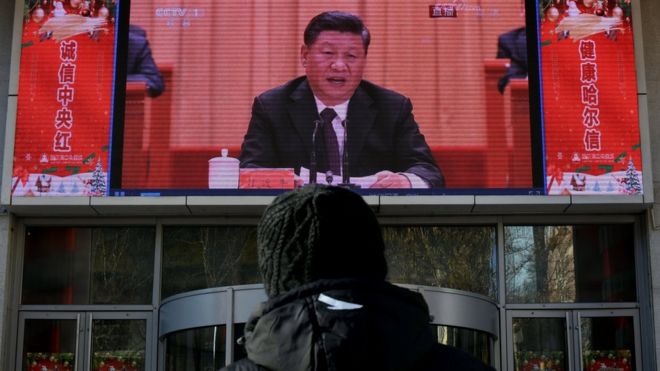
man stands and watches a large screen during President Xi Jinping"s speech at a grand gathering to celebrate the 40th anniversary of China"s reform and opening-up in Beijing on December 18, 2018 in Harbin, ChinaImage copyrightGETTY IMAGES

Chinese President Xi Jinping has vowed that his country will not develop at the expense of other nations, in a speech marking 40 years since China introduced major economic reforms.

However, he also said that the global superpower would not be told what to do by anyone.

Late leader Deng Xiaoping’s campaign of “reform and opening up” began four decades ago.

The resulting growth has made China the second-largest economy in the world.

Hundreds of millions of people have been lifted out of poverty but in recent years China has struggled with mounting debt and slowing economic growth.

Mr Xi said despite his country’s economic achievements, China would “never seek global hegemony” and also highlighted its contributions towards a “shared future for mankind”.

He did not mention the current trade dispute with the United States.

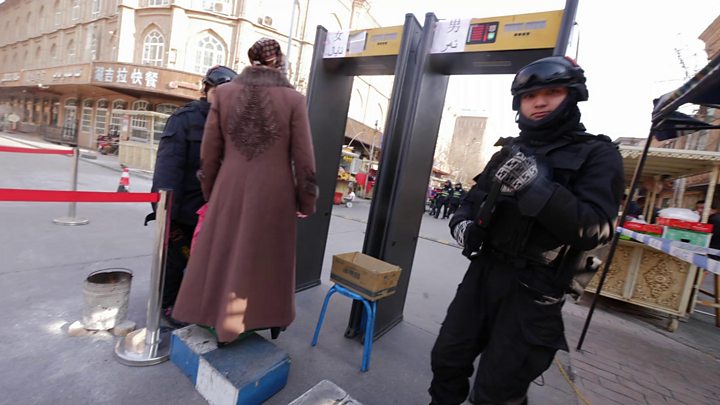
China continues to crack down on political dissent and is accused of locking up hundreds of thousands of Muslims without trial in the western region of Xinjiang.

Its militarisation of islands in the South China Sea – home to vital shipping lanes – has sparked concerns among Asian neighbours that it seeks to dominate the region.

Critics also say that while China is helping to build much-needed infrastructure across Asia and Africa, it is saddling countries with billions in debt in a bid to gain strategic influence.

Mr Xi spent much of his lengthy speech listing examples of China’s progress over the past decades, praising them as “epic achievements that moved heaven and Earth”.

He said that given its success, “no-one is in a position to dictate to the Chinese people what should or should not be done”.

At the same time, he stressed what he described as Chinese efforts to work towards the greater global good, saying Beijing was a “promoter of world peace”, a “defender of international order” and holding “a leading role in dealing with climate change”.

China’s economic reform was initiated by then leader Deng Xiaoping in 1978 and the programme was ratified on 18 December that year.

The reform path turned the country away from the old-style communism of Mao Zedong when collectivisation had led to an impoverished and inefficient economy.

The transformation focussed on agricultural reform, private sector liberalisation, industry modernisation and opening to international trade.

Xi Jinping described the reforms as a “break from the shackles” of previous mistakes.

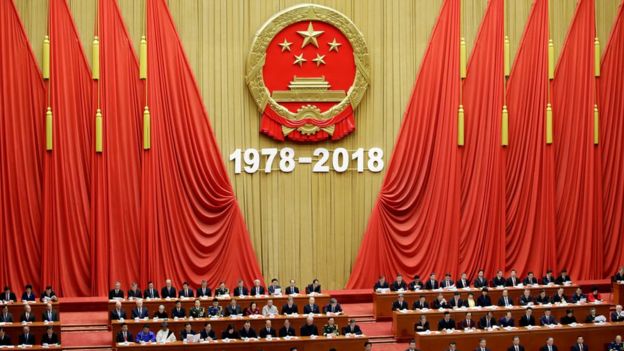
The audience of Xi Jinping's speech in the Great Hall of the PeopleImage copyrightREUTERS
Image captionChina’s reform process was kicked off in 1978

He said the last 40 years had been a “quantum leap for socialism with Chinese characteristics,” driving China’s “great rejuvenation in modern times”.

The Chinese president made no direct mention of the current trade dispute with the US but stressed his country’s contribution to economic globalisation and international order.

The row with the US has led to a spiral of tit-for-tat tariffs with potentially serious economic consequences for both China and the US should they fail to resolve the dispute.

In October US Vice-President Mike Pence accused China of a raft of illiberal economic policies, saying that “while Beijing still pays lip service to ‘reform and opening’, Deng Xiaoping’s famous policy now rings hollow”.

No political changes

Despite the economic reforms, the past decades have not brought change to China’s rigid one-party system of communist rule.

China’s president gave his speech on Tuesday in the Great Hall of the People in Beijing’s Tiananmen Square, where calls for political reforms were brutally crushed by the military in 1989.

Media captionJohn Sudworth reports from Xinjiang, where all filming and reporting by foreign media is tightly controlled

Xi Jinping is widely seen as China’s most influential leader since Mao Zedong. In 2017, he cemented his power, enshrining his political views in the constitution.

In his address, Mr Xi reiterated his belief in strengthening the party leadership and praised Beijing’s crackdown on corruption.

Critics say the rule of Xi Jinping has been marked by an ever-intensifying crackdown on political dissent and any groups that the Communist Party sees as a threat to its authority, such as unofficial Christian churches and labour activists.

18/12/2018

Xi meets with Macao SAR chief executive

CHINA-BEIJING-XI JINPING-MACAO SAR CHIEF EXECUTIVE-MEETING (CN)

Chinese President Xi Jinping (R) meets with Chief Executive of the Macao Special Administrative Region (SAR) Chui Sai On, who is on a duty visit, in Beijing, capital of China, Dec. 17, 2018. (Xinhua/Xie Huanchi)

BEIJING, Dec. 17 (Xinhua) — President Xi Jinping on Monday met with Chief Executive of the Macao Special Administrative Region (SAR) Chui Sai On, who is on a duty visit to Beijing.

During the meeting, Xi heard a report by Chui on Macao’s current situation and the Macao SAR government’s work.

Xi said that over the past year, the Macao SAR government, under Chui’s leadership, had faithfully fulfilled its duties, been prudent and steady in its work style, and implemented the “one country, two systems” policy and the Macao SAR Basic Law.

The Macao SAR government had improved the institutions and mechanisms for safeguarding national security, proactively taken part in the development of the Guangdong-Hong Kong-Macao Greater Bay Area and in the Belt and Road Initiative, promoted the proper diversification of the economy, improved the livelihood of the people, and strengthened the disaster prevention and reduction system, winning the praise of the Macao society, Xi said.

“The central government fully endorses the work by Chui and the Macao SAR government,” he said.

In the process of reform and opening up of the new era, Hong Kong and Macao still have a special status and unique advantages, and can still play an irreplaceable role, Xi said.

Xi said he believed the compatriots of Macao would seize the opportunities, expand the space of development and foster new drivers of growth by integrating the SAR’s own development into the development of the country, and greet the 20th anniversary of Macao’s return to the motherland with new achievements.

18/12/2018

Xi Jinping: The man who leads China’s reform into a new era

BEIJING, Dec. 17 (Xinhua) — Wang Jun is a deputy editor and main author of the book “A Study of Xi Jinping Thought on Reform and Opening-Up.”

Paper and documents pile up in his office. These are what his team has collected for research in writing the book.

“Xi Jinping is a man whole-heartedly devoted to reform and opening-up,” said Wang, president of the Guangdong Academy of Social Sciences.

In 2018, China celebrates the 40th anniversary of the reform and opening-up, a cause started by Deng Xiaoping and is now being carried forward by Xi.

In late October, Xi came to Guangdong Province. He visited a reform-themed exhibition at the foot of the Lotus Mountain in Shenzhen, spending more than an hour inside the museum halls.

Xi paused in front of a large painting.

It was a morning rush hour scene of the city in the 1980s. A giant poster stood tall before the Shekou industrial zone to constantly remind the city’s early builders to seize the moment and strive for economic miracles.

It was not the first time Xi visited Shenzhen, a prominent test-bed of China’s reform and opening-up.

“Coming to Shenzhen, Guangdong again (because) we want to declare to the world that China will never drag its feet on reform and opening-up! China is certain to show the world impressive new achievements in the next 40 years!” Xi said.

Six years ago, when Xi was elected general secretary of the Communist Party of China (CPC) Central Committee, reform entered what many people call a “deep-water” zone. The CPC faced arduous challenges in reform, some foreign media claimed.

Xi has withstood the pressure and led China to achieve so much, Wang said.

The Chinese economy is being transformed from fast growth to high-quality development. In 2017, the growth picked up for the first time in six years, reaching 6.9 percent, way above the 3.7-percent global economic growth.

Over the past six years, more than 70 million new jobs have been created, more than the population of Britain. The size of the Chinese middle-income group has swelled to 400 million, constituting a huge consumer market in the world.

Overseas media called Xi “a far-sighted reformer” and “a serious reformer who built a unique path for China’s future” whose clear vision for reform “has inspired the nation.”

DETERMINED TO REFORM

When China began the reform and opening-up in 1978, Xi was studying chemical engineering at Tsinghua University. His father, Xi Zhongxun, was then the Party chief of Guangdong Province.

The elder Xi had high hopes for reform. He sought Deng’s permission for “taking the first step” to set up a special economic zone that would break the new ground for reform.

The father’s courage and sense of mission left a deep impression on the son.

In the early 1980s, as Xi senior was promoted to Beijing, Xi Jinping was sent down to work in the county of Zhengding, Hebei Province. He began his reform experiments there, starting with the rural land contract trial, being the first in Hebei to adopt this practice already tested in southern provinces.

As the county Party chief, Xi already knew how hard it was to press ahead with reforms. He was critical of the “middle-level obstruction” issue and solved it by appointing willing and competent cadres to push forward reforms.

Xi’s reputation as a reformer was reinforced as he advanced his political career. In Ningde, Xiamen and Fuzhou of Fujian Province, Zhejiang Province and Shanghai Municipality, he kick-started innovative reform strategies to tackle different sorts of challenges.

“In a real sense, Xi comes from a reformer family. More important, Xi is deeply committed to reform,” said Robert Kuhn, a leading U.S. expert on China and chairman of the Kuhn Foundation, adding that when they met in 2005 and 2006, Xi spoke a lot on the importance of “reform in all facets.”

“Xi’s reform is derived from his experience,” said Shi Zhihong, a former deputy director of the Policy Research Office of the CPC Central Committee. “He knew that the rigid old paths would lead nowhere, and reform was a must.”

In 2012, reflecting on China’s reform cause, Xi spoke highly of Deng. “If there were no Deng who guided our Party to make the historic decision to reform and open up, we couldn’t have achieved this much,” Xi said.

“The reform and opening-up is a great awakening of our Party, and it gave rise to great theoretical and practical innovations,” he added.

Xi’s thinking and practices of reform in provinces have been compiled into books, from which observers say one can trace the roots of China’s comprehensive deepening reform that is being rolled out in the new era.

“FIFTH MODERNIZATION”

On Nov. 15, 2012, Xi met the press right after being elected general secretary of the CPC Central Committee. He spoke of the need to adhere to reform and opening-up to continue liberating social productive forces, resolve people’s difficulties in life and work and stay committed to the path of common prosperity.

At the moment, Xi’s resolve to carry on the reform could not be more obvious. But Xi knew how hard it would be. All low-lying fruits have been picked, what is left are hard bones, he said.

People following Xi in his reforms need to be brave enough to cross hurdles in thinking and break through the blockade of vested interest.

Xi came to Guangdong in his first domestic inspection tour after assuming the Party’s top post. It was not by coincidence that in 1992 Deng visited Guangdong in his now well-known “southern tour.” Deng’s talks during the tour were instrumental in advancing the reform and opening-up.

In his 2012 visit, Xi paid tribute to Deng’s bronze statue. “Reform and opening-up is a make-or-break move that decides China’s destiny,” Xi said. “There is no pause or backtrack.”

The Financial Times said, “Mr. Xi is hardly the first Chinese leader to talk about the need for reform. But the tone of the pronouncements emerging from his weekend trip has been more forceful than those employed by past leaders.”

For Xi, reform must be carried on along the path of socialism with Chinese characteristics. Neither the old path nor the detour could work.

Xi insisted that reform shall suit China’s own needs for change, and China would not reform to make others happy. “Only the wearer knows whether the shoes fit or not,” he said.

The overall goal of deepening reform is to improve and develop the system of socialism with Chinese characteristics and modernize China’s system and capacity for governance.

This overarching objective is described by observers as China’s “Fifth Modernization” drive.

According to Xi, the reform must balance several pairs of relations: between mind emancipation and truth-seeking; overall advancement and breakthroughs in key areas; top-level design and crossing the river by feeling the stones.

He Yiting, vice president of the Party School of the CPC Central Committee, said Xi’s thought on reform has enriched and developed the theory of socialism with Chinese characteristics.

Zheng Yongnian, director of the East Asian Institute at the National University of Singapore, said Xi answered the questions related to what to change, how to change in the new round of reform and who will implement it.

In November 2013, Xi presided over the third plenary session of the 18th CPC Central Committee that issued an extensive reform plan and a seven-year implementation timetable.

China’s deepening reform in all areas has caught the world’s attention. Some overseas media said the reform gave a big impetus to China’s lasting and inspiring rise.

Since then, the succeeding Party plenums have all stressed deepening reform, which constitutes a prominent fixture in Xi Jinping Thought on Socialism with Chinese Characteristics for a New Era.

Xi has become the leader in China’s new round of reform and opening-up.

LEAD BY ACTION

After the third plenary session of the 18th CPC Central Committee, Xi served as the head of a leading group on deepening overall reform. When it was changed to a committee, he remained as the chair.

In the meantime, he also chairs a number of high-level committees and commissions on areas such as law-based governance, foreign affairs, cyber-security and informatization.

By heading these groups, Xi can have face-to-face discussions with people working in different areas and better learn about actual situations.

Xi went through each version of major reform documents, added his personal insights and pushed for major progress.

Take the market’s role as an example. In 2013, the Party decided to let the market play a “decisive” role in allocating resources. It sent a strong signal of policy adjustment as the original wording — “basic” — had remained unchanged since 1992.

When drafting the change, some people said it was still too early to make such a big leap. It was Xi who decided to make the change.

“Many of the major reforms would not have been possible if it weren’t Xi,” said an academic who was involved in drafting the document.

Xi led reform on multiple fronts to achieve breakthroughs: the gaps between urban and rural populations have been narrowed, the two-child policy initiated and pushed to yield results, splurge on government bills curbed, and vested interests broken up.

He constantly called on officials to have the perseverance to hammer away at obstacles until a task is done and make concrete, meticulous and effective efforts in reform.

Between late 2012 and late 2017, Xi took 50 domestic inspection tours, in which he researched and pushed for reform.

The reform progress encompasses an expansive scope of fields.

In the economy, he made the judgment of new normal, initiated the supply-side structural reform and drew a clear line between the government and the market.

In science, he set the goal of turning China into one of the world’s science centers and an innovation high ground.

He led the anti-corruption fight to form a crushing tide and has won a sweeping victory.

He launched a major institutional reform to reshape Party and state organs, including the establishment of the National Supervisory Commission and the Commission for Law-based Governance of the CPC Central Committee.

Reform progress is reported on other fronts: people have stronger cultural confidence and sense of fulfillment; environmental protection systems are improved; and the armed forces have been reshaped.

In the five years since late 2012, more than 1,500 reform measures were issued. Reform picked up pace after the 19th CPC National Congress in late 2017.

In his 2018 New Year speech, Xi called on the Chinese people to “cut paths through mountains and build bridges across rivers” to advance reform.

Wang, the book author, said Xi has made breakthroughs in a number of tough and stalemated issues.

“Xi has been and is a remarkably comprehensive reformer, whose reforms are broader in scope than those of prior generations,” Kuhn said.

FOR THE PEOPLE

In April, Xi told visiting UN Secretary-General Antonio Guterres that “everything we do is for people’s happiness and national rejuvenation and to seek common ground for the world.”

Xi has been stressing that reform should focus on what the people care about and expect the most. The aim, he says, is to give the people a stronger sense of fulfillment.

That may be felt more directly from the rise of earnings. The average income of Chinese grew by 7.4 percent annually over the past six years, eclipsing the GDP growth.

In October, wage-earners hailed a personal income tax reform which exempts those who earn less than 5,000 yuan (725 U.S. dollars) a month.

Many migrant workers also made it to the country’s expanding middle-income group.

Zou Bin is one of them who benefit from the reform. He rose from laying bricks at construction sites to heading a team in the Fortune 500 firm China Construction Group as a project manager.

This year, Zou started serving as a deputy to the National People’s Congress, the top legislature. His first legislative proposal was, not surprisingly, about deepening construction labor reforms.

Poverty reduction is another milestone. In the past six years, about 70 million rural people had been lifted over the poverty line.

William Jones, Washington bureau chief of the Executive Intelligence Review news magazine, said ending poverty had long been regarded a major task for humanity but until recently, was seen as a Utopian dream.

“With China, that dream is now becoming a reality,” he said.

Under Xi’s lead, China’s social security network has expanded, with the basic medical insurance covering 1.3 billion people and the social old-age insurance covering more than 900 million.

This summer, a domestic film shot up to box office stardom. “Dying to Survive” tells a fictional story of a shopkeeper who illegally imports cheap Indian drugs and sells them to cancer patients in China.

The blockbuster touched a public sore point of costly drugs. But fortunately, the issue is being addressed.

Policies have been introduced to exempt import tariffs on many cancer drugs, and efforts are on-going to bring more life-saving medicines into the medical insurance program.

Xi’s reform also aims to nurture a great environment to conduct business.

The World Bank Group said in its annual “Doing Business Report” that China advanced to a global ranking of the 46th this year, up from the 78th last year, as the country implemented the largest number of reforms in the East Asia and Pacific region.

The “2018 China Business Report” by the American Chamber of Commerce in Shanghai also found that 83 percent of respondents in manufacturing sector and 81 percent in retail achieved profit, while 61.6 percent of companies expected to increase their China investment in 2018.

Private sectors in China have entered a new phase of development.

In 2018, a total of 28 Chinese private companies were enlisted in the Fortune 500, compared with a lone company in 2010.

CONNECTING THE WORLD

China’s reform has benefited the world. China contributed to global growth by an annual average of 18.4 percent in the past 40 years, second only to the United States, according to the National Bureau of Statistics.

In 2017, China accounted for 27.8 percent of global economic growth, more than that of the United States and Japan combined.

CRRC Corporation Limited (CRRC), the world’s leading supplier of rail transit equipment, has improved infrastructure and brought jobs to more than 100 countries and regions since it was founded three years ago.

“President Xi visited our workshop in 2015, asking us to speed up innovation and create a brand for ‘made-in-China’ products, which has promoted our modern enterprise system reform and CRRC’s integration with the global economy,” said a CRRC executive.

Facing mounting protectionism and a stagnant world economy, Xi proposed to foster a new type of international relations featuring win-win cooperation and follow the principle of achieving shared growth through discussion and collaboration in engaging in global governance.

An important feature of Xi’s reform is the integration of promoting domestic reform with the participation of global governance reform, said Shi.

Xi’s proposition of building a community with a shared future for humanity reflects the pursuit of common values, Shi added.

When Xi was governor of east China’s Fujian Province 18 years ago, he pushed for a demonstration project to help the Eastern Highland Province of Papua New Guinea with Juncao and dry-land rice planting.

The Juncao technology cultivates edible and medicinal mushroom from special wild grass so that trees do not need to be cut for mushroom growing. The technology has brought the hope of poverty eradication across the globe.

The success of Juncao is an epitome of the advancement of the Belt and Road Initiative, proposed by Xi to promote a shared prosperity of humanity by cooperation on trade and infrastructure. So far, more than 140 countries and international organizations have signed agreements with China to jointly build the Belt and Road.

Ecological degradation is a key global challenge. Xi attended the UN Climate Change Conference in Paris in November 2015. China is one of the first countries to sign the Paris Agreement on climate change. Xi personally handed over China’s instruments of joining the Paris Agreement to then UN Secretary-General Ban Ki-moon in September 2016.

In the past six years, China has kept its promise to protect the Earth through deepening domestic reforms, including the implementation of 10 air pollution prevention and control measures, the promotion of a river chief system and introduction of a national park mechanism. Many of the reforms were initiated by Xi.

Xi brought China’s opening up to a new level. He designed and pushed forward the opening of the world’s first import-themed national-level expo. At the China International Import Expo, he reiterated opposition to trade protectionism and commitment to an open world economy.

The expo, held in Shanghai in November this year, was attended by over 3,600 companies, including nearly 180 American companies. Agreements on intended one-year purchases of goods and services were valued at 57.83 billion U.S. dollars.

China announced a series of measures to further open up its economy, including broadening market access, easing foreign equity restrictions, lowering automobile import tariffs and increasing imports. The number of free trade zones has risen to 12 in five years.

“Openness brings progress while seclusion leads to backwardness,” Xi said.

Xi led China to be more involved in international economic cooperation, turning the country into a more mature modern market economy, said Wang.

ON THE WAY

“Xi has transformed China at an astonishing pace,” Geoff Raby said in his column in the Australian Financial Review. “At over 8,000 U.S. dollars per capita, China is now at the higher end of the World Bank’s middle-income economy range, and some 40 percent of that was added during Xi’s tenure.”

“This is the new order in Asia. It is no longer emerging, it has arrived,” he said.

The People’s Republic of China will celebrate its 70th anniversary next year. The Chinese nation with a history of humiliation has stood up, grown rich and is becoming strong.

Xi’s reform has laid a firm foundation for the Chinese nation’s rejuvenation. It will be the first time in human history that a country of more than 1 billion people march into modernization as a whole.

China’s reform has inspired the world: developing countries can walk a new path to modernization that is different from the West. It breaks the “end of history” and “Western-centered” mentalities.

The year 2018 also marks the 200th anniversary of Karl Marx’s birth. China’s successful practice has injected new vitality into the classic theory named after him.

What Xi aims to develop is a model of how a rising country can avoid confrontation with an established one. It will show that different civilizations can enrich exchanges and co-exist peacefully.

The reform is still on the way. It is no easy task to change the world’s biggest developing country. China’s per capita GDP has surpassed 8,000 U.S. dollars, yet far from 57,000 dollars of the United States.

China is still facing an unbalanced industrial structure, weak innovation and financial risks.

Xi has many challenges ahead. With great courage, he is ready to lead the Party and the country to forge ahead with the reform.

“A lot of progress has been made over the past few years,” Xi said. “But much can still be achieved as we embark on the new journey.”

13/12/2018

Xi holds talks with Ecuadorean president, eyeing steady development of bilateral ties

CHINA-BEIJING-XI JINPING-ECUADOR-PRESIDENT-TALKS (CN)

Chinese President Xi Jinping (L, front) holds a welcoming ceremony for Ecuadorean President Lenin Moreno Garces ahead of their talks at the Great Hall of the People in Beijing, capital of China, Dec. 12, 2018. (Xinhua/Li Tao)

BEIJING, Dec. 12 (Xinhua) — President Xi Jinping on Wednesday held talks with Ecuadorean President Lenin Moreno at the Great Hall of the People in Beijing, calling for the healthy and steady development of the bilateral ties.

Recalling his state visit to the South American country in 2016, Xi said the healthy and steady development of China-Ecuador ties goes with not only the fundamental interests of the two countries and peoples but also the trend of peace, development and win-win cooperation.

During the 2016 visit, the two countries established a comprehensive strategic partnership, ushering in a new chapter for the bilateral relationship, Xi said.

Xi said he appreciates President Moreno’s commitment to deepening the friendly cooperation between the two countries since Moreno took office last year.

Xi stressed that the two sides should increase interactions to intensify their strategic communication and coordination and exchange experience on governance, so as to enhance mutual understanding and support for each other’s path of development and continue backing each other firmly on issues involving their core interests and major concerns.

Noting that Ecuador’s participation in the construction of the Belt and Road is welcomed by the Chinese side, Xi expects the two sides to jointly promote cooperation in areas such as infrastructure, production capacity, agriculture, information technology, new energy and environmental protection.

“China welcomes Ecuador to actively explore the Chinese market and share opportunities brought by China’s development,” Xi said.

China’s financing cooperation with Ecuador is conducted on the basis of equality, mutual benefit and business principles, without attaching any political condition, said Xi.

Noting that the Chinese government requires Chinese enterprises in Ecuador to abide by local laws and regulations and run business fairly in the market, Xi expects the Ecuador side to create a good investment environment and protect their legitimate rights and interests.

He called for closer people-to-people and technology exchanges, urging both sides to carry out law enforcement cooperation to guarantee normal exchanges of personnel, economy and trade.

Xi also said China will continue to support Ecuador’s post-earthquake reconstruction and its disaster prevention work.

China and Ecuador have same or similar positions on major international and regional issues, said Xi, calling on the two sides to collaborate closely to safeguard multilateralism, promote reform of the global governance system and defend the legitimate rights and interests of developing countries.

Moreno expressed gratitude for China’s assistance on Ecuador’s economic and social development, especially for the help offered after Ecuador was hit by an earthquake in 2016.

Moreno said Ecuador is ready to actively take part in the Belt and Road Initiative and expand bilateral cooperation in various fields.

He welcomed and appreciated China’s financing cooperation with Ecuador and expects to expand exports to China. Moreno also expressed the will to enhance coordination and collaboration with China in multilateral affairs such as UN Sustainable Development Goals.

After the talks, the two leaders witnessed the signing of several cooperation documents, including a memorandum of understanding on jointly promoting the construction of the Belt and Road.

12/12/2018

Book of Xi’s remarks on Belt and Road Initiative published

BEIJING, Dec. 11 (Xinhua) — A compilation of remarks by President Xi Jinping on the Belt and Road Initiative (BRI) over the past five years has been published by the Central Party Literature Press.

The book contains 42 articles drawn from the speeches and public remarks made by Xi, beginning with a speech he delivered at Nazarbayev University, Kazakhstan, in September 2013 calling for jointly building the Silk Road Economic Belt, and ending with the one he delivered at the opening ceremony of the 8th Ministerial Meeting of the China-Arab States Cooperation Forum in July 2018.

The book, with about 130,000 Chinese characters, was compiled by the Institute of Party History and Literature of the Communist Party of China Central Committee.

The BRI, first proposed by Xi, has received warm responses from the international community, especially the countries along the BRI routes. Jointly pursuing the BRI is becoming a Chinese solution for the country to participate in global opening-up and cooperation, improve the global economic governance, push for common development and prosperity of the world and build a community with a shared future for humanity.

The book will be available nationwide starting Tuesday.

Law of Unintended Consequences

continuously updated blog about China & India

ChiaHou's Book Reviews

continuously updated blog about China & India

What's wrong with the world; and its economy

continuously updated blog about China & India