Chindia Alert: You’ll be Living in their World Very Soon
aims to alert you to the threats and opportunities that China and India present. China and India require serious attention; case of ‘hidden dragon and crouching tiger’.
Without this attention, governments, businesses and, indeed, individuals may find themselves at a great disadvantage sooner rather than later.
The POSTs (front webpages) are mainly 'cuttings' from reliable sources, updated continuously.
The PAGEs (see Tabs, above) attempt to make the information more meaningful by putting some structure to the information we have researched and assembled since 2006.
NEW DELHI (Reuters) – India sought to boost growth in a federal budget on Saturday that raised spending on farms and expressways and offered cuts inpersonal taxes, but the measures fell short of market expectations and battered stocks.
Prime Minister Narendra Modi’s government is grappling with the country’s worst slowdown in a decade, with falling employment, consumption and investment ratcheting up the pressure to revive growth.
The government estimates growth this year to March 31 will slip to 5%, the weakest pace since the global financial crisis of 2008-09. It also warned an expected rebound the following year might entail a blow-out in fiscal deficit targets.
Finance Minister Nirmala Sitharaman, presenting the budget for the financial year beginning April 1, said 2.83 trillion rupees ($39.8 billion) will be allocated toward agriculture and allied activities, up 5.6 percent on the previous year.
RELATED COVERAGE
India raises import taxes in move set to spook some foreign firms
The funds will be deployed to help farmers set up solar power generation units as well as establish a national cold storage system to transport perishables.
Sitharaman also vowed to spend $50.7 billion in coming years on a federal water scheme to address challenges facing one of the world’s most water-stressed nations.
Agriculture accounts for near 15% of India’s $2.8 trillion economy and is a source of livelihood for more than half of the country’s 1.3 billion population.
Sitharaman announced a new personal tax system including cuts for those ready to give up a myriad of tax breaks. She also abolished payment of dividend distribution tax by companies to spur investment.
“People have reposed faith in our economic policy,” Sitharaman said to the thumping of desks in parliament. “This is a budget to boost their income and enhance their purchasing power.”
Opposition parties slammed the budget, saying it had failed to address the slowdown in consumer demand and investment. “The government is in complete denial that the economy faces a grave macro economic challenge,” said former finance minister P. Chidambaram.
But higher government spending has put pressure on public finances, prompting caution from rating agencies. Sitharaman said the fiscal deficit for the current year would widen to 3.8% of GDP, up from 3.3% targeted for the current year.
Gene Fang, associate managing director, sovereign risk at Moody’s, said: “India’s 2020/21 budget highlights the challenges to fiscal consolidation from slower real and nominal growth, which may continue for longer than the government forecasts.”
GOVERNMENT SPENDING
For fiscal 2020/21 Sitharaman set the fiscal deficit at 3.5 percent. Moody’s said India’s government debt is already significantly higher than the average for Baa-rated sovereigns, a product of persistent fiscal deficits.
To help finance government spending, Sitharaman set a target for selling stakes in state firms at 2.1 trillion rupees for 2020/21, more than three times the amount expected this year.
She said the government will sell a part of its holding in state-run Life Insurance Corp, the country’s biggest insurance company.
But many experts said the measures did not go far enough to address the slowdown and structural flaws.
“In a normal scenario this budget would have been considered as good providing tax benefit to the common man, corporate and focus on farmers’ incomes, but the situation required more,” said Vinod Nair, head of research at Geojit Financial Services in Kochi.
Indian shares slid to a more than three-month low after a special trading session on Saturday, dented by what analysts said was a lack of sufficient stimulus measures. The NSE Nifty 50 index .NSEI closed 2.5% lower while the benchmark S&P BSE Sensex .BSESN fell 2.4%
“Markets had very high expectations from the budget … these expectations have not been met,” said Deepak Jasani of HDFC Securities.
The government also announced higher duties on a host of imports from walnuts to phone parts. Taxes on imports of pre-assembled printed circuit boards were raised to 20% from 10% and there were new taxes on mobile phones ringers and display panels in a bid to boost local manufacturing.
In its annual economic report released on Friday the government predicted growth would rebound to 6.0% to 6.5% in the fiscal year beginning April 1.
Some economists say global trade tensions and the outbreak of coronavirus in China pose a new risk to economic recovery by hitting cross-border commerce and supply chains.
NEW DELHI (Reuters) – India’s government has stepped up the purchase of air purifiers over the last two years, taking the number of devices in ministries to protect against deteriorating air quality to nearly 300, government data seen by Reuters showed.
Six federal ministries – including the health, foreign and home affairs – bought at least 159 air purifiers during 2018-2019 at a cost of 5 million rupees ($70,353), according to previously unpublished data obtained under a Right to Information (RTI) law.
That compares with at least 140 air purifiers bought for $55,000 during 2014-2017 for the six ministries and Prime Minister Narendra Modi’s office, as previously reported by Reuters. The latest data on purchases for Modi’s office was not available. (reut.rs/2ppjyBj)
The purchases come as the federal and city governments faced criticism for failing to address the problem of worsening air pollution, especially in the winter, and drew criticism from one activist.
“It’s absolutely criminal to spend taxpayers’ money in buying air purifiers for government officials,” said environmentalist Vimlendu Jha, who is a member of a government panel tasked with solving Delhi’s pollution crisis.
In November, the level of pollution in the capital forced authorities to shut schools, restrict the use of cars and declare a public health emergency.
A senior official at the environment ministry, which bears the most responsibility for tackling pollution, said there was no particular drive to buy purifiers to protect civil servants.
“The government is not spending a fortune by buying air purifiers. And it’s not that officials don’t get to inhale toxic air by confining themselves to their offices,” said the ministry official.
The six ministries and Modi’s office did not respond to requests for comment.
Air purifiers can cost up to nearly $1,000 and are too expensive for most Indians.
Per capita income in New Delhi, a city of more than 20 million, is about $400 a month and thousands of homeless people endure the cold and the toxic air while sleeping on the streets.
Reuters requested for data using the RTI law from the six ministries as it had comparable numbers previously reported in 2018. These were the ministries of foreign affairs, tourism, agriculture, health, home affairs and the federal think-tank Niti Aayog.
(Graphic: Modi’s government purifer purchases 2018-2019 link: here).
Of the total of 159 devices bought by the ministries, the home affairs ministry topped the list with 103 of them in 2018 and 2019, the data showed.
“All the air purifiers have been installed in various offices/rooms of this ministry,” the ministry said in its RTI response, adding the amount spent was 3.1 million rupees ($43,619).
In October and November, when New Delhi saw some its worst air pollution last year, the foreign ministry bought 12 purifiers. Four of them – bought for the minister’s office – were priced at nearly $1,000 each.
The federal health ministry bought 23 air purifiers in the last two years, including 14 in 2019, its highest annual purchases since 2015, the data showed.
AYODHYA/MUMBAI (Reuters) – Just six months after sweeping to re-election, Indian Prime Minister Narendra Modi has delivered on two major promises of his party’s Hindu agenda, electrifying his base but sowing unease among liberals and the nation’s large Muslim minority
The latest boost for Modi came on Saturday, when the Supreme Court handed Hindu groups control of a contested site where a 16th-century mosque was razed over two decades ago, paving the way for the construction of a temple there that has long been an election promise of the ruling Bharatiya Janata Party (BJP).
That followed New Delhi’s move in August to strip Muslim-majority Jammu and Kashmir of its special status as a state in what Modi’s government said was a bid to integrate the restive region with the rest of predominantly-Hindu India.
Now, the BJP may move towards delivering on its third traditional plank: Creating a uniform civil code that does away with the independence of religious communities on certain issues.
RELATED COVERAGE
Factbox: What does India’s ruling Hindu nationalist party want to achieve?
“After just a few months of Modi 2.0, they’ve accomplished two out of three (main cultural objectives). It’s quite possible that they will accomplish all three by next year,” said Milan Vaishnav, a senior fellow at the Carnegie Endowment for International Peace in Washington D.C.
“It’s striking that the government has moved with a clarity of purpose on its social agenda that’s completely absent when it comes to economic matters,” added Vaishnav in reference to the slowing of the country’s once red-hot economic growth.
Many Muslims have watched with a mix of fear and resignation as the BJP has morphed into the officially secular country’s near-undisputed political force.
The controversial site in the northern state of Uttar Pradesh has been one of the most explosive issues in the nation of 1.3 billion, where Muslims constitute about 14% of the population.
In 1992, a rally led by the BJP and affiliate organizations spiralled out of control and a Hindu mob destroyed the Babri Masjid or mosque in the city of Ayodhya. That triggered riots in which about 2,000 people, most of them Muslims, were killed across the country.
In its verdict on Saturday, the Supreme Court called the mosque’s demolition illegal but handed the plot of land to Hindus, who believe the site is the birthplace of Lord Ram, a much venerated god-king. The court directed that another plot in Ayodhya be provided to a Muslim group that contested the case.
In over a dozen interviews, Muslim community leaders, businessmen, and students said they respected the verdict but it exacerbated their sense of alienation.
“Why did the court then give a ruling which is completely one-sided? Was the court under pressure? We don’t know. We can’t trust anyone now. No door is open for us,” said local Muslim community leader Azam Quadri during evening prayers in Ayodhya.
“BEST TO BE NUMB”
While Modi himself has said the court verdict should not be seen as a “win or loss” for anyone, many Muslims Reuters spoke to expressed resignation after the ruling.
Some were bitter that a probe into the demolition has inconclusively dragged on for three decades and that many of the politicians accused of conspiring to take down the mosque are prominent BJP members. Those people have said the demolition was spontaneous and not planned.
“I feel humiliated by the Supreme Court verdict,” said one affluent Mumbai-based Muslim businessman, who declined to give his name. “Others don’t care. They have become numb. It’s best to be numb in Modi’s India.”
Some people believe that Hindu nationalists, galvanized by the Ayodhya triumph, could turn their attention to two other Uttar Pradesh mosques they believe Mughal conquerors built over the remains of Hindu temples centuries ago.
“This (verdict) seems to generate incentives for Hindus to take down mosques and resettle,” said Neelanjan Sircar, an assistant professor at Ashoka University near New Delhi.
Another likely move is the uniform civil code.
New Delhi has already taken steps toward creating such a code, with the BJP-led parliament in July outlawing the centuries-old right of a Muslim man to instantly divorce his wife. While many activists thought the Muslim custom was wrong, some Muslim groups said Modi was targeting them while turning a blind eye to discrimination in Hindu society.
For a factbox on the BJP’s plans, please see:
Despite the focus on social issues, political analysts predict the government and the BJP will have to shift attention quickly to a sagging economy and surging unemployment or risk losing popular support.
India, long touted as the world’s fastest-growing large economy, has seen economic expansion wither to six-year lows.
Two college students – one Hindu, one Muslim – in Uttar Pradesh’s capital Lucknow separately said after the court verdict that they hoped the government would now focus on economic issues.
“This case has gone on for so long… Now that it’s done with altogether, maybe more economic issues can come forward”, said Rajat Mishra, a business student.
“Attention can now move beyond topics of religion,” said medical student Irfan, 22, who declined to give his surname.
India has formally divided the state of Jammu and Kashmir into two new federally-administered territories.
In the new arrangement, Jammu and Kashmir is one territory, and Ladakh, which borders China, is separate.
The two new union territories are now ruled directly from the capital Delhi.
It’s part of a controversial move announced in August to tighten the Indian government’s control over the part of Kashmir it administers.
R K Mathur and Girish Chandra Murmu were sworn in as lieutenant governors of Ladakh and Jammu and Kashmir respectively on Thursday.
“Now the real participation of co-operative federalism will be seen. New highways, new railway lines, new schools, new hospitals will take the development of the people of Jammu and Kashmir to new heights,” Prime Minister Narendra Modi said at a public rally in the western state of Gujarat.
Union territories have far less autonomy from the federal government than states do.
The former state has long been one of the world’s most dangerous flashpoints and is a highly militarised area.
India and Pakistan both claim Kashmir in full, but control only parts of it.
How does this affect the people there?
Almost 98% of the state’s population will be in the union territory of Jammu and Kashmir, comprising two regions – the Muslim-majority Kashmir valley, which has about eight million people, and the Hindu-majority Jammu, which has about six million.
The third region, the newly created union territory of Ladakh, is a high-altitude desert inhabited by 300,000 people, with almost equal numbers of Muslims and Buddhists.
Workers from the previous state government will continue to retain their jobs in the new territories, the government said.
What’s the background?
On 5 August, the government revoked Kashmir’s special status, sparking protests in the Muslim-majority valley.
Article 370, as the constitutional provision guaranteeing special status was known, allowed the region a certain amount of autonomy, including special privileges in property ownership, education and jobs. This provision had underpinned India’s often fraught relationship with Kashmir.
Before the Bharatiya Janata Party-led government announced its decision to scrap the special status, it put the region under lockdown – mobile phone networks, landlines and the internet were cut off; and regional political leaders were placed under house arrest.
Media caption The children being ‘tortured’ in Kashmir
The region also witnessed protests where security forces often clashed with civilians. Thousands of activists and others were believed to have been picked up from their homes in the days that followed the surprise move.
Almost three months later, the situation is still far from normal.
On Tuesday, militants killed five migrant labourers in Kulgam district. Just a day before, a truck driver from outside the region was killed in Anantnag district.
Earlier this month, the Indian government restored mobile services 72 days after they were suspended.
But internet services continue to be suspended and most businesses remain closed – some in protest against the government, and others for fear of reprisals from militants opposed to Indian rule.
NEW DELHI/MUMBAI (Reuters) – India’s ruling Bharatiya Janata Party (BJP) is set to sweep two state polls next week, the first since Prime Minister Narendra Modi’s landslide win in a parliamentary election in May, a leading pollster said.
The BJP is set to comfortably win elections in the western state of Maharashtra and the northern state of Haryana, leaving the main opposition Congress party trailing, according to a survey by polling agency CVoter released on Friday.
CVoter estimates that a BJP-led alliance in Maharashtra will pick up 194 of the 288 seats on offer. In Haryana, the party is predicted to win 83 of the state’s 90 seats, leaving just three for Congress.
Voting in the elections will be held on Monday with the results expected to be announced on Thursday.
Several Congress party officials conceded they had all but given up hope of posing a serious challenge to Modi and the BJP.
In particular, the resignation of Congress chief Rahul Gandhi in July, after weeks of drama following the loss to the BJP in the general election, has sown internal confusion, triggering infighting and exits, two party officials in New Delhi said.
“It’s going to be a rout, and it will deflate morale even further,” one of the officials said, referring to the state elections. “It’s like a slow-moving disaster.”
They requested anonymity because they are not authorised to speak to the media.
Pranav Jha, the secretary in charge of Congress’s communication department, said the party was undergoing a period of “cleansing and churning” and remained committed to taking on the BJP.
“The people of India…can see through the diversionary drama of the ruling party, and realise that jobs, economy and issues of farmers can only be put on track by the Congress party,” Jha told Reuters.
Modi, analysts say, has moved decisively, including withdrawing special rights for Muslim-majority Jammu and Kashmir state, and consolidating the BJP’s hold over India’s Hindu-majority electorate.
INFIGHTING, INDIFFERENCE
In Maharashtra, one of India’s most industrialised states which includes Mumbai, two Congress officials said the top leadership’s relative indifference and infighting had hurt their already weak campaign.
Congress’s state wing had asked for Gandhi, his mother and current party chief Sonia Gandhi, and his charismatic sister Priyanka Gandhi Vadra to join the campaign, one of the two officials said.
But only Rahul Gandhi came and spoke at a handful of rallies.
“Senior leaders from BJP have covered every district. They have been visiting Maharashtra for the last two months to build momentum,” said one Congress official, who is contesting the upcoming poll.
“There wasn’t any concrete effort from Congress leaders in New Delhi to give energy to our cadre,” he said.
The list of recent resignations from the party include Ashok Tanwar, Congress’s former chief in Haryana who quit earlier this month and is now campaigning against his old party.
“The state of affairs in the Congress party is so dire that the decision makers can’t win an election themselves, while the soldiers on ground who stay in touch with the masses are neglected,” Tanwar wrote in his resignation letter.
The situation has even riled Congress allies. Two leaders from the Nationalist Congress Party, which is in alliance with the Congress in Maharashtra, said their partner was slack.
“It looks like Congress is not very serious about the state elections,” one of the leaders said. “Congress is not in the picture. Congress leaders are not attacking the ruling party the way we expected.”
In New Delhi, Congress officials said there was a sense of inertia at the party headquarters, without any understanding of who will become president after Sonia Gandhi, who is only holding charge temporarily.
“Without a clear leadership, nothing is going to change,” one of the officials said, “If it continues like this, the party will fade away.”
Luo Zhaohui, who was credited with helping to resolve 2017 Doklam stand-off peacefully, joins group set up to tackle global warming
Luo Zhaohui previously served as China’s ambassador to India. Photo: Handout
China’s former ambassador to India Luo Zhaohui has joined a national team in charge of fighting climate change, the Chinese government website has announced.
The team, led by Premier Li Keqiang, will be responsible for coming up with proposals to tackle the problem, develop proposals for energy conservation and analyse the impact of climate change on socio-economic development.
China is currently the world’s largest polluter, accounting for a quarter of the world’s total emissions, making it crucial in the effort to curb global warming.
The US withdrawal from the Paris Climate Agreement in 2017 also makes China the largest single economy committed to the efforts to limit emissions.
In this post, Luo is in charge of Beijing’s relations with its Asian neighbours, replacing Kong Xuanyou, who was named China’s new ambassador to Japan.
Luo was credited by diplomatic observers as having helped bring relations with India back on track after the 2017 Doklam stand-off, one of the worst border disputes in decades between the two sides.
In July 2017, Luo told media in New Delhi that the Chinese people were deeply angry over the “occupation” by Indian troops of its sovereign territory but helped to resolve the situation through diplomatic means, paving the way for an informal summit between President Xi Jinping and Prime Minister Narendra Modi in Wuhan last year.
Luo, 57, has also served in diplomatic missions in Singapore and the US and was head of the foreign ministry’s department for Asian affairs.
He previously served as ambassador to Pakistan and Canada before being posted to the embassy in New Delhi in India in 2016.
Image copyright GETTY IMAGESImage caption Millions of poor Indians still defecate in the open
Two men in the central Indian state of Madhya Pradesh have been arrested for allegedly killing two Dalit (formerly untouchables) children who were defecating in the open, police say.
Roshni, 12, and Avinash, 10, were attacked on Wednesday while defecating near a village road, they said.
The children’s family told BBC Hindi that they have no toilet at home.
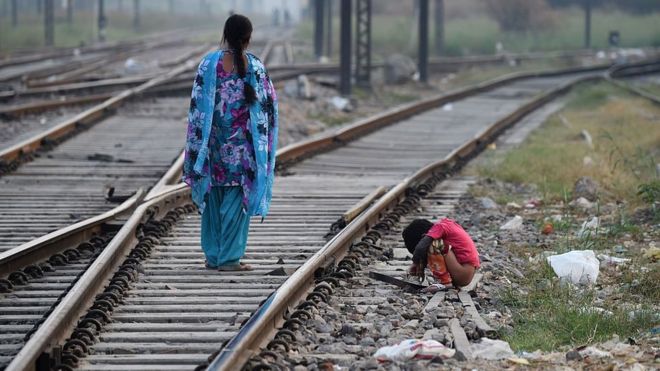
Millions of poor Indians defecate in the open, which especially puts women and children at risk.
Dalits are at the bottom of the Hindu caste system and despite laws to protect them, they still face widespread discrimination in India.
“The two children were beaten to death with sticks,” police superintendent Rajesh Chandel told BBC Hindi’s Shuraih Niazi. “We have registered a murder case against both the accused. They are being questioned.”
Within hours of the attack early on Wednesday morning, police arrested two upper-caste men – Rameshwar Yadav and Hakim Yadav.
Roshni and Avinash were cousins, but Roshni had been brought up by Avinash’s parents and lived with them.
Avinash’s father, Manoj, says that as a daily wage labourer, he cannot afford to build a toilet at his house. He also says he has been unable to access a government subsidy as part of a flagship scheme to build toilets for the poor.
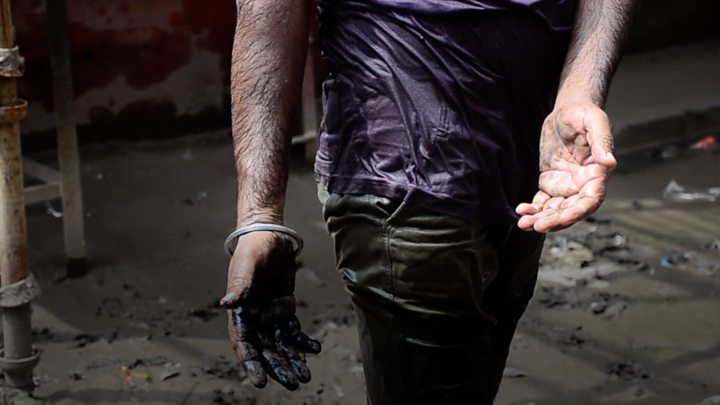
Media caption The Dalits unblocking India’s sewers by hand
The Swachh Bharat Mission or Clean India programme seeks to end open defecation by increasing toilet infrastructure and improving sanitation across the country. When Prime Minister Narendra Modi launched the program in 2014, he vowed to make India “open defecation free” by 2 October 2019.
Manoj’s village – Bhavkhedi – has been declared “open defecation free”, a tag given by the government to villages and cities have successfully ended open defecation.
Image caption Women who go out at night to defecate are often at risk
Research has shown that while the construction of toilets has increased rapidly, lack of water, poor maintenance and slow change in behaviour have stood in the way of ending open defecation.
But many have praised Mr Modi for highlighting the issue and launching a major scheme to address it – the Bill & Melinda Gates Foundation honoured him this week, describing the Swachh Bharat Mission as “a model for other countries around the world that urgently need to improve access to sanitation for the world’s poorest.”
Image copyright EPAImage caption Indian scientists say contact with the lander was lost seconds before it was scheduled to touch down
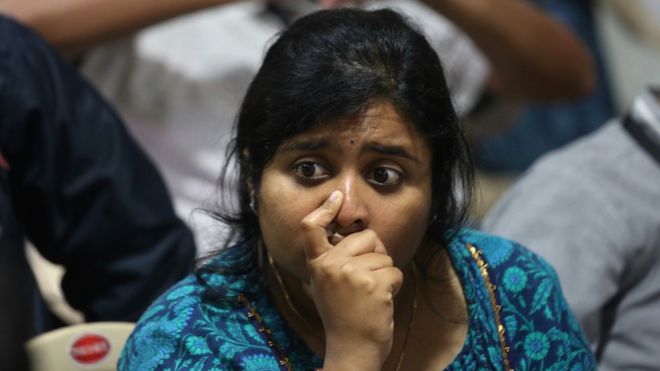
India’s space agency, Isro, has not yet released information on how it lost contact with its Moon lander seconds before it was due to touch down on the lunar surface. But former members of the agency tell the BBC what may have gone wrong.
Chandrayaan-2 (Moon vehicle 2) entered the Moon’s orbit on 20 August and was due to land on the lunar surface a little after midnight India local time (1800 GMT) on 7 September – a month after it first shot into space.
But contact was lost moments before the lander (named Vikram, after Isro founder Vikram Sarabhai) was expected to touch down at the lunar south pole.
The orbiter has since spotted the lander on the surface of the Moon – unbroken, but tilted on its side. So far, scientists have not been able to establish contact with it.
Image copyright GETTY IMAGESImage caption The event was watched by millions across India
The lander’s final heart-stopping descent were monitored on screens, complete with readings which reflected the movement of the lander as it headed towards the surface of the Moon.
The screens carrying the readings also appeared on television and various social media accounts as the landing was broadcast live.
When the countdown began, the lander was moving at a velocity of 1,640 metres per second. Scientists say it appeared to be moving as planned during the first two phases of deceleration, known as the rough braking and fine braking operations.
It was during the final stage, known as the “hovering” stage, that the problem occurred.
The problem could well have been with the lander’s central engine, according to Prof Roddam Narasimha, a former member of Isro. He said that his theory was based on the readings on the screen.
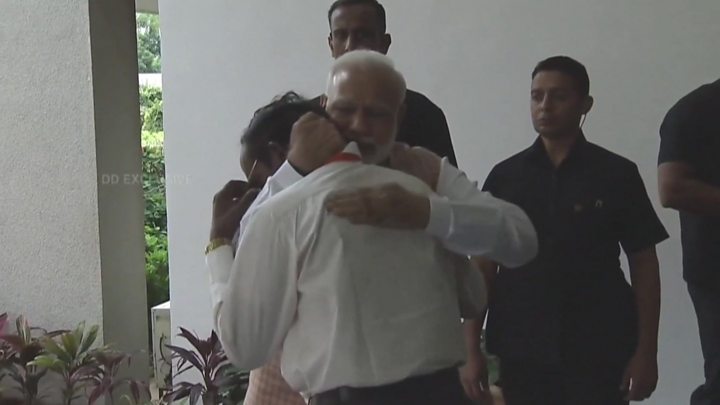
Media caption Modi consoles scientists after India Moon-lander loses contact
“One plausible explanation was that the lander started falling more rapidly,” he told BBC Hindi’s Imran Qureshi. “It’s supposed to come down at a velocity of two metres per second when it hits the Moon’s surface. But the gravity on the moon would have made it fall somewhat more rapidly.”
He believes this could be because the central engine was not “producing the thrust that is required and, therefore, the deceleration was no longer what it was supposed to be”.
And this, in turn, may have led to eventually losing communication with the lander itself.
The head of India’s first Moon mission, Mylswamy Annadurai, also said the anomaly in the velocity profile was an indication that something had malfunctioned in the lander as it hurtled towards the Moon.
“Most likely the orientation [of the lander] could have been disrupted. Once we look at the data we will be able to say for sure what happened, but it is likely that either a sensor or a thruster could have malfunctioned,” he told BBC Tamil.
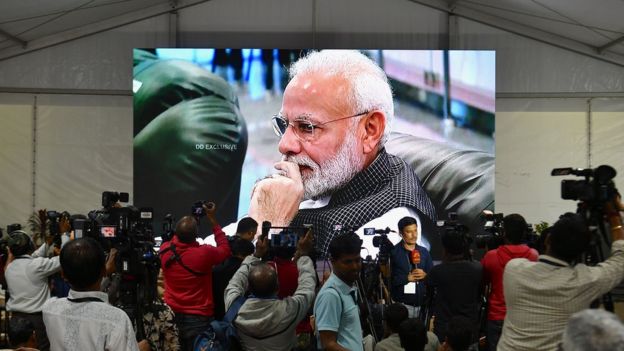
Image copyright GETTY IMAGESImage caption Prime Minister Narendra Modi also watched the event live
Dr Rajeswari Rajagopalan, the head of the Nuclear and Space Policy Initiative of the Observer Research Foundation (ORF), also said an engine malfunction was the likeliest reason.
“In the absence of data parameters, it is difficult to come to a conclusion, but the readings on the screen did show that something was wrong,” she told BBC Hindi.
“The other possibility is that when you do a landing at a higher speed, you cause a lot of dust to rise that also shakes up the spacecraft because of the gravitational pull. But it’s more likely the malfunctioning of one of the engines.”
Chandrayaan-2 was the most complex mission ever attempted by Isro.
The lander carried within its belly a 27kg Moon rover (called Pragyan, which translates as wisdom in Sanskrit), which included instruments to analyse the lunar soil.
The rover had the capacity to travel 500m from the lander in its 14-day life span, and would have sent data and images back to Earth for analysis.
The mission would have focused on the lunar surface, searching for water and minerals and measuring moonquakes, among other things.
ISLAMABAD (Reuters) – Pakistan would not use nuclear weapons first, Prime Minister Imran Khan said on Monday, amid tensions with arch-rival India after New Delhi revoked the special status of its part of the disputed Kashmir region.
“We both are nuclear-armed countries. If these tensions increase, the world could be in danger,” Khan said, addressing members of the Sikh religious community in the eastern city of Lahore. “There will be no first from our side ever,” he said.
The foreign ministry’s spokesman subsequently said on Twitter that the comments were being taken out of context and did not represent a change in Pakistan’s nuclear policy.
“PM was simply reiterating Pakistan’s commitment to peace and the need for both nuclear states to demonstrate responsible behaviour,” spokesman Mohammad Faisal said on his official Twitter account.
Tension remains high in Kashmir, where security forces have used tear gas against stone-throwing protesters and the valley remains under lockdown after Indian Prime Minister Narendra Modi’s decision to withdraw special rights for the Muslim-majority state on Aug. 5.
By stripping Indian-controlled Kashmir of its special status, New Delhi blocked the region’s right to frame its own laws and allowed non-residents to buy property there. Delhi said the change would help Kashmir’s development, to the benefit of all, but its move angered many residents of the region and was strongly condemned by Pakistan.
Khan has so far focused on a global diplomatic campaign condemning India’s actions, accusing Modi of committing human rights violations and atrocities in the valley.
He has also said frequently that any misadventure between two nuclear-armed nations could endanger the world.
Muslim-majority Kashmir has long been a flashpoint between India and Pakistan. Both countries rule parts of Kashmir while claiming it in full. Two of the three wars they have fought have been over it.
Also on Monday, Islamabad gave a consular access to an Indian who was given a death sentence for spying by a Pakistani military court, which the International Court of Justice asked Pakistan to review in mid-July.
“Pursuant to the decision of the International Court of Justice, Pakistan provided consular access on 02 September, 2019 to India for Commander Kulbhushan Jadhav, Indian spy, serving Indian Naval officer,” a Pakistani foreign office statement said.
The statement said that at India’s request, there was no restriction on the language of communication and the access was recorded, which continued for two hours.
An Indian external affairs ministry statement said “Jadhav appeared to be under extreme pressure to parrot a false narrative to bolster Pakistan’s untenable claims.” It said Delhi would wait for a detailed report to determine the extent of conformity to the ICJ directives.
Image copyright GETTY IMAGESImage caption Four million people were stripped of their citizenship in the draft list last July
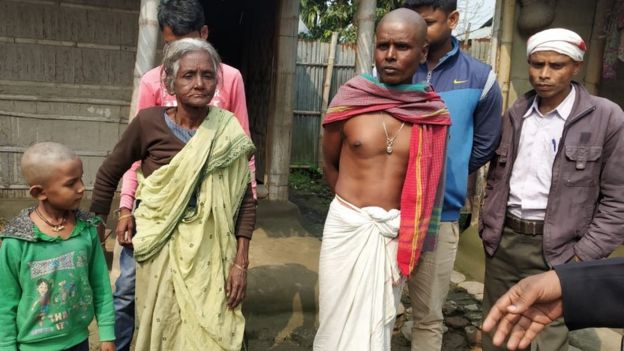
India has published the final version of a list which effectively strips about 1.9 million people in the north-eastern state of Assam of their citizenship.
The National Register of Citizens (NRC) is a list of people who can prove they came to the state by 24 March 1971, the day before neighbouring Bangladesh declared independence from Pakistan.
People left off the list will have 120 days to appeal against their exclusion.
It is unclear what happens next.
India says the process is needed to identify illegal Bangladeshi migrants.
It has already detained thousands of people suspected of being foreigners in temporary camps which are housed in the state’s prisons, but deportation is currently not an option for the country.
The process has also sparked criticism of “witch hunts” against Assam’s ethnic minorities.
A draft version of the list published last year had four million people excluded.
What is the registry of citizens?
The NRC was created in 1951 to determine who was born in Assam and is therefore Indian, and who might be a migrant from neighbouring Bangladesh.
The register has been updated for the first time.
Image copyright EPAImage caption The NRC was created in 1951 to determine who was born in the state and is Indian
Families in the state have been required to provide documentation to show their lineage, with those who cannot prove their citizenship deemed illegal foreigners.
Prime Minister Narendra Modi’s Hindu nationalist Bharatiya Janata Party (BJP) has long railed against illegal immigration in India but has made the NRC a priority in recent years.
An anxious wait
By Rajini Vaidyanathan, BBC News, Assam
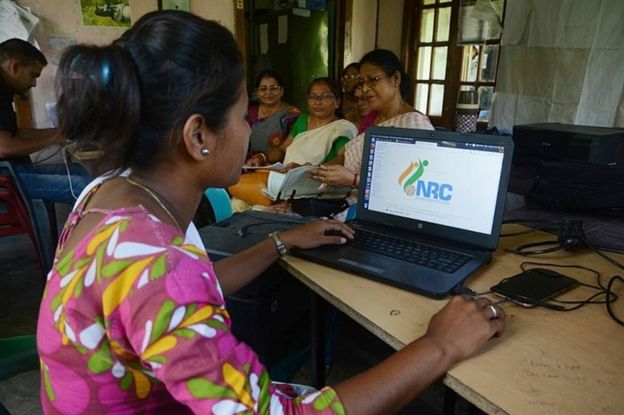
A small community centre in the village of Katajhar is being guarded by two members of the Indian army. Outside, a line of people wait. Some are clutching plastic bags containing documents.
As they enter one of two rooms, an official runs his eyes down a print-out to see if their names or photos are on it. This list – the National Register of Citizens – is one with huge consequences. And so there’s fear and trepidation as people here find out whether they’ve been included.
Many here who haven’t made it tell me it’s a mistake as they show me paperwork they say proves they belong in this country.
None of Asia Khatun’s family of nine made the list. They now have the chance to appeal but there’s real fear about what might come next. “I’d rather die than go to a detention centre,” she tells me. People here are angry but they’re also scared.
Why is the registry happening in Assam?
Assam is one India’s most multi-ethnic states. Questions of identity and citizenship have long vexed a vast number of people living there.
Among its residents are Bengali and Assamese-speaking Hindus, as well as a medley of tribespeople.
A third of the state’s 32 million residents are Muslims, the second-highest number after Indian-administered Kashmir. Many of them are descendants of immigrants who settled there under British rule.
But illegal migration from neighbouring Bangladesh, which shares a 4,000-km long border with India, has been a concern there for decades now. The government said in 2016 that an estimated 20 million illegal immigrants were living in India.
So have 1.9 million people effectively become stateless?
Not quite. Residents excluded from the list can appeal to the specially formed courts called Foreigners Tribunals, as well as the high court and Supreme Court.
However, a potentially long and exhaustive appeals process will mean that India’s already overburdened courts will be further clogged, and poor people left off the list will struggle to raise money to fight their cases.
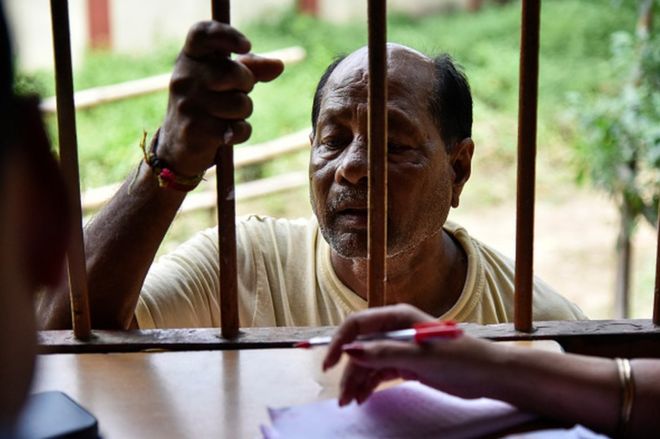
Image copyright AFPImage caption Saheb Ali, 55, from Goalpara district, has not been included in the list
If people lose their appeals in higher courts, they could be detained indefinitely.
Some 1,000 people declared as foreigners earlier are already lodged in six detention centres located in prisons. Mr Modi’s government is also building an exclusive detention centre, which can hold 3,000 detainees.
“People whose names are not on the final list are really anxious about what lies ahead. One of the reasons is that the Foreigners Tribunal does not have a good reputation, and many people are worried that they will have to go through this process,” Sangeeta Barooah Pisharoty, author of Assam: The Accord, The Discord, told the BBC.
Why have been the courts so controversial?
The special courts were first set up in 1964, and since then they have declared more than 100,000 people foreigners. They regularly identify “doubtful voters” or “illegal infiltrators” as foreigners to be deported.
But the workings of the specially formed Foreigners Tribunals, which have been hearing the contested cases, have been mired in controversy.
There are more than 200 such courts in Assam today, and their numbers are expected to go up to 1,000 by October. The majority of these tribunals were set up after the BJP came to power in 2014.
The courts have been accused of bias and their workings have often been opaque and riddled with inconsistencies.
Media caption Living in limbo: Assam’s four million unwanted
For one thing, the burden of proof is on the accused or the alleged foreigner.
For another, many families are unable to produce documents due to poor record-keeping, illiteracy or because they lack the money to file a legal claim.
People have been declared foreigners by the courts because of differences in spellings of names or ages in voter rolls, and problems in getting identity documents certified by authorities. Amnesty International has described the work by the special courts as “shoddy and lackadaisical”.
Journalist Rohini Mohan analysed more than 500 judgements by these courtsin one district and found 82% of the people on trial had been declared foreigners. She also found more Muslims had been declared foreigners, and 78% of the orders were delivered without the accused being ever heard – the police said they were “absconding”, but Mohan found many of them living in their villages and unaware they had been declared foreigners.
“The Foreigners Tribunal,” she says, “must be made more transparent and accountable.”
Both the citizen’s register and the tribunals have also sparked fears of a witch hunt against Assam’s ethnic minorities.
Have the minorities been targeted?
Many say the list has nothing to do with religion, but activists see it as targeting the state’s Bengali community, a large portion of whom are Muslims.
They also point to the plight of Rohingya Muslims in neighbouring Bangladesh.
Image copyright GETTY IMAGESImage caption The move to make millions of people stateless will probably spark protests
However significant numbers of Bengali-speaking Hindus have also been left off the citizenship list, underscoring the communal and ethnic tensions in the state
“One of the communities worst affected by the list are the Bengali Hindus. There are as many of them in detention camps as Muslims. This is also the reason just days before NRC is to be published the BJP has changed tack, from taking credit for it to calling it error-ridden. That is because the Bengali Hindus are a strong voter base of the BJP,” says Barooah Pisharoty.
And in an echo of US President Donald Trump’s policy to separate undocumented parents and children, families have been similarly broken up in Assam.
Detainees have complained of poor living conditions and overcrowding in the detention centres.
Image copyright CITIZENS FOR JUSTICE AND PEACEImage caption A father and son killed themselves 30 years apart because of citizenship doubts (photo shows funeral)
One detainee told a rights group after his release he had been taken to a room which had a capacity for 40 people, but was filled with around 120 people. People who have been declared foreigners as well as many inmates have been suffering from depression. Children have also been detained with their parents.
Human rights activist Harsh Mander, who visited two detention centres, has spoken about a situation of “grave and extensive human distress and suffering”.
What happens to people who are declared foreigners?
The BJP which rules the state, has insisted in the past that illegal Muslim immigrants will be deported. But neighbouring Bangladesh will definitely not accede to such a request.
Many believe that India will end up creating the newest cohort of stateless people, raising the spectre of a homegrown crisis that will echo that of the Rohingya people who fled Myanmar for Bangladesh.
It is not clear whether the people stripped of their Indian citizenship will be able to access welfare or own property.
One possibility is that once they are released, they will be given work permits with some basic rights, but will not be allowed to vote.






 CHINDIA ALERT: You'll be living in their world, very soon