Archive for ‘pro-democracy activists’

22/05/2020

NPC: China begins move to impose controversial Hong Kong security law

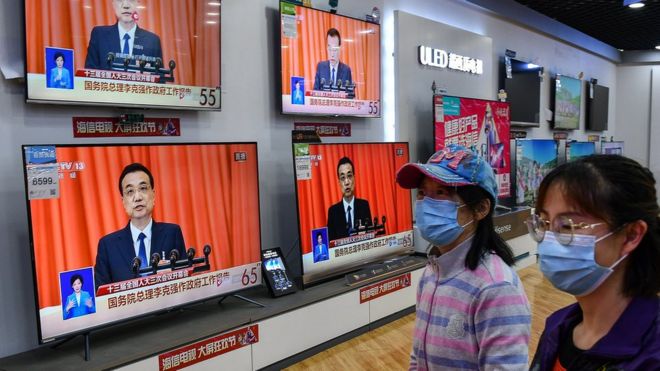
Shoppers walking past a broadcast of Chinese Premier Li Keqiang delivering his speech at the opening of the NPCImage copyright AFP / GETTY
Image caption Shoppers walking past a broadcast of Chinese Premier Li Keqiang delivering his speech at the opening of the NPC on Thursday

China’s ruling Communist Party has set in motion a controversial national security law for Hong Kong, a move seen as a major blow to the city’s freedoms.

The law to ban “treason, secession, sedition and subversion” could bypass Hong Kong’s lawmakers.

Critics say China is breaking its promise to allow Hong Kong freedoms not seen elsewhere in China.

It is likely to fuel public anger and may even trigger fresh protests and demands for democratic reform.

The plan was submitted at the annual National People’s Congress (NPC), which largely rubber-stamps decisions already taken by the Communist leadership, but is still the most important political event of the year.

Hong Kong, a semi-autonomous region and an economic powerhouse, was always meant to have introduced such laws after the handover from British control to Chinese rule in 1997.

After last year’s wave of sustained and violent protest, Beijing is now attempting to push them through, arguing “law-based and forceful measures” must be taken to “prevent, stop and punish” such protests in the future.

On Friday, Hong Kong’s government said it would co-operate with Beijing to enact the law, adding it would not affect the city’s freedoms.

What is in Beijing’s proposed law?

The “draft decision” – as it is known before approval by the NPC – was explained by Wang Chen, vice chairman of the Standing Committee of the NPC.

It consists of an introduction and seven articles. Article 4 may prove the most controversial.

That article says Hong Kong “must improve” national security, before adding: “When needed, relevant national security organs of the Central People’s Government will set up agencies in Hong Kong to fulfil relevant duties to safeguard national security in accordance with the law.”

China could essentially place this law into Annex III of the Basic Law, which covers national laws that must be implemented in Hong Kong – either by legislation, or decree.

Addressing the congress, Premier Li Keqiang spoke of the economic impact of the coronavirus and on Hong Kong and Macau said: “We’ll establish sound legal systems and enforcement mechanisms for safeguarding national security in the two Special Administrative Regions.”

What do opponents say the dangers are?

Hong Kong is what is known as a “special administrative region” of China.

It has observed a “one country, two systems” policy since Britain returned sovereignty in 1997, which has allowed it certain freedoms the rest of China does not have.

Pro-democracy activists fear that China pushing through the law could mean “the end of Hong Kong” – that is, the effective end of its autonomy and these freedoms.

Last year’s mass protests in Hong Kong were sparked by a bill that would have allowed extraditions to mainland China.
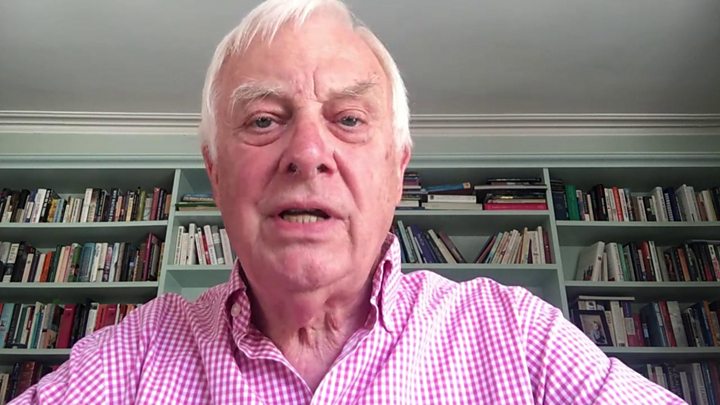
Media caption Former Hong Kong governor Chris Patten: “UK should tell China this is outrageous”

The bill was paused, then withdrawn – but the protests continued until the virus outbreak at the end of the year.

The US has also weighed in, with President Trump saying the US would react strongly if it went through – without giving details.

It is currently considering whether to extend Hong Kong’s preferential trading and investment privileges.

Why is China doing this?

Mr Wang said the security risks had become “increasingly notable” – a reference to last year’s protests.

“Considering Hong Kong’s situation at present, efforts must be made at the state-level to establish and improve the legal system and enforcement mechanisms,” he is quoted as saying in state media.
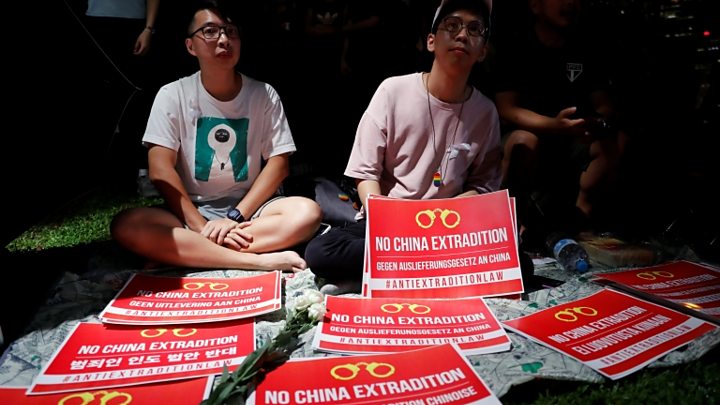
Media caption The BBC’s Helier Cheung on Hong Kong’s 2019 protests

Beijing may also fear September’s elections to Hong Kong’s legislature.

If last year’s success for pro-democracy parties in district elections is repeated, government bills could potentially be blocked.

What is Hong Kong’s legal situation?

Hong Kong was under British control for more than 150 years up to 1997.

The British and Chinese governments signed a treaty – the Sino-British Joint Declaration – that agreed Hong Kong would have “a high degree of autonomy, except in foreign and defence affairs”, for 50 years.

This was enshrined in the Basic Law, which runs out in 2047.

As a result, Hong Kong’s own legal system, borders, and rights – including freedom of assembly and free speech – are protected.

But Beijing has the ability to veto any changes to the political system and has, for example, ruled out direct election of the chief executive.
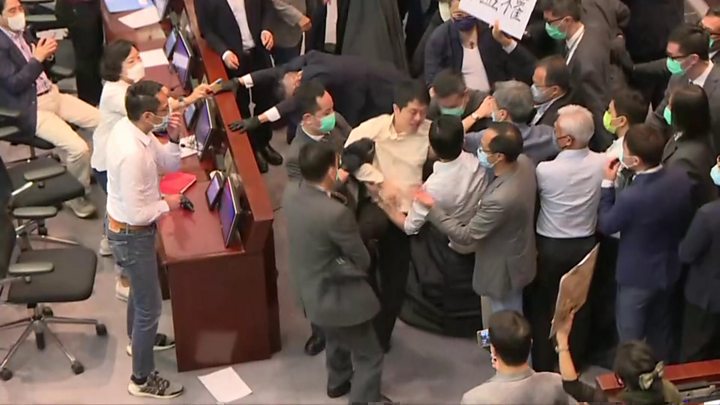

Media caption Uproar on Monday in Hong Kong’s legislature

Source: The BBC

10/04/2019

Hong Kong ‘Umbrella’ protesters found guilty of public nuisance

Media caption The “Umbrella Movement” activists said they would continue to strive for democracy

Nine pro-democracy activists in Hong Kong have been found guilty of public nuisance charges for their role in a civil disobedience movement that called for free elections in the city.

Among them are three prominent activists, seen as figureheads of Hong Kong’s pro-democracy movement.

They could be jailed for up to seven years for their part in the “Umbrella Movement” protests of 2014.

Thousands marched demanding the right for Hong Kong to choose its own leader.

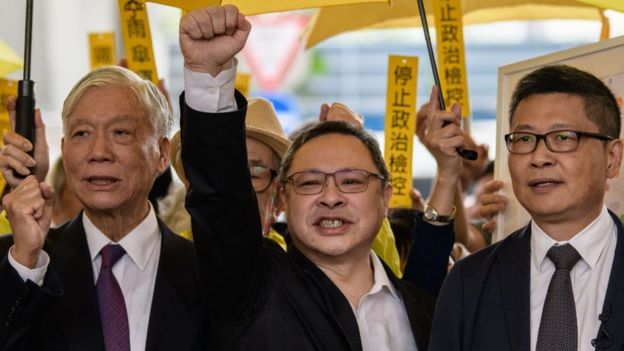
Those convicted include the so-called “Occupy trio” – sociology professor Chan Kin-man, 60, law professor Benny Tai, 54, and Baptist minister Chu Yiu-ming, 75.

They are seen as the founders of the movement that galvanised protesters in their campaign of civil disobedience.

“No matter what happens today… we will persist on and do not give up,” Mr Tai told reporters ahead of the verdict.

Mr Tai, Mr Chan and five others were found guilty of two charges of public nuisance, and Mr Chu and one other of just one charge.

A large crowd gathered outside the court on Thursday to support them. It is not yet clear when they will be sentenced.

Presentational grey line
Chu Yiu-ming, Benny Tai, Chan Kin-manImage copyrightAFP
Chu Yiu-ming, Benny Tai and Chan Kin-man (left to right) were charged under colonial-era laws that carry possible jail terms of up to seven years

Like just another day

By Martin Yip, BBC News Chinese, Hong Kong

The nine defendants walked into the court building looking refreshed and in high spirits. All but one said a few words in what might have been their last hours of freedom before their predicted jail term.

Delivering his verdict, Justice Johnny Chan said the defendants had caused a nuisance – by occupying major roads – leading to injuries among civilians. The nine looked calm and not particularly emotional. They were later released on bail. Benny Tai, Chan Kin-man and Chu Yiu-ming smiled as they passed me, as if it was just another day.

They are yet to say if they will appeal. The court was adjourned for the day as the lawyers are yet to finish their mitigation submissions. The sentences have yet to be announced.

The broader pro-democracy camp already has bad relations with Beijing. Activists and politicians did express their anger but political analysts also warn that people might simply leave the movement out of frustration.

“Some people might feel dispirited and helpless. I hope they can see that other people haven’t given up,” Benny Tai told BBC News Chinese ahead of today’s verdict.

Seventy nine days of sit-in protests have already changed Hong Kong a lot. But today’s verdict might serve more as a reminder that this city remains divided.

Presentational grey line

What has the reaction been?

At the trial Judge Johnny Chan rejected the idea that this would have a substantial impact on society.

“It cannot be reasonably argued that a charge of conspiracy to cause public nuisance would generate a chilling effect in society,” he wrote in his ruling.

But rights groups criticised the ruling, with Humans Rights Watch saying the court was “sending a terrible message”.

“[This] will likely embolden the government to prosecute more peaceful activists, further chilling free expression in Hong Kong,” said researcher Maya Wang in a statement to the BBC.

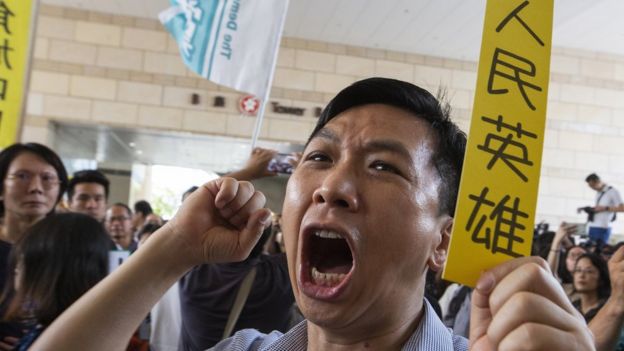
A pro-Democracy activist holds a piece of yellow paper with a slogan in Chinese saying "People"s Hero"Image copyrightEPA
One pro-democracy supporter outside the court held up a sign saying “People’s Hero”

Lord Chris Patten, the last British governor of Hong Kong, released a statement saying that it was “appallingly divisive to use anachronistic common law charges in a vengeful pursuit of political events which took place in 2014”.

This verdict comes after a string of frustrations for pro-democracy activists. In the last few years the courts have removed six lawmakers for changing their swearing in oaths to include protest phrases. Others have also been disqualified from running for office.

What were the protests about?

The protests started in reaction to a decision made by China that it would allow direct elections in 2017, but only from a list of candidates pre-approved by Beijing.

Beijing is highly sensitive about Hong Kong’s status and any calls for more autonomy from China.

The former British colony was handed back in 1997 on condition it would retain “a high degree of autonomy, except in foreign and defence affairs” for 50 years.

Many people in Hong Kong believe they should have the right to elect their own leader.

In 2014, the three activists’ calls for non-violent civil disobedience joined with student-led protests and snowballed into the massive demonstrations.

Tens of thousands of people camped in the streets and demanded the right to fully free leadership elections.

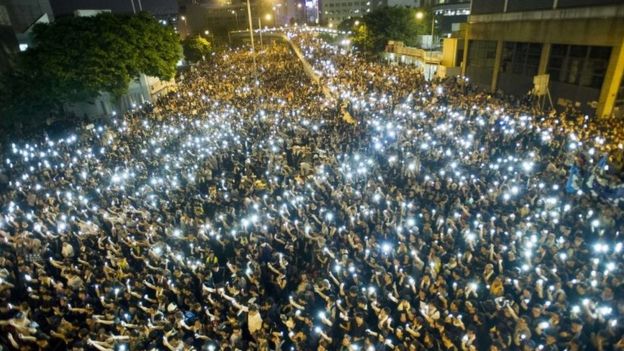
Hong Kong protests (Sept 2014)Image copyrightAFP The pro-democracy protests bought an area of central Hong Kong to a standstill for weeks in 2014

The protests became known as the “Umbrella Movement” after people used umbrellas to shield themselves from pepper spray fired by police to disperse the crowd.

Protesters accused the Chinese government of breaking its promise to allow full democracy in Hong Kong, and of encroaching more and more on the region.

But the number of protesters dwindled to just a few hundred as the weeks dragged on and they ultimately failed to achieve their goal.

Source: The BBC

Law of Unintended Consequences

continuously updated blog about China & India

ChiaHou's Book Reviews

continuously updated blog about China & India

What's wrong with the world; and its economy

continuously updated blog about China & India