Chindia Alert: You’ll be Living in their World Very Soon
aims to alert you to the threats and opportunities that China and India present. China and India require serious attention; case of ‘hidden dragon and crouching tiger’.
Without this attention, governments, businesses and, indeed, individuals may find themselves at a great disadvantage sooner rather than later.
The POSTs (front webpages) are mainly 'cuttings' from reliable sources, updated continuously.
The PAGEs (see Tabs, above) attempt to make the information more meaningful by putting some structure to the information we have researched and assembled since 2006.
SRINAGAR, India (Reuters) – Indian police have released a pigeon belonging to a Pakistani fisherman after a probe found that the bird, which had flown across the contentious border between the nuclear-armed nations, was not a spy, two officials said on Friday.
“The pigeon was set free yesterday (May 28) after nothing suspicious was found,” said Shailendra Mishra, a senior police official in Indian-administered Kashmir. It was unclear where the bird was released and whether it flew back to its owner.
The Pakistani owner of the pigeon had urged India to return his bird, which Indian villagers turned over to police after discovering it.
“It’s just an innocent bird,” Habibullah, the owner of the bird, who goes by just one name, told Reuters on Friday.
He rejected allegations that the numbers inscribed on a ring on the pigeon’s leg were codes meant for militant groups operating in the disputed region of Kashmir.
Habibullah, who lives in a village near the Kashmir border, one of the most militarised zones in the world, said the bird had participated in a pigeon racing contest and the digits on the bird’s leg were his mobile phone number.
The sport is especially popular in the border villages, said Yasir Khalid of the Shakar Garh Pigeon Club, adding such races are held in India too, and it is not unusual to lose a bird on either side. Owners identify their birds with stamps on the wings, paint and rings on the feet.
“We had to take the bird into our custody to probe if it was being using for spying,” a senior Indian border security officer said requesting anonymity, while explaining this was part of the drill given border sensitivities.
In 2016, a pigeon was taken into Indian custody after it was found with a note threatening Indian Prime Minister Narendra Modi.
BEIJING, April 17 (Xinhua) — The lander and rover of the Chang’e-4 probe have resumed work for the 17th lunar day on the far side of the moon after “sleeping” during the extremely cold night.
The lander woke up at 1:24 p.m. Friday (Beijing time), and the rover awoke at 8:57 p.m. Thursday. Both are in normal working order, according to the Lunar Exploration and Space Program Center of the China National Space Administration.
The Chang’e-4 probe, launched on Dec. 8, 2018, made the first-ever soft landing on the Von Karman Crater in the South Pole-Aitken Basin on the far side of the moon on Jan. 3, 2019.
A lunar day equals 14 days on Earth, and a lunar night is the same length. The Chang’e-4 probe, switching to dormant mode during the lunar night due to the lack of solar power, has survived about 470 Earth days on the moon.
The rover Yutu-2, or Jade Rabbit-2, has worked much longer than its three-month design life, becoming the longest-working lunar rover on the moon.
Carrying scientific instruments such as panoramic camera, lunar penetrating radar, infrared imaging spectrometer and neutral atom detector, the rover will continue to move northwest to conduct scientific detection.
The scientific tasks of the Chang’e-4 mission include conducting low-frequency radio astronomical observation, surveying the terrain and landforms, detecting the mineral composition and shallow lunar surface structure and measuring neutron radiation and neutral atoms.
The Chang’e-4 mission embodies China’s hope to combine wisdom in space exploration with four payloads developed by the Netherlands, Germany, Sweden and Saudi Arabia.
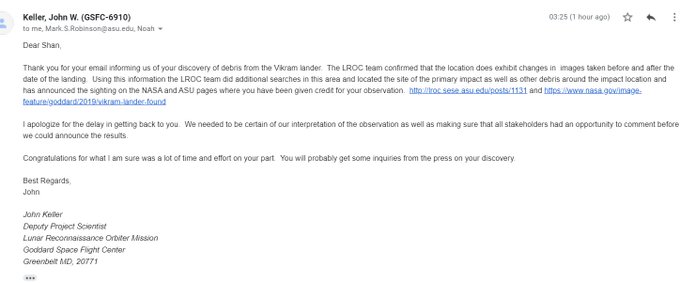
In late September, pictures from a Nasa spacecraft had showed the targeted landing site of the Vikram rover.
Many people had downloaded the image released by Nasa’s Lunar Reconnaissance Orbiter Camera (LROC) team, a statement by the space agency said.
It said after receiving Mr Subramanian’s tip about the location of the debris, the LROC team “confirmed the identification by comparing before and after images”.
Mr Subramanian has tweeted an email sent to him by the space agency congratulating him for his effort.
“We had the images from Nasa [of] the lander’s last location. We knew approximately where it crashed. So I searched pixel-by-pixel around that impact area,” the 33-year-old Chennai-based engineer told BBC Tamil.
Mr Subramanian said he had always “been interested in space” and had watched the July launch of the rocket.
The rover (called Pragyan – wisdom in Sanskrit) had the capacity to travel 500m from the lander in its 14-day life span, and would have sent data and images back to Earth for analysis.
The mission would have focussed on the lunar surface, searching for water and minerals and measuring moonquakes, among other things.
Why would it have been significant?
A soft landing on another planetary body – a feat achieved by just three other countries so far – would have been a huge technological achievement for Isro and India’s space ambitions, says science writer Pallava Bagla.
He adds that it would also have paved the way for future Indian missions to land on Mars, and opened up the possibility of India sending astronauts into space.
For the first time in India’s space history, the interplanetary expedition was led by two women – project director Muthaya Vanitha and mission director Ritu Karidhal.
Media caption Is India a space superpower?
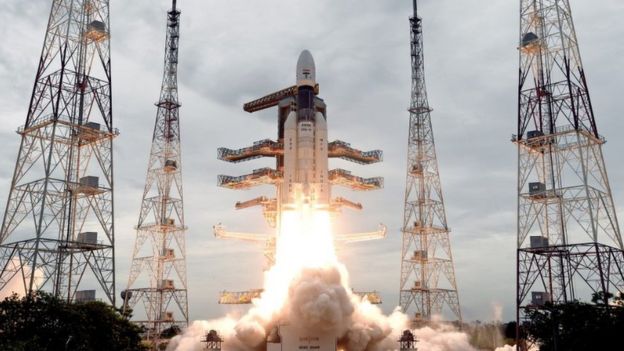
It was also a matter of national pride – the satellite’s lift-off in July was broadcast live on TV and Isro’s official social media accounts.
The mission also made global headlines because it was so cheap – the budget for Avengers: Endgame, for instance, was more than double at an estimated $356m. But this wasn’t the first time Isro has been hailed for its thrift. Its 2014 Mars mission cost $74m, a tenth of the budget for the American Maven orbiter.
Indian Prime Minister Narendra Modi told his country’s space scientists he was proud of a programme that had come so near to putting a probe on the Moon.
Contact with Chandrayaan-2 was lost moments before its Vikram module was due to touch down at the lunar south pole.
The fate of the craft is not yet known, but Mr Modi said there would be further opportunities.
India would have been the fourth nation to make a soft landing on the Moon.
“The best is yet to come in our space programme. India is with you,” said Mr Modi.
The Chandrayaan-2 approached the Moon as normal until an error occurred about 2.1km (1.3 miles) from the surface, officials said.
Image copyright ISROImage caption The mission’s lift-off was broadcast live to an audience of hundreds of millions
India’s Space Research Organization (Isro) said it lost contact seconds before the ship was expected to land.
The country’s first Moon mission – Chandrayaan-1, in 2008 – carried out the first and most detailed search for water on the lunar surface using radars.
What happened?
Chandrayaan-2 entered the Moon’s orbit on 20 August and was due to make a controlled descent to the surface early on Saturday, Indian time, over a month after it first took off.
Staff at mission control were glued to the screens at Isro’s Bangalore space centre as the spacecraft made its descent towards the surface.
The control room burst into applause during the so-called rough breaking phase of the descent, with Prime Minister Modi watching the action from behind a glass screen.
Isro chairman Kailasavadivoo Sivan announced to staff that the ship’s initial descent had been “normal,” and that the mission’s data would be analysed.
Mr Sivan had earlier described the final descent as “15 minutes of terror”.
The rover (called Pragyan – wisdom in Sanskrit) had the capacity to travel 500m from the lander in its 14-day life span, and would have sent data and images back to Earth for analysis.
The mission would have focused on the lunar surface, searching for water and minerals and measuring moonquakes, among other things.
Why would it have been significant?
A soft landing on another planetary body – a feat achieved by just three other countries so far – would have been a huge technological achievement for Isro and India’s space ambitions, writes science writer Pallava Bagla.
He adds that it would also have paved the way for future Indian missions to land on Mars, and opened up the possibility of India sending astronauts into space.
For the first time in India’s space history, the interplanetary expedition was led by two women – project director Muthaya Vanitha and mission director Ritu Karidhal.
Media caption Is India a space superpower?
It is also a matter of national pride – the satellite’s lift-off in July was broadcast live on TV and Isro’s official social media accounts.
The mission has also made global headlines because it’s so cheap – the budget for Avengers: Endgame, for instance, was more than double at an estimated $356m. But this isn’t the first time Isro has been hailed for its thrift. Its 2014 Mars mission cost $74m, a tenth of the budget for the American Maven orbiter.
SYDNEY (Reuters) – Australia is investigating the whereabouts of a Chinese-Australian man, the Department of Foreign Affairs and Trade (DFAT) said on Wednesday, after a newspaper report raised fears that the dissident former diplomat has been detained in China.
The Sydney Morning Herald newspaper reported on Wednesday that friends feared Yang Hengjun, an author and former Chinese diplomat who is now an Australian citizen, had been detained because he had not been reachable for several days.
His disappearance comes at a time of high tension between China and some parts of the West after two Canadians, a diplomat on unpaid leave and a consultant, were arrested in China on suspicion of endangering state security.
Those arrests were widely seen in the West as retaliation by Beijing for the arrest of Meng Wanzhou, a senior Huawei Technologies [HWT.UL] executive, in Canada on Dec. 1. She is accused of violating U.S. sanctions on Iran.
Two friends contacted by Reuters said they had reported Yang as missing to DFAT. They said he had been missing since he flew from New York to Guangzhou in southern China on Friday.
One of those friends, Feng Chongyi, an academic at the University of Technology in Sydney, said Yang had been scheduled to fly on to Shanghai but never arrived.
“I believe he is in custody of the Ministry of State Security in Beijing,” Feng said.
China’s Foreign Ministry spokeswoman Hua Chunying, asked about Yang’s disappearance, told a regular briefing that she had “no understanding” of the situation.
China’s Ministry of Public Security did not respond immediately to requests for comment.
A DFAT spokeswoman confirmed the department was investigating but did not identify Yang by name.
“The Department of Foreign Affairs and Trade is seeking information about an Australian citizen who has been reported missing in China,” the spokeswoman said.
A source familiar with the investigation said Australia made contact with Chinese officials overnight to ask about Yang’s whereabouts.
Australia joined international condemnation of the arrest of the two Canadians but Yang has long been in the sights of Chinese authorities. He has criticised what he described as Chinese interference in Australia.
Chinese President Xi Jinping has presided over a sweeping crackdown on dissent since coming to power in 2012, with hundreds of rights lawyers and activists detained. Dozens have been jailed.








 CHINDIA ALERT: You'll be living in their world, very soon