Chindia Alert: You’ll be Living in their World Very Soon
aims to alert you to the threats and opportunities that China and India present. China and India require serious attention; case of ‘hidden dragon and crouching tiger’.
Without this attention, governments, businesses and, indeed, individuals may find themselves at a great disadvantage sooner rather than later.
The POSTs (front webpages) are mainly 'cuttings' from reliable sources, updated continuously.
The PAGEs (see Tabs, above) attempt to make the information more meaningful by putting some structure to the information we have researched and assembled since 2006.
Unveiled in Shandong, prototype will be a first step towards ground-breaking high-speed travel that will rival passenger jets, project engineer says
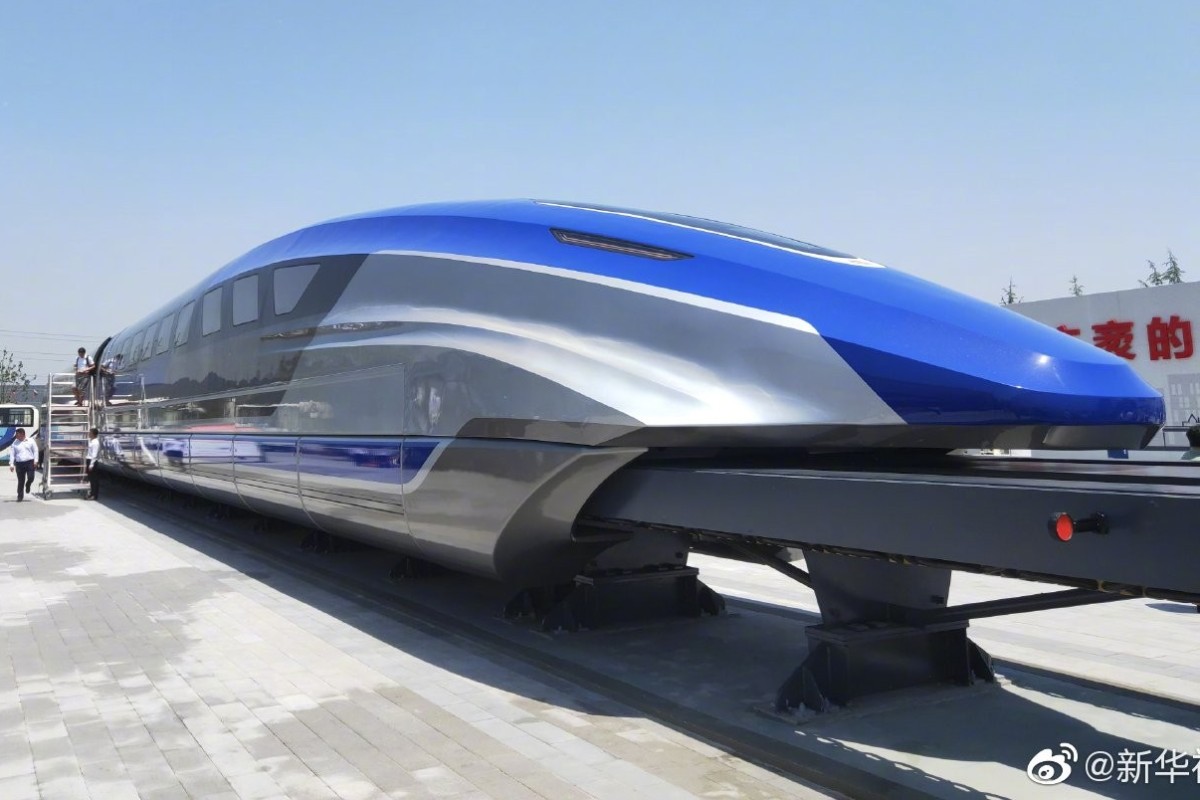
One possible future for rapid transport in China is unveiled in the form of a magnetic levitation train at Qingdao in Shandong province. Photo: Weibo
An experimental magnetic levitation train capable of travelling at 600km/h went on show at Qingdao in eastern Shandong province on Thursday, state media said.
Powerful electromagnets hold the Qingdao prototype at a thumb’s width from the rail, giving a quiet, smooth ride at speeds close to those involved in air travel, developers said.
While China operates the world’s fastest conventional train service, which can reach a speed of 350km/h, the Shanghai Maglev has been in commercial operation since the end of 2002 and can reach a top speed of 430km/h. It operates on one 30-kilometre (19-mile) line between two stations.
Ding Sansan, deputy chief engineer with developer the CRRC Sifang Corporation, said China achieved breakthroughs in maglev technology during the “three-year-battle” to build the new train that involved cooperation between more than 30 enterprises, universities and government research institutes.
The construction of a train body with ultra-lightweight, high-strength materials was a challenge, Ding said. Complex physical problems created by high speeds also needed to be solved in new ways if the Qingdao prototype was to reach peak performance.
China was a leader in technologies that included suspension, guidance, control and high-powered traction, Ding told Qingdao Daily.
“The test vehicle has been powered up and is in good order,” Ding was quoted by the newspaper as saying.
Chinese maglev train capable of travelling at 600km/h on track for 2020 test run as design completed
The prototype promised to eliminate the advantages jet passenger planes had over ground vehicles over a distance of 1,500km, he said.
Taking Beijing-to-Shanghai by plane as an example, Ding suggested: “It takes about four-and-a-half hours by plane including preparation time for the journey; about five-and-a-half hours by high-speed rail, and [would] only [take] about three-and-a-half hours by maglev.”
While earlier reports suggested the prototype was expected to begin full-scale testing by 2020, it was unclear what Thursday’s unveiling meant for this timetable.
China’s latest prototype high-speed maglev train factors the comfort of paying customers into its test operations. Photo: Weibo
More maglevs would join the development project in the coming months, the team leader was quoted as saying, while mass production of the technology was likely by 2021.
In contrast to the optimism of the team at Qingdao, Chen Peihong, professor of economics at Beijing Jiaotong University and a transport analyst, was more circumspect about the future of maglev trains.
“The market has to be bigger. Technology alone cannot make [the concept] a success,” she said.
Plane or train: as high-speed rail link connects Hong Kong to 44 mainland Chinese cities, what are cheapest and fastest ways to get where you are going?
Public transport relied heavily on economies of scale, Chen said. Chinese cities including Jinan, Hangzhou and Chongqing were considering maglev lines, but even the longest – from Jinan to Taian – would not exceed 50 kilometres.
Chen said that electromagnetic fields from maglevs were greater than those from the lines that powered high-speed trains, while environmental worries might keep maglevs out of densely-populated areas.
There was a debate in China in the early 2000s about the benefits of a developing a maglev compared to high-speed rail, researchers on that project said. Rail was preferred by the government because it was an established technology and one that was cheaper to realise.
By the end of last year, China’s high-speed rail network extended to most of the country at a distance in excess of 29,000 kilometres, according to government figures, twice as long as the rest of the world’s high-speed rail lines combined. Spain’s high-speed AVE network was the second-longest at 3,100km.
Elsewhere, researchers in Chengdu, Sichuan province, said a vehicle inside a vacuum tube powered by a superconductor coil from a maglev train – a hyperlink – was in development. They expected the vehicle to reach speeds in excess of 1,000km/h as air was pumped from the tube and resistance to the speeding object gradually eliminated.
Image copyright REUTERSImage caption Economists say India’s growth is powered by the ‘top 100 million’ people
As India lumbers towards the final phase of an exhausting general election and Prime Minister Narendra Modi’s BJP seeks a second term in power, there’s some worrying news. The world’s fastest growing major economy appears to be headed for a slowdown.
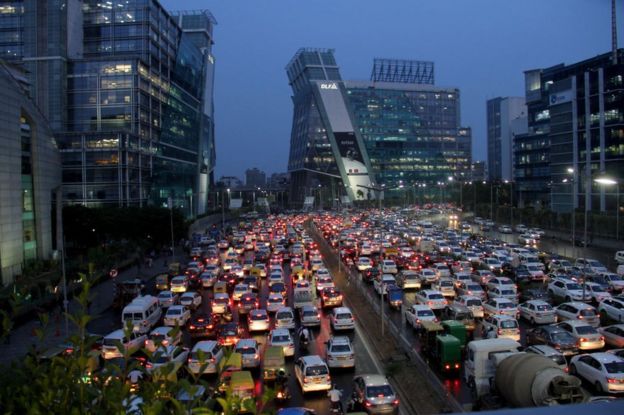
The signs are everywhere. Economic growth slowed to 6.6% in the three months to December, the slowest in six quarters. Sales of cars and SUVs have slumped to a seven-year-low. Tractors and two-wheelers sales are down. Net profits for 334 companies (excluding banks and financials) are down 18% year-on-year, according to the Financial Express newspaper.
Image copyright GETTY IMAGESImage caption Sales of cars and SUVs have slumped to a seven-year-low.
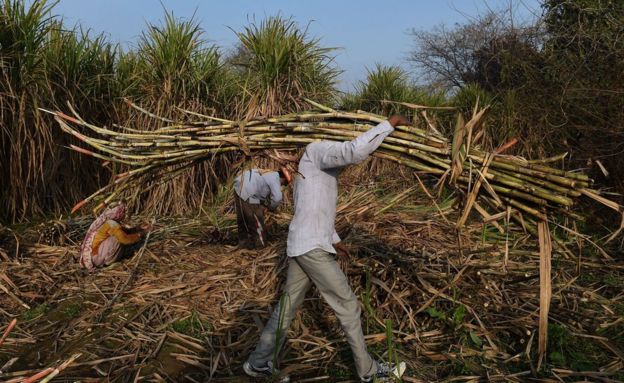
One newspaper wondered whether India was “losing the consumption plot”. Taken together, all this points to a fall in both urban and rural incomes, leading to demand contraction. A crop glut has seen farm incomes drop. And credit stagnation, partly triggered by the collapse of a major non-banking financial institution, or a shadow bank, has led to a fall in lending and worsened matters.
Kaushik Basu, former chief economist of the World Bank and professor of economics at Cornell University, believes the slowdown is “much more serious” than he initially believed. “The evidence is now mounting to the point where it can no longer be ignored,” he told me.
One reason, he believes, is the controversial currency ban in 2016 – also called demonetisation – which adversely hit farmers. More than 80% of the currency circulating in India’s sprawling cash-driven economy was taken out of circulation in what, in the words of one of Prime Minister Modi’s own advisers, was a “massive, draconian, monetary shock”.
Image copyright AFP
“This was evident to all by early 2017. What many observers did not realise then – I did not – is that the shock made the farmers take on debts which ended up causing sustained hardship to them that is continuing and slowing down the agriculture sector.”
Women make up nearly half of India’s 900 million voters, but they are still poorly represented in the country’s law-making bodies. One political party is trying to correct the balance by nominating 41% female candidates. The BBC’s Geeta Pandey travelled to the state of West Bengal to see how they are faring.
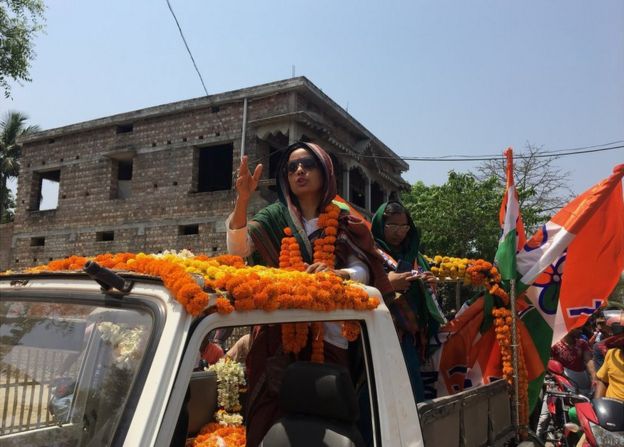
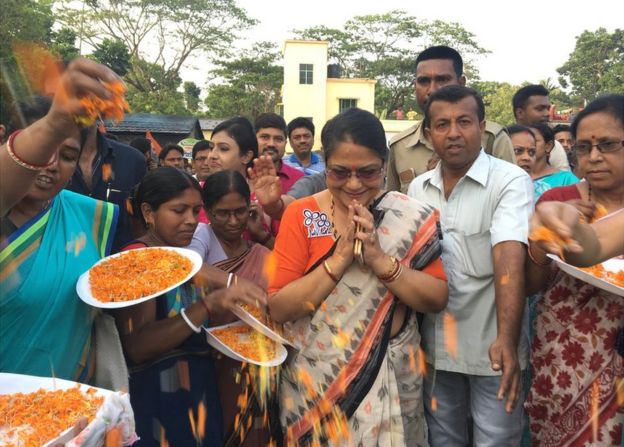
On a bright sunny morning, as an open jeep decorated with bright yellow and orange flowers hurtles along the dirt track from one village to the next, women in colourful saris and men rush to greet Mahua Moitra.
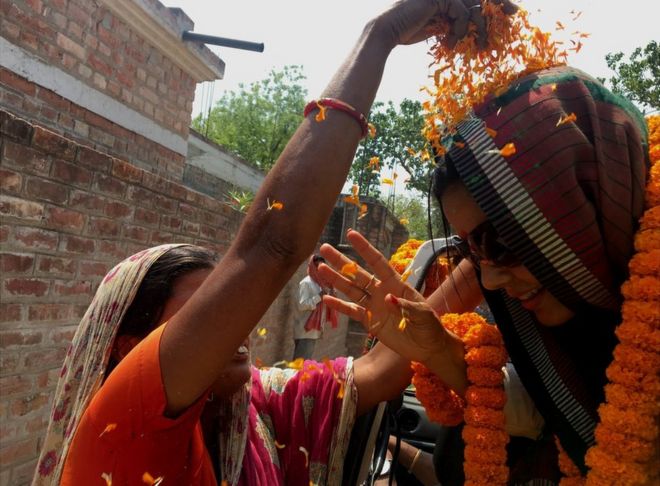
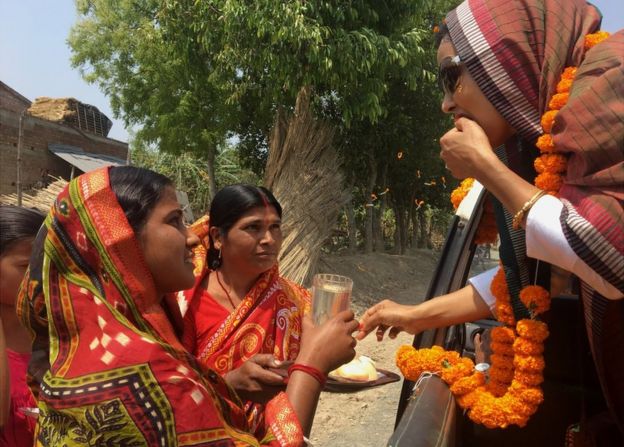
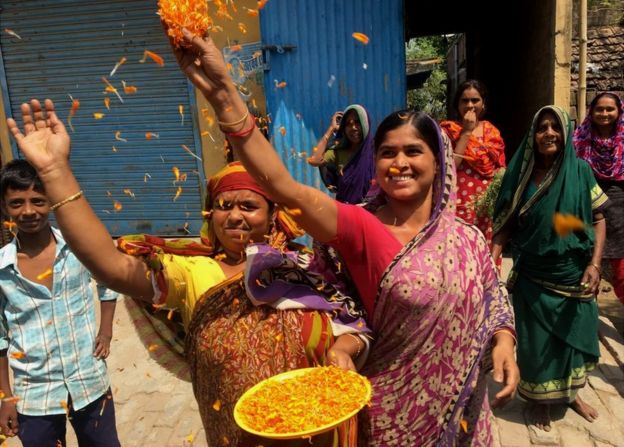
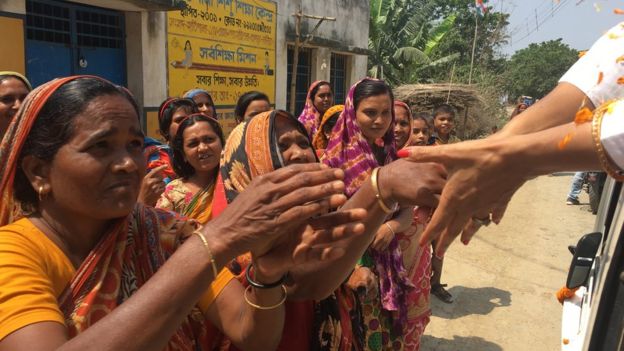
They shower bright orange marigold petals on her, place garlands around her neck and many reach out to shake and kiss her hands. She waves at them, greeting them with her palms joined: “Give me your blessings.”
Young men and women whip out their smartphones to take photos and selfies. On the way, she’s offered coconut water and sweets.
Ms Moitra, who is contesting the general election as a candidate of the state’s governing Trinamool Congress Party (TMC), is campaigning in her constituency Krishnanagar.
Image caption On the campaign trail, women offer coconut water and sweetsImage caption Supporters throw marigold petals at Mahua Moitra
In one village, party workers tell her about an old man who’s too ill to come to meet her, so she walks to his home to greet him.
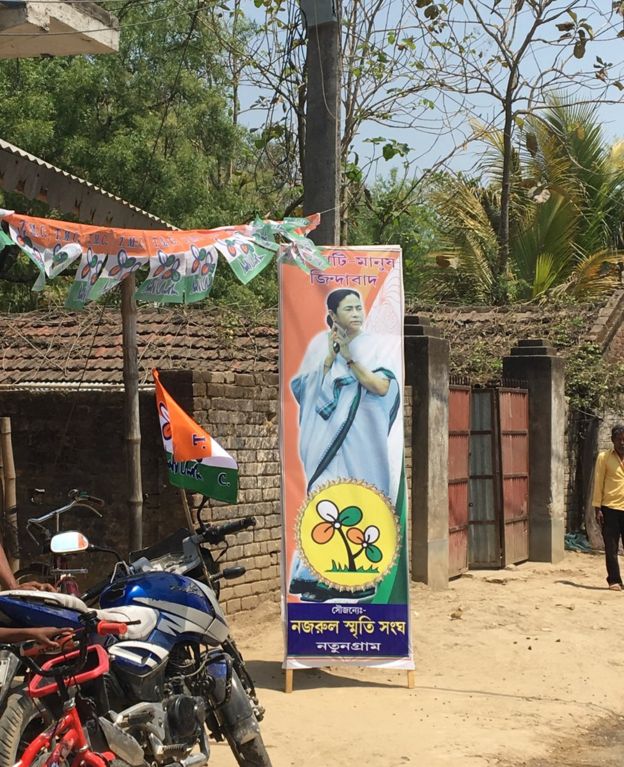
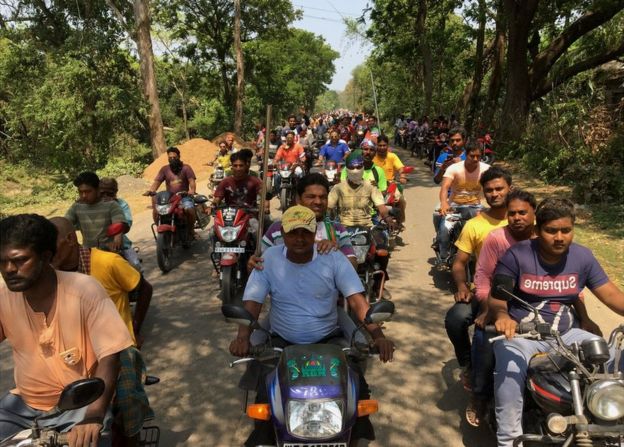
Her jeep is followed by dozens of bikes and their riders, all young men, chanting slogans like “Long live Trinamool Congress, Long live Mamata Banerjee.”
The loud, colourful procession is led by a small truck, fitted with loudspeakers, from which announcements asking people to vote for Ms Moitra are played on a loop.
With the election season well under way in India and political leaders criss-crossing the length and breadth of the country, addressing rallies, I’m travelling across the country to see if the high-decibel campaigns are addressing the real issues that actually affect millions of people. One of them is getting more women into parliament.
A bill to reserve 33% of seats for women in parliament and regional assemblies has been pending since 1996, so the decision by the TMC – led by West Bengal Chief Minister Mamata Banerjee – to give 41% of her party nominations to women has created a huge buzz.
Image caption Ms Moitra quit her banker’s job in London to return to India and enter politics
Ms Banerjee, who set up the TMC in 1998 after falling out with the Congress party, is a feisty politician who was named one of Time magazine’s 100 most influential people in the world in 2012.
Her female candidates, says my BBC Bengali colleague Subhajyoti Ghosh, are an “interesting mix” of career politicians and first-timers. They include actors, doctors, a tribal activist and the 25-year-old widow of a recently-murdered politician.
Ms Moitra, the TMC’s national spokesperson and a member of the state assembly since 2016, is among 17 women who have made it to the party’s list of 42 general election nominees.
A former investment banker with JP Morgan, she gave up a well-paying job in London in 2009 to return to the heat and dust of Indian politics.
Her decision left her family aghast. Her parents, she told me, thought she was “insane”. Some party workers too had their doubts – “she’s a memsahib”, they said at the time, “she won’t survive”.
Image caption Mamata Banerjee was named one of Time magazine’s 100 most influential people in the world in 2012But she has survived – and thrived. In 2016, she won the Karimpur assembly seat that no non-Left party had won since 1972 and has now set her eyes on the national parliament.
She’s agreed to let me follow her on the campaign trail, so for two days I’ve been a “fly on the wall” – standing behind her in her jeep, travelling in her car, watching her strategise with party workers, aides and confidants.
The previous evening, I had watched her be the chief guest at a college cricket match and address a gathering at the local market in Plassey.
A four-hour drive from Kolkata, Plassey is the site of the famous 1757 battle between the British East India Company and the local ruler supported by the French.
Image caption Her jeep is followed by dozens of supporters on bikesImage caption Many women reach out to shake hands with Ms Moitra
“What’s the point of saying you killed all those terrorists in Pakistan? It’s not important who you killed in Pakistan or how many. What’s important is you failed to protect our soldiers.”
She talks about how the government has failed to create jobs and accuses the BJP of trying to divide Hindus and Muslims.
“You have taken away our livelihoods and you’re trying to teach us about [the Hindu god] Ram and [Muslim saint] Rahim? I don’t have to write my religion on my forehead,” she declares to loud claps from her supporters.
Elections in the past were to change the government, she says, but this election is to save the constitution of India. “It is no ordinary vote.”
Her main rival is the BJP’s Kalyan Chaubey, a former footballer who played in goal for India. So drawing a football analogy, she declares: “I’m an A-league centre-forward player, stop my goal if you can. I am here to win.”
Kakoli Ghosh Dastidar, a founder member of the TMC and two-term MP, says to nominate so many women is part of a “continuous process” followed by Mamata Banerjee because “you can’t develop a society without uplifting the status of its women”.
In the last general election in 2014, she points out that the party nominated 33% women and 12 of their 34 MPs in the outgoing lower house were women.
Ms Banerjee, she says, believes that gender sensitive laws will come only if more women are in power.
At a campaign rally that Dr Ghosh Dastidar addresses in Kumhra Kashipur village in her constituency Barasat, women are seated in the front rows.
Their opinion though is divided over whether having more women in parliament will actually benefit other women.
Image caption Dr Kakoli Ghosh Dastidar is among the founder members of the TMC and a two-term MP
Supriya Biswas says it’s easier if their MP is a woman because then it’s easier to approach her. “For, who can understand a woman better than a woman?”
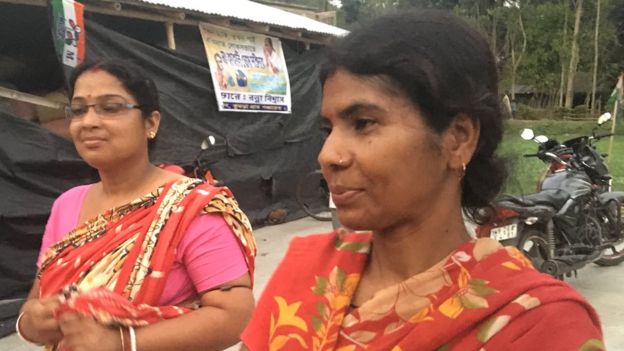
Archana Mallick and Meena Mouli, who live just across from the rally ground, point to the broken roads near their homes and complain about poor medical facilities in their village. They say that the candidate’s gender is “inconsequential” and what’s important is “who works for our benefit”.
Saswati Ghosh, professor of economics at Kolkata’s City College, says that politics in India is “still very patriarchal” and it’s “absolutely necessary” to elect more women MPs.
“It is important to have more women in lawmaking bodies because I think after a certain number, you’ll reach the threshold level and that will lead to change. I don’t know if 33% is the magic number that will change the quality of discourse, maybe 25% can do the trick?”
Image caption Archana Mallick and Meena Mouli say a candidate’s gender is “inconsequential”
Critics, however, question whether celebrities are the right candidates to bring about that change.
Prof Ghosh says actors and celebrities make for “winnable candidates” and that’s why all parties choose them even though sometimes they may not be the right candidates to reach that threshold.
But, she says that Ms Banerjee is a strong leader who’s regarded by many women as “a role model who inspires more women to come into politics”.
And that’s something that many Indians think the country sorely needs.
In their manifestos, the main opposition Congress party has promised to pass the women’s reservation bill, if elected to power. So has the ruling Bharatiya Janata Party, although it had made similar promises in its last manifesto and did nothing about it.
By allotting 41% seats to women, Ms Banerjee has shown that one doesn’t need to set artificial quotas to elect more women.








 CHINDIA ALERT: You'll be living in their world, very soon