Archive for ‘promised’

22/05/2020

China scraps annual economic growth target for first time

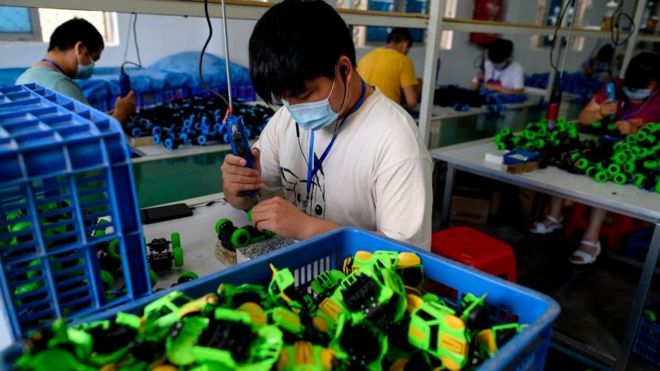
Workers assembling toys at the Mendiss toy factory in Shantou, in southern China's Guangdong province.Image copyright GETTY IMAGES

China will not set an economic growth goal for this year as it deals with the fallout from the coronavirus pandemic.

It is the first time Beijing has not had a gross domestic product (GDP) target since 1990 when records began.

The announcement was made by Premier Li Keqiang at the start of the country’s annual parliament meeting.

The world’s second largest economy shrank by 6.8% in the first quarter from a year ago as lockdowns paralysed businesses.

“This is because our country will face some factors that are difficult to predict in its development due to the great uncertainty regarding the Covid-19 pandemic and the world economic and trade environment,” Premier Li said.

The country’s leadership has promised to boost economic support measures amid growing concerns that rising unemployment could threaten social stability.

The move comes as tensions between Beijing and Washington are becoming increasingly strained over the coronavirus pandemic, trade and Hong Kong.

On Thursday, President Donald Trump stepped up his attacks on China, suggesting that the country’s leader, Xi Jinping, is behind a “disinformation and propaganda attack on the United States and Europe.”

It came as Mr Trump and other Republicans have escalated their criticism of Beijing’s handling of the early stages of the outbreak.

Also on Thursday, China announced plans to impose new national security legislation on Hong Kong after last year’s pro-democracy protests.

The announcement was met with a warning from Mr Trump that the US would react “very strongly” against any attempt to gain more control over the former British colony.

Separately, two US senators have proposed legislation to punish Chinese entities involved in enforcing the planned new laws and penalise banks that do business with them.

Earlier this week, the US Senate unanimously passed a proposal to delist Chinese companies from American stock exchanges if they fail to comply with US financial reporting standards.

US-listed Chinese companies have come under increasing scrutiny in recent weeks after Luckin Coffee revealed that an internal investigation found hundreds of millions of dollars of its sales last year were “fabricated”.

Source: The BBC
08/04/2019

India election 2019: Are India’s farmers receiving what they were promised?

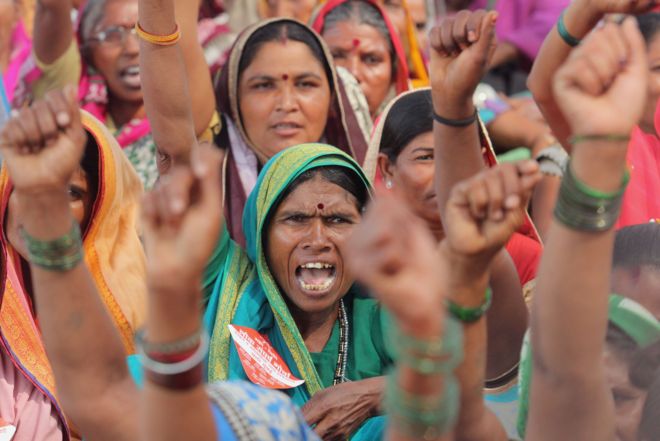
Farmers near Mumbai protesting for better compensationImage copyrightGETTY IMAGES

The plight of India’s farmers has been a major theme in the campaigns ahead of national elections, which get under way on 11 April.

Angry farmers have regularly taken to the streets demanding a better financial deal.

Many find themselves in debt and burdened by other liabilities they’ve taken on to buy seed, fertilisers and equipment.

Thousands of farmers commit suicide every year in India, although the reasons are often complex.

Presentational grey line

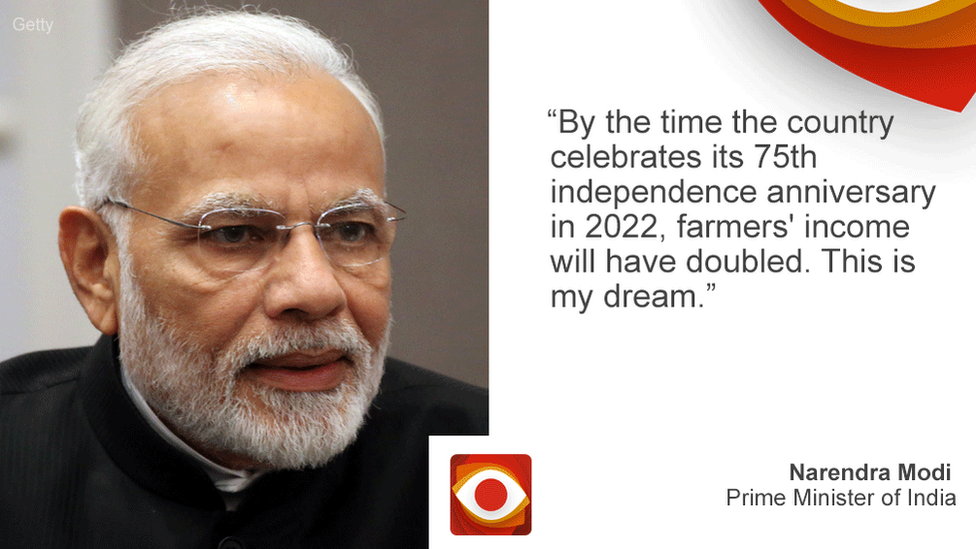
Pledge: Speaking in 2016, India’s Prime Minister, Narendra Modi, said farmers’ incomes would double by 2022.

Verdict: Official data shows farmers’ incomes were rising between 2013 and 2016. Income data for the past two years is not available but there are signs the rural economy is depressed. Unless there is a significant upturn, the doubling of farm incomes by 2022 is unlikely.

Modi quote card
Presentational grey line

The government has now pledged to pay 6,000 Indian rupees (£64) a year to help farmers with holdings of less than two hectares (20,000 sq m), in a bid to reach that goal.

These moves have been criticised by opposition parties as vote-buying ahead of the elections.

The agricultural sector employs more than 40% of the workforce in India, despite its shrinking contribution to the country’s gross domestic product (GDP), the total value of goods and services produced.

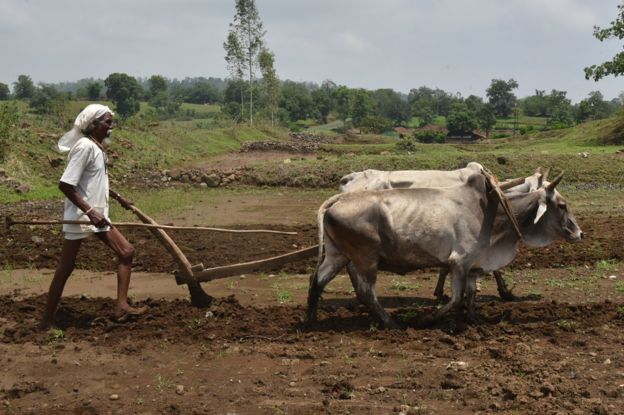
Farmer ploughing field near Jabalpur, India

What’s happened to farming incomes?

In 2016, the average monthly income of a farming household was about 9,000 Indian rupees (£100), according to a survey conducted by the National Bank for Agriculture and Rural Development.

This report also found that farmers’ income had increased by 40% in the three years up to 2016, the latest year for which data is available.

However, there is evidence of a more recent slowdown in the rural economy.

According to one estimate, farm income, which had grown by more than 14% in the year to 2017, slumped to just over a 2% growth rate between 2017 and 2018.

And in several state elections in December 2018, the ruling BJP fared poorly – something put down to growing discontent in rural areas.

What problems do farmers face?

Droughts, bad weather and a lack of modern equipment have plagued Indian agriculture for decades.

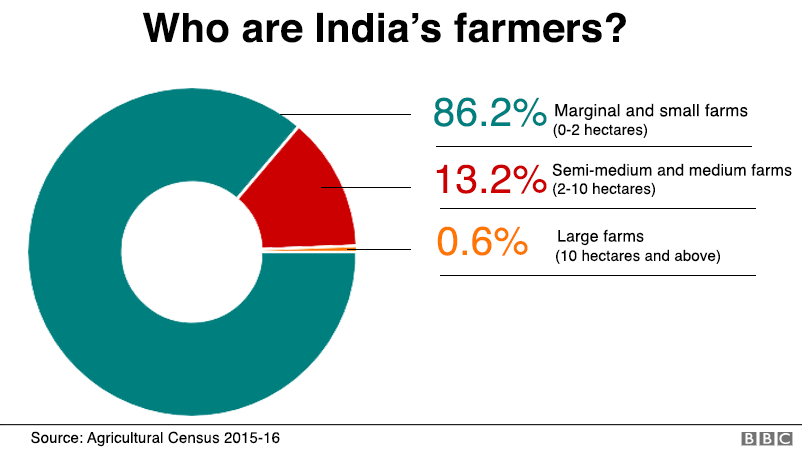
In addition, many of India’s farmers work on vulnerable small or marginal holdings.

Pie chart showing size of farm holdings

The current administration has introduced pro-farming policies that include:

  • a crop insurance scheme
  • a soil health card scheme to improve productivity
  • an online trading platform for agricultural produce

But it’s also faced criticism for other policies that have negatively affected farmers – such as the sudden decision to 2016 withdraw the 500 and 1,000 rupee notes from circulation in a bid to tackle the black economy.

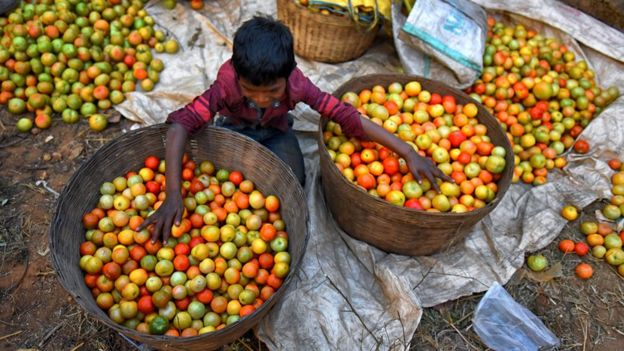
Boy sorting tomato cropImage copyrightGETTY IMAGES
Image captionThere are issues with storage and processing

Why aren’t farmers earning more?

A very good harvest in any year will result in a sharp fall in the price of a commodity.

This helps keep food prices in check for urban consumers but is not so good for rural producers.

To counter this, the government sets a minimum purchase price for major agricultural products each year.

However, a recent official report pointed out serious shortcomings of these price controls.

It cited a lack of awareness among farmers, delays in payments and insufficient facilities to enable farmers to store produce at government-controlled warehouses.

At various times over the years, national and state governments have also announced loan waivers for farmers to write off their debts.

These schemes are expensive and not everyone qualifies for help.

Source: The BBC

Law of Unintended Consequences

continuously updated blog about China & India

ChiaHou's Book Reviews

continuously updated blog about China & India

What's wrong with the world; and its economy

continuously updated blog about China & India