Archive for ‘propeller’

14/08/2019

Chinese engineers follow the Sea Dragon with new submersible that can ‘fly’ through water like a plane in the air

  • Developers say their prototype craft could dive to 1,000 metres in five minutes
  • Liu Kaizhou, who also worked the Jiaolong submersible, says ‘We are in uncharted water’
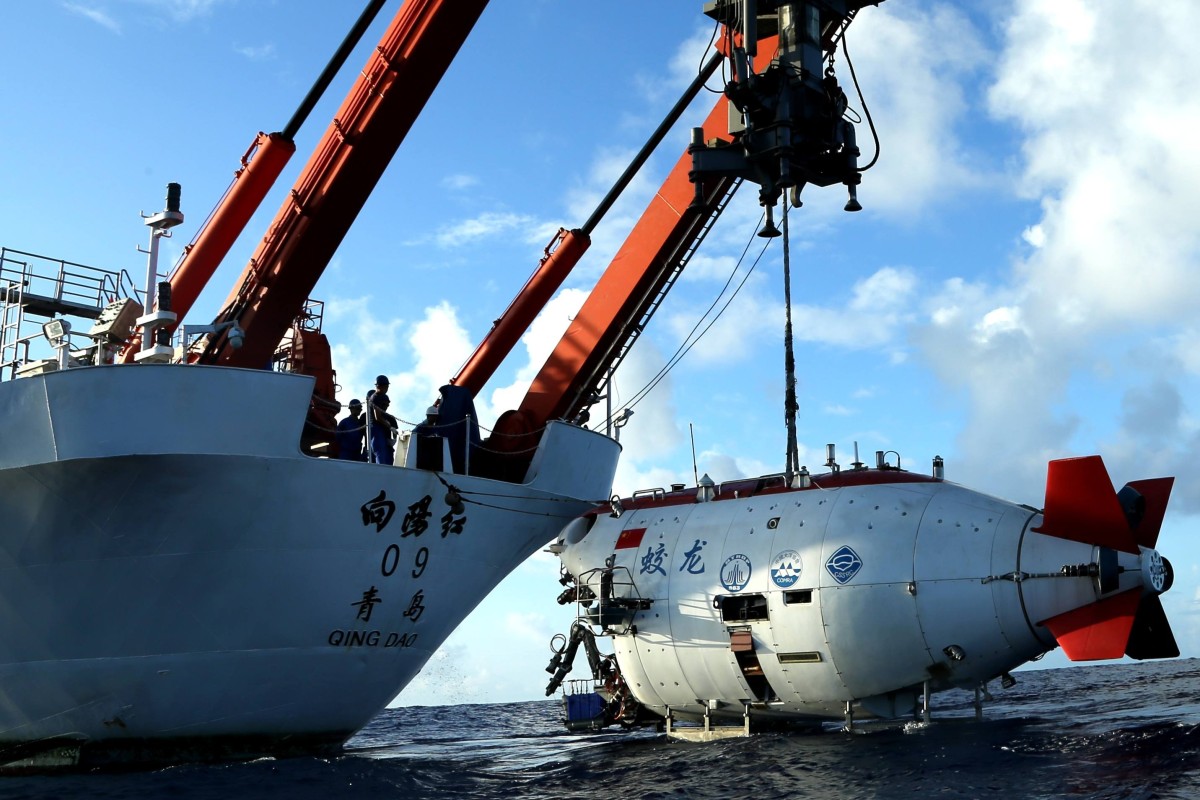
Professor Liu Kaizhou, who developed the autopilot for China’s manned Jiaolong submersible, says his team has designed a vessel that can move through water like a plane moves through the air. Photo: Xinhua
Chinese engineers say they are developing a radical design for a super-fast robot submersible which the project leader, who worked on the manned deep-sea vessel Jiaolong, or Sea Dragon, claims can “fly” in water like a plane travels through the air.

At 3 metres (9.8ft) long, the prototype consists of a cigar-shaped body, with a guidance system in the bow and a jet plane style rudder and a propeller in the stern.

Outriggers house batteries and two more propellers. These are attached to the body by wing-like planes that the developers said will give the vessel the kind of lift in water that takes an aeroplane into the air and back to the earth.

Developers said the prototype will be capable of 10 knots and could dive to a depth of 1,000 metres (3,281 feet) – or surface from that depth – at about three metres a second, taking about 5½ minutes.

Professor Liu Kaizhou, lead scientist of the project at the Shenyang Institute of Automation, part of the Chinese Academy of Sciences in Liaoning province, said the design had great potential.

If a traditional submarine was like an air balloon, he said, the prototype was like an aircraft. “It is technically flying, fast and freely, like a plane for the water.”

The prototype has 20 major components on board, including a computer, and communications and surveillance equipment. These were all developed and tested by the team, but getting them to work together posed some unexpected challenges, Liu said, meaning the transition to operations in a tough marine environment was some time away.

Underwater station could be a game changer, Chinese scientist says

“We aim to make the first open sea test in about a year,” he said.

The submersible can be powered by conventional batteries or a chemical engine that mixes lithium and sulphur hexafluoride to produce heated steam for electrical generators – an energy source often used by torpedoes.

Funded by the Ministry of Science and Technology from 2017, the project was driven by China’s growing ambition to become a superpower in the world’s oceans.

The team said their submersible had the potential to become the backbone of China’s search-and-rescue operations at sea, naval intelligence gathering, high-precision sea floor mapping, or to transport minerals from the seabed to the surface.
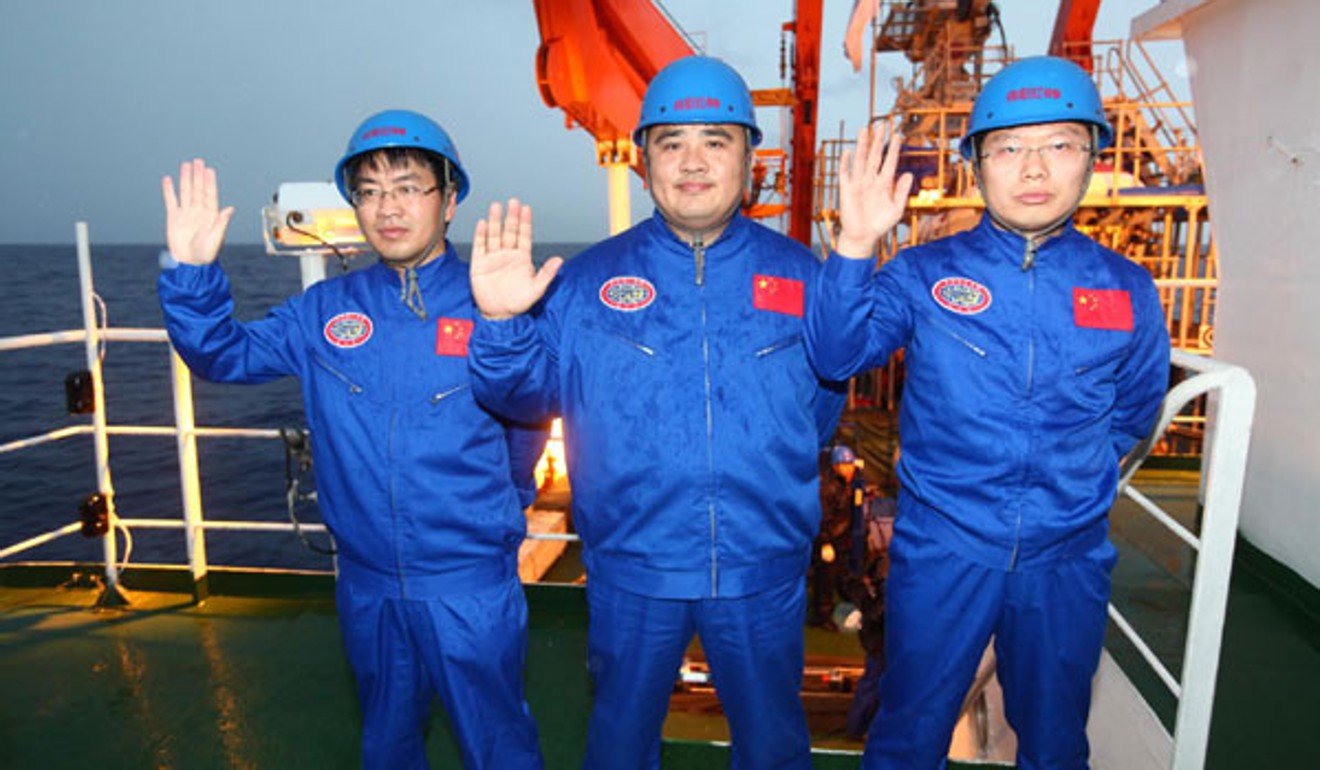
Professor Liu Kaizhou (left) with colleagues Ye Cong and Yang Bo, was instrumental in the success of China’s Jiaolong manned submersible. Photo: Xinhua

Professor Du Tezhuan, a researcher in fluid dynamics at the Institute of Mechanics of the Chinese Academy of Sciences in Beijing, said the design was a bold one but it posed the research team many hard questions.

The density of water was much higher than that of air, he said, which meant the vessel would encounter more drag and would need a strong power source.

“Without sufficient speed, the lift will be weak, and to reach high speeds, lots of energy will be needed. Flying in water is not as easy as flying in the air,” said Du, who was not involved in the project.

Why Beijing is speeding up underwater drone tests in the South China Sea

“But in theory it should work. It is worth a try.”

Liu – who led the design of the autopilot system that can take the Jiaolong to depths of more than 7,000 metres (23,000 ft) – said that after tests on the prototype were complete, other innovations were possible. These included covering the vessel with air bubbles to reduce friction.

“This technology is brand new,” he said. “We are in uncharted water and we are excited by the challenges.”

Source: SCMP

19/05/2019

Cooperation only right choice for China, U.S.: Chinese envoy

UN-US-CHINA TRADE RELATIONS-CHINESE ENVOY-BRIEFING

Ma Zhaoxu (C, front), China’s permanent representative to the United Nations (UN), hosts a briefing on the U.S.-China trade relations at the UN headquarters in New York, May 17, 2019. Cooperation is the only right choice for China and the United States, said Ma Zhaoxu on Friday. (Xinhua/Ma Jianguo)

UNITED NATIONS, May 18 (Xinhua) — Cooperation is the only right choice for China and the United States, said China’s Permanent Representative to the United Nations (UN) Ma Zhaoxu on Friday.

The economic and trade relations between China and the United States are the “ballast” and “propeller” of this important bilateral relationship, said the Chinese envoy when hosting a briefing on the U.S.-China trade relations at the UN headquarters in New York, adding that it is not only about U.S.-China bilateral relations but also world peace and prosperity.

Representatives from more than 100 UN member states and international agencies attended the meeting.

Referring to the consultations between the two countries since the United States unilaterally provoked the frictions in March 2018, Ma said that China will resolutely defend its core interests and will never give in on major issues of principle.

China strongly opposes the U.S. practice of imposing additional tariffs, said the Chinese envoy, while expressing the hope that the United States and China could work together, meet each other in the halfway, address each other’s concern based on mutual respect and equality, and strive for a mutually beneficial agreement.

“The agreement between the two sides must be equal-footed and mutually beneficial,” he said, noting that China’s three core concerns — remove all the additional tariffs, work out a realistic amount of purchases, and improve the balance of the wording of the text — must be addressed.

The Chinese economy has maintained steady growth and has shown positive momentum, Ma told the audience. “The trade protectionist measures of the United States will have an impact on the Chinese economy, but it can be overcome.”

“The Chinese economy is a sea, not a small pond,” he added. “We will continue to promote reform and opening up according to our own pace, and promote high-quality development of the economy according to our own timetable and road map, to realize the long-term stability and growth of the Chinese economy.”

According to Ma, paying mutual respect to each other’s core concerns, and making mutual concessions on the basis of mutual respect, equality and mutual benefit are the premises of expanding cooperation, and only in such a way, the trade issues between the two sides could be resolved.

Source: Xinhua

Law of Unintended Consequences

continuously updated blog about China & India

ChiaHou's Book Reviews

continuously updated blog about China & India

What's wrong with the world; and its economy

continuously updated blog about China & India