Archive for ‘protests’

25/01/2019

Assam citizenship bill: Anti-migrant protests rock north-east India

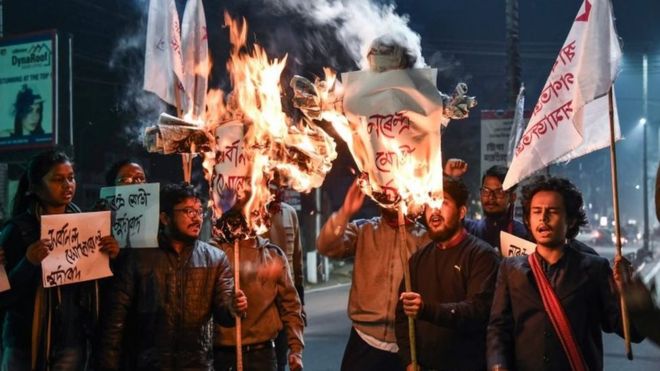
Activists of Students" Federation of India (SFI) burn the effigies of India's Prime Minister and Chief Minister of Assam in Guwahati on January 8, 2019 after India's lower house passed today legislation that will grant citizenship to members of certain religious minorities but not MuslimsImage copyrightAFP
Image captionProtesters have burnt effigies of PM Narendra Modi

Violent protests are continuing in India’s north-eastern states over a proposed amendment to the country’s citizenship law.

The protests have been particularly vocal in the state of Assam, which recently saw four million residents left off a citizens’ register.

The bill attempts to grant citizenship to immigrants who are not Muslim.

Students, activists, politicians and celebrities have all joined the protests against India’s ruling party.

What does the bill say?

The Citizenship (Amendment) bill seeks to provide citizenship to non-Muslim migrants from Pakistan, Bangladesh and Afghanistan.

Supporters of the bill defend it by saying that Muslims have been excluded as the bill offers Indian nationality only to religious minorities fleeing persecution in neighbouring countries.

It comes months after the publication of the National Register of Citizens (NRC) – a list of people who can prove they came to the state by 24 March 1971, a day before neighbouring Bangladesh became an independent country. Around 3.62 million of those left off the register have submitted claims for inclusion again.
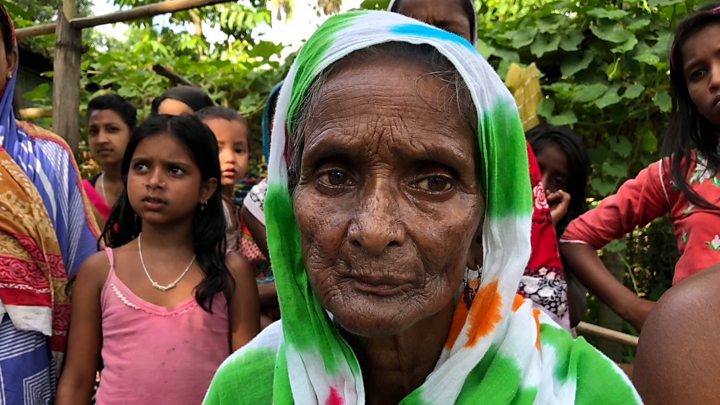
Media captionLiving in limbo: Assam’s four million unwanted

India said the process was needed to identify illegal Bangladeshi migrants.

Thousands of students have joined writers, artists and activists in regular protests against the bill, fearing that tens of thousands of Bengali Hindu migrants who were not included in the NRC may still get citizenship to stay on in the state.

How bad are the protests?

Offices of the Bharatiya Janata Party (BJP), which runs both the federal government and Assam’s state government, have been burnt down by angry mobs in many places.

Protesters have also frequently surrounded the state secretariat in the capital, Guwahati, demanding the shelving of the amendment.

Some supporters of Assamese peasant leader Akhil Gogoi even staged a nude protest in the national capital, Delhi, earlier this month.

“The movement against the bill has gained momentum across the north-east and if it is not withdrawn, the situation in the region may turn volatile,” Sammujal Bhattacharyya of the All Assam Students Union (Aasu), which is leading the protests against the bill in Assam, told the BBC.

He said it was an attempt to provide citizenship “by backdoor” to illegal non-Muslim migrants who were excluded from the NRC.
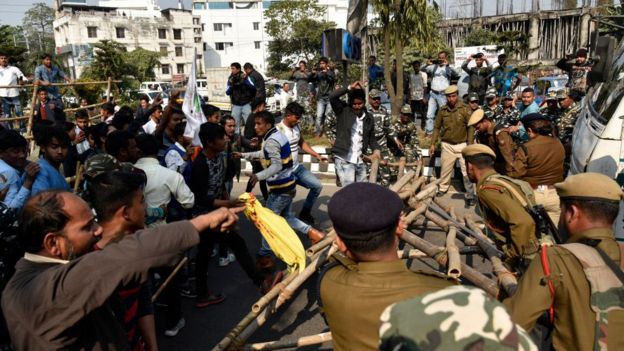
Activists of Krishak Mukti Sangram Samiti (KMSS), Asom Jatiyatabadi Yuba Chatra Parishad (AJYCP) and several other indigenous organizations staging protest in front of the Janata Bhawan in Dispur, Guwahati, Assam, India in against the Citizenship (Amendment) Bill, 2016 on Wednesday, Jan 9, 2019.Image copyrightGETTY IMAGES
Image captionAssam has seen vocal protests against the bill

In the early 1980s, Aasu was behind the anti-migrant protests in Assam that paralysed the state and degenerated into rioting that led to more than 3,000 deaths.

The agitation ended in 1985 after March 1971 was agreed as the cut-off date to determine citizenship.

Why is the BJP determined to get the bill through?

Despite the protests, BJP president Amit Shah has insisted that the government is determined to pass the bill.

“Hindus from these countries have nothing to fear, they will all get Indian citizenship,” Mr Shah told a rally in West Bengal state this week. Analysts say it’s an obvious attempt to win over Bengali Hindus to the BJP’s cause.

The Bengali Hindus are in a majority in the states of West Bengal and Tripura, with substantial numbers in Assam. The three states together will account for 58 seats in upcoming general elections.
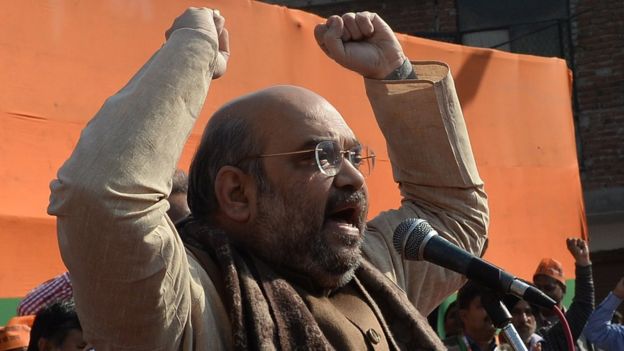
BJP President Amit Shah during a rally in New Delhi.Image copyrightGETTY IMAGES
Image caption
BJP president Amit Shah has said the government is committed to pass the bill

But while the BJP may seek to win many of these seats to offset possible losses in north India, it risks losing the support of the ethnic Assamese, who voted for the party in the 2016 state elections.

Assam Chief Minister Sarbananda Sonowal, himself a former Aasu leader, is on the defensive, requesting students not to join the agitation which, he says, is fuelled by “misinformation”.

“Nobody will automatically get citizenship if the amendment is passed into law. The government will closely examine all applications and reject those that are not tenable,” he said this week.

What are the other reactions to the bill?

India’s main opposition Congress party opposes the bill on the grounds that determining citizenship on the basis of religion goes against the spirit of the constitution.

Regional parties who have joined hands with the BJP to form governments in Assam and the neighbouring states of Meghalaya, Nagaland and Mizoram have threatened to renege on their alliances because they all oppose the bill.
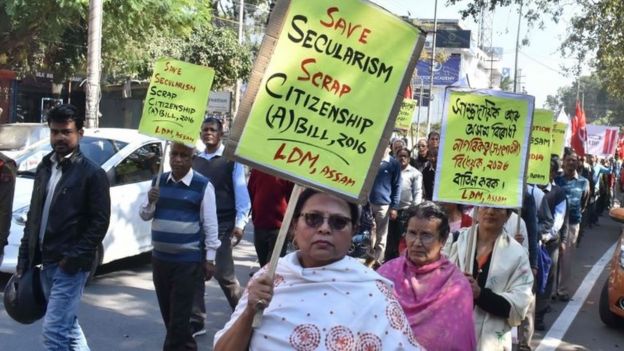
Activists of the Left Democratic Manch alliance hold placards as they take part in protest rally in protest against Citizenship Amendment Bill 2016, which will provide citizenship or stay rights to minorities from Bangladesh, Pakistan and Afghanistan in India, in Guwahati on January 7, 2019.Image copyrightAFP
Image caption
Demands to scrap the bill have been growing louder

“Anyone who came to Assam after March 1971 is a foreigner, an illegal migrant. We don’t care if he or she is Hindu or Muslim. Religion is not the issue here, it is a question of protecting indigenous people from being swamped by foreigners in their own land,” university student Mitali Baruah told the BBC as she marched to a protest rally.

That has been the dominant sentiment with most of the indigenous communities – a migrant is unwelcome, regardless of religion.

“The BJP has failed to understand the pulse of the region, because they see everything through the prism of religion,” said analyst Samir Purkayastha.

Source: The BBC

03/01/2019

One dead in Kerala protests over Sabarimala row, 100 injured during bandh

The Bharatiya Janata Party is supporting the shutdown while the Congress-led UDF is observing a “black day” on Thursday.

INDIA Updated: Jan 03, 2019 15:47 IST

Ramesh Babu
Ramesh Babu
Hindustan Times
Sabarimala,sabarimala protest,Congress on sabarimala
Police intervene as members of Sabarimala Karma Samithi try to disrupt a celebratory meeting after two women entered Sabarimala Ayyapa temple, at the High Court Junction in Kochi in the Indian state of Kerala on January 2, 2019(AFP)

More than 100 people, including 38 policemen, were injured on Thursday as a shutdown to protest against the Kerala government for helping two women enter the Sabarimala temple turned violent at several places in the state.

In Thrissur, four workers of the BJP were stabbed while enforcing the shutdown call by Sabarimala Karma Samithi, an umbrella organisation of various pro-Hindutva groups, spearheading protests against the Supreme Court’s September 28 verdict, and Antarrashtriya Hindu Parishad (AHP).

The Bharatiya Janata Party is supporting the shutdown while the Congress-led UDF is observing a “black day” on Thursday. (Live updates)

Police in Pandalam, Kozhikode, Kasargode and Ottapalam baton charged at protesters as several party offices and houses were attacked throughout the state. In Kozhikode, police used tear gas to disperse protesters who tried to enforce the 12-hour shutdown.

New agency AFP reported journalists were assaulted in Palakkad during a march organised by the BJP and the Rashtriya Swayamsevak Sangh (RSS), the ideological mentor of Prime Minister Narendra Modi-led party.

The shutdown forced the state to a standstill as shops and other small businesses were closed in many places. Most bus services were halted and taxis were refusing to take passengers as some drivers, who said they feared they could be attacked.

Various universities, including Kerala, Mahatma Gandhi, Calicut and Kannur have deferred their examinations scheduled for Thursday.

It was the first time that women aged between 10 and 50 had set foot in the gold-plated temple nestled in a tiger reserve since the Supreme Court in September last year ordered the lifting of the ban on women of menstruating age entering the hilltop shrine.

The temple has refused to abide by the ruling and subsequent attempts by women to visit it had been blocked by thousands of angry devotees.

Bindu Ammini and Kanakadurga dressed in all black were escorted by police into the temple through a side gate early on Wednesday, catching the devotees off guard. The temple priests closed the shrine dedicated to the celibate Lord Ayyappa for purification rituals and protests against the women entering the temple erupted quickly.

A 55-year-old activist of the Samithi died after he was injured during a stone pelting incident in Pathanamthitta on Wednesday. Others have also been injured.

Kerala chief minister Pinarayi Vijayan defended helping the two women in gaining entry to the Sabarimala temple as he accused the Sangh Parivar of trying to incite trouble in the state.

Also watch: Two women below the age of 50 enter Sabarimala Temple

Vijayan said during a press conference it was his government’s constitutional obligation to help the two women and warned that troublemakers will be dealt with sternly.

“The Sangh Parivar is trying to sabotage the Supreme Court verdict. The real devotees are not against the verdict,” the chief minister said.

“Kanakadurga and Bindu were given protection after they sought security to visit the shrine. They were not airdropped. They visited shrine like normal devotees. None of the devotees protested,” he told reporters.

The BJP and held the chief minister responsible for the violence.

17/12/2018

Indian forces lock down Kashmir city, hold leaders to stifle protests

SRINAGAR, India (Reuters) – Indian police detained separatist leaders in the disputed Kashmir region on Monday and sealed off roads in an effort to stifle protests against the killing of civilians on the weekend.

An Indian policeman stands guard behind concertina wire laid across a road leading to the Indian army headquarters in Srinagar December 17, 2018. REUTERS/Danish Ismail

Unrest has intensified over recent weeks in the Muslim-majority region at the heart of decades of hostility between India and Pakistan, and seven civilians were killed on Saturday when security forces opened fire at a protest over the killing of three militants.

Separatists leaders Mohammad Yasin Malik and Mirwaiz Umar Farooq said they were detained as they marched towards an army headquarters in Kashmir’s main city of Srinagar. Another leader, Syed Ali Shah Geelani, was under house arrest, police said.

“Indian troops are killing Kashmiris,” Malik told reporters as police in riot gear took him away in a white vehicle. “For the last many years they are on a killing spree.”

A senior police official, who declined to be identified, said Malik and Farooq would be released “once the situation stabilises”.

A spokesman for India’s Ministry of Home Affairs in New Delhi said he had no comment.

Police and para-military forces put up barricades in various parts of Srinagar, including on roads leading to the army headquarters, and were patrolling in force.

The army warned the population against being used to make trouble.

“Army advises people not to fall prey to such designs of anti-national forces,” the army said in a statement late on Sunday.

“It’s an attempt to pit the civilian population against the security forces”.

One soldier was killed in the Saturday violence.

‘DIALOGUE, NOT VIOLENCE’

Shops, government offices and banks were closed in Srinagar and a nearby district and traffic was off the roads. Authorities have also shut down mobile internet and train services.

Slideshow (3 Images)

Pakistan, which like India, claims Kashmir in full but rules it in part, condemned the Saturday killings.

“Only dialogue and not violence and killings will resolve this conflict,” Pakistan Prime Minister Imran Khan said, adding that his country would raise India’s “human rights violations” at the United Nations.

Hindu-majority India accuses Pakistan of training and arming separatist militants operating in Kashmir.

Pakistan denies that saying it only offers political support to the people of the Muslim region who are being denied their rights by India’s security forces.

Indian forces say they have killed 242 militants this year in the region, while 101 civilians and 82 members of the security forces have been killed, making it the bloodiest year in more than a decade.

Meenakshi Ganguly, South Asia director at Human Rights Watch, said Indian authorities should investigate and prosecute those responsible for “indiscriminate use of force”.

“Security forces are aware that villagers gather, protest during gunfights with Kashmir militants and have responsibility to ensure civilians are not at risk,” she said in a tweet.

15/12/2018

China jails boss of 100 billion yuan pyramid scheme for inciting protests

BEIJING (Reuters) – A Chinese court has jailed for 17 years a businessman who ran a 100 billion yuan pyramid scheme and organised a rare street protest in Beijing against police investigations into his activities, state media reported.

Zhang Tianming and nine other staff from his company, Shenzhen-based Shan Xin Hui, were found guilty in a hearing on Friday of running a multi-level marketing company and of disturbing social order.

Shuangpai County People’s Court in central Hunan province handed Zhang a 17-year jail sentence and a 100 million yuan fine after he used social media to organise a public protest involving more than 600 people from his marketing platform, state broadcaster CCTV reported late on Friday.

The investors took to the streets of the capital in July last year, holding banners and shouting slogans, which obstructed and defied police work, the court said.

Zhang’s company had lured investors with promises of high rates of return on projects that were meant to help the poor, but had instead paid out early members purely using funds from new joiners, a court investigation found.

Nearly 6 million people and over 100 billion yuan ($14.48 billion) were involved in the scheme, the court said.

The nine other executives were handed prison sentences ranging from 18 months to 10 years, it said.

Reuters was unable to contact Zhang or the other nine individuals.

Beijing police detained 67 Shan Xin Hui investors for disturbing social order in July last year after they staged a rare protest on the heavily guarded streets of the capital.

Investors told Reuters at the time that they had come to complain that the company had been dealt a huge injustice and that it had genuinely helped a lot of poor people. They said by detaining its leaders, the government had unfairly targeted the company, which they called a charity.

The government has repeatedly vowed to crack down on financial crime and fraud. In 2016, Chinese authorities shut down peer-to-peer lender Ezubao over an online scam that state media said took in some 50 billion yuan from about 900,000 investors.

Law of Unintended Consequences

continuously updated blog about China & India

ChiaHou's Book Reviews

continuously updated blog about China & India

What's wrong with the world; and its economy

continuously updated blog about China & India