05/05/2020
- Modified version of country’s most powerful rocket carries next-generation capsule designed to take astronauts to its planned space station
- It will be able to launch and land with three crew members and up to 500kg of cargo, according to state media
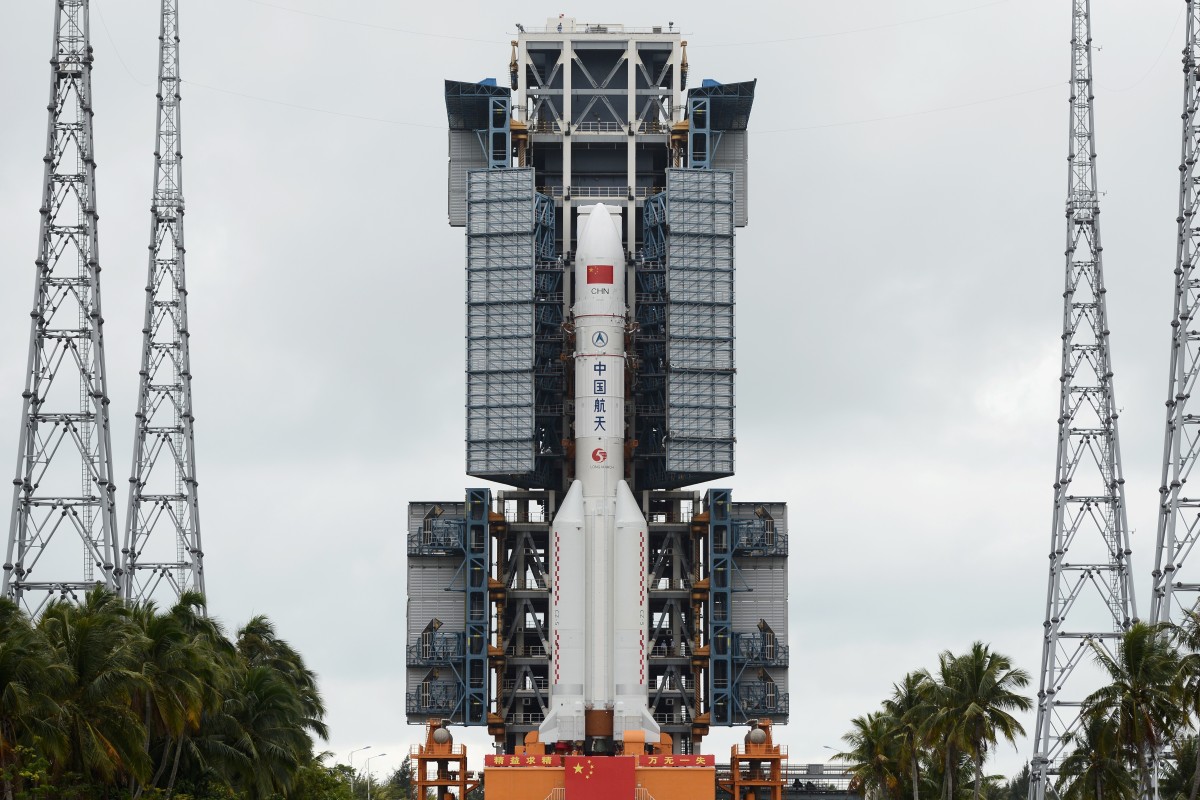
China launched a new version of its heavy-lift Long March 5 rocket on Tuesday. Photo: Reuters
China successfully launched a prototype of its next-generation manned spacecraft – without astronauts – along with a new version of its heavy-lift Long March 5 rocket on Tuesday, its space agency said.
The Long March 5B rocket was launched into low-Earth orbit from the Wenchang Satellite Launch Centre on Hainan Island in the country’s south.
The launch marks a significant step forward for China’s two big space exploration ambitions – building a space station and a mission to Mars.
A modified version of China’s most powerful rocket, the Long March 5B is 53.7 metres (176 feet) tall. It will carry the next-generation crew capsule prototype designed to replace the Shenzhou spacecraft, to transport astronauts to its planned space station in low-Earth orbit.
China aims to launch the core module of that space station designed for three crew members, the Tianhe, in 2021. Beijing has been planning to build its own space station for decades as an alternative to the International Space Station, from which China has been excluded by the United States over security concerns.
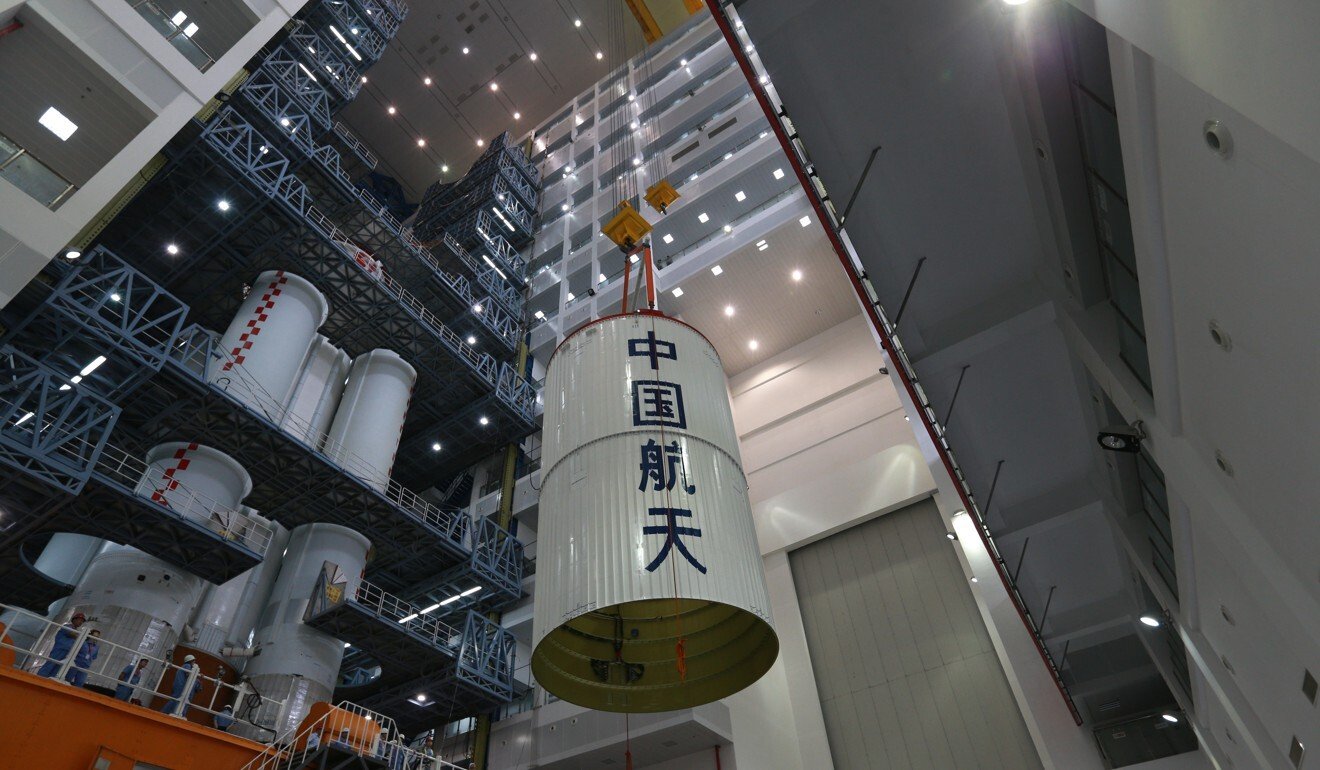
China’s space station project has been delayed by problems with its heavy-lift rockets. Photo: Xinhua
The prototype capsule has a different configuration to Shenzhou’s and it will be able to launch and land with three astronauts on board as well as up to 500kg of cargo, according to state news agency Xinhua. That will mean it can be used to transport research specimens and hardware from the space station back to Earth.
While the Shenzhou can ferry three astronauts, the new capsule design will be able to accommodate up to six crew members and, unlike the Shenzhou, it will be capable of carrying them to the moon, according to Chinese media reports.
Its systems, performance in orbit and parachute deployment are among the areas that will be put to the test during the launch.
Why China’s next Long March 5 rocket mission will be about restoring national pride
14 Dec 2019
The long-anticipated space station project has been delayed by problems in the development of heavy-lift rockets to carry the modules. In 2017, an oxygen supply problem caused the failure of the second Long March 5 launch, and it
plunged into the Pacific Ocean shortly after take-off. But in December it successfully
carried a Shijian-20 satellite into orbit, while the liquid oxygen-liquid hydrogen engines used in both the Long March 5 and 5B rockets passed testing in January.
China’s other space ambitions include a Mars probe, and landing astronauts on the moon within the next decade. For the Mars mission, the unmanned orbiter and rover Tianwen-1 will be launched by the Long March 5 and it is expected to take up to seven months for the probe to reach the red planet. China would be the third country to do so – after the United States and the Soviet Union.
Zhang Kejian, head of the China National Space Administration, said China was on track to launch the mission this year, with July the likely launch date.
Source: SCMP
Posted in 2021, ambitions, astronauts, Beijing, cargo, China, China National Space Administration, country’s south, crew members, December, delayed, designed, Earth, Excluded, Hainan, hardware, heavy-lift rockets, International Space Station, island, July, launches, liquid oxygen-liquid hydrogen engines, Long March 5B rocket, Low Earth orbit, manned, Mars probe, mission to Mars, Moon, national pride, next-generation capsule, orbit, oxygen supply, Pacific Ocean, parachute, planned, problems, prototype, research specimens, restoring, rover, security concerns, Shenzhou spacecraft, Shijian-20 satellite, Soviet Union, Space exploration, space station, space station project, spacecraft, third country, Three, Tianhe, Tianwen-1, Transport, Tuesday, Uncategorized, United States, Wenchang Satellite Launch Centre |
Leave a Comment »
04/09/2019
- Prototype tested last month transports high-voltage power and liquefied natural gas side by side
- It could cut the high cost and waste involved in sending energy from the far west to the east coast
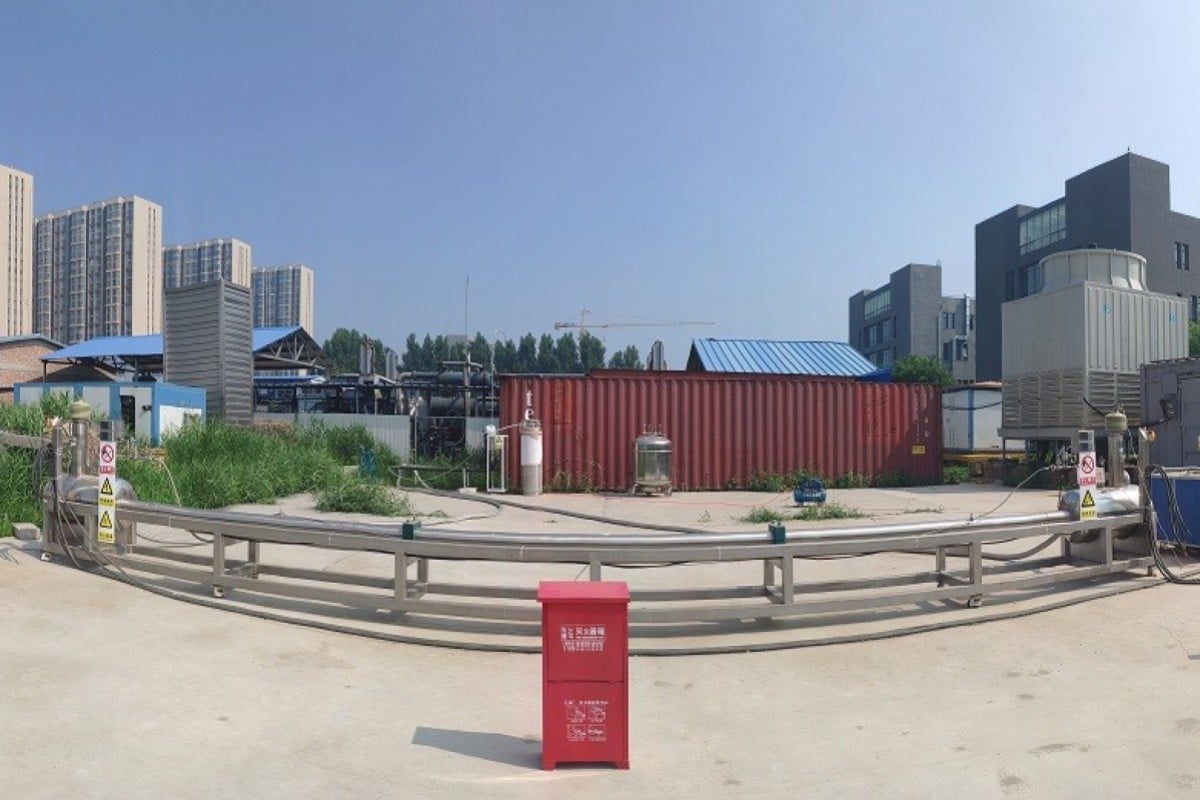
The 10-metre prototype line, combining high-voltage electricity and liquefied natural gas. Photo: Chinese Academy of Sciences
Chinese scientists have developed the world’s first prototype of a superconducting hybrid power line, paving the way for construction of a 2,000km (1,243-mile) line from energy-rich Xinjiang in the country’s far west to its eastern provinces.
The 10-metre, proof-of-concept wire and liquid natural gas hybrid transmission line was up and running at the Chinese Academy of Sciences’ Institute of Electrical Engineering in Beijing last month to show the feasibility of the technology.
The line contains a superconducting wire which can transmit nearly 1,000 amps of electric current at more than 18,000 volts with zero resistance.
In a further difference from a traditional power line, the gap between the superconducting wire and the power line’s outer shell is filled by a flow of slowly moving natural gas liquefied at low temperatures – between minus 183 and minus 173 degrees Celsius (minus 279 to minus 297 Fahrenheit). This allows the line to transfer electricity and fossil fuel at the same time.
Professor Zhang Guomin, the government research project’s lead scientist, told the South China Morning Post that the voltage and current could be much higher in its real-world applications.
“This technology can take the overall efficiency of long-distance energy transport to new heights,” he said.
Existing infrastructure to transfer energy from Xinjiang Uygur autonomous region to the developed eastern areas such as Shanghai has high operational costs because almost 10 per cent of the energy is lost in transmission, according to some studies.
That infrastructure includes the world’s most advanced high-voltage power line and four natural gas pipes, each thousands of kilometres long. One of the natural gas pipelines, from Xinjiang to Shanghai, cost 300 billion yuan (US$42 billion).
The superconductor and natural gas hybrid line offered a possible solution, Zhang said.
Loss of electricity over the superconducting wire would be almost zero because of the elimination of resistance to the movement of electrons, he said.
The transport of liquefied natural gas would also be efficient, because one cubic metre (1,000 litres) of it would be equivalent to 600 cubic metres of the same fuel in gas form.
The temperature needed for liquefaction of natural gas is almost identical to that required for occurrence of superconductivity, at about minus 163 degrees.
Wang Gengchao, professor of physics at East China University of Science and Technology in Shanghai, said the combination was a “smart idea”.
Superconducting materials are not new but their applications have been limited by the difficulty and cost of creating and maintaining the low-temperature environment.
“They are trying to kill two birds with one stone,” Wang, who was not involved in the study, said.
China is preparing to buy US liquefied gas and soybeans again
“But whether the technology can find a use in large-scale infrastructure depends on other things, such as safety. Not everyone will feel comfortable with the idea of putting a high-voltage electric line and flammable natural gas side by side.”
Zhang said another new prototype line, about 30 metres long, was being developed and the 2,000km project was awaiting government approval.
He said the team had solved some major technical obstacles, including reducing the risk of accidents from electrical sparks and gas leakage.
“Many problems remain to be solved, but we are confident this technology will work,” he said. “It will protect the environment. It will save a lot of land from being used for power and gas lines.”
Xinjiang has more energy resources than any other Chinese province or region. It has nearly half of the nation’s coal reserves, a third of its oil and gas, and some of the largest wind and solar farms, according to government statistics.
Source: SCMP
Posted in China alert, Chinese Academy of Sciences, coal reserves, Country, develops, East China University of Science and Technology, east coast, far west, high-voltage power, hybrid power line, Institute of Electrical Engineering, Natural gas, oil and gas, prototype, Shanghai, south china morning post, soybeans, span, superconducting, superconducting wire, transports, two birds with one stone, Uncategorized, US liquefied gas, wind and solar farms, Xinjiang, Xinjiang Uygur Autonomous Region, zero resistance |
Leave a Comment »
28/12/2018
BEIJING (Reuters) – A third prototype of China’s home-built C919 narrowbody passenger jet completed its first test flight on Friday, its manufacturer said, in another step forward in the nation’s push to become a global civil aerospace player.
The C919, which will compete with Boeing Co’s (BA.N) 737 and the Airbus SE (AIR.PA) A320, is widely regarded as a symbol of China’s civil aerospace ambition and President Xi Jinping’s policy of upgrading manufacturing capabilities.
In a statement on its official microblog, Commercial Aircraft Corp of China Ltd (COMAC) [CMAFC.UL] said the plane landed safely at Shanghai Pudong International Airport at 12:45 p.m. (0445 GMT), having flown for 1 hour and 38 minutes.
The jet will next fly to the city of Xian in central China for more test flights with a focus on aircraft flutter and airspeed calibration, the company said.
The second prototype of the C919 jet conducted its first flight in December 2017, seven months after the maiden flight of the first C919.
COMAC said it is assembling a further three prototypes, and that all six will be scheduled to conduct flight tests next year.
The C919 has dozens of customers that have placed orders and commitments for 815 jets.
COMAC is aiming to obtain certification for the plane from Chinese regulators by the end of 2020, as well as Europe’s aviation safety regulator, which agreed in April to start the certification process.
Posted in China alert, jet, prototype, test flight, Uncategorized |
Leave a Comment »




 CHINDIA ALERT: You'll be living in their world, very soon