Chindia Alert: You’ll be Living in their World Very Soon
aims to alert you to the threats and opportunities that China and India present. China and India require serious attention; case of ‘hidden dragon and crouching tiger’.
Without this attention, governments, businesses and, indeed, individuals may find themselves at a great disadvantage sooner rather than later.
The POSTs (front webpages) are mainly 'cuttings' from reliable sources, updated continuously.
The PAGEs (see Tabs, above) attempt to make the information more meaningful by putting some structure to the information we have researched and assembled since 2006.
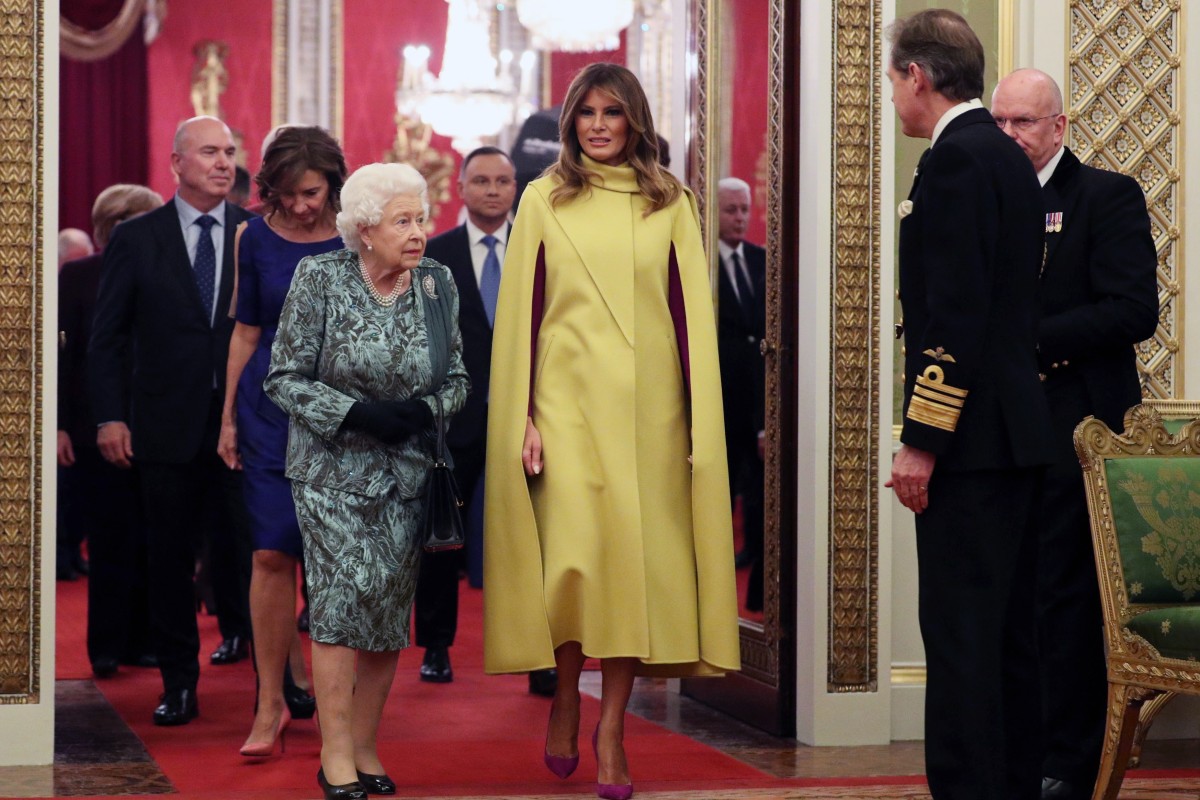
In June, the US first lady joined US President Donald Trump and his children on a trip to Buckingham Palace, but this year she and Trump went alone
Queen Elizabeth with first lady Melania Trump during a reception at Buckingham Palace. Photo: Yui Mok/EPA-EFE
Away from the developing impeachment inquiry at home, US president Donald Trump flew to Britain for the 70th Nato summit. In the middle of a series of meetings with senior leaders from the world, Trump attended an anniversary event at Buckingham Palace on December 3 hosted by Queen Elizabeth.
From Trump to Lam – dissecting the style statements of 6 women in politics
Compared to his last royal visit in June when he was accompanied by his wife, first lady Melania, and children, Donald Jr, Eric, Ivanka and Tiffany, this time, the US president was only joined by the first lady.
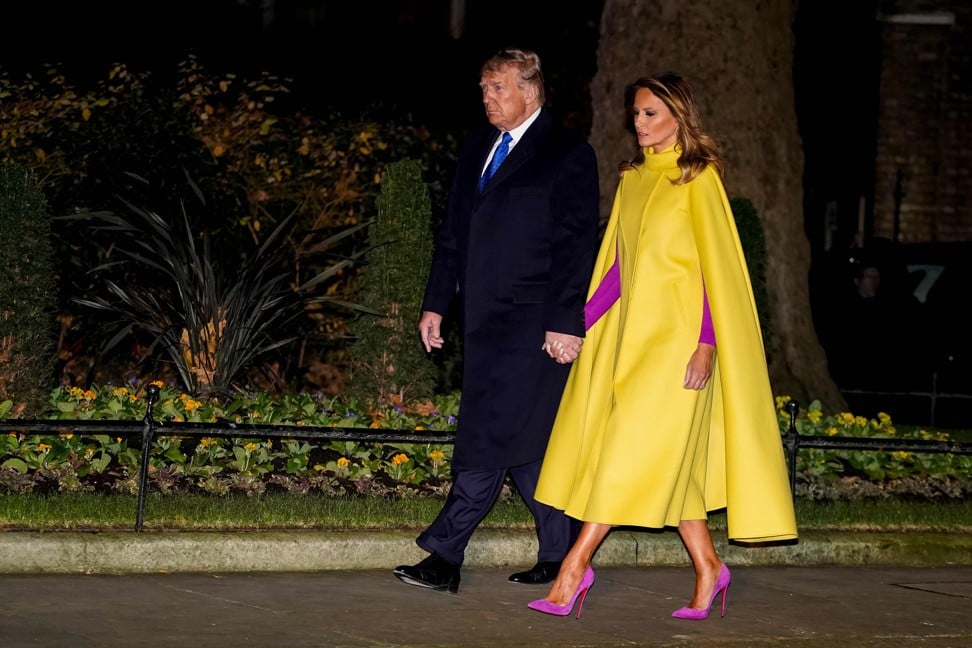
US President Donald Trump and first lady Melania Trump arrive at 10 Downing Street in central London to attend a reception hosted by Britain’s Prime Minister Boris Johnson ahead of the Nato alliance summit. Photo: Niklas Halle’n/AFP
What should you wear when you meet the queen?
Turning up at the reception, the first lady, a former model, was dressed in a striking yellow coat with a dropping cape from Italian fashion house Valentino, matched with a long-sleeve magenta-pink dress underneath. She paired the sleek outfit with a pair of suede Christian Louboutin So Kate pumps that matched the hue of her dress.
NEW DELHI (Reuters) – Hundreds of people holding candles and the national flag marched through the northern Indian city of Amritsar on Friday, on the eve of the centenary of the colonial-era Jallianwala Bagh massacre that British Prime Minister Theresa May has called a “shameful scar.”
On April 13, 1919, some 50 British Indian army soldiers began shooting at unarmed civilians who were taking part in a peaceful protest against oppressive laws enforced in the Punjab region.
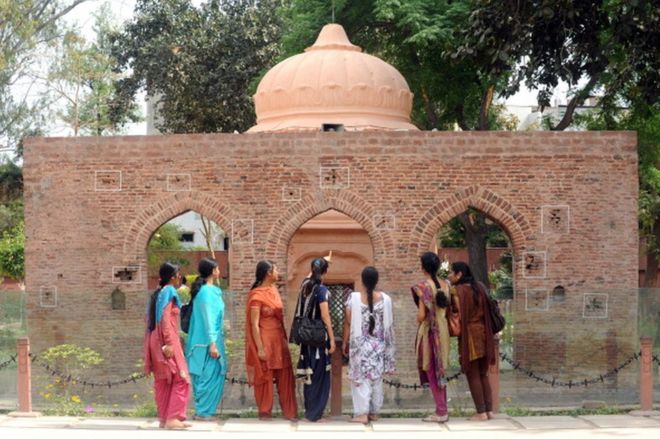
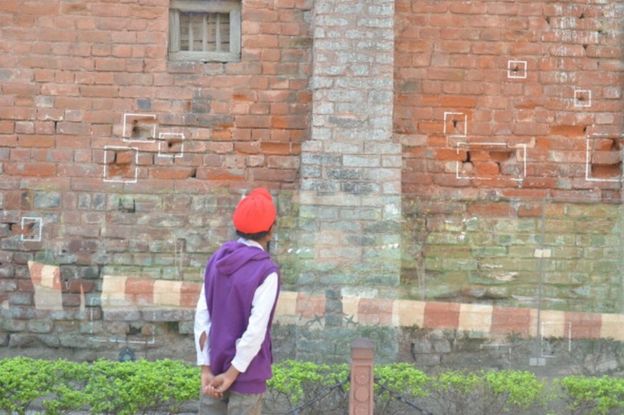
At least 379 Sikhs were killed, according to the official record, although local residents said in the past the toll was far higher. The massacre took place in the walled enclosure of Jallianwala Bagh, which is still pocked with bullet marks.
The massacre became a symbol of colonial cruelty and for decades Indians have demanded an apology from Britain, including during Queen Elizabeth’s visit to Amritsar in 1997.
On Wednesday, May told the British parliament that “the tragedy of Jallianwala Bagh in 1919 is a shameful scar on British Indian history”, but she did not issue a formal apology.
In 2013, then British Prime Minister David Cameron described the killings as a “deeply shameful event” in a visitor book at the site, now marked by a 46-foot (14-metre) high flame-shaped memorial.
“There are events in the histories of nations which are difficult to forget and they hold a very emotionally charged space in a nation’s memory,” Navtej Sarna, a Sikh who has served as India’s High Commissioner to the United Kingdom, told Reuters.
“We have an excellent relationship with the United Kingdom today but it’s a question of assuaging sentiments and healing a wound which has been festering as part of our shared history.” India gained independence from Britain in 1947.
Security in the city – also home to Sikhism’s holiest shrine the Golden Temple – has been stepped up as hundreds of visitors and groups are likely to arrive at the site, Amritsar Police Commissioner S.S. Srivastava said.
Residents of the city, tourists, visitors, top government officials and students took part in the candle lit evening march from a building called Townhall to the massacre site.
The march of about one kilometre was accompanied by loudspeakers playing patriotic songs and onlookers thronged the roadsides. At the end of the march, people observed a two-minute silence.
Punjab state’s Chief Minister Amarinder Singh and Governor V P Badnore took part in the march while Rahul Gandhi, president of the opposition Congress party, was expected to visit the city later in the evening.
Image copyrightAFPImage captionVisitors can inspect a bullet-ridden wall at the site of the massacre
Hundreds of Indians attending a public meeting were shot dead by British troops in the northern Indian city of Amritsar in 1919. Historian Kim Wagner sifts fact from fiction as the UK House of Lords prepares to debate the massacre, including if Britain should apologise.
On 13 April 1919, Sergeant WJ Anderson witnessed first-hand the brutal massacre of hundreds of Indian civilians at Jallianwala Bagh, a public garden in Amritsar city.
“When fire was opened the whole crowd seemed to sink to the ground, a whole flutter of white garments, with however a spreading out towards the main gateway, and some individuals could be seen climbing the high wall,” Anderson later recalled.
“There was little movement, except for the climbers. The gateway would soon be jammed. I saw no sign of a rush towards the troops.”
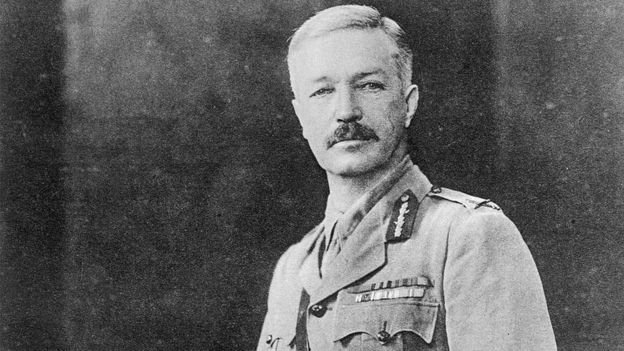
He had served as the bodyguard of Brigadier General RH Dyer, who had rushed to Amritsar a few days earlier to quell what he believed to be a major uprising.
The crowd of more than 20,000 people, however, were not armed rebels. They were local residents and villagers from the surrounding countryside who had come to listen to political speeches or simply to spend a few hours in the gardens.
It was also the day of the Baisakhi festival, which marked the anniversary of the creation of the Khalsa, or Sikh community, and annually attracted thousands of visitors and pilgrims.
The crowd comprised Hindus, Muslims and Sikhs. Most were men and young boys, including some infants; only a few women were present.
Image copyrightGETTY IMAGESImage captionBrigadier General Dyer rushed to Amritsar to quell what he believed to be a major uprising
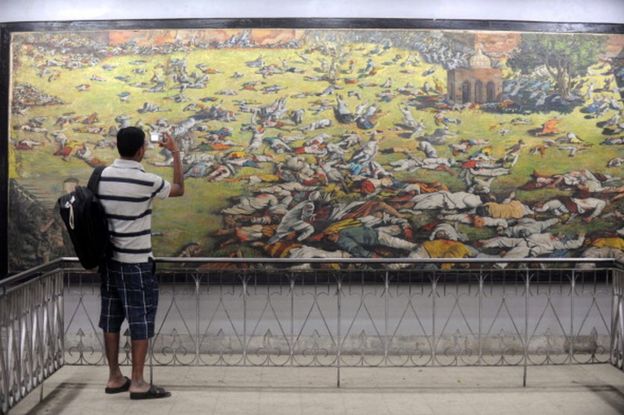
When Gen Dyer ordered his troops to cease firing, Jallianwala Bagh resembled a battlefield strewn with corpses. Between 500 and 600 people were killed, and probably three times as many wounded. The exact numbers will never be known for certain but the official death count, reached months later, was just 379.
In recent years, much of the public debate has focused on calls for a formal British apology – the demand has been led by, among others, Indian politician and author Shashi Tharoor.
Queen Elizabeth II visited the memorial at Jallianwala Bagh in 1997 and then Prime Minister David Cameron visited in 2013 – both showed their respect yet carefully avoided making an actual apology.
In December 2017, the Mayor of London, Sadiq Khan, nevertheless urged the British government to make just such a gesture during his own visit to Amritsar.
“I am clear that the government should now apologise, especially as we reach the centenary of the massacre. This is about properly acknowledging what happened here and giving the people of Amritsar and India the closure they need through a formal apology,” he said.
Image copyrightAFPImage captionOn his 2013 visit, Cameron avoided making an actual apology but said the massacre was “deeply shameful”
Exactly what happened at Jallianwala Bagh, however, remains unclear, and a century later, the actual circumstances of the massacre are still shrouded in myth and misconceptions.
There are, for instance, people, often with a nostalgic attachment to the Empire, who still insist that Gen Dyer only opened fire as a final resort when the crowd ignored his warning to disperse – even though the general himself was quite clear that he gave no such warning.
Similarly, the idea that the shooting was necessary and prevented much worse violence conveniently ignores the fact that Indian riots in April 1919 were in each and every case precipitated by British actions.
Factual inaccuracies are also to be found at the Jallianwala Bagh memorial today. Among other things, a sign claims that 120 bodies of the victims of the massacre were recovered from what has become known as the Martyrs’ Well. It’s believed that many people jumped into the well to escape the bullets.
But there is no evidence for this story, which appears to be based on a mix-up with the infamous well at Kanpur city, where the bodies of British women and children were disposed after a massacre in 1857.
Visual depictions of the Jallianwala Bagh massacre also show machine guns being used, when the historical record is quite clear that the shooting was carried out by 50 Gurkha and Baluchi troops armed with rifles.
Gen Dyer also did not orchestrate the massacre, and deliberately trap the crowd inside the gardens, as some popular accounts have it.
Image copyrightGETTY IMAGESImage captionThe crowd were not armed rebels but local residents and villagers
In fact, it was British panic and misreading of the political turmoil in India that was at the root of the violence.
While Indian nationalists were looking forward to political reforms and greater self-determination after the end of World War One, the British were still haunted by the spectre of the 1857 “mutiny”, an uprising that is often referred to as India’s first war of independence.
So, when riots broke out in Amritsar on 10 April – and five Europeans and dozens of Indians were killed – the authorities responded with immediate and indiscriminate force. Three days later, Gen Dyer entered what he mistakenly perceived to be a war zone.
Where popular depictions show a peaceful crowd of locals quietly listening to a political speech, Gen Dyer instead perceived a defiant and murderous mob, which had only days before run rampant through Amritsar. When he ordered his troops to open fire, it was an act of fear, spurred on by a disastrously flawed threat assessment.
None of this exonerates Gen Dyer or detracts from the sheer brutality of the massacre – nor does it justify the subsequent torture and humiliation of Indians under martial law. The indisputable violence of the Jallianwala Bagh massacre hardly requires any embellishment. Nevertheless, facts matter if we are to pay our respect to those who died rather than simply perpetuate politically convenient fiction. And to understand is not the same as to condone.
Image copyrightGETTY IMAGESImage captionThere are bullet marks on a wall in the garden
Apologies and centenaries, which are essentially about the present rather than the past, are rarely conducive to an honest and nuanced reckoning with history.
An apology from a British government in the throes of Brexit, at the moment, seems highly unlikely. It it indeed doubtful whether an official acknowledgement of the massacre would be construed as more than an act of political expediency.
The question thus remains whether an apology without a genuine understanding of the past can ever provide the “closure” that so many seek.




 CHINDIA ALERT: You'll be living in their world, very soon