

 Image copyright GETTY IMAGES
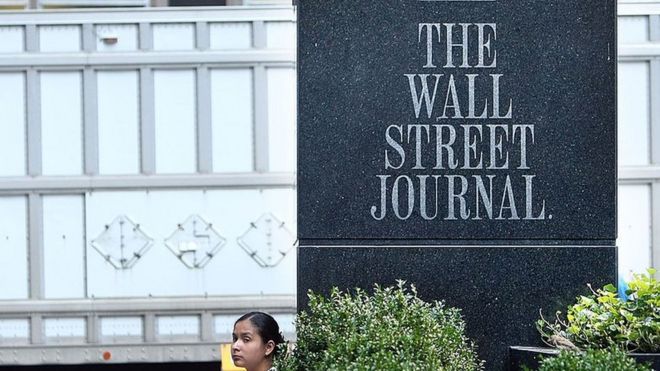
China has ordered three foreign journalists of the Wall Street Journal to leave the country over an opinion piece it said was “racist”.
The article published on 3 February criticised the country’s response to the deadly coronavirus outbreak.
The Chinese foreign ministry said it had asked the newspaper to apologise several times but it had declined.
The newspaper said the journalists – who had not written the opinion piece – were given five days to leave China.
The article called the authorities’ initial response “secretive and self-serving” and said global confidence in China had been “shaken”.
China’s Foreign Ministry spokesman Geng Shuang said the article was “racist” and “denigrated” China’s efforts to combat the outbreak that has killed more than 2,000 people in the country.
“The Chinese people do not welcome media that publish racist statements and maliciously attacks China,” Mr Geng said, without naming the journalists being expelled.
The Wall Street Journal identified the reporters as two US citizens – Josh Chin, who is the deputy bureau chief, and Chao Deng – as well as Australian citizen Philip Wen. The newspaper has not yet commented.
It is the first time in more than two decades that journalists holding valid credentials have been ordered to leave China, the BBC’s John Sudworth in Beijing reports.
The Foreign Correspondents Club of China called the decision “an extreme and obvious attempt by the Chinese authorities to intimidate foreign news organizations”.
The measure comes a day after the US said it would begin treating five Chinese state-run media outlets that operate in the country in the same way as foreign embassies, requiring them to register their employees and properties with the US government.
The decision affects the Xinhua News Agency, China Global Television Network and China Daily Distribution Corp.

Press freedom in China
- China is consistently rated poorly for press freedom and can be a difficult place for foreign journalists to work
- In 2019 Reporters Without Borders ranked the country 177 of 180 countries for press freedom, after measuring media independence, respect for safety and freedom of journalists, and pluralism
- The BBC is blocked in China and in 2019 it launched an international news website on the dark web via Tor, in an attempt to thwart censorship attempts by governments including China
- Nine journalists have been either expelled or effectively expelled through non-renewal of visas since 2013, according to the Foreign Correspondents Club of China
Last year, the government declined to renew the credentials – necessary for the work of foreign journalists in the country – of another Wall Street Journal reporter.
The journalist, a Singaporean national, had co-written a story that authorities in Australia were looking into activities of one of China’s President Xi Jinping’s cousins suspected of involvement in organised crime and money laundering.
And in 2018, the Beijing bureau chief for BuzzFeed News Megha Rajagopalan was unable to renew her visa after reporting on the detention of Muslim minority Uighurs and others in China’s Xinjiang region.
Meanwhile, two Chinese citizen journalists who disappeared last week after covering the coronavirus in Wuhan, the epicentre of the outbreak in Hubei province, remain missing.
Fang Bin and Chen Qiushi had been sharing videos and pictures online from inside the quarantined city.

Source: The BBC




 CHINDIA ALERT: You'll be living in their world, very soon