02/04/2020
- 36-hour exercise simulates countering enemy planes during wartime, report says
- People’s Liberation Army placing increasing emphasis on airborne early-warning and control aircraft, observers say
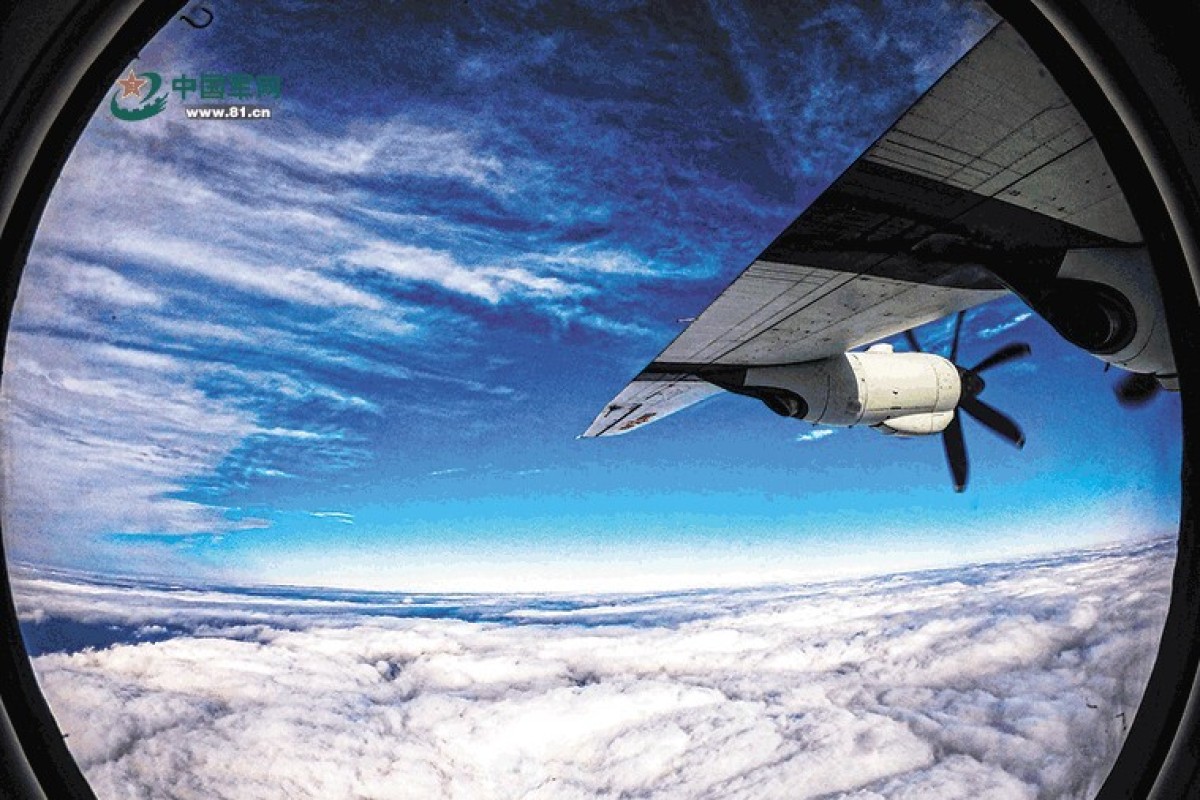
The Eastern Theatre Command’s latest exercise follows joint air and naval drills near Taiwan in February. Photo: Handout
The Chinese military command responsible for patrols around
Taiwan stepped up its drills by staging a long-endurance early-warning exercise in March, the official
PLA Daily reported on Wednesday.
A warplane conducted tactical acrobatics, which were not specified, immediately after taking off, the report said. The move had not been common during previous drills, and was intended to simulate quickly countering enemy planes during wartime, the report quoted the plane’s captain Liu Yin as saying.
The plane performed reconnaissance, early-warning and surveillance work, tested airborne strikes, and an unspecified number of fighter jets in two groups staged a confrontation in a combat scenario.
The drill lasted for about 36 hours, the report said.
Taiwan shows off its military power after presidential election
Zi Kun, an officer from the division’s training unit, said the drill was a test for both pilots and equipment because it involved planning and coordination to meet actual combat requirements.
The exercise came after the Eastern Theatre Command in early February launched joint drills featuring naval and air forces near Taiwan and a combat-readiness drill in which its warplanes encircled the self-ruled island.
It also came after the United States sent EP-3E Aries electronic warfare and reconnaissance aircraft to fly near Kaohsiung, in southern Taiwan, and Hong Kong in late March.
Beijing may step up drills in South China Sea amid US military tensions
Beijing views the self-governed Taiwan as a renegade province that must be united with mainland China by force if necessary.
Experts said the drill was designed to enhance China’s intelligence-gathering capabilities to better monitor activities at sea and in the air.
Taiwan’s re-elected president Tsai Ing-wen meets US and Japanese envoys to call for closer ties
“The People’s Liberation Army’s Air Force used to rely only on ground-based early-warning radar. Only in the past two decades, it started to acquire airborne early-warning and control aircraft, which could allow the air force to extend their radar coverage beyond the limits of ground-based radars,” said Collin Koh, a research fellow from the S Rajaratnam School of International Studies at Singapore’s Nanyang Technological University.
“The problem with ground-based radars is they are often limited by line of sight and Earth curvature, whereas the airborne early-warning assets can help to address these radar gaps and also have a better ability to pick up low-flying targets and those obscured by terrain,” Koh said.
Taiwan military stages exercise to fight off mock invasion
Zhou Chenming, a Beijing-based military expert, said that China did not have enough early-warning planes to support its expanding military ambitions and needed to maximise its capabilities through various exercises to act as a credible deterrent.
The command’s ongoing drills in recent months would be intended to send signals to the outside world on two fronts, according to Koh.
“The Eastern Theatre Command’s primary area of responsibility would cover Taiwan. And by extension, it also means targeting US forces concentrated not just in the nearby bases in Japan but also further afield beyond the First Island Chain, especially Guam,” he said.
Source: SCMP
Posted in aimed at, airborne early-warning and control aircraft, airborne strikes, Beijing, Chinese air force’s drill, combat requirements, combat scenario, CONFRONTATION, deterrent, early-warning and surveillance work, Eastern Theatre Command’s latest exercise, EP-3E Aries electronic warfare and reconnaissance aircraft, fighter jets, First Island Chain, ground-based early-warning radar, Guam, intelligence-gathering capabilities, Japan, joint air and naval drills, Kaohsiung, Mainland China, military power, naval and air forces, People’s Liberation Army, People’s Liberation Army’s Air Force, pilots and equipment, President Tsai Ing-wen, reconnaissance, renegade province, signalling, Singapore’s Nanyang Technological University, South China Sea, tactical acrobatics, Taiwan, Uncategorized, united, United States, US and Japanese envoys, warplane |
Leave a Comment »
13/09/2019
- Operations aimed to caution Beijing that US forces can carry out amphibious campaigns far from home
- Washington has power to intervene directly in territorial disputes between its allies and China
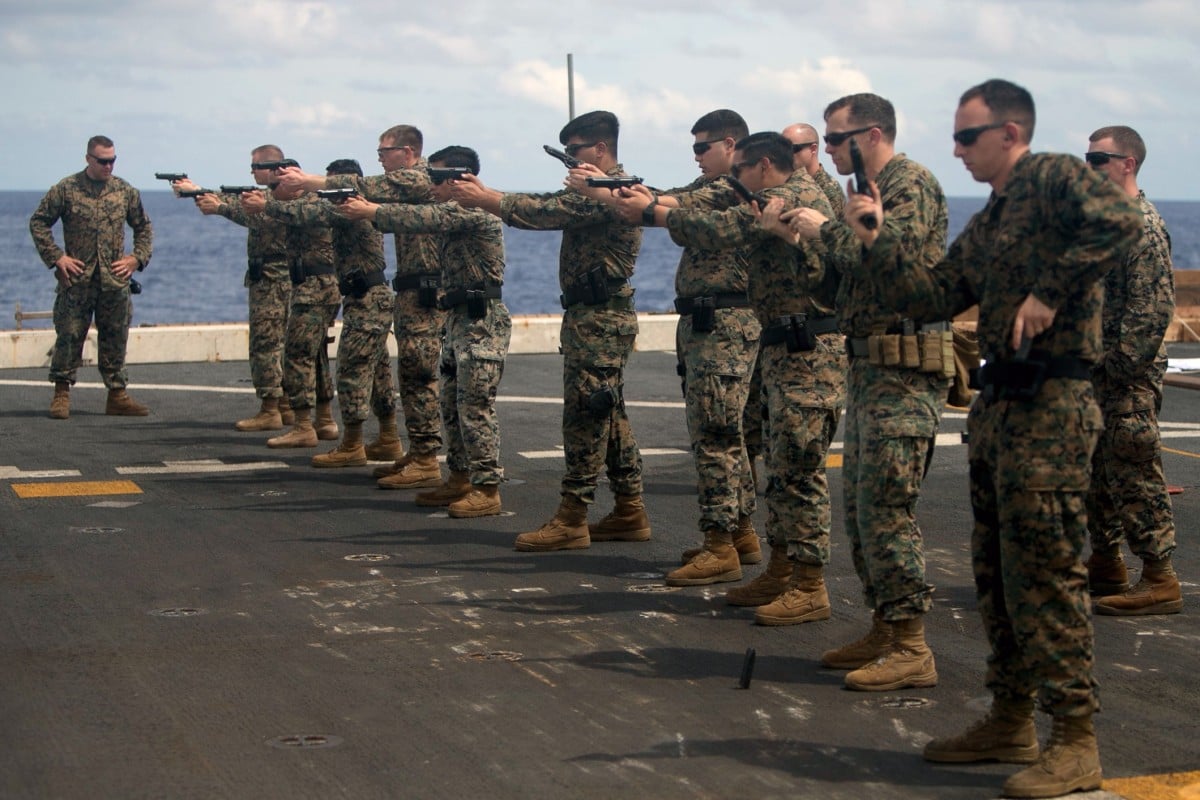
US Marines practise speed reloads on August 9 aboard the USS Green Bay, part of the Wasp Amphibious Ready Group, in the Indo-Pacific region. Photo: Handout
US Marines have conducted airfield- and island-seizure drills in the East and South China seas in what observers say is meant to remind Beijing of US military supremacy in the Asia-Pacific.
The 11-day naval drills were conducted near the Philippines and around the Japanese island of Okinawa by Okinawa-based US marine expeditionary units, the 31st Marine Expeditionary Unit said.
Observers said the operations were meant as a warning to Beijing that the US military could carry out amphibious campaigns far from home if Washington needed to intervene in territorial disputes between China and America’s allies in the region.
The 31st Marine Expeditionary Unit and Amphibious Squadron 11 conducted joint weapons drills from their Wasp Amphibious Ready Group ships from August 9-19, the Okinawa-based marine unit said in a statement.
The activity took place in the Philippine and East China seas and around an American naval base in Japan, it said.
The unit’s Amphibious Reconnaissance Platoon also performed a reconnaissance and surveillance mission through a high-altitude, low-opening parachute jump onto Okinawa.
A tilt-rotor aircraft, which hovers like a helicopter but flies like an aeroplane, afterward sent a landing team from a Wasp ship more than 400km (250 miles) away to establish the arming and refuelling point. The team achieved its objective in just over one hour, the statement said.
“The speed with which the Marines were able to establish the forward arming and refuelling point demonstrates a capability that is critical to conducting expeditionary operations in a contested environment,” the statement quoted Lieutenant Guirong Cai, a FARP officer-in-charge from the Marine Air Traffic Control Mobile Team, as saying.
“Their proficiency in swiftly setting up a refuelling point with 5,500 pounds (2.5 tonnes) of fuel demonstrates the 31st MEU’s ability to rapidly refuel and redeploy our air assets as the mission requires.”
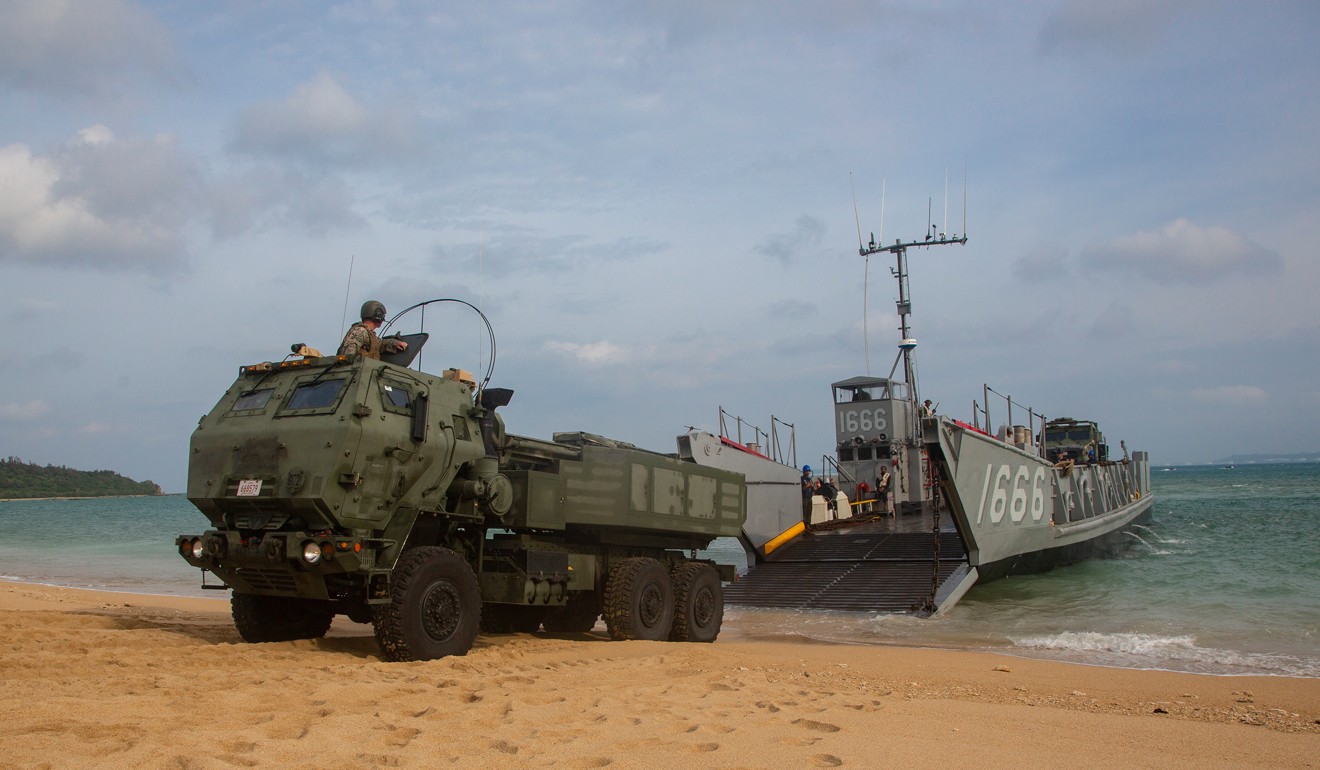
A US landing craft lowers its ramp to unload a high mobility artillery rocket system as part of a simulated amphibious raid at Kin Blue on Okinawa on August 14. Photo: Handout
China has a territory dispute with Japan over Diaoyu Islands, known as the Senkakus in Japan, in the East China Sea, while both Beijing and Manila have put in claims on the Scarborough Shoal – also known in China as Huangyan Dao – in the South China Sea.
Adam Ni, a China specialist at Sydney’s Macquarie University, said the drills near the Philippines and Okinawa showed that such a campaign would encompass a wide area, including the South and East China seas, where the US has joined other countries in the region to conduct freedom of navigation operations since 2015.
Maritime drills between US, Asean coincide with rising tensions
“It is a clear reminder to China of US military supremacy despite the narrowing of gaps in military capability in recent years,” Ni said. “The message is that the US military can still take China-controlled South China Sea features in high-intensity conflict.”
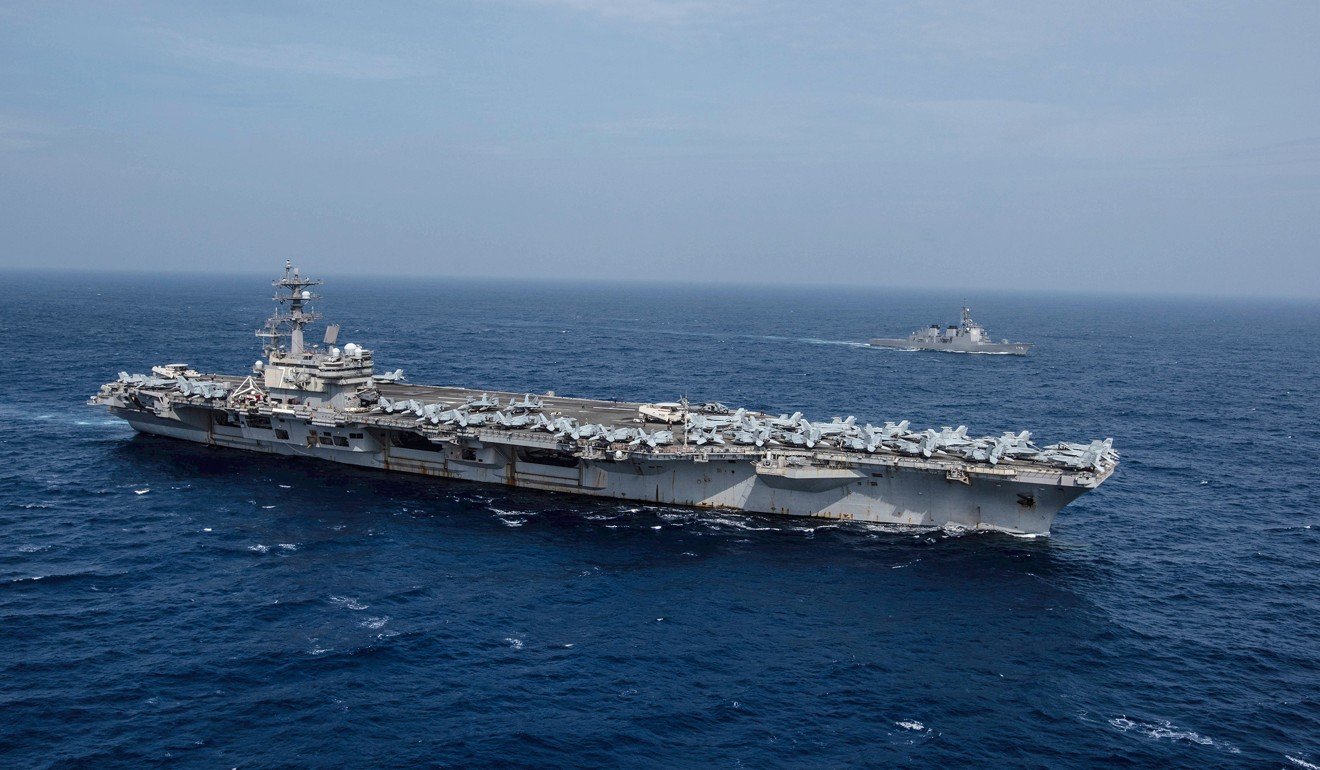
The USS Ronald Reagan aircraft carrier sails alongside a Japan Maritime Self-Defence Force guided-missile destroyer during drills. Photo: Handout
The statement did not say whether the Philippine navy and Japanese maritime self-defence force took part in the drills. But Hong Kong-based military commentator Song Zhongping said the US government would call on its two allies to observe the exercises.
“Whether Washington will intervene in territorial disputes between China and the Philippines as well as China and Japan, the American [military] has used [these drills] to strengthen its island-capture and airfield seizure capabilities in unfamiliar waters and areas,” Song said.
“To show its close relationship with and commitments to Manila and Tokyo, the Americans would invite the two allies to watch the drills. That could also be a good time to sell their amphibious warships and new model aircraft to Japan.”
During the drills, 10 simulated casualties were treated by three medical technicians from the US Air Force’s special operations group and given blood transfusions before being loaded onto a KC-130 transport aircraft for in-flight medical treatment en route to Marine Corps Air Station Futenma on Okinawa, the US Marines said.
Source: SCMP
Posted in 31st Marine Expeditionary Unit, Aircraft carrier, airfield- and island-seizure drills, America’s military edge, American naval base, amphibious campaigns, amphibious raid, Amphibious Reconnaissance Platoon, ASEAN, Asia-Pacific, Asia-Pacific drills, Beijing, China alert, Diaoyu Islands dispute, East China Sea, East China seas, guided missile destroyer, high mobility artillery rocket system, high-altitude, Huangyan Dao, Indo-Pacific region, Japan, Japan Maritime Self-Defence Force, Japanese island, Kin Blue, low-opening parachute jump, Macquarie University, Manila, Marine Air Traffic Control Mobile Team, Marine Corps Air Station Futenma, Marines, Maritime drills, Okinawa, Philippine Navy, Philippines, reconnaissance, remind, Scarborough Shoal, Senkakus, South China Sea, surveillance mission, Sydney, Uncategorized, US, US landing craft, US Marines, US military supremacy, USS Green Bay, USS Ronald Reagan, Washington, Wasp Amphibious Ready Group |
Leave a Comment »




 CHINDIA ALERT: You'll be living in their world, very soon