28/05/2020
BEIJING, May 28 (Xinhua) — Chinese lawmakers Thursday voted to adopt the country’s long-expected Civil Code at the third session of the 13th National People’s Congress, the top legislature.
The Civil Code will take effect on Jan. 1, 2021.
In addition to general provisions and supplementary provisions, the Civil Code, the world’s latest modern-day civil law, has six parts on real rights, contracts, personality rights, marriage and family, succession, and tort liabilities.
The personal rights, property rights and other lawful rights and interests of the parties to civil legal relations shall be protected by law and shall not be infringed upon by any organization or individual, reads the Civil Code in its opening chapter.
Lawmakers say the codification is not about formulating a new civil law but rather systematically incorporating existing civil laws and regulations, modifying and improving them to adapt to new situations while maintaining their consistency.
A major innovation of China’s Civil Code, jurists say, is embodied in the personality rights part. While some countries have related law provisions, few have a specific law book in civil code dedicated to protecting personality rights.
The personality rights part covers stipulations on a civil subject’s rights to his or her life, body, health, name, portrait, reputation and privacy, among others.
The personality rights part shows that China has reached a new height in protecting the dignity of people, said Chen Jingying, a national lawmaker and vice president of East China University of Political Science and Law.
The Civil Code is a milestone in developing the socialist legal system with Chinese characteristics, and will greatly boost the modernization of China’s system and capacity for governance, said Wang Yi, dean of the law school at Renmin University of China.
Source: Xinhua
Posted in 13th National People's Congress, adapt, adopted, body, boost, capacity, China's, China's system, Chinese Characteristics, Chinese lawmakers, Civil Code, civil law, civil laws, civil legal relations, civil subject's, codification, consistency, contracts, dedicated, developing, East China University of Political Science and Law, embodied, existing, Family, formulating, general provisions, Governance, health, his or her life, improving, incorporating, individual, infringed, innovation, interests, jurists, Law, law book, lawful rights, lawmakers, legal system, maintaining, marriage, milestone, modernization, modifying, name, national legislature, opening chapter, organization, parties, personal rights, personality rights, portrait, privacy, property rights, protected, protecting, real rights, regulations, Renmin University of China, reputation, rights, situations, socialist, specific, succession, supplementary provisions, systematically, tort liabilities, Uncategorized, Wang Yi, world's latest modern-day civil law |
Leave a Comment »
17/06/2019
- It is expected the two leaders will meet in Japan at the end of June
- Analysts see an increasing caution from China amid low expectations of any deal
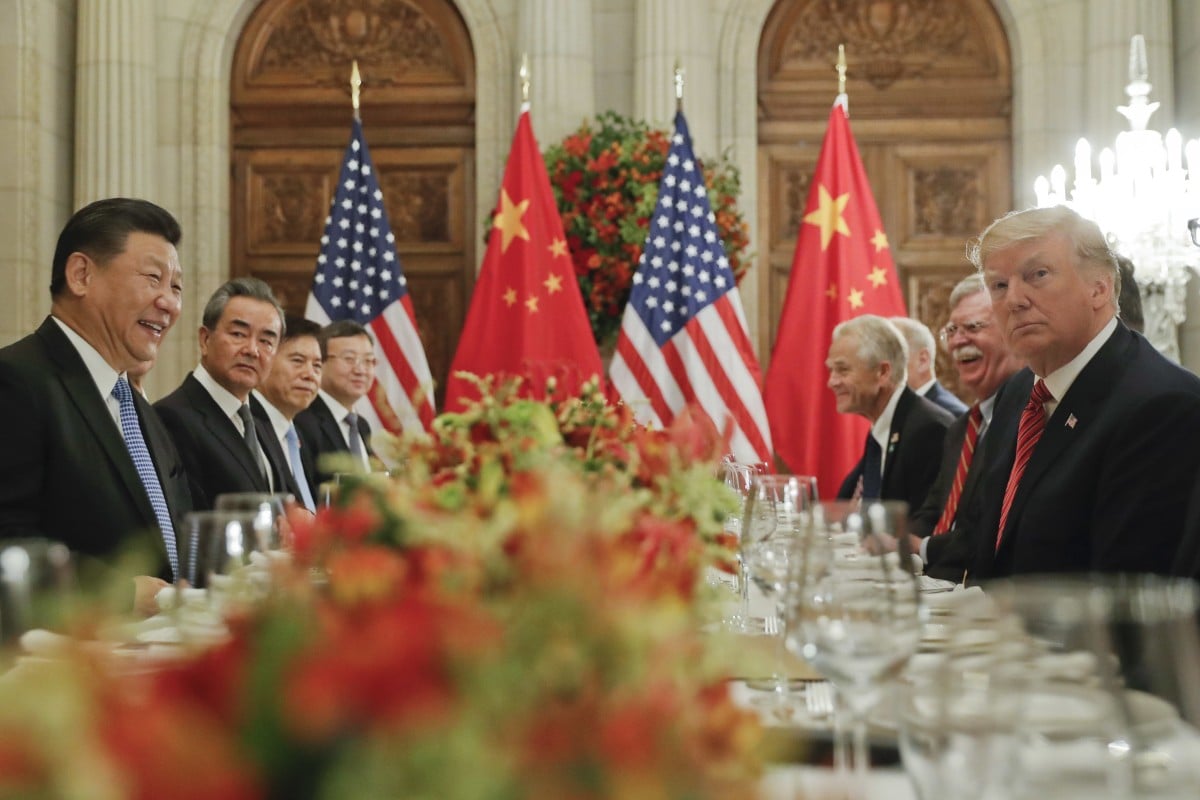
Chinese President Xi Jinping and US President Donald Trump last met in Argentina in December on the sidelines of the G20 summit. Photo: AP
China’s relative silence in response to comments by US President Donald Trump in relation to the trade war is due to Beijing redoubling its efforts to take a cautious approach ahead of future talks amid “low expectations” of a quick deal after negotiations collapsed last month, analysts said.
Trump has openly threatened to levy tariffs on additional Chinese products if a meeting with counterpart Xi Jinping does not take place at the G20 summit in Japan at the end of the month, while also urging Beijing to return to talks based on terms negotiated earlier in the year.
“It’s me right now that’s holding up the deal,” Trump said on Tuesday. “And we’re going to either do a great deal with China or we’re not going to do a deal at all.”
China, though, has remained tight-lipped on both a meeting and also the prospects of future talks, with the foreign ministry yet to confirm whether there will be a summit between
in Osaka. The South China Morning Post reported this week that the two leaders could share a more formal dinner, similar to the scene witnessed on the sidelines of the G20 summit in Argentina in December.
That meeting produced a ceasefire and more than five months of negotiations until early May when the talks broke down and the US more than doubled tariffs on US$200 billion in Chinese imports to 25 per cent.
Shi Yinhong, an international relations expert from Renmin University of China, said China had very low expectations ahead of the G20 summit in Japan due to the current level of strained bilateral relations.
Trump’s open threats had put Xi “in a very disadvantageous position”, as any agreement “would be seen as being weak or surrendering to US pressure”, he said.
Instead, the two sides were likely to reach “piecemeal deals” on smaller issues such as people-to-people exchanges and relaxation of visa restrictions, according to Shi, which in turn might help to build a friendlier atmosphere to pave the way for more substantive talks in the future.
It’s me right now that’s holding up the deal. And we’re going to either do a great deal with China or we’re not going to do a deal at all: Donald Trump
China’s state-controlled media outlets have maintained their criticism of the US for starting the trade war, although editorials carried by Xinhua and the People’s Daily have not given concrete information about Beijing’s demands, instead, in its latest editorial, Xinhua urged “US politicians to treat China’s rise with reasonable sense”.
Geng Shuang, a foreign ministry spokesman, said last week that China was aware of hopes emerging from the US side of a meeting between Trump and Xi in Osaka, but that China had no information to disclose on that subject, reiterating government statements from previous days.
Amid a war of words between Beijing and Washington over which side is to blame for the stalled trade talks, both sides have showcased their willingness to talk as long as the conditions are appropriate. Commerce vice-minister Wang Shouwen said at the start of June that China “is always sincere” about negotiating with the US, but the talks must be conducted with mutual respect.
“Otherwise, the negotiation would be meaningless. Even if there’s negotiation, there won’t be an enforceable and sustainable agreement,” Wang said.
Xi said at an economic forum in Russia last week that he did not want to see a decoupling of the US and China and believed that “my friend” Trump did not want that either.
“Trump’s stance that he is unlikely to make any concessions is very clear. So, China should be very cautious when arranging a bilateral meeting with him,” said Liu Weidong, a China-US affairs expert from the Chinese Academy of Social Sciences, a state think tank
Scott Kennedy, a senior adviser at the Centre for Strategic and International Studies in Washington, said Trump and Xi may reach “some sort of truce” as they did in Buenos Aires so that “both sides agree to put on hold their various actions against the other and not further escalate”, but added that the chance was small.
Source: SCMP
Posted in Argentina, Beijing, Chinese Academy of Social Sciences, Chinese President Xi Jinping, fiery rhetoric, G20 meeting, Japan, Osaka, President Donald Trump, Renmin University of China, south china morning post, trade talk demands, Uncategorized, Washington |
Leave a Comment »
11/05/2019
- Birth rate continues to fall three years after one-child policy was relaxed
- Survey finds high cost of raising children biggest deterrent to second baby
Chinese mothers say financial pressures are stopping them from having another child. Photo: Shutterstock
Half of China’s working mothers do not want a second child, mainly because of financial pressures, a survey released ahead of Mother’s Day has found.
Another 40 per cent said they hoped to have a second child, but dared not to, according to the 2019 working mothers’ living condition survey by Chinese recruitment website Zhaopin.com, which polled 8,739 women over the past two weeks.
The biggest obstacle deterring the mothers from having a second child was economic pressure, with 85 per cent saying they could not afford the high cost of raising children.
China’s low birth rate has been a top concern for the government since it introduced a universal two-child policy in 2016. After decades of a rigidly enforced restriction on couples to have only one child, the number of newborns has not risen as expected.
Births across the country have continued to fall over the past three years, from 17.86 million in 2016, to 17.23 million in 2017, and 15.23 million last year, according to data from the National Bureau of Statistics.
Social demography professor Yang Juhua, from the Centre for Population and Development Studies at Renmin University of China in Beijing, said there were several factors influencing Chinese women’s decision to stick to one child, despite the policy relaxation.
“People are reluctant to give birth because of two reasons: no money to raise kids and no people to look after them, especially when the babies are too young to be admitted to kindergartens,” she said.
The economic stress of raising a child was not about basic living costs, but the expense of extracurricular courses and tuition fees at elite private schools, she said.
“Parents have to send their kids to learn various subjects in order to keep up with their peers amid fierce competition. So the kids are called cash-smashers.”
‘Burden’ of homework leaves kids sleep-deprived Doris Ding, a mother of an eight-year-old boy in Shanghai, said she decided years ago not to have another child.
The senior manager at an audit firm and her husband, an IT engineer at a technology company, pay more than 200,000 yuan (US$30,000) a year for their son to attend an international primary school. His after-school classes, which include piano and public speaking, cost another 50,000 yuan a year.
“So it’s out of our reach to raise a second kid,” Ding said.
Yang said that for many families the second major challenge was an inability to find relatives or other trustworthy people to take care of their children while they were at work.
“Grandparents are too old or not strong enough to do that. We often hear complaints from old people that they are tired of raising the first kid and don’t want to help raise the second one. Otherwise, they don’t have a personal life at all for many years,” she said.
Chinese database lists whether 1.8 million women are ‘BreedReady’
Nurseries providing places for children under the age of three was far from sufficient to resolve the problem, Yang said.
On Thursday, China’s executive State Council proposed a raft of policies aimed at easing the childcare burden for new parents, including encouraging companies to set up day care services for children aged three and under, as well as extended childcare and maternity leave.
According to research by Zhu Qin, a professor from the Centre for Population and Development Policy Studies at Shanghai’s Fudan University, China’s total fertility rate is just 1.54 per woman, putting the country among the lowest birth rates in the world.
As well as the economic factors, Zhu said women were not willing to give birth because of the lack of support from society.
The latest survey from Zhaopin.com showed only 8 per cent of companies had designated rooms for mothers and infants, while 40 per cent of working mothers said they did not take their legally entitled maternity or breastfeeding leave.
“In big cities, white-collar women face the challenge that their career progress will be affected by having babies,” Zhu said.
Source: SCMP
Posted in Beijing, Birth rate, can’t afford them, Centre for Population and Development Studies, China’s mothers, Fudan University, no to more babies, One-child policy, professor from the Centre for Population and Development Policy Studies, Renmin University of China, Social demography professor, Uncategorized, Yang Juhua, Zhu Qin |
Leave a Comment »




 CHINDIA ALERT: You'll be living in their world, very soon