Archive for ‘researcher’

29/04/2020

Coronavirus: Oxford vaccine effective in monkeys, heading for mass production in India

  • Six animals inoculated with vaccine candidate then exposed to virus did not catch Covid-19 after 28 days
  • Up to 60 million doses could be produced by Serum Institute of India this year
Microbiologist Elisa Granato gets an injection on Thursday as part of the first human trials in Britain for a potential coronavirus vaccine. Photo: University of Oxford via AP

A leading candidate for a Covid-19 vaccine has shown promising results in animal trials, and is expected to see mass production in India within months.

The Serum Institute of India, the world’s largest maker of vaccines by volume, said on Tuesday that it plans this year to produce up to 60 million doses of a potential vaccine developed by the University of Oxford, which is under clinical trial in Britain.

While the vaccine candidate, called “ChAdOx1 nCoV-19”, is yet to be proven to work against Covid-19, Serum decided to start manufacturing it as it had shown success in animal trials and had progressed to tests on humans, Serum Chief Executive Adar Poonawalla said.

Six rhesus macaque monkeys were inoculated with the vaccine candidate at the National Institutes of Health’s Rocky Mountain Laboratory in Montana last month, according to The New York Times.

Covid-19 vaccine trial starts in Oxford, but remdesivir treatment reportedly flops in China tests
The subjects were exposed afterwards to large quantities of the novel coronavirus, but all six remained healthy after more than 28 days, the newspaper reported, citing researcher Vincent Munster, who conducted the test.

More than 3 million people have been reported to be infected globally and over 210,000 have died from Covid-19, the respiratory disease caused by the coronavirus.

“They are a bunch of very qualified, great scientists [at Oxford] … That’s why we said we will go with this and that’s why we are confident,” Poonawalla told Reuters in a phone interview.

“Being a private limited company, not accountable to public investors or bankers, I can take a little risk and sideline some of the other commercial products and projects that I had planned in my existing facility,” Poonawalla said.

Bill Gates hopes his virus vaccine ‘manufacturing within a year’

27 Apr 2020

As many as 100 potential Covid-19 candidate vaccines are now under development by biotech and research teams around the world, and at least five of these are in preliminary testing in people in what are known as phase one clinical trials.

Poonawalla said he hoped trials of the Oxford vaccine, due to finish in about September, would be successful. Oxford scientists said last week the main focus of initial tests was to ascertain not only whether the vaccine worked but that it induced good immune responses and no unacceptable side effects.

Serum, owned by the Indian billionaire Cyrus Poonawalla, plans to make the vaccine at its two manufacturing plants in the western city of Pune, aiming to produce up to 400 million doses next year if all goes well, Poonawalla said.

“A majority of the vaccine, at least initially, would have to go to our countrymen before it goes abroad,” he said, adding that Serum would leave it to the Indian government to decide which countries would get how much of the vaccine and when.

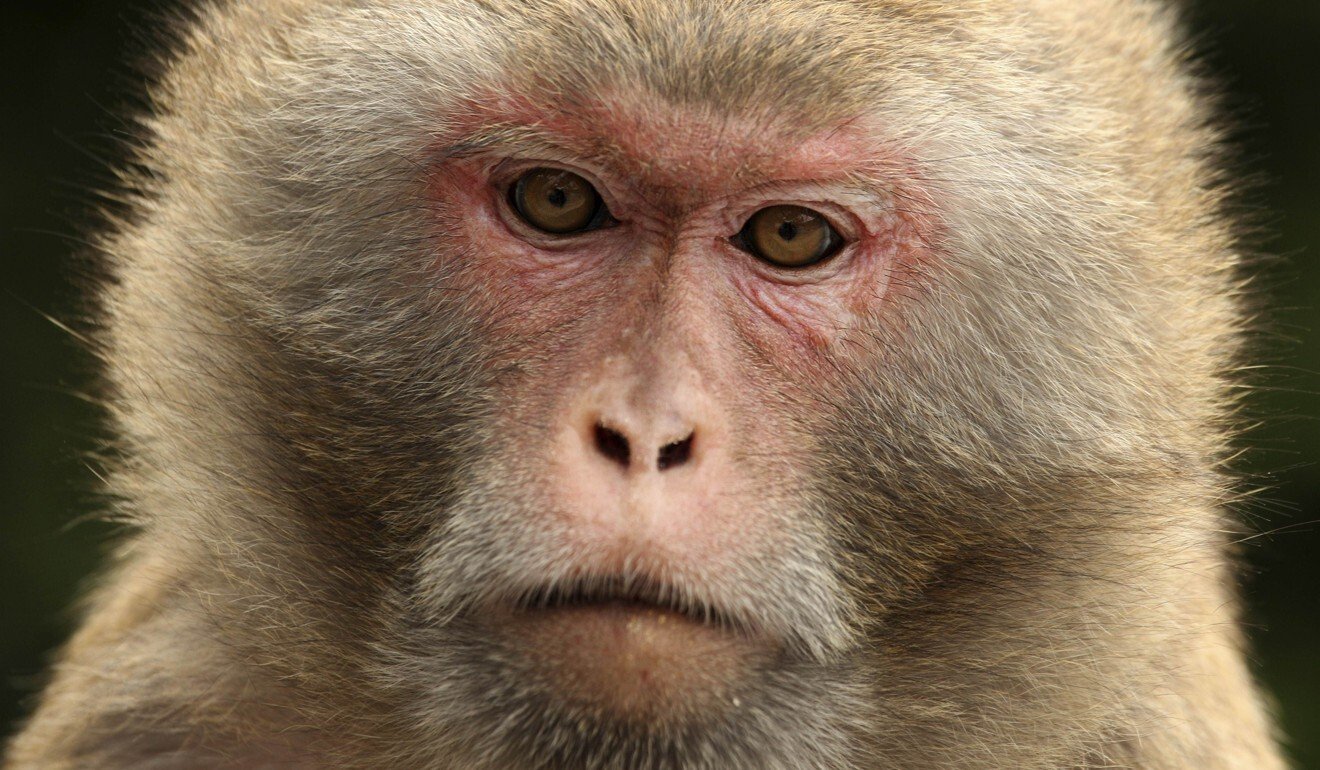
Rhesus macaque monkeys are often used in animal testing because of their similarity to humans. Photo: AFP
Serum envisages a price of 1,000 rupees (US$14.70) per vaccine, but governments would give it to people without charge, he said.

He said Prime Minister Narendra Modi’s office was “very closely” involved in the vaccine production and the company is hoping the government will help foot the cost of making it.

Over roughly the next five months, Serum will spend some 300 million to 400 million rupees (US$4.4 million to US$5.9 million) on making around 3-5 million doses per month, he said. “[The government] are very happy to share some risk and fund something with us, but we haven’t really pencilled anything down yet,” Poonawalla said.

Coronavirus: clinical trial begins on third vaccine candidate in China

22 Apr 2020

Serum has also partnered with the US biotech firm Codagenix and Austria’s Themis on two other Covid-19 vaccine candidates and plans to announce a fourth alliance in a couple of weeks, he said.

Serum’s board last week also agreed to invest roughly 6 billion rupees (US$8.8 billion) on making a new manufacturing unit to solely produce coronavirus vaccines, Poonawalla said.

Source: SCMP

23/11/2019

Peking Man wasn’t that smart – even for the Stone Age, Chinese scientist says

  • Researcher says some might find it hard to accept that early humans they assumed to be their ancestors ‘were stupid’
  • Report suggests that isolation may have made Peking Man less adaptable
Peking Man is the earliest human sub species discovered in China. Photo: Reuters

“Peking Man”, the Stone Age humans who are believed to be ancestors of the Chinese, left little evidence that they had ever evolved, according to a Chinese scientist.

“It may be hard for some people to accept, but evidence shows they [

Peking Man

] were stupid,” said Professor Wei Qi, a researcher with the Institute of Vertebrate Palaeontology and Palaeoanthropology at the Chinese Academy of Sciences in Beijing.

In 1929, a nearly complete skull of Homo erectus pekinensis was discovered in a cave at Zhoukoudian in southwest Peking, as the Chinese capital was then known.

Peking Man became a household name as the earliest human sub species discovered in China, and some scientists maintained that they passed their DNA on to present-day Chinese.

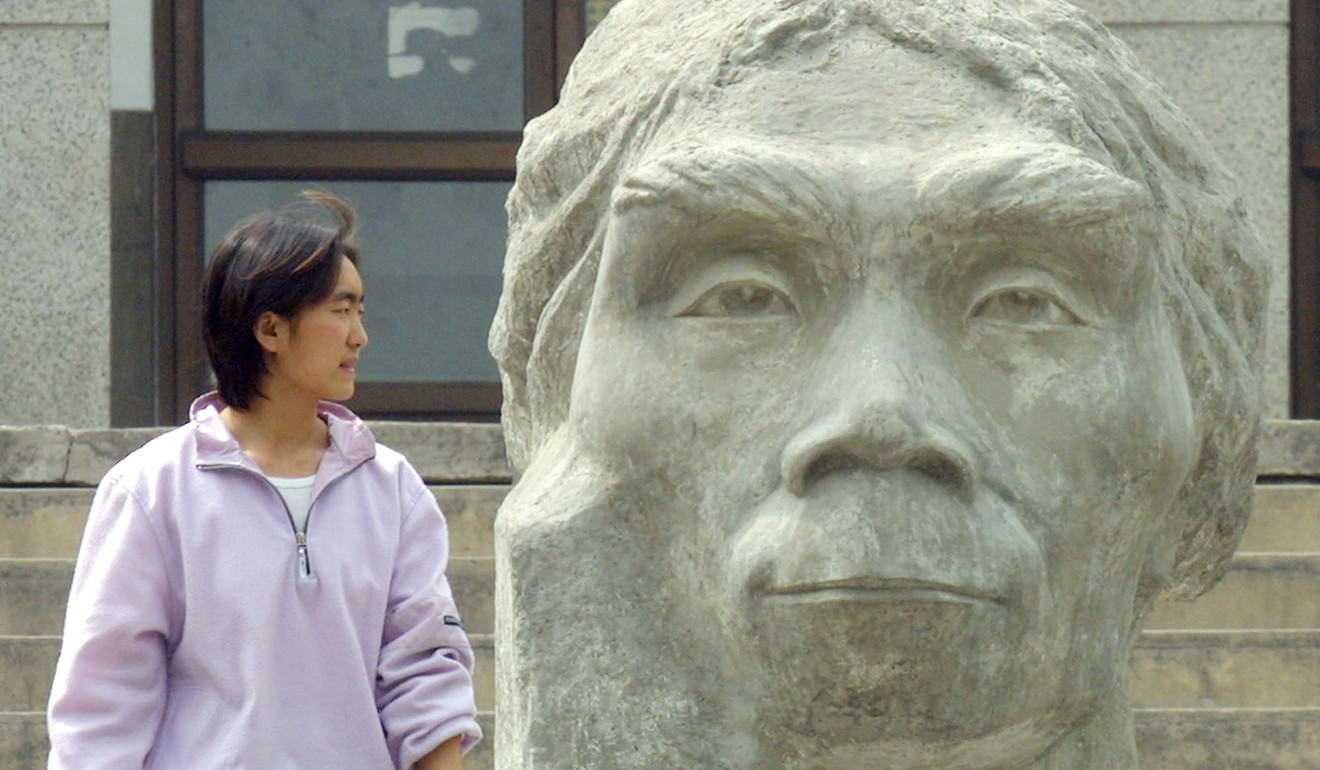
Peking Man is thought to be an ancient ancestor of modern Chinese. Photo: AP

In a paper for the journal Fossils to be published at the end of the month, Wei compared stone tools found at the Peking Man site to those made by the Nihewanians, palaeolithic humans who lived in what is now Yangyuan, northern Hebei province, more than a million years ago.

According to the theory of evolution, the human brain’s complexity should increase over time, expanding creativity and improving the quality of tools.

Wei said his study found very little evidence of evolution in Peking Man. He said they tended to work a piece of stone by repeatedly striking it on one side but rarely turning it.

How Asian fossils could rewrite history of human evolution

Most of the stones worked by the Nihewanians for cutting or other purposes had marks all over them. “It means they would try another side to get a better result,” Wei said. “That is a sign of intelligence.”

He said there was more evidence in Peking Man finds, including many coarse artefacts and few finely processed tools.

ADVERTISING

Other researchers have said the same thing over the years. Pei Wenzhong, a palaeontologist who discovered some of the first Peking Man remains, said the tools appeared primitive compared to other early human artefacts, but there was no investigation at the time.

A Chinese report suggests there is little evidence of evolution to be found in Peking Man remains. Photo: UPI

Wei, who analysed more than 140 finds dated to roughly 700,000 years ago, said the structural changes in Peking Man skulls found in different layers of sediment from various times suggested an unusually slow evolution over half a million years.

Professor Chen Quanjia, a palaeoanthropologist with the college of humanities at Jilin University in northeastern China, said there was an appearance of roughness to Peking Man tools, but that did not mean a lack of intelligence.

“The blame lies in the material,” he said.

Peking Man made tools with quartz, the only material available in the area. Quartz is not easy to handle, often creating a rough surface that makes further processing difficult.

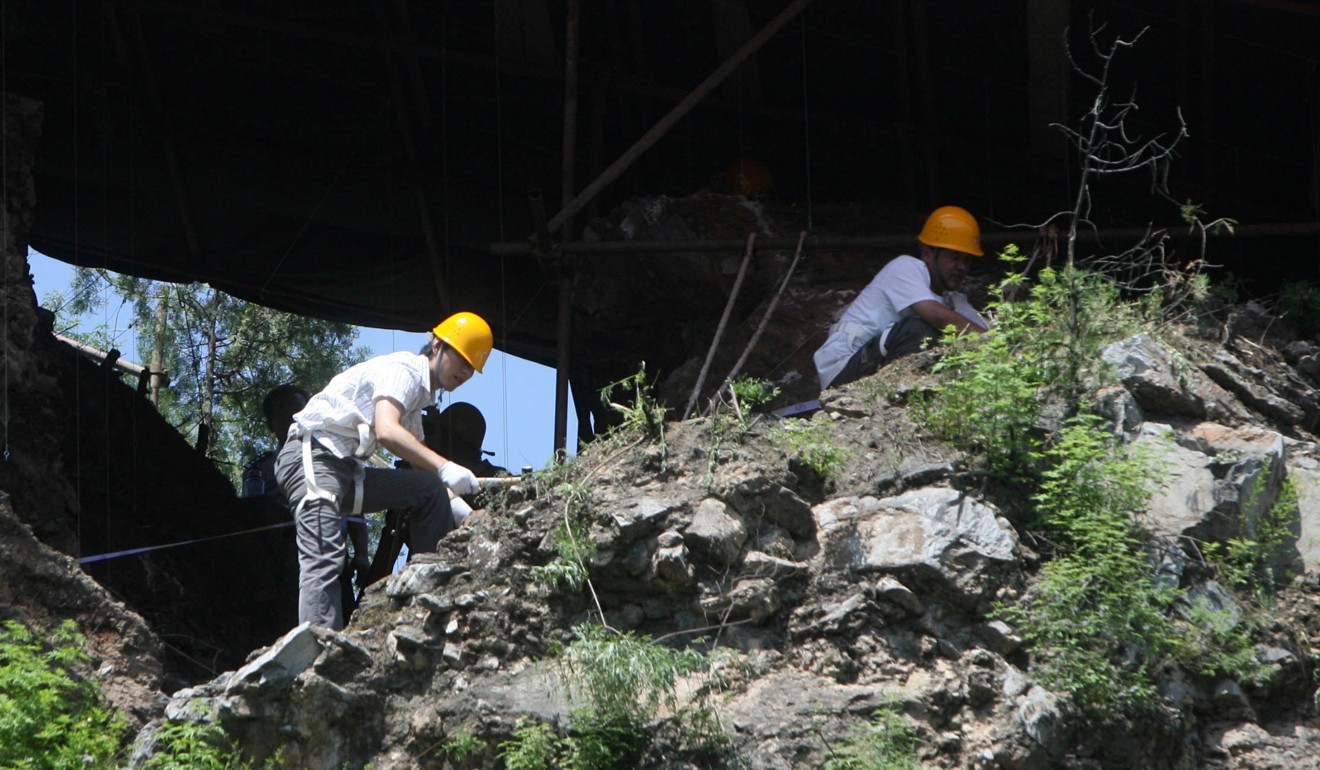
The caves of Zhoukoudian on the outskirts of Beijing are still a treasure trove for archaeologists. Photo: AFP

Wei said material could not explain the difference. A few fine tools made with quartz were found at Zhoukoudian but they were dated to about 300,000 years ago.

“Making high-quality tools with quartz is not a problem, but [that becomes possible] only when the maker becomes smart enough,” he said.

100,000 year old human remains ‘show evidence of cannibalism’

Why Peking Man crafts were so poor remains a big question. Wei said that some patterning on their tools suggested they might be an offshoot of the Nihewanians that was driven out and settled in Zhoukoudian – now a World Heritage Site – about 200km (124 miles) away.

In that isolated environment, Peking Man might have interbred over many generations, Wei said.

This increases the chances of offspring being born with so-called deleterious traits such as inherited conditions and illnesses that affect quality of life and the ability to adapt and survive.

Source: SCMP

19/05/2019

China narrows urban-rural gap in healthcare services

BEIJING, May 19 (Xinhua) — China has allocated 47 billion yuan (6.8 billion U.S. dollars) for building 1,390 county-level hospitals since 2016, in a bid to ensure that every county and urban district has at least one county-level hospital, Health News reported.

This is part of the country’s efforts to narrow the gap in health services between urban and rural areas.

Traditional Chinese service centers have been set up in more than 30,000 health centers in towns, townships and communities, according to the newspaper.

The standard for the per capita basic public health service subsidy has raised from 25 yuan in 2011 to 55 yuan in 2018, and the number of free services provided by the national basic public health service program has been increasing over the period.

The health inequality index rated by urban and rural residents dropped by 32.5 percent from 2006 to 2016, according to the newspaper.

“The achievement is attributed to the national reforms in the medical and health care system aiming to ensure every citizen has the access to basic health services,” Miao Yanqing, a researcher with the health development research center under the National Health Commission, was quoted as saying.

Source: Xinhua

19/05/2019

Shanghai Bund’s historic buildings saved from demolition … for now

  • Experts win reprieve for two out of three heritage houses but fear their success is only temporary
  • Authorities plan public cultural facilities for the site
The historic buildings on Shanghai’s Bund in the 1930s. One of the three structures has already been demolished but authorities have temporarily suspended plans to knock down the other two. Photo: Handout
Two historic buildings on Shanghai’s famous Bund have temporarily escaped demolition after a group of experts appealed to the government to conserve the heritage sites, but the intervention was too late to save a third.
About 15 architecture, history and culture experts based in Shanghai banded together to write an article on social media app WeChat last month, calling on the city’s government to “protect the city’s memories” by preserving three houses on Huangpu Road.
A few days after the article was published one of the buildings was demolished as part of a plan to build public cultural facilities on the site. But authorities suspended work on the other two and are considering removing only the interior structure while preserving the external walls, according to the group.
The houses, which date back to 1902, witnessed the city’s boom in the first half of the 20th century when it became one of the world’s most important, and famous, ports, the experts said.
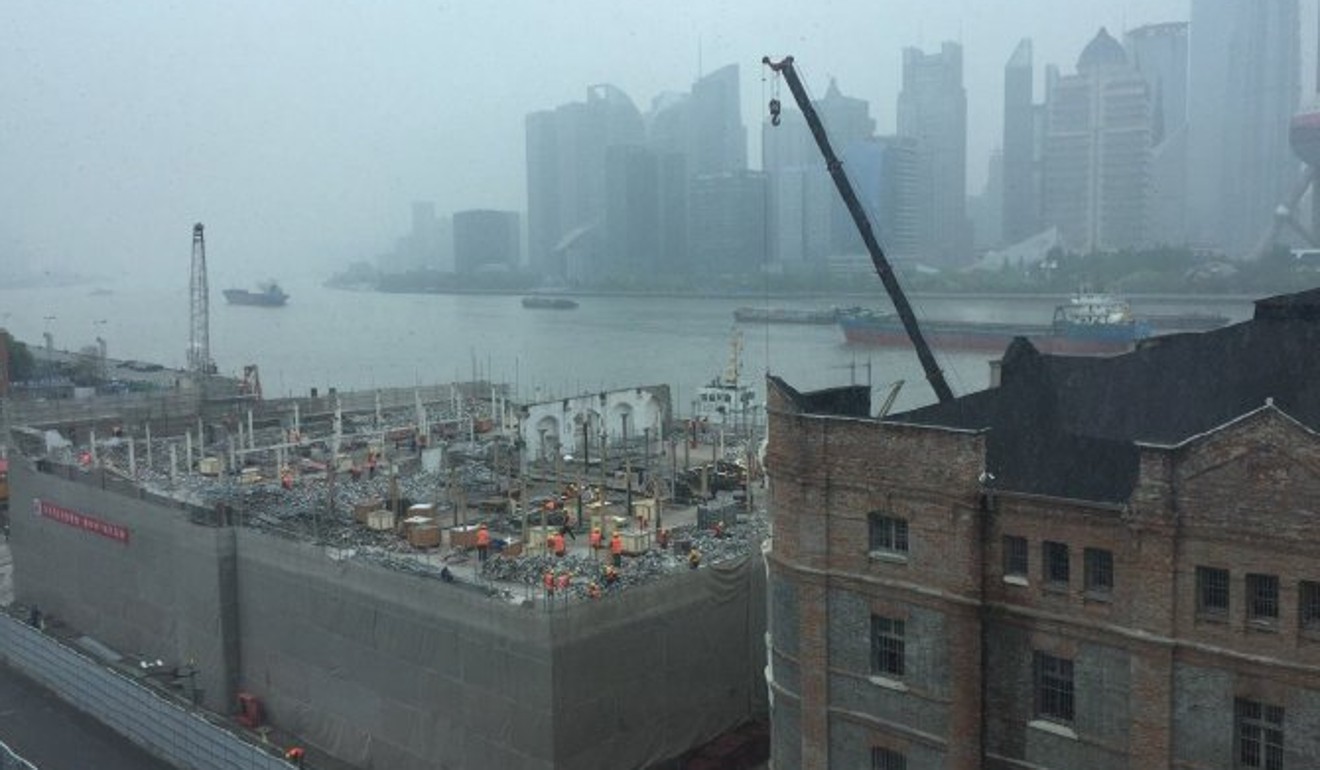
The demolition project on The Bund, Shanghai has been suspended, but not before one of the three historic buildings was demolished. Photo: Urban China magazine

All three of the properties originally belonged to Japanese shipping company Nippon Yusen Kaisha Group and were later used as storage facilities for Japan’s military forces during the second world war, according to Yu Hai, a sociologist from Shanghai’s Fudan University.

“These buildings, along with the nearby Yangzijiang port on the Huangpu River, represented Shanghai’s wharf culture and port culture,” Yu said. “They are historically significant as they witnessed Shanghai grow prosperous through shipping and trade industries about a century ago.”

Although the two remaining buildings are safe for now, the experts argue their interiors are also worth preserving.

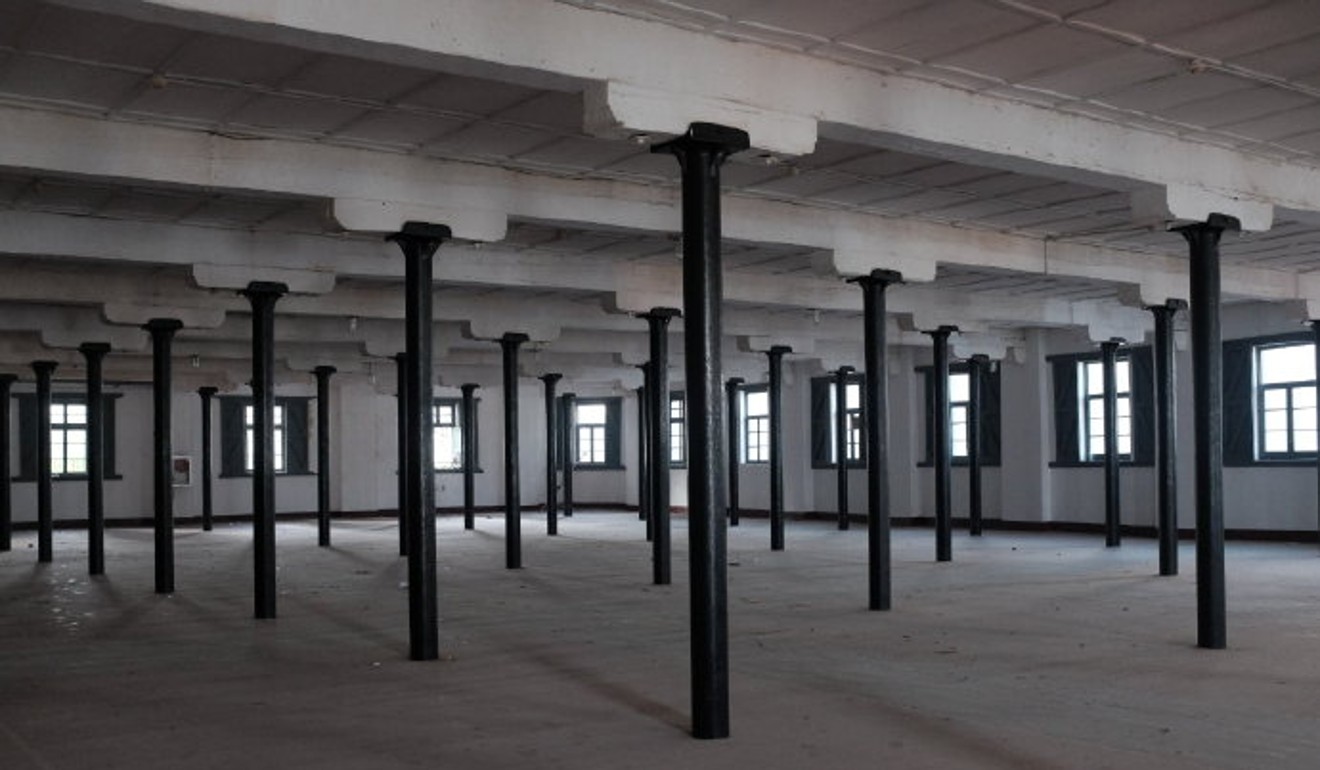
Liu Gang, an architecture professor at Shanghai’s Tongji University, said the properties featured big wooden beams supported by black iron pillars, which were prominent architectural features of industrial buildings dating back to the 19th century.

“We guess it was hard to move these giant beams with vehicles at the beginning of the 20th century. Quite possibly they were transported on the river. We guess that the wood was chopped down and processed in places across the Pacific [from North America] and shipped to Shanghai.”

In the WeChat article, Liu called for the protection of the interior structure of the buildings. “Without solid research, we cannot simply take them down to be replaced by new ones.”

Yu agreed, saying: “The building with a new inside structure would be a fake and this plan will destroy historical heritage.”

Experts say the interiors of the historic buildings are also worth preserving. Photo: Urban China magazine

Huangpu Road, where these houses sit, is rich with history. It features the Garden Bridge of Shanghai – the city’s first steel bridge, built in 1907 – and was once home to the consulates of the United States, Russia, Japan, Germany, Denmark and the Austro-Hungarian empire.

Other notable landmarks on the road include the Astor House Hotel, built in 1846, where Charlie Chaplin, Albert Einstein and George Bernard Shaw stayed in the 1920s and 1930s. The hotel is still there.

“History happened here,” Yu said. “But it’s a pity that most of the old buildings in this area no longer exist.”

Despite their success in winning a stay of execution for the two buildings, the experts are cautious in their expectations.

“The demolition work was suspended, but that does not mean they have accepted our proposals. We are not optimistic,” Yu said.

About two weeks ago as part of their effort to save the buildings, Yu and three other scholars approached officials from Shanghai’s Planning and Natural Resources Bureau, the government body behind the demolition project.

“Officials emphasised the difficulties of keeping the completeness of the old buildings and we just pointed out the damage to their historical values,” Yu said.

The Shanghai bureau did not immediately reply to a request for comment.

Shanghai nightclub king opens new art space – in disused oil tanks
Appeals by the public to conserve historical buildings have generally not been successful. Shenyuli, a typical Shanghai residential community built in the 1930s, was included in the city’s protected list of historical buildings in 2004.
The listing was not enough to prevent its demolition eight years later to make way for a public green land space.
Three years ago, the Shanghai government announced it was suspending the planned demolition of a former sex slavery station used by Japanese soldiers during the second world war, following media reports and a public outcry.
However, the building was later demolished, according to Su Zhiliang, history professor from Shanghai Normal University and a researcher on sex slavery, who predicts a similar outcome for this latest conservation effort.
“I think the government is just using the same tactic to postpone their plan. After the public’s attention is over, they will continue demolishing,” Su said.
Source: SCMP
13/05/2019

China not to compromise on major principles, capable to cope with challenges: think tanks

BEIJING, May 12 (Xinhua) — Facing U.S. tariff hike threats, China has adhered to its bottom line, defended national dignity and people’s interests, experts with domestic think tanks said Sunday at a symposium on China-U.S. trade relations.

Imposing new tariffs goes against the will of the people and the trend of the times. China has the resolution, courage and confidence to rise to all sorts of challenges, they said.

The United States on Friday increased additional tariffs on 200 billion U.S. dollars worth of Chinese imports from 10 percent to 25 percent.

At the 11th round of economic and trade consultations that ended in Washington the same day, the Chinese delegation made clear its consistent and resolute stance: problems can not be solved by increasing tariffs and cooperation is the only right choice for the two sides, but it has to be based on principles. China will never make concessions on major issues of principle.

RAISING TARIFFS MORE DETRIMENTAL TO U.S. ECONOMY

“Increasing tariffs will impact enterprises of both countries, but harm American businesses more,” said Gao Lingyun, a researcher with the Institute of World Economics and Politics under the Chinese Academy of Social Sciences (CASS).

The additional tariffs can not change U.S. demand for Chinese goods and will be eventually passed on to American consumers and retailers by U.S. importers, Gao said.

“If the United States insists on going its way to raise tariffs on all Chinese imports, its domestic prices would be dramatically pushed up, resulting in inflation,” Gao said.

A wide range of U.S. industry associations have expressed strong opposition to imposing additional tariffs on Chinese imports. Raising tariffs to 25 percent could cost nearly one million American jobs and increase volatility of financial market, said the Tariffs Hurt the Heartland campaign.

Of the Chinese goods already under higher tariffs, more than 70 percent are intermediates and investment goods. Such a higher proportion means that the tariffs will be eventually be passed on to American businesses, consumers and farmers, said Chen Wenling, chief economist with the China Center for International Economic Exchanges.

Chen said the trade war provoked by the United States is ineffective. The United States wanted to fix the problem of trade deficit but its trade deficits to China, European Union and other economies rose rather than fell. In addition, the corresponding industry chain restructuring did not benefit the U.S. either. Auto makers Tesla and Ford are moving to the Chinese market instead.

“Some U.S. enterprises may find it difficult to survive if quitting the Chinese market as a very large share of their profits come from China,” said Liang Ming, a researcher with a research institute of the Ministry of Commerce.

Based on an estimate of the effect of having additional tariffs on 200 billion U.S. dollars worth of Chinese goods, Liang said the United States still needs to import a majority of the goods from China. But most of the Chinese products involved are less dependent on the U.S. market, and can be exported to other markets, Liang noted.

Experts said that the spill-over effect of trade wars can reach the whole world, posing severe challenges to the global order, rules, trade systems, supply chains and even bringing negative impact on the peaceful development of the world.

“What China emphasizes, such as avoiding raising tariffs and a balance in the appeals of both sides, is not only the requests of China but also the rational choice for any country when facing unreasonable trade demand,” said Dong Yan, a researcher with the CASS’s Institute of World Economics and Politics.

Analysts agreed at Sunday’s symposium that cooperation benefits China and the Unites States, while conflicts hurt both; cooperation is always the right path to resolve the China-U.S. trade dispute.

NO YIELDING ON PRINCIPLES, FIGHT AND TALK ALTERNATELY

Experts said that the U.S. accusation of China’s “backtracking” for the unsuccessful talks is untenable and irresponsible as the two are still in the process of negotiation. As a matter of fact, the U.S. side is to blame for the negotiating setback as it has been exerting pressure on China and upping the ante.

“The U.S. requests involve China’s core interests and major concerns. They touch the bottom line and China will not compromise,” said Wei Jianguo, executive deputy director of the China Center for International Economic Exchanges.

He noted that a successful agreement must ensure both sides are satisfied for the most part and have both sides to make compromises.

If an agreement satisfies only one side with the concerns of the other side not respected or not taken care of, it can hardly sustain during the implementation and may even be revoked, he said.

After more than a year, both sides have conducted 11 rounds of economic and trade consultations, which experts said fully displays that the consultation is a continuing battle. Taking it easy is necessary while preparations must be fully made psychologically and at working level.

“It’s normal for major countries to have frictions. China must adapt to it,” said Wang Wen, executive dean of the Chongyang Institute for Financial Studies, Renmin University of China.

Chen Wenling said Chinese negotiators have stuck to their principles and stance during the consultation. “It will be normal for both sides to fight and talk alternately. China must not be vague in resolutely safeguarding its core national interests and major concerns and upholding national dignity,” Chen said.

Experts noted that China’s position on upholding the overall interests of the China-U.S. relations and consolidating bilateral economic and trade cooperation remains unchanged. The two countries should meet each other halfway in line with the principles of mutual respect, equality and mutual benefit and resolve their core differences through dialog rather than confrontation.

Dong Yan said that the Sino-U.S. economic and trade friction is a long-term problem, complicated and arduous. Before everything, China and the United States should continue to build mutual trust, step up coordination in bilateral and multilateral areas, and expand common interests.

“We believe that in the face of huge cooperative interests, the U.S. side is also very clear that a trade war will not solve the economic and trade differences between the two countries,” said Liang Ming.

Although the tariff escalation is regrettable, Liang said he believed both sides had hope for the future of their economic and trade relations. A win-win cooperation between China and the United States is in line with the aspirations of the two peoples and the world at large, Liang said.

FACING CHALLENGE WITH CONFIDENCE

“Above 8,000 meters, it is the stratosphere, where the air gets thin. For mountain climbers, this requires extra efforts to overcome, which is similar to the phase that China’s economy has to overcome in order to achieve high-quality development.”

Wang Wen, citing mountain climbing as a metaphor, said the current stage requires China to stay patient and make hard work persistently according to a set route.

With both solid strength and huge potential as well as a strong capability to cope with risks and strikes, China has the confidence, resolution and ability to face all kinds of risks and challenges, said Zheng Shuiquan, deputy secretary of the Party Committee of Renmin University of China.

“No matter how the situation goes in the future, we need to manage our own affairs well,” said Zhang Yansheng, chief research fellow with the China Center for International Economic Exchanges.

Since last year, a series of measures have been taken by the central government to consolidate the growth momentum of the Chinese economy. Wang Jinbin, deputy dean of School of Economics, Renmin University of China, said that stabilizing expectation and confidence is very essential.

Starting this year, transition towards new growth engines from the traditional ones has accelerated, with new industries and businesses constantly emerging, said Yan Jinming, executive director of the National Academy of Development and Strategy of the Renmin University of China.

He said that the Chinese economy has strong resilience and flexibility, a huge market and promising prospect.

“The key is to manage our own affairs now, so as to constantly increase the potential for economic development,” said Yan.

“A win-win cooperation is an unstoppable trend of development. Trade development needs to be aligned with major national strategies. By deepening Belt and Road economic cooperation, China will see its high-quality development path getting broader and broader,” said Chen.

Source: Xinhua

Law of Unintended Consequences

continuously updated blog about China & India

ChiaHou's Book Reviews

continuously updated blog about China & India

What's wrong with the world; and its economy

continuously updated blog about China & India