Archive for ‘residents’

10/09/2019

Block of flats collapses in southern China after ‘sinking into ground’

  • Residents evacuated from building in Shenzhen as it leans to one side
  • An investigation is launched and utilities in the area are cut off
The building leans to one side after apparently sinking into the ground. Photo: Weibo

Emergency workers sealed off a building in the southern Chinese city of Shenzhen after it collapsed on Wednesday morning, local authorities said.

At around 11.20am, a block of flats in Luohu district suddenly sank into the ground and leaned to one side, the Shenzhen government said on Weibo, China’s equivalent of Twitter.

“Before it happened, the local community office heard noises coming from underground, and evacuated residents. Right now there are no casualties,” the Weibo post said. “The case is being investigated.”

In a short video published by state broadcaster CCTV, a residential building appears to have sunk into the ground and leans on the neighbouring building, with bricks and concrete strewn on the ground.

The area was closed off as police, ambulance crews and firefighters attended the scene.

The authorities also evacuated residents from surrounding buildings, moving them into temporary housing. A panel of experts began to investigate the cause of the collapse, while water, gas and electricity supplies were cut off in the area and construction work was halted as a precaution.

Earlier this month, a stadium in Shenzhen collapsed while demolition work was being carried out, killing three workers and injuring three. The part of the venue that collapsed had previously been used as a basketball court but was being renovated, with most of the interior having been torn down apart from a few pillars supporting the roof.

Source: SCMP

22/07/2019

Migrant workers forced out as one of Shenzhen’s last ‘urban villages’ faces wrecking ball

  • Some 150,000 residents of Baishizhou have to leave by the end of September to make way for malls, hotels and high-end residential projects
  • They worry about finding affordable housing in the city, and their children’s education
Urban villages like Baishizhou provide affordable housing, mostly for migrant workers. Photo: Phoebe Zhang
As their eviction deadline nears, all Chen Jian can think about is the wrecking ball – and where his family is going to go. He often dreams about the negotiations – with officials, real estate developers, landlords. On other nights, he cannot sleep at all.
“I’m mostly worried about my daughter – she starts secondary school in September,” said Chen, 41, who works as a quality supervisor for a foreign trading company.

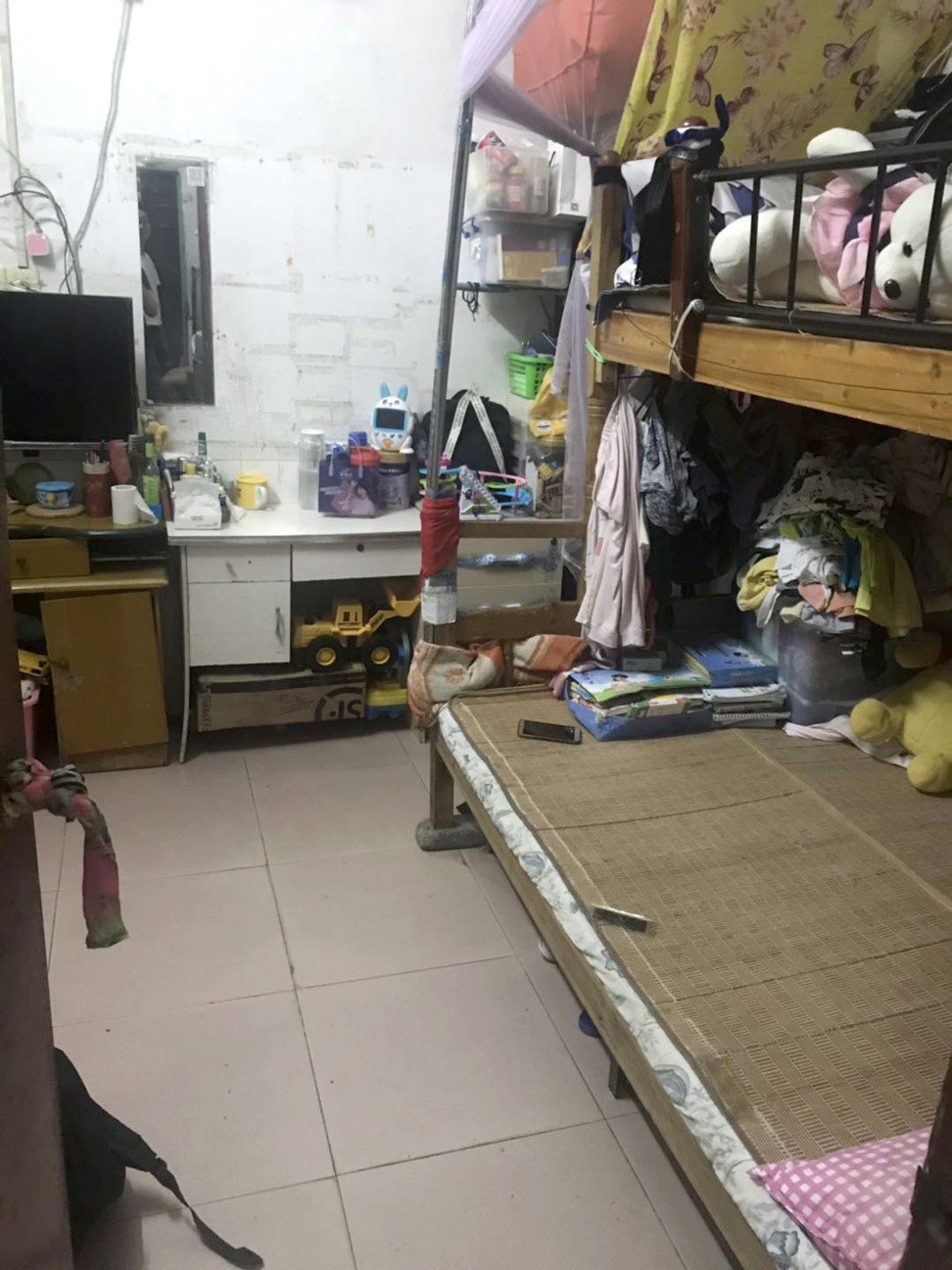
His family of four lives in a cheap one-bedroom flat in Baishizhou, one of the last standing chengzhongcun, or “urban villages”, in the flourishing commercial zones of southern Chinese city Shenzhen.

The villages provide affordable housing – costing from a few hundred to a few thousand yuan per month – to a mostly migrant worker population that provides services and labour.
But Baishizhou, in the Nanshan district, will not be standing for much longer. Many tenants in the area have received eviction notices since June, telling them to move out before the end of September to make way for a real estate project led by Shenzhen-based developer LVGEM Group.
The developer bought the land and buildings from their landlords, and it plans to knock them down and replace them with malls, hotels, high-end residential projects and skyscrapers.
Some 150,000 people are affected, mostly migrant workers, and they will have to find new homes, change jobs or even move back home at short notice.
Chen Jian lives in a one-bedroom flat in Baishizhou with his wife, daughter and son. Photo: Phoebe Zhang

For Chen and more than 2,000 other families, their children’s education is the most urgent issue. He said they could move somewhere else nearby, but the rent would be more than four times higher. A cheaper area would mean a long walk to school for his daughter from the nearest subway station.

As the breadwinner, Chen’s monthly income of 12,000 yuan (US$1,750) has to cover the whole family. His wife takes care of their three-year-old son and their daughter, 12.

“If I were here by myself, I would just pack up my bags and go,” said Chen, who moved to Shenzhen from Henan province. “But I can’t – I have children, I would do anything for my children.”

Families who’ve lived in old Chinese town for generations being kicked out to make way for tourists
Urban villages are a phenomenon that grew from China’s rapid development. In the 1980s, soon after Shenzhen became the country’s first special economic zone, the local government expropriated mostly vacant land from villagers and allowed developers to build commercial properties there.
The locals invested the large sums of money they received into new living spaces in their villages, which they rented out to the migrant workers that flowed into the city amid a manufacturing boom.
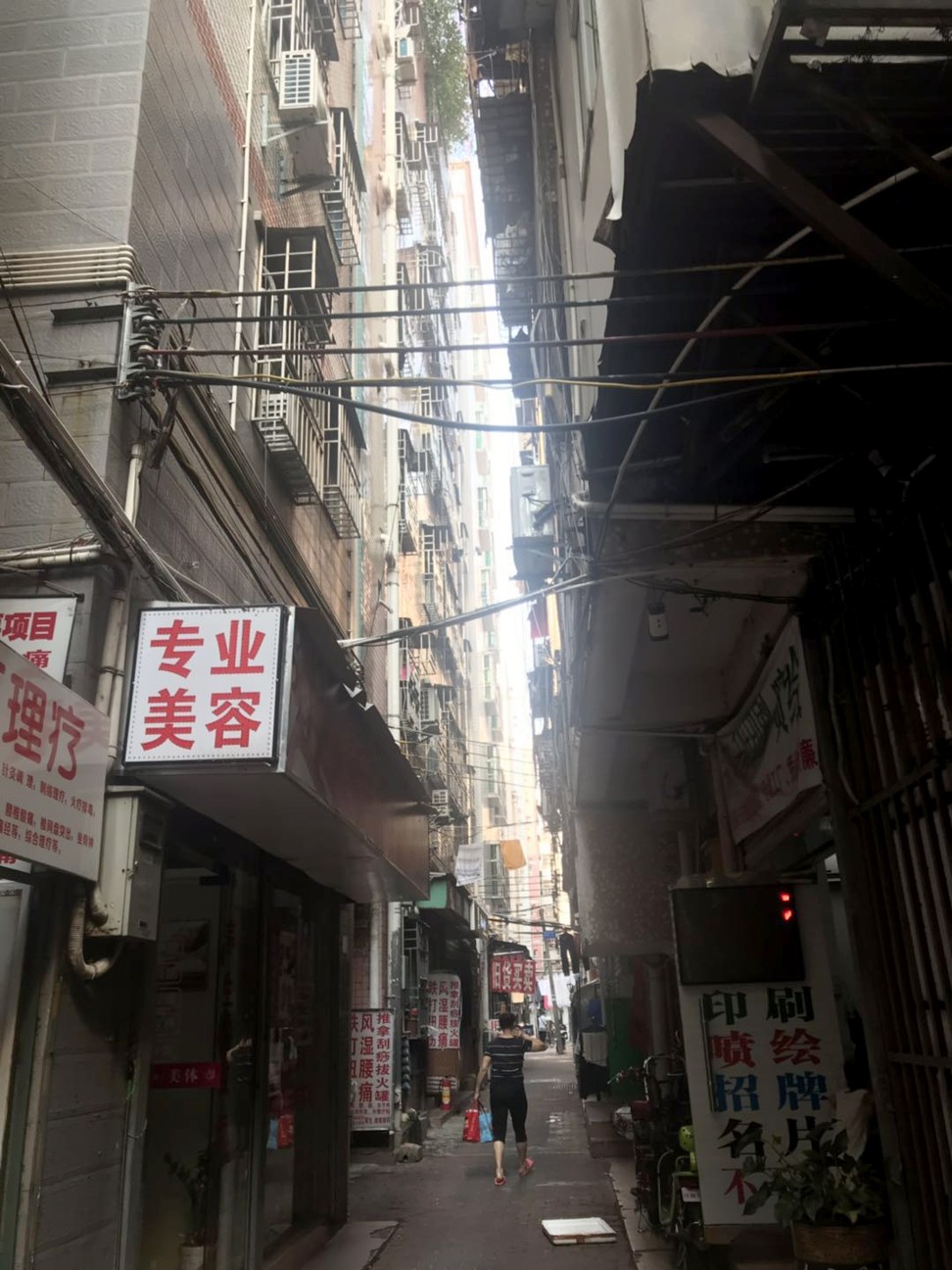
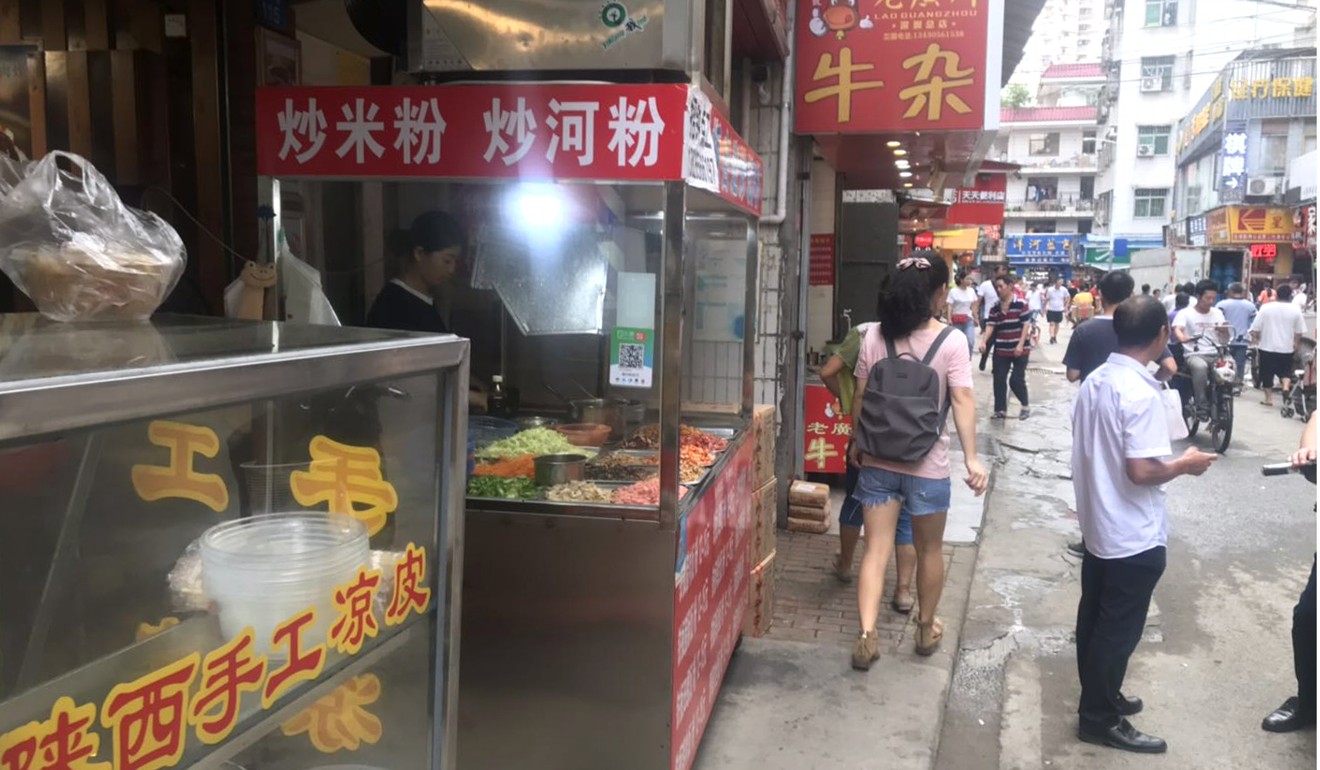
These chengzhongcun emerged as a tangle of damp alleyways, where electricity and telephone wires hang like spiderwebs. They bustle with fruit carts, soy milk shops, cobblers, karaoke parlours, short-stay love hotels and hair salons offering massage services. The “handshake buildings” where people live are packed together so tightly that residents could reach out of the window and shake their neighbour’s hand in the opposite flat.
“I call this ‘voluntary urbanisation’,” said Duan Peng, an architect based in the city. Since he moved to Shenzhen in 2001, Duan has spent many days and nights in Baishizhou. He said its development was in line with the government’s urban planning policy, since it allowed migrant workers to live in a relatively prosperous area in the city centre rather than on its periphery.
“Handshake buildings”, where residents can shake their neighbours’ hands through the windows, are a feature of China’s urban villages. Photo: Phoebe Zhang

Chen moved to Shenzhen with his wife in 2000, and both their children were born there. They moved to Baishizhou in 2008 after he was introduced to his landlord, who is from Chen’s hometown and rented him the flat for 650 yuan a month.

The rent has gone up by just 300 yuan in the 11 years they have lived there. They have watched as new developments sprang up around them – amusement parks, a golf course, malls and an area that is home to some of the country’s top tech companies including Huawei, Tencent and DJI.

How the eviction of Beijing’s migrant workers is tearing at the fabric of the city’s economy
But away from the shiny new developments, 150,000 migrant workers from all over the country are packed into 2,500 buildings in Baishizhou, where rents and services are affordable.
The urban village is full of people like Chen. Small business owner Wang Fang came to Shenzhen from northeast China in 2003 and has lived in Baishizhou ever since. Six months ago, she signed a three-year lease on a commercial space and opened a dumpling restaurant, but she is worried about the future.
“I can’t go back home, I already have a Shenzhen hukou,” she said, referring to the household registration document that gives access to public services. “I don’t have land there any more and can’t make a living there [as a farmer].”
She has not been told she has to leave the restaurant, but Wang and her two sons have until the end of September – when the building’s water and electricity will be cut off – to vacate their flat.
“It’s only a matter of time before the business is shut down as well,” she said.
Small shops and street vendors line Baishizhou’s bustling alleyways. Photo: Phoebe Zhang

According to an online poll of 1,031 Baishizhou residents this week, about half said they may have to find another job, and more than 600 were concerned about their children’s education. The survey, conducted by Shenzhen University urban planning professor Chen Zhu, also found that 70 per cent of those polled planned to find another flat in the city, while 28 per cent would leave.

Duan said the evictions and redevelopment would inevitably affect the surrounding areas, as well as the residents.

“The prices of services in the neighbourhood will increase, because many of the workers [now providing those services] will move far away, and rents will increase as well,” he said.

But for many such redevelopments, while the government, landlords and village officials might be consulted, the tenants are left out.

“Most of these residents, their voices and their interests aren’t on the negotiating table – their losses aren’t calculated in the real estate developer’s demolition costs,” Duan said.

A receptionist at LVGEM said he was not aware of any complaints about the redevelopment, while emails to the company went unanswered.

Meanwhile the developer’s partner, Baishizhou Corporation, told Southern Metropolis Daily it would provide legal services, rentals support and school buses for tenants who will be displaced.

But it is not enough for migrant workers like Chen. Like many of those facing eviction, he fears he will have to pay more rent, and there may not be a school bus service in his area.

He mentions a slogan plastered on walls in the city, “Once you come, you’re a Shenzhener” – part of a government campaign to lure talent and investors.

Chen said he worried that Shenzhen wanted only hi-tech workers and luxury residential compounds in the city, leaving little room for low-income workers.

“Despite what the slogan says, you ask yourself, are you really a Shenzhener?” he said.

Source: SCMP

02/02/2019

China Focus: Xi visits cadres, residents in Beijing ahead of Spring Festival

CHINA-BEIJING-XI JINPING-LUNAR NEW YEAR-VISIT (CN)

Chinese President Xi Jinping, also general secretary of the Communist Party of China Central Committee and chairman of the Central Military Commission, visits residents’ homes in Qianmen area in central Beijing, capital of China, Feb. 1, 2019. President Xi Jinping on Friday visited residents and primary-level officials in Beijing and extended Lunar New Year greetings to Chinese people of all ethnic groups. (Xinhua/Ju Peng)

BEIJING, Feb. 1 (Xinhua) — President Xi Jinping on Friday visited Beijing’s primary-level cadres and residents in downtown neighborhoods ahead of the Spring Festival and extended Lunar New Year greetings to Chinese people of all ethnic groups.

Xi, also general secretary of the Communist Party of China (CPC) Central Committee and chairman of the Central Military Commission, also inspected the preparation work for the Beijing 2022 Olympic and Paralympic Winter Games.

When inspecting the Beijing Municipal Public Security Bureau, Xi stressed the city’s glorious mission and weighty responsibility to safeguard the social stability of the national capital as 2019 marks the 70th anniversary of the founding of the People’s Republic of China.

Xi asked for coordinated efforts to promote work in all fields with resolve to complete the mission.

Touring a “hutong,” or traditional alley, in central Beijing’s Qianmen area, Xi ordered the efforts to protect cultural heritage sites and conserve traditional culture while renovating the city’s old areas.

He called for both improving local residents’ living conditions and protecting historical and cultural deposits, so that history and modernity will perfectly blend. He stressed specific measures to maintain the original features of hutong areas.

Xi dropped into two courtyards along the hutong, inquiring about the living conditions of local residents after the renovation projects in the neighborhood.

“What the CPC pursues is to make the people’s life better,” he told the residents, gladly chatting and making dumplings with them.

Noting close attention from the CPC Central Committee to the renovation of old towns and shanty areas, Xi said that the Party aims to create a more comfortable and better living environment for the people and solve problems they care about most so that they can enjoy modern life even in old hutong areas.

After chatting with residents, Xi went to a property service center to visit staff and community workers.

On the way back, Xi dropped in on a restaurant, chatted with the owner and some customers and wished them good luck.

Xi also called on a nearby express delivery station and visited the deliverymen who were on duty, stressing that priority should be given to solving employment problems and creating more jobs.

At 3:30 p.m., Xi arrived at the Shougang Park in Shijingshan District, the seat of the Beijing Organizing Committee for the 2022 Olympic and Paralympic Winter Games, to learn about the preparation for the Games and the planning and construction of the venues and infrastructure.

Xi stressed the need to stay committed to hosting the Games in a green, sharing, open and clean manner, and to complete all preparation tasks with high standards.

The venue construction must meet the Olympic standards and be completed on time, Xi said.

Stressing that the features of technology, intelligence, greenness and frugality should be highlighted, Xi said advanced technological approaches should be applied, energy-saving and environmental friendly requirements should be strictly enforced, the environment and cultural relics should be well protected, and Chinese styles should be on full display.

Xi visited the office building of the Beijing Organizing Committee, meeting with some of the staff and volunteers there.

Noting that Beijing will become the world’s only host of both the Summer and Winter Olympics, he stressed that China must fulfill the solemn commitments it made to the world.

“Hosting the 2022 Winter Olympics is an important support to the coordinated development of the Beijing-Tianjin-Hebei region,” Xi said, adding that Hebei Province must develop together with Beijing.

During his visit to the national winter sports training center, Xi stressed promoting sportsmanship with Chinese characteristics, boosting coordinated development of mass sports, competitive sports and the sports industry, and speeding up building China into a country strong on sports.

Vice Premier Han Zheng, also a member of the Standing Committee of the Political Bureau of the CPC Central Committee, accompanied Xi on the inspection tour of the preparation work for the Beijing 2022 Olympic and Paralympic Winter Games.

Source: Xinhua

28/12/2018

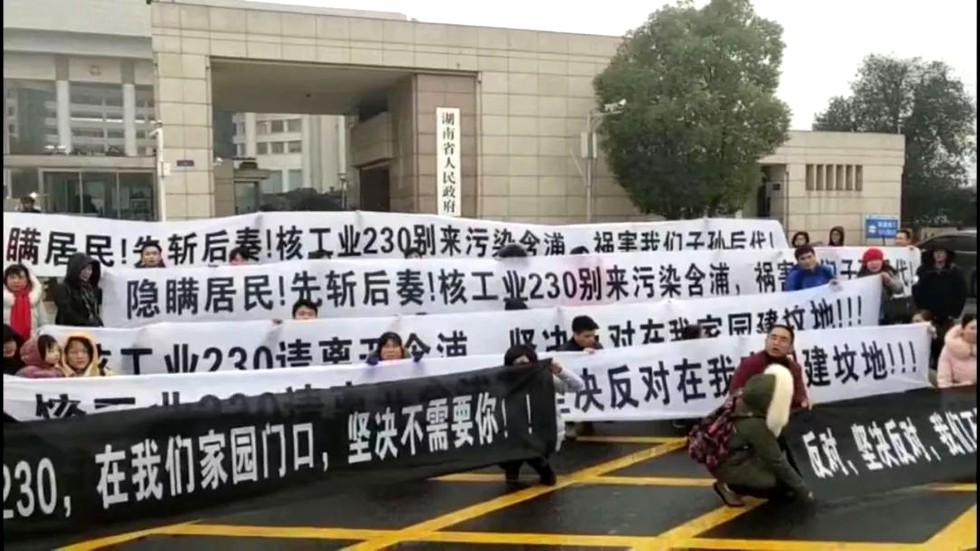
Chinese city residents protest over plans for nuclear research plant

  • Local suspicions over Changsha plant heightened by failure to officially announce the plans until one day before public consultation process was due to end
PUBLISHED : Friday, 28 December, 2018, 7:40pm
UPDATED : Friday, 28 December, 2018, 7:40pm

The protesters fear that radioactive materials used at the planned facility in Changsha, the capital of Hunan province, will pose a health risk.

The institute behind the project did not officially release their plans on Tuesday – after work had began on the site and one day before the public consultation period was supposed to end.

An environmental impact assessment into the project said Number 230 Research Institute, a branch of the China National Nuclear Corporation, had acquired a space of over 20,000 square metres near a densely populated area to expand its offices and laboratories at the site, which will be dedicated to the geological exploration of uranium.

Although the facility is not intended to handle refined uranium, and scientists say that unprocessed material does not emit harmful levels of radiation, residents have expressed concerns about the possible health risks and have called for building work to be halted.

Their concerns were heightened by the failure to carry out an assessment of the radiological hazards and the decision to announce the plans a day before the consultation period was due to end.

Wu Xiaosha, one of the protesters, said people were also angry that the project is already being built without approval.

“The environmental impact assessment report lied about the population in the area – it said there are only 40,000 people in the area, but actually it’s nearly 250,000,” said Wu.

Yang Wenqiang, an official from the Changsha Urban Rural Planning Bureau, refused to comment on the matter, saying the government was holding an emergency meeting and will release a statement later.

In a public letter issued on Thursday, Luo Zheng, deputy head of the Xueshi subdistrict, said he had no idea what the project was planning to do and had asked the institute to explain its population estimate – a question it has not yet answered.

“As for what does this institute does and why should it be built here, I am very curious too,” said Luo.

He said he would visit related institutions to see how they operate and how they evaluate the risks.

Environmental concerns have fuelled a growing number of protests in China in recent years as public awareness of the possible health risks increases.

The Chinese Academy of Social Sciences reported that half of protests with more than 10,000 participants between 2001 and 2013 were sparked by concerns about pollution.

Law of Unintended Consequences

continuously updated blog about China & India

ChiaHou's Book Reviews

continuously updated blog about China & India

What's wrong with the world; and its economy

continuously updated blog about China & India